What do kidneys do?
▪Filter your blood and clean it
▪Excrete waste
▪Regulate water and electrolytes: Na and K
▪Regulate acid base
▪Hormone secretion
▪Renin, angiotensin II
▪ Erythropoietin for RBC production
▪Activated vitamin D for bone metabolism
What’s the filtrate?
The liquid filtered by the glomerulus, before some of its content is reabsorbed and called urine
▪The filtrate (= ultrafiltrate) contains water, electrolytes, urea, Cr, sugar, amino acids
▪It does not contain cells, proteins, fats. Those stay in the glomerular capillary
What is the Glomerular Filtration Rate GFR?
▪GFR is the amount of plasma filtered through the glomeruli per unit time. It is expressed as ml/min.
▪It can refer to the function of a single nephron (SNGFR), but most often refers to the functions of all of the 2 million nephrons (i.e. both kidneys) collectively.
▪GFR assesses patient renal function.
▪Measurement of GFR relies on the concept of clearance
▪Clearance: how much of a substance is removed from the circulation by the kidney and put into the urine
▪The way we estimate GFR is by calculation of Creatinine clearance
▪CKD epi, MDRD, Cockroft Gault formulae are all acceptable (Schwartz formula in children)
▪Take into account patient’s age, ±weight, serum Cr (µmol/L) to estimate Cr clearance, and thus GFR
What are the Determinants of Glomerular filtration rate (GFR)?
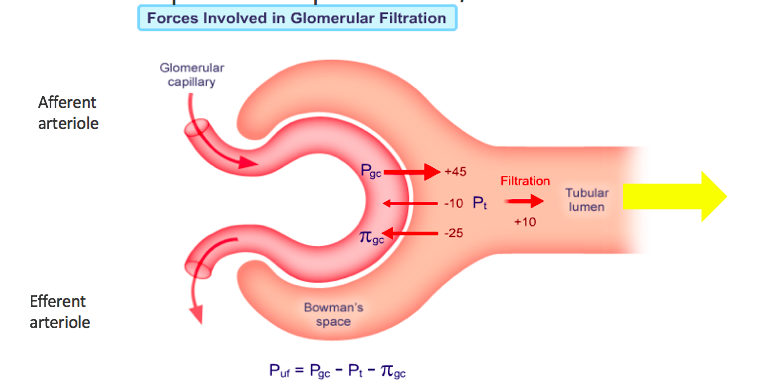
Kf : ultrafiltration coefficient- total capillary area available for filtration
PGC : transcapillary hydraulic pressure- favors filtration
PT or PBS: hydraulic pressure in tubule opposes filtration
π : transcapillary oncotic pressure, which opposes filtration
What is creatinine clearance?
▪Creatinine Clearance (CrCl) is an estimate of GFR
▪Creatinine: produced at a constant rate from plasma creatine, which comes from skeletal muscle. Cr has stable plasma concentration, is freely filtered at the glomerulus and stays in the tubule to be excreted. Filtered amount = excreted amount
▪GFR x Plasma concentration Cr = Urine concentration Cr x urine Volume
▪GFR = UV/P
▪male: 0.18 to 0.22 mmol/kg/day
▪female: 0.13 to 0.18 mmol/kg/day
▪If plasma Cr concentration goes up, means GFR is down.
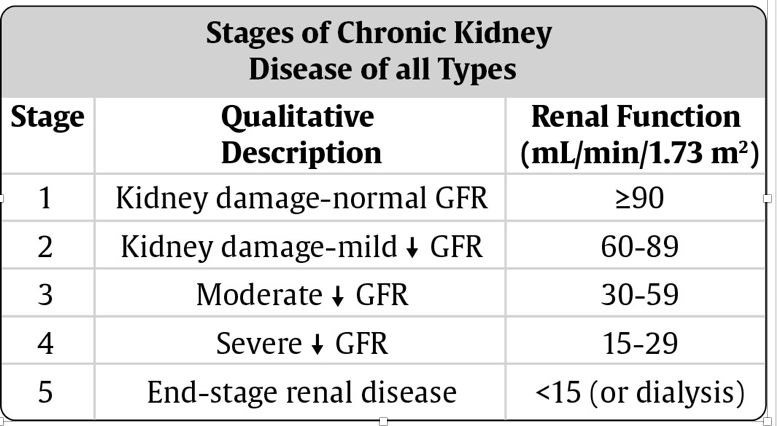
What are the stages of kidney failure?
When can’t we use the Cockroft Gault’s formula to calculare GFR?
If the GFR is not steady
What are the autoregulation mechanisms of the kidney?
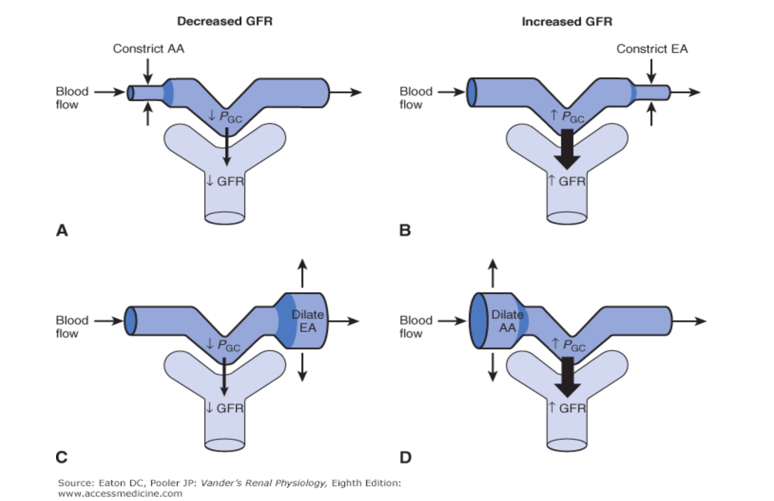
For a sudden rise or fall in systemic blood pressure, autoregulation occurs so that GFR does not rise or fall just because blood pressure rises or falls
- Myogenic reflex results in vasospasm of afferent arteriole; (50%of autoregulation)
- Tubuloglomerular feedback
In situations of major drop in systemic blood pressure there is:
- activation of sympathetic nervous system, epinephrine, which causes vasoconstriction
- Activation of the renin-angiotensin-aldosterone system and angII causes vasoconstriction
▪BP too high? Myogenic mechanism constricts afferent arteriole
▪BP too low: AngII constricts efferent arteriole
▪Prostaglandins dilate glomerular afferent arteriole, to preserve GFR
▪TG feedback: if the distal tubule Cl is too low, means the GFR is low, so afferent arteriole opens up
What is the proximal tubule function?
- The tubule cells have one side facing urine (apical side) and the other facing the blood (basolateral side) so they can reabsorb or secrete things (tubule cell polaity).
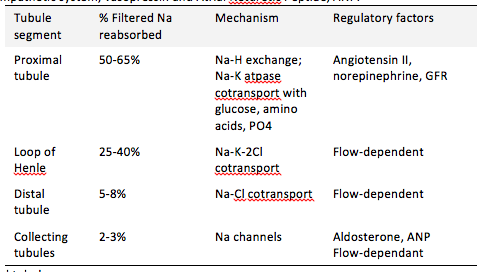
- Proximal tubule reabsorbs ~60% of the filtered Na and water. It reabsorbs almost all of the filtered glucose, phosphate, amino acids by linking their transport to Na
- Reabsorption of 90% of the filtered bicarbonate via the Na-H exchange
- Removal of solutes creates an osmotic gradient promoting water reabsorption via aquaporins
- Ca, K, Cl follow down their concentration gradients
- Urinary glucose reabsorption threshold by the sodium glucose transport protein (SGLT; Tmax) may be exceeded in the PTC (ex. Diabetes)
What is the function of the Loop of Henle?
Two components to water regulation:
- The Loop of Henle sets up a high interstitial osmotic gradient (separation of Na and water) THE COUNTERCURRENT SYTEM**
- Site of ADH action and insertion of aquaporins-water channels so that the water can be resorbed
The thin descending limb of the loop is permeable to water and the thick ascending limb moves Na out via active Na transport by the Na-K-2Cl cotransporter in the apical (tubular) side and reabsorb Ca and Mg
What is the function of the distal collecting tubule?
- Na is reabsorbed into the interstitium + circulation via the Na-Cl cotransporter
- Calcium reabsorption
What is the function of the collecting tubule?
- Principal cells important for Na and water reabsorption and K secretion
- Selective Na channels under hormonal (aldosterone) control
- Intercalated cells involved in regulation of acid base balance
- Water transport- antidiuretic hormone
What is the major difference between water and sodium reabsorption?
- Sodium reabsorption is an active process (uses ATP) occurring in all tubular segments (except the descending thin limb of Henle’s loop)
- Water reabsorption is by osmosis and is dependent upon sodium reabsorption
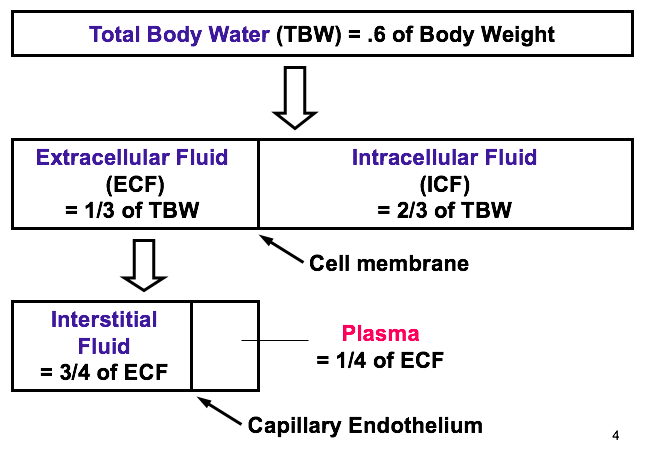
What’s the Total Body Water (TBW) ?
= .6 of Body Weight
What’s the osmolarity equation?
Posm = [Na] x 2 + [urea] + [glucose] ≈ 275-290 mosm/kg
Not albumin because it’s a protein therefore contributes to oncotic pressure
What is the action of ADH / Vasopressin ?
- Vasopressin is a peptide hormone, also called anti-diuretic hormone (ADH)
- Produced by a group of hypothalamic neurons, and then released from the posterior lobe of the pituitary gland
- Couples to V2, a vasopressin receptor in the collecting duct
- Vasopressin stimulates the insertion of aquaporins in the luminal membrane (urine side) of the collecting duct cells to increase water permeability/reabsorption.
Stimulation:
- Hypertonicity sensed by osmoreceptors in the hypothalamus
- Hypovolemia felt at carotid sinus which signals hypothalamus
What are the determinants of the water regulation in the collecting duct?
- Permeability of collecting duct to water (regulated by ADH =vasopressin)
- High osmolarity of the medullary interstitium to draw the water out of the tubule into the interstitium and back to the blood stream
What does alcohol do on ADH?
It supresses it so you piss a lot
What is the Vasa Recta?
- Medullary blood supply
- Prevents the osmolarity from being dissipated
- U-shape permits bulk flow of fluid and solutes into the blood via the usual colloid osmotic and hydrostatic pressure that favors resorption
- Carries away only as much solute and water as the net absorbed from the medullary tubules, and the high concentration of solutes established by the countercurrent mechanism is maintained- steady state
What is the important channel in the Thick Ascending Limb- TAL that reabsorbs sodium?
The Na-K-2Cl channel
How is Na controled in the body?
Changes in intake and body Na content are sensed by pressure receptors in vascular wall (felt as volume), the renal afferent arteriole and the heart. Activation of these receptors leads to changes in renin angiotensin aldo axis, sympathetic system, vasopressin and Atrial Naturetic Peptide, ANP.
How is Na reabsorbed in the PCT?
- Bicarbonate, Na, phosphate and glucose reabsorption while H is secreted into the urine
- Na-K ATP-ase in the basolateral membrane actively pumps Na out of the cell (low cellular [Na])
- Water Follows Osmotic Gradient: Lower tubular fluid osmolality creates an osmotic gradient that promotes water reabsorption
How is Na reabsorbed in the Thick Ascending Limb Loop of Henle?
- 50% of Na reabsorption is transcellular. Passive entry into cell via: Na/2Cl/K symporter and Na-H antiporter
- 50% of Na reabsorption is paracellular down electrochemical gradient together with K, Ca, Mg
- Impermeable to H2O so tubular fluid becomes hypo-osmolar
How is Na reabsorbed in the DCT?
- Vitamin D-dependant Ca binding protein
- Exclusively transcellular: Na-Cl symporter and Basolateral Cl channel
- Impermeable to water: tubular fluid becomes more hypo-osmolar



