What are the functions of the nervous tissue?
Sensation
Information processing
Regulation of other organ systems: cardiac, smooth muscles and glands
Control of movement
Provides extremel rapid response
Describe the reflex circuit
- Sensory receptor: responds to a stimulus by producing a graded potential
- Sensory neuron: nerve impulse propagates from the sensory receptor along the axon of the sensory neuron to the axon terminals, which are located in the spinal cord or brain stem. Relay neurons send nerve impulses to the area of the brain that allows conscious awareness that the reflex has occured.
- Integrating centre: one or more regions within the CNS act as integrating centres
- Motor neuron: impulse triggered by the integrating centre propagate out of the CNS along a motor neuron to the part of the body that will respond.
- Effector
What are the channels involved in an action potential?
- The first channel to open is the voltage gated sodium channels which allow Na+ to rush into the cell which causes depolarisation
- Then the potassium gated ion channels open allowing K+ to flow out, which produces repolarisation
- The after-hyperpolarisation occurs when the voltage gated potassium channels remain open after the repolarisiing phase end.
Why does the polarisation in the resting membrane potential exist?
In neurons, the resting membrane potential of -70mV arises from three major factors:
- Unequal distribution of ions in the ECF and cytosol
- Inability of most ions to leave the cell
- Electrogenic nature of the sodium-potassium pump
What factors effect the speed of propagation?
- Amount of myelination
- Axon diameter: larger = faster
- Temperature: lower=slower
Describe the sequence of events that occurs at a chemical synapse?
- Nerve impulse arrives at the synaptic end bulb of a presynaptic axon
- The depolarisation phase of the nerve impulse opens voltage gated calcium channels, whcih are present in the membrane of the synaptic end bulbs, producing a net movement of calcium into the cell.
- This triggers exocytosis of the synaptic vesicles. As the membranes fuse, neurotransmitter molecules are released into the synaptic cleft.
- The neurotransmitters diffuse across the synaptic cleft and bind to the neurotransmitter receptors in the postsynaptic neuron’s plasma membrane
- Binding of neurotransmitter molecules to their receptors on ligand-gated channels opens the channels and allows particular ions to flow accross the membrane
- A postsynaptic potential occurs as ions flow through the opened channels. An influx of sodium results in depolarisation, whereas an opening of Cl- or K+ channels causes hyperpolarisation.
- When a depolarising postsynaptic potential reaches threshold, it triggers an action potential in the axon of the postsynaptic neuron.
Thalamus
Involved in sensory processing. Most sensory information undergoes initial processing in the spinal cord or brainstem, and then goes to the thalamus for further processing.
The thalamus is also involved in motor function. Some thalamic nuclei have interconnections with motor systems, including motor cerebral cortex, the basal ganglia and the cerebellum.
Hypothalamus
the hypothalamus is involved in regulating numerous homeostatic processes.
For example:
- maintains water balance, regulating thirst and osmolarity
- Maintains energy balance by regulating apetite, body temperature and blood pressure
- Coordinates sleep-wake cycle
In order to carry out these functions, the hypothalamus regulates many endocrine organs and the ANS.
It also produces several hormones, many of which regulate the anterior pituitary gland.
Also involved in emotions.
Brainstem
Involved in control of movement, processing sensory information, contributing to homeostasis through regulating other organ systems including the cardiovascular and respiratory systems.
Most cranial nerves arise from the brainstem, and innervate structures in the head and neck, and for one nerve many organs in the thoracic and abdominal cavities as well.
The brainstem is also a conduit through which axon tracts convey sensory information from the spinal cord to the thalamus, or motor commands from the cerebral cortex to the spinal cord.
Cerebellum
The cerebellum is located posterior to the brainstem and inferior to the occipital lobe or the cerebral hemispheres. It is important in coordinating ongoing movements, planning movemnt sequences, and learning motor tasks. It recieves motor related sensory information as well as information from cerebral cortex areas related to movement, and send output to various motor areas of the brainstem, and to the cerebral cortex via the thalamus.
Cerebral hemisphere
Composed of a superficial layer of grey matter called the cerebral cortex and white matter that interconnects the regions of th CNS.
The surface is highly folde, forming gyri shaped grooves calcced sulci. Certain sulci, and larger grooves called fissures separate the cerebral cortex into four main lobes: frontal, parietal, temporal and occipital.
Parts of each lobe in the cerebral cortex are devoted to specific functions (localised processing).
Some functions are spread around various regions of the cerebral cortex (distributed processing).
Association cortex includes large areas of the frontal, parietal and temporal lobes. These areas have integrative functions, recieving sensory information from various cortical areas, processing this information in the context of experience and emotions, and making decisions.
The cerebral cortex exhibits lateralisation, meaning some functions are found exclusively or predominantly on one side of the brain.
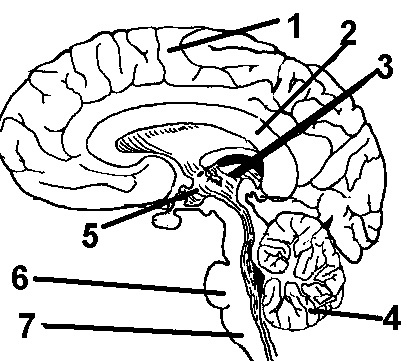
1 = cerebellum
2 = corpus callosum
3 = thalamus
4 = cerebellum
5 = hypothalamus
6 = pons
7 = medulla oblongata
Which of the regions of the brain directly regulates the function of the anterior pituitary gland? What is the pituitary gland’s anatomical relationship to this part of the brain?
The pituitary gland is inferior to the hypothalamus, which controls its activity.

-
Week 1 - Levels of Structural Organisation23
-
Skeletal System20
-
Integumentary System6
-
Endocrine System13
-
Nervous System13
-
Cardiovascular System6
-
Digestive System2
-
Fertilisation to Gastrulation5
-
Fluid Compartments7
-
Introduction to gross anatomy4
-
Mechanisms and processes of development2
-
Medical Imaging Modalities9
-
Muscular System3
-
Organogenesis and the Foetal Period to Birth14
-
Reproductive System6
-
Respiratory System12



