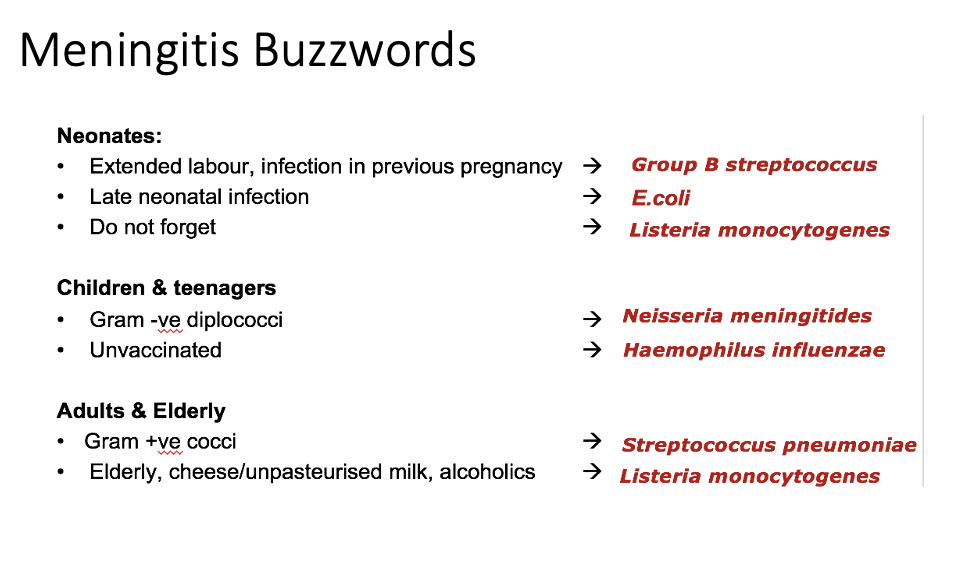
What common infections are prevelant in
Neonates
Children
Adults
Elderly
What is Extradural heamorrhage?
Signs OE and ix>
Blood between dura and bone. Bleeding and accumulation of blood in the extradural spacce.
Cause: Head trauma – fracture pterion -> MMA rupture
Epi: Young – 20-30, male
Sx: Headache (inc.), LOC -> lucid interval -> rapid dec. in consciousness
OE: dec. GCS, sx of inc. seizures (hemiparesis, inc. reflexes, upgoing plantars), Cushings response as signs of raised ICP e.g unresopsive pupil on the side of the trauma
Ipsilateral pupil dilation – suggests midline shift
Ix: Urgent CT - LEMON SHAPE – does not cross suture lines. lenticular shape
What is a cluster headache?
Recurrent severe headaches, unilateral and cyclical pattern Unilateral attacks lasting 15-180 minutes associated with autonomic symptoms secondary to parasympathetic hyperactivity and sympathetic hypo-activity - Pain often localised to unilateral orbital, supra-orbital and/or temporal areas and can occur from once every other day to 8 times per day
What is the aetiology of a cluster headache and epidemiology?
Aetiology: • UNKNOWN aetiology Genetic factor implicated Epidemiology: • More common in MEN Usually occurs between 20-40 yrs
What is the pattern for cluster headaches?
• TWO types of cluster headaches: ○ Episodic - occurring in periods lasting 7 days - 1 year, separated by pain-free periods lasting a month or longer. Cluster periods usually last between 2 weeks - 3 months ○ Chronic - occurring for 1 year without remissions or with short-lived remissions of less than a month. Chronic cluster headaches can arise de novo or arise from episodic cluster headaches. • Pattern of Occurrence ○ Headaches occur in bouts lasting 6-12 weeks ○ These occur once every year or once every 2 years, and tends to occur at the same time each year ○ Headaches typically occurs at night, 1-2 hours after falling asleep ○ The interval between bouts tends to be the same 10% with episodic cluster headaches go on to develop chronic cluster headaches
What are the presenting symptoms of a cluster headache?
○ Pain comes on rapidly over around 10 mins ○ Pain is intense, sharp and penetrating ○ Pain is centred around the eye, temple or forehead ○ Pain is unilateral ○ Pain typically lasts around 45-90 mins (range: 15 mins - 3 hours) ○ Pain occurs once or twice daily ○ Associated autonomic features: Ipsilateral lacrimation Rhinorrhoea Nasal congestion Eye lid swelling Facial swelling Flushing Conjunctival injection Partial Horner’s syndrome Patients find it difficult to stay still and will pace around, occasionally banging their heads on things
What are the investigations for a cluster headache?
• CLINICAL diagnosis based on history • Can use the International Classification of Headache Disorders (ICHD) for diagnosis Neurological examination may be useful, confirm diagnosis by neurologist +/- neuroimaging
What is the Mx for cluster headaches?
w/o CVD (cardiovascular disease) / uncontrolled HTN – O2 + SC Sumatriptan w/ CVD/ uncontrolled HTN – O2 + intranasal lidocaine Preventative: trigger avoidance, verapamil, headache diary (to try and determine the trigger)
What is dementia?
Progressive deficits in memory and one or more domains- language, visuospatial, praxis (inability to perform actions e.g. dressing apraxia), in a setting of clear consciousness and interfering with work, social activities, relationships - Alzheimer’s, Vascular, Lewy body, Pick’s disease
What is the aetiology of Alzheimer’s dementia?
- Lesions in the brain- tau neurofibrillary tangles, plaques of beta amyloid and neurone loss with corticol atrophy, loss of ACh. Cerebral amyloid angiopathy. Cerebral atrophy - Neurone loss in: hippocampus, amygdala, temporal neocortex, subcorticol nuclei - 95% show signs of vascular dementia
What is the aetiology of dementia?
- Toxic: Alcohol, lead, barbs, drug abuse - Metabolic: low thiamine, low T4, low B12, low folate, low glucose (repeated), pellagra (niacin or B3 deficiency) - Head trauma: injury, subdural haemorrhage - Tumours: frontal, posterior fossa (causing hydrocephalus), brain mets, paraneoplastic, meningioma - Infection: WHipple’s disease, HIV, syphillis, CNS cysticerosis, Cryptococcosis - Vascular: multiple infarcts - Inflammation: SLE, sarcoid, vasculitis, multiple sclerosis - Inherited: Wilson’s, Huntington’s, cerebellar ataxias - Degenerative: PD, CJD, Pick’s, Lew body dementia - Familial autosomal dominant Alzheimer’s - CADASIL: Cerebral Autosomal-Dominant Arteriopathy with Subcorticol Infarcts and Leykoencephalopathy
What is the epidemiology of dementia?
- Rare under 55 yrs - Over 65s: 5-10% - Over 80: 20% - Over 100: 70%
What are presenting symptoms of dementia?
- Initial presentation is usually memory loss over months or years. - If days: think infection/stroke - If weeks: depression - In later stages: non-cognitive symptoms: agitation, aggression, apathy Positive symptoms: - Aggression, wandering, agitation, hallucinations, flight of ideas, logorrhoea: incoherent talkativeness Negative symptoms: - Low repetitive speech, apathy, mood disturbance: depression is common but may also cause dementia
What are the signs of dementia on examination?
- Normal pressure hydrocephalus: dilated ventricles without dilated cerebral sulci. Gait apraxia, incontinence - Cognitive testing: MMSE score less than 24 abnormal. Severe is less than 9 points - Verbal recall: Hopkin’s verbal learning test - Executive function: clock drawing task - Physical exam: cause of impairment, risk factors for vascular dementia, parkinonism
What are the investigations for dementia?
- Bedside cognitive testing: impaired recall, nominal dysphasia, disorientation, constructional dyspraxia and impaired executive function - FBC: rule out anaemia - Metabolic panel: exclude abnormals odium, calcium, glucose levels - Serum TSH: TSH may be low or high - Serum vitamin B12: may be low - Urine drug screen: may be positive - CT: may exclude space-occupying lesions or other pathology - MRI: generalised atrophy with medial temporal lobe and later parietal predominance
What is encephalitis?
Inflammation of the brain parenchyma
What is the aetiology of encephalitis and epidemiology?
Epi: Extremities of age : <1, >65 yoa
Majority of cases, it is the result of viral infection
- Virus: Most common in UK is HSV. Others include herpes zoster, mumps, adenovirus, coxsackie, echovirus, enterovirus, measles, EBV, HIV, rabies (Asia) and arboviruses transmitted by mosquitoes e.g. Japanese B encephalitis
- Non-viral: rare e.g. syphilis, S aureus
- Immunocompromised: CytoMeglaVirus , toxoplasmosis,
Listeria
- Autoimmune or paraneoplastic: May be associated with antibodies e.g. anti-NMDA or anti- VGKC
Meningitis, TB, malaria , lyme disease
What are the presenting symptoms of encephalitis?
- In many cases, it is mild self-limiting illness
Sx: Subacute headache, fever w/ behavioural/ cognitive change, prodrome before neuro Sx, altered mental state.
Altered mental state:
- Memory disturbances
- Personality change
- Psychiatric manifestations
- Impiared consciousness
What are the signs of encephalitis on examination?
- Decreased level of consciousness with deteriorating GCS, seizures, pyrexia
- Signs of meningism: Neck stiffness, photophobia, Kernig’s test positive.
Signs of raised intracranial pressure: hypertension, bradycardia, papilloedema.
- Focal neurological signs - Minimental examination may reveal cognitive or psychiatric disturbances
What are the investigations for encephalitis? What is the tx?
- Blood: FBC (raised lymphocytes),
U&E (SIADH may occur,
glucose (compare with CSF glucose)
viral serology, ABG
- MRI/CT: Excludes mass lesion. HSV produces characteristic oedema of the temporal love on
- Lumbar puncture check CSF with PCR: Raised lymphocytes, monocytes and protein. Glucose usually normal.
CSF culture is difficult, PCR now first line
- EEG: May show epileptiform activity e.g. spiking activity in temporal lobes
- Brain biopsy: now very rarely performed
Tx: Acyclovir
what is ICP?
Some causes and signs and Sx?
Ix and Tx?
ICP > 15mmHg
Causes:
Mass effect/ SOL - 1o/2o tumour, bleed
Oedema - infection, head injury
Outflow obstruction - hydrocephalus
Triad: Headache + Papilloedema + Vomiting = Raised ICP
Sx: Headache – bilateral, throbbing, inc. w/ coughing, lying down
•Vomiting, Altered GCS, seizures
OE: Focal neurological signs – eg. CN6 palsy, Papilloedema
- Cushings reflex – inc. SBP, irreg. breathing, dec. HR
- Cheyne Stokes Breathing – prog. Deeper breathing
Ix: Urgent CT head
DO NOT DO LP -> Herniation -> Death
Tx: Mannitol – osmotic diuretic
Hyperosmotic saline
What is epilepsy?
- Epilepsy: More than 2 seizures - Seizure (ictus): Paroxysmal synchronised corticol electrical discharges
What is a focal seizure?
Seizure localised to specific cortical regions, such as temporal lobe seizures, frontal lobe seizures, occipital seizures, complex partial seizures
What is a generalised seizure?
Seizures which affect consciousness typically tonic-clonic, absence attacks myoclonic, atonic (drop attacks) or tonic seizures




