What do the various parts of this diagram indicate?
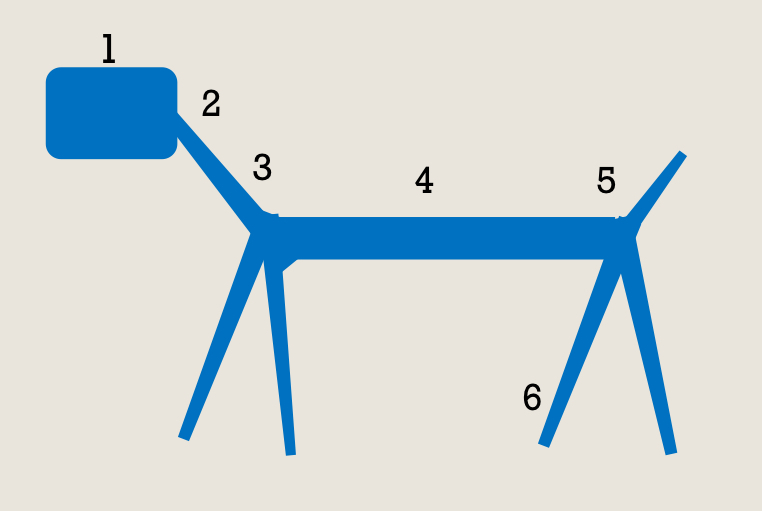
- Intracranial
- C1-C5
- C6-T2
- T3-L3
- L4-S3
- PNS/LMN
What are the various parts involved in intracranial lesions?
- Forebrain
- cerebrum & diencephalon
- Cerebellum
- Brainstem
- midbrain (mesencephalon)
- pons (ventral metencephalon)
- medulla (myelencephalon)
What are the various lobes of the forebrain associated with?
- Frontal - motor
- Temporal - auditory/vestibular
- occipital - visual
- parietal - somatosensory (proprioception)
- pyriform - olfactory
Intracranial lesions localized to the cerebrum would result in what deficits?
- seizures
- behavior and/or mentation changes
- circling
- head pressing
- menace deficits - contralateral side
- blind with normal PLRs
- hemi-neglect
Intracranial lesions localized to the diencephalon would result in what deficits?
- signs similar to cerebral lesions
- circle - either side (towards lesion)
- endocrine dysfunction
- PU/PD
- abnormal eating/thermregulation
- thalamic pain syndrome
- decr to absent menace & vision
- involvement of optic n. or lateral geniculate nucleus
- stupor/coma due to Asc. Reticular Activating Syst.
- midbrain to medulla
When you have a brainstem lesion in the midbrain, what are the deficits you see? What CN originate here?
- CN III and IV
- Disturbances in consciousness (ARAS)
- UMN paresis to plegia (uni or bilateral)
- Lesion of caudal midbrain/cranial pons = ipsilateral deficits (due to decussation)
When there’s a lesion in the pons, what types of deficits will you see? What CN originates here?
- CN V originates
- Change in consciousness
- UMN paresis to plegia
- Abnormal resp activity - major resp centers (Pons < medulla)
If your patient has a lesion in the medulla oblongata, what type of deficits might you see? What CNs originate here?
- CN VI, VII, VII, IX, X, XI, XII
- Alterations in consciousness
- Rostral lesion = central vestibular
- Caudal lesion = dysphonia, dysphasia, tongue paresis
- Abnormal resp activity - major resp centers (pons < medulla)
- Autonomic dysfunction - HR and BP
- UMN paresis to plegia - ipsilateral
- UMN for resp mm vs. LMN in phrenic n. (C5-C7)
If your patient has a lesion in the cerebellum, what type of deficits might you see?
- Coordinates and regulates movement - does NOT initiate
- Hypermetria -exaggerated movements
- Ataxia WITHOUT paresis
- Intention tremors
- Vestibular signs - head tilt, nystagmus, circling
- Decr menace with normal vision
- Anisocoria - normal pupil usually dilated with slow PLRs
If you have a lesion at high cervical or high thoracic (C1-C5;T3-L3), limbs immediately behind it are going to have _______
Intact UMN reflexes
If you have a lesion at low cervical or low thoracic (C6-T2; L4-S3), the limbs immediately after it will _________
Have LMN reflexes (decreased or absent)
What would you expect to see with a patient who has a C1-C5 myelopathy?
- Hemiparesis to hemiplegia vs. tetraparesis to tetraplegia
- +/- pain
- CP deficits x 4
- +/- low head carriage; decr ROM
- All 4 limbs affected
- UMN reflexes x 4 Ataxia
What would you expect to see with a patient who has a C6-T2 myelopathy?
- +/- pain
- CP deficits x 4
- +/- low head carriage; decr ROM
- All 4 limbs affected
- LMN reflexes to FLs
- UMN reflexes to the HLs
- +/- Horner’s - symp fibers in T1-T3
- Don’t forget phrenic n. (C5-C7)
- Ataxia and paresis - may look worse in HLs
What would you expect to see with a patient who has a T3-L3 myelopathy?
- Normal FLs
- CP deficits HL
- +/- pain
- Kyphosis
- Paresis to plegia
- UMN reflexes to HLs
- UMN bladder (sphincters still intact, may be hyperactive)
- Ataxia & paresis (para or mono)
What would you expect to see with a patient who has a L4-S3 myelopathy?
- Normal FLs
- CP deficits HL
- LMN reflexes to HL
- LMN bladder
- +/- pain
- Low tail carriage
- Ataxia (para or mono)
What would you expect to see with a patient who has a PNS neuropathy?
Nerve = neuropathy
- No ataxia
- Decr to absent reflexes - patellar = ONLY reliable reflex
- Decr to absent muscle tone
- Varied distribution - poly vs. mononeuropathy
- Neurogenic atrophy (very quick onset)
- Variable CP deficits
What would you expect to see with a patient who has a PNS myopathy?
Muscle = myopathy
- Normal reflexes
- +/- decr withdrawals
- Normal CPs
- Generalized weakness - exercise intolerance
- Usually bilaterally symmetrical
- +/- myalgia
What would you expect to see with a patient who has a PNS junctionopathy?
NMJ = junctionopathy
- Generalized weakness - interference of nerve-muscle communication
- Varied reflexes - normal to absent
- Usually diffuse distribution
- +/- exercise intolerance




