Sensory-Level INF Current
What is sensory-level interferential (INF) current?
Sensory-level inferential current (INF) is a type of electric modality that uses an electrical current to stimulate specific nerve fibers that help to decrease the amount of pain messages that enter the brain. Sensory-level inferential current is used for pain relief.
Reference:
- See ECS II, “Modalities & Physical Agents Procedural Manual” Word doc.
Iontophoresis
What is iontophoresis?
Iontophoresis (aka, ion transfer) is a type of electric modality that uses a direct current to introduce medicinal ions into the skin and mucous membranes of the body. The principle on which it is based is the repulsion of the ion by the similarly charged electrode.
A common medicinal ion that is used with iontophoresis is called acetate. Acetate is an anion (i.e., it has a negative polarity) that is derived from acetic acid. Acetate is used to treat conditions characterized by calcium deposits (e.g., calcific tendinitis).
References:
- See ECS II, “Modalities & Physical Agents Procedural Manual” Word doc.
- See “TherapyEd Review and Study Guide,” Table 10-7, p.404
- Goodman and Fuller (4th ed.), p.487 (“Ultrasound and Iontophoresis”)
High-Voltage Pulsed Electrical Stimulation
What is high-voltage pulsed electrical stimulation?
High-voltage pulsed electrical stimulation is a type of electric modality that uses a high-voltage pulsed current (HVPC) for either pain relief or the facilitation of wound healing.
*Note: For clean wounds, use a positive HVPC to augment the positive polarity associated with the wound healing process. For infected wounds, use a negative HVPC to eliminate any microogranisms (e.g., bacteria) that are slowing down the wound healing process.
References:
- See ECS II, “Modalities & Physical Agents Procedural Manual” Word doc.
- See ECS II lecture, “Iontophoresis & HVPC” PDF
Diathermy
What is diathermy?
Diathermy is a thermal (heat) modality that uses electromagnetic energy to produce deep heating within tissues. Diathermy is used to decrease pain or increase soft-tissue extensibility.
Reference:
- See “TherapyEd Review and Study Guide,” p.394 (“Short-Wave Diathermy”)
Paraffin Wax Bath
What is a paraffin wax bath?
A paraffin wax bath is a thermal (heat) modality that uses warm, melted paraffin wax to provide superficial heat to decrease pain and improve soft-tissue extensibility. Paraffin is ideal for treating chronic joint disorders (e.g., rheumatoid arthritis) because it provides even distribution of the superficial heat to all of the joints.
References:
- Cameron (5th ed.), keyword: paraffin wax
- ECS II lecture, “Thermal Agents” (slide 47)
Moist Heat Packs
What are moist heat packs?
Moist heat packs (aka, hot packs) are thermal (heat) modalities that involve the use of heated canvas packs filled with silica gel to provide superficial heat to decrease pain or increase soft-tissue extensibility.
*Note #1: The ideal treatment time for moist heat packs is 20-30 minutes.
*Note #2: Make sure to add layers of towels between the hot pack and the treatment area in order to reduce the risk of burns.
*Note #3: The moist heat pack reaches peak temperatures within the first 5 minutes of application. During this time, the patient is at the greatest risk for burns. Physical therapy personnel should check the skin within the first 5 minutes of treatment and periodically afertwards. Signs of overheating include uneven, blotchy, red, and white areas in an individual with light skin, and darker and lighter areas in an individual with dark skin. If overheating is observed, the appropriate action is to add more towel layers.
Reference:
- See “TherapyEd Review and Study Guide,” p.389 (“Superficial Heating Physical Agents–Hot Pack”)
Therapeutic US - Clinical Definition
What is therapeutic ultrasound?
Therapeutic ultrasound refers to the use of acoustic energy to generate thermal and non-thermal effects within the body.
Continuous ultrasound refers to the continuous delivery of ultrasound throughout the treatment period. Continuous ultrasound generates thermal effects that decrease pain and increase soft-tissue extensibility. Continuous ultrasound is typically used before stretching of shortened soft-tissue structures.
Pulsed ultrasound refers to the intermittent delivery of ultrasound such that the delivery of ultrasound is pulsed on and off throughout the treatment period. Pulsed ultrasound is used to generate non-thermal effects (e.g., acoustic streaming) that alter membrane permeability and accelerate tissue healing and repair.
*Note: The amount of absorption of continuous ultrasound into biological tissue is directly proportional to the frequency of continuous ultrasound (*units in megahertz, or MHz).
- 3 MHz–Increase in absorption of acoustic energy, resulting in higher maximum temperatures. However, depth of ultrasound penetration will be less.
- 1 MHz–Decrease in absorption of acoustic energy, resulting in lower maximum temperatures. However, the depth of ultrasound penetration will be more.
References:
- See Cameron (5th ed.).
- See ECS II lecture, “Ultrasound” PDF (p.4)
Therapeutic US - Contraindications and Precautions
What are contraindications and precautions related to the use of therapeutic ultrasound?
Contraindications:
- Malignant tumor or current diagnosis of cancer
- Therapeutic ultrasound may increase the rate of tumor growth or metastasis.
- Pregnancy
- Therapeutic ultrasound may result in fetal abnormalities if applied over the abdomen, low back, or pelvis of the patient.
- Pacemaker or implantable cardiac rhythm device
- Therapeutic ultrasoud may affect a pacemaker or implantable cardiac rhythm device.
- Joint cement or plastic components of prosthetic joints
- Therapeutic ultrasound rapidly heats the cement and plastic materials.
- Thrombophlebitis (i.e., inflammation of a vein caused by a thrombus)
- Therapeutic ultrasound may cause embolism.
- Over the eyes, reproductive organs, or central nervous system tissue
Precautions: (*Note: In general, only low-intensity ultrasound is recommended for the following conditions.)
- Acute inflammation
- Epiphyseal plates
- Fractures
- Breast implants
Reference:
- See Cameron (5th ed.).
Electric Modalities - Skin Irritation
How do minimize skin irritation when completing electrical stimulation with electric modalities?
- Use larger electrodes.
- Increase the distance between the electrodes (i.e., interelectrode distance).
- Decrease the current’s intensity, or gradually increase the current’s intensity over a longer period of time.
- Use a shorter pulse duration.
References:
- See ECS II lecture, “Intro to E-Stim.”
- See Cameron (5th ed.).
Astrocytoma
What is astrocytoma?
Astrocytoma is a type of brain tumor that involves neuroglial cells called astrocytes. When astrocytoma becomes malignant, the cancerous astrocytes can spread to other parts of the central nervous system (i.e., brain and spinal cord).
*Note: Neurological signs and symptoms (e.g., seizures) associated with astrocytoma are the result of impairment of the function of the central nervous system.
Reference:
- Medscape: Astrocytoma–Pathophysiology (https://emedicine.medscape.com/article/283453-overview#a5)
Seizures - Clinical Definition
What are seizures?
A seizure refers to a finite event (i.e., definitive beginning and end) that is characterized by transient neurological impairment or loss of consciousness due to excessive and chaotic electric discharge of neurons in the brain.
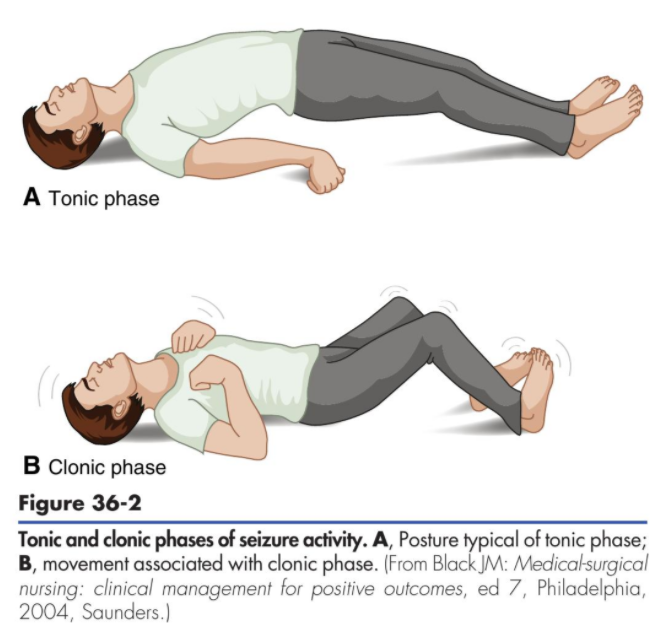
A tonic-clonic seizure (aka, grand-mal seizure) is a type of seizure that begins with a sudden loss of consciousness, followed by generalized rigidity (tonic phase) and very rapid generalized jerking movements (clonic stage) (*see image below).
- Another seizure may follow without recovery of consciousness or, after recovery of consciousness, the person may experience seizure again.
- Complications of seizures include:
- Cessation of respiration during tonic phase
- Altered speech
- Transient paralysis
- Ataxia
- Headache
- Disorientation
- Muscle soreness
Reference:
- Goodman and Fuller (4th ed.), p.1591 (“Overview and Definition”), 1593 (“Pathogenesis”), 1597 (“Seizures With Tonic and/or Clonic Manifestations”)
Seizures - PT Implications
What steps should be taken when a patient is having a seizure?
- Make sure the patient is lying a surface that will prevent a fall (e.g., lying on the floor).
- Make sure that the immediate area is clear of objects that can potentially be knocked over onto the person and cause injury.
- Roll the person onto his or her side to help to keep the airways clear and prevent aspiration.
*Note: There is no need to prevent the patient from biting his or her tongue, and there is no need to insert an object (e.g., tongue blade) into the mouth, which can cause damage to the patient’s teeth.
Reference:
- Goodman and Fuller (4th ed.), p.1604 (“Special Implications for the Therapist”)
Emergency Situation
What steps should be taken in an emergency situation (e.g., patient has a seizure, patient is injured)?
Steps in an emergency situation:
- Perform a quick visual survey of the emergency situation: assess for safety, formulate an initial impression of the patient, and determine the need for additional resources.
- Check for patient responsiveness.
- If the patient is unresponsive, call for someone to activate the emergency response system and get an automatic external defibrillator (AED).
- Open the airway, making sure the unresponsive patient is in a supine (face-up) position.
- Check breathing and pulse rate.
- If the patient is not breathing or does not have a pulse (e.g., as during a cardiac arrest), start cardiopulmonary resuscitation (CPR), and use the AED when it is available.
Reference:
- See Important School Documents –> Certif Forms –> AHA BLS Online Certification (04-23-19) –> PDF Resources –> American Red Cross_BLS Participant’s Manual (2019).
Research - Correlation
What is correlation?
Correlation refers to the joint relationship between two or more variables. The degree of correlation is represented as a correlation coefficient, which is a quantitative index of the relationship between the variables.
The most well-known correlation coefficient is called the Pearson product-moment correlation coefficient (r). The values for r ranges from -1 to +1.
- A value of +1 is the result of a perfect positive relationship between two or more variables. Positive correlations indicate that both variables move in the same direction.
- A value of -1 represents a perfect negative relationship. Negative correlations indicate that as one variable increases, the other decreases; they are inversely related.
- A value of zero indicates no correlation.
References:
- See DEA II lecture, “Non-Experimental Lecture Handout #1” (slides 85-89).
- Investopedia: Pearson Coefficient (https://www.investopedia.com/terms/p/pearsoncoefficient.asp)
Research - Predictive Values
What is predictive value?
Predictive value refers to likelihood that a given test result correlates with the presence or absence of a condition.
- A positive predictive value refers to the likelihood that a condition is present if a test has a positive result.
- A negative predictive value refers to the likelihood that a condition is absent if a test has a negative result.
References:
- The Free Dictionary: Predictive Value (https://medical-dictionary.thefreedictionary.com/predictive+value#:~:text=predictive%20value.%20P%20value%20Decision-making%20A%20value%20that,correlate%20with%20the%20presence%20or%20absence%20of%20disease)
- The Free Dictionary: Positive Predictive Value (https://medical-dictionary.thefreedictionary.com/positive+predictive+value)
- The Free Dictionary: Negative Predictive Value (https://medical-dictionary.thefreedictionary.com/negative+predictive+value)
Research - IV and DV
What are independent and dependent variables?
Independent variables are those that are varied by and under the control of the experimenter. The independent variable is believed to affect the dependent variable.
Dependent variables are those that respond to experimental manipulation and are the outcome variables that the experimenter is interested in measuring. In other words, the dependent variables are factors that are hypothesized to change as a result of the independent variable.
Example: An experiment is done to compare the differences in functional outcomes among two groups of patients. One group of patients is given a treatment over x number of weeks, and another group of patients is given the same treatment over y number of weeks.
- Independent variable: The number of weeks the treatment is given
- Dependent variable: Functional outcomes
Reference:
- Norman and Streiner (3rd ed.), p.2
Research - Validity and Reliability
What are validity and reliability?
Validity refers to (1) the degree to which a test measures what it is supposed to measure and (2) the degree to which a test correctly represents the true value of the variable being measured.
Reliability refers to (1) the reproducibility of the results of a measurement, (2) the degree to which the test yields the same results when given on two different occasions or by two different examiners to the same group, and (3) the degree to which the test scores are free from errors of measurement.
Reference:
- DEA I Measurement Unit lecture videos: “VC 17_Part 4b, i - iv - Test Reliability,” “VC 11_Part 4a, i - ii - Diagnostic Tests - AccuracyValidity”
Research - t-Test
What is the t-test?
The t-test compares the means of two groups.
The independent t-test (aka, student’s t-test, independent sample t-test) is used to answer the question, “Is there a difference between two groups?”
Reference:
- See DEA II “Exam #1 Review (personal)” Word doc.
Research - p-Value and α-Level
What is the p-value and alpha (α) level?
The p-value represents the the probability that the study’s findings (i.e., the effect) occurred due to chance.
- Example: A p-value equal to 0.10 is interpreted to mean that there is a 10% probability that a study’s findings occurred due to chance.
The p-value is generally related to the alpha (α) level, or significance level. The α-level refers to the threshold that the experimenters have selected to detect statistical significance before beginning their data collection.
- The level of alpha has traditionally been set at 0.05. This means that the experimenters accept a 5% chance of incorrectly rejecting the null hypothesis (i.e., hypothesis that there is no statistically significant difference or relationship between the groups or variables) and subsequently committing a type I error (“false positive”) (i.e., an effect is said to have occurred when it did not actually occur).
The p-value is compared with the α-level to determine whether the observed data are statistically significantly different from the null hypothesis.
- If the p-value is less than or equal to the α-level (p ≤ 0.05), then we reject the null hypothesis, and we say the result is statistically significant.
- If the p-value is greater than the α-level (p > 0.05), then we fail to reject the null hypothesis, and we say that the result is statistically nonsignificant (i.e., non-significant effect).
Reference:
- See DEA II “Exam #1 Review (personal)” Word doc.
Tilt Table Assessment for OH
How is a tilt table used to assess for orthostatic hypotension (OH)?
What are indications for stopping the tilt table assessment of OH?
A tilt table is a mechanical or electrical table designed to elevate a patient from horizontal supine in a controlled and incremental manner. A tilt table may be used to assess orthostatic hypotension (OH) by monitoring blood pressure and pulse as the patient is tilted from horizontal supine to 60 degrees upright.
Indications to return the patient to horizontal supine position:
- Blood pressure and heart rate changes
- Decrease in systolic blood pressure of at least 20 mm Hg, OR
- Decrease in diastolic blood pressure of at least 10 mm Hg, AND
- A 10% to 20% increase in pulse rate (i.e., increase of 15 bpm or more)
- Diaphoresis (excessive sweating) and agitation also warrant returning the patient to the horizontal supine posiiton.
Reference:
- See “Specific NPTE Study Topics” Word doc.
Wheelchair Fitting
What are the considerations for seat depth and width when completing wheelchair fitting?
- The actual seat depth should be 2-3 inches shorter than the measured seat depth (i.e., the measured distance between the rear of the buttocks and the popliteal crease).
- The actual seat width should be 2 inches wider than the measured seat width (i.e., the measured distance between the widest points of the hips).
Prosthetic Gait Deviations
What are common prosthetic gait deviations and their underlying causes?
Transfemoral (aka, above-knee amputation) gait deviations:
- Midstance: Lateral trunk lean toward the prosthetic side
- Prosthesis is too short, or gluteus medius weakness on the prosthetic side
- Mid-swing: Vaulting on the non-prosthetic side, or circumduction on the prosthetic side
- Prosthesis is too long (e.g., as a result of an excessively small prosthetic socket; inadequate prosthesis suspension; or a locked knee unit [i.e., excessive mechanical resistance to knee flexion])
- Prosthesis suspension refers to the method by which the prosthetic limb is attached to the body (e.g., suction).
- Prosthesis is too long (e.g., as a result of an excessively small prosthetic socket; inadequate prosthesis suspension; or a locked knee unit [i.e., excessive mechanical resistance to knee flexion])
Transtibial (aka, below-knee amputation) gait deviations:
- Initial contact to loading response: Excessive knee flexion
- Heel of the prosthetic foot is excessively stiff or firm
Reference:
- See Chui et al. (4th ed.).




