What is the definition of normal labour?
The process in which the fetus, placenta and membranes are expelled via the birth canal
When and how does normal labour begin?
This process occurs spontaneously, at term (37-42 weeks gestation), with the fetus presenting by the vertex and results in a spontaneous vaginal delivery (SVD).
What do we need to consider about defining a labour as ’normal’?
Though we have a medical definition of what ‘normal’ labour should be in reality the event is unique to each woman and birth is a life changing pychosocial experience.
Therefore the care provided during and about labour should by tailored to meet the emotional, social, physical and mental health needs of the woman, and her family if applicable.
Explain the initiation of labour. What are the key changes that occur during initiation?
The processes of labour are not fully understood. There are multiple theories surrounding it.
The processes are triggered by paracrine and autocrine signals generated by maternal, fetal and placental factors which interplay.
The key changes are:
- Cervix softens - chnages from supportive in pregnancy, to birth canal.
- Myometrial tone changes to allow for coordinated contractions.
- Progesterone decreases whilst oxytocin and prostaglandins increase to allow for labour to initiate. (These can be artificially given to induce labour.)
What are the two parts of stage 1 labour?
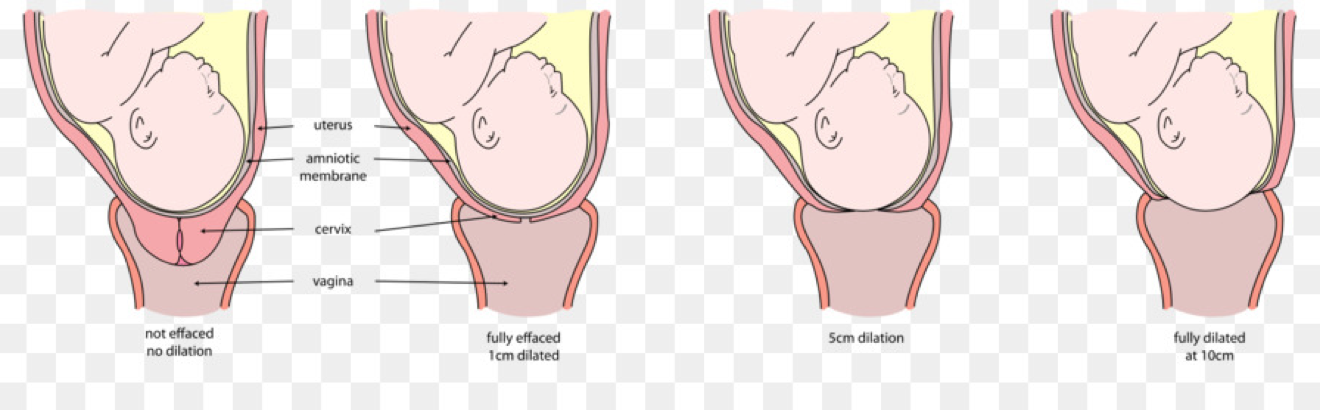
- Latent first stage: There are intermittent, often irregular, painful contractions which bring about some cervical effacement and dilatation up to 4cm.
- Established first stage: Regular, painful contractions that result in progressive effacement and cervical dilatation from 4cm.
At what point is the first stage of labour complete?
How long does the first part of labour usually last?
What is anticipated progress?
Complete when cervix is fully dilated - 10cm
Length of established first stage of labour varies between women but for a primagravida this stage lasts on average 8 hours (unlikely to last longer than 18 hours) and for a multigravida this stage lasts on average 5 hours (unlikely to last over 12 hours).
0.5 – 1.0 cm per hour (this is checked roughly every 4 hours)
Where do uterine contractions first start?
What do these contrations do and what are the impacts of them?
Uterine contractions start at the fundus and move down and across the uterus itself.
- Exerts pressure on the foetal pole, encouraging flexion.
- Puts pressure on the cervix, causing thin and dilation here too.
What is the second stage of labour?
What are the 2 distinct stages of Labour?
Full cervical dilatation to the birth of the baby.
Passive Second Stage of Labour
- the finding of full dilation of the cervix before or in absence of involuntary expulsive sontractions (woman wanting to push). Plan usually allows one hour of passive second stage to allow for further fetal descent.
Active Second Stage of Labour
- The presenting part is visible.
- Expulsive contractions with a fully dilated cervix.
- Active maternal effort following confirmation of full dilation of the cervix in the absence of expulsive contractions.
What timing difference in terms of the second stage of labour be for a woman giving birth for the first time, and a woman who had already given birth?
In a primagravida birth would be expected within two hours of active second stage commencing.
For a multigravida birth would be expected within one hour of active second stage commencing.
What is the 3rd stage of Labour?
The time between the birth of the baby and the expulsion of the placenta and membranes.
What are the aspects of active managemnt of the thirs stage of labour?
What about the physiological management of this stage?
Active Management
- Routine use of uterotonic drugs
- Deferred clamping and cutting of the umbilical cord - health benefits for baby.
- Controlled cord traction after signs of separation of the placenta - signs include: blood, increased contractions, “pressure”)
Physiological
- No utertonic drug use
- No clamping of cord until pulsation has stopped.
- Delivery of placenta by maternal effort.
What is the definition of a prolonged stage 3?
If it is not completed within 30 minutes of the birth with active managmenet, or wihtin 60 minutes with physiological management.
How is the progress of Labour monitored?
- Blood Pressure, Pulse, Temperature, Respirations, O2 Sats, Urine output, Urinalysis.
- Abdominal Palpation
- Asses foetal lie, presentation, position and engagement.
- Vaginal Examination
- Asses presentation, engagement, station, position, cervical effacement, dilation, and the presence/absence of membranes.
- Monitoring of Liquor (colour, smell, volume) once spontaneous or artificial rupture of membranes has occured.
- Ascultation of the foetal heart - by hand-held doppler or pinards, or with continuous CTG (cardiotocograph).
- Every 15 mins in 1st stage
- Every 5 mins in second stage
- Palpation of the uterine muscle contractions
- Aiming for 3-4:10 minutes, lasting approximately 40-60 seconds with moderate to strong strength.
- External Signs - e.g. Rhomboid of Michaelis and anal cleft line
What does CTG monitoring look at?
Looks at both foetal heart rate and uterine contratios, therby showing the link between the two.
What are the various fetal lies and presentations?
What is the ideal?
Fetal Lie
- Oblique
- Longitudinal
- Transverse
Presentation
- Face Presentation
- Brow Presentation
- Vertex Presentation
- Breech Presentation
- Shoulder Presention
Ideals are in bold.
What is fotal attitude?
the relationship of the fetal parts to each othe
What is fetal station?
the position of the fetal head in relation to the pelvic bones.
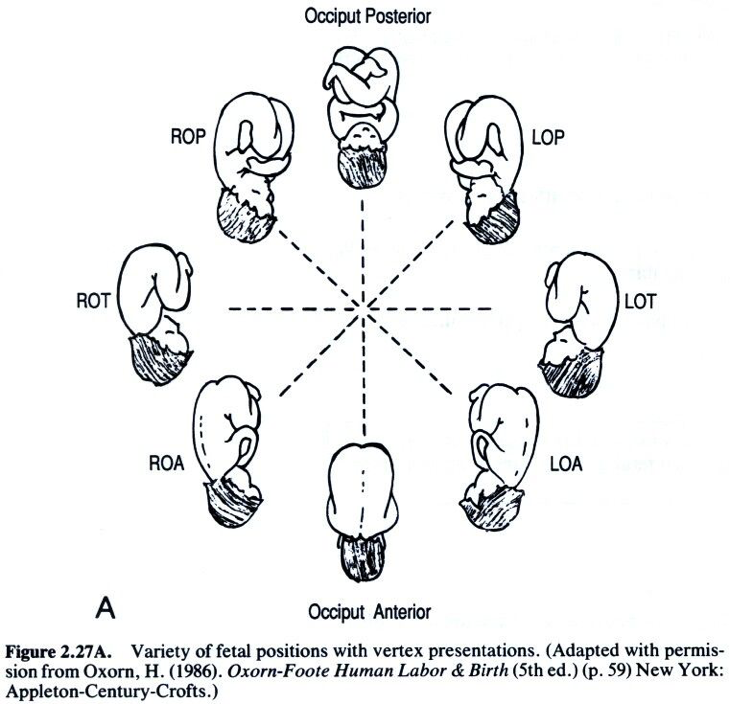
In normal labour, postion is determined by what?
Relation to the occiput. (posterior fontanelle)
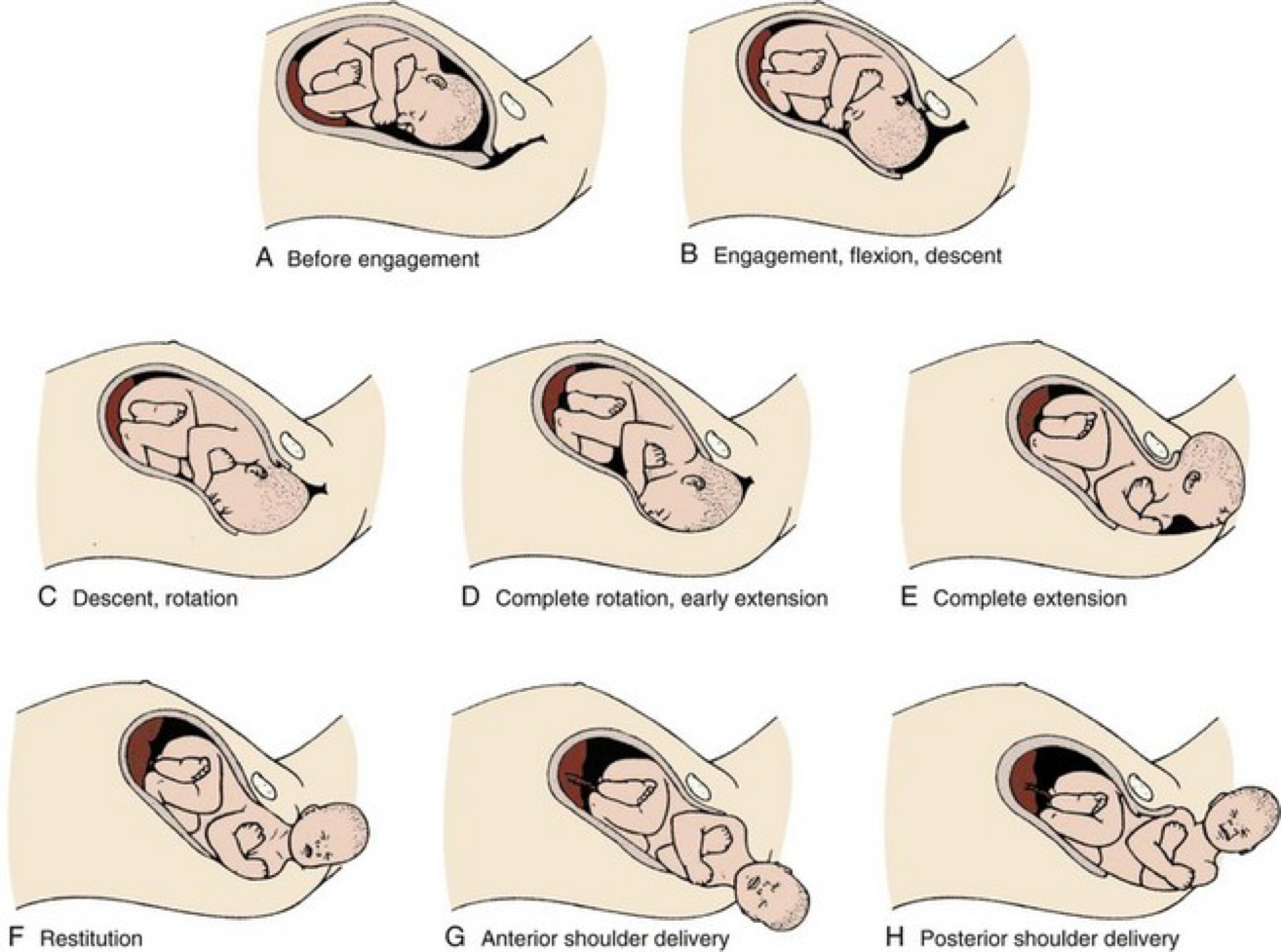
What is the mechanism of labour?
- Descent
- Flexion
- Internal rotation of the head
- Crowning and extension of the head
- Restitution
- Internal rotation of the shoulders
- External rotation of the head
- Lateral flexion
What is crowning?
Widest part of the head is through the cervix and doesn’t slip backwards between contractions.
What are the various analgesia options in labour?
- Breathing
- Massage
- TENS
- Paracetamol
- Dihydrocodeine
- Entonox (inhaled NO and O2)
- Opiods (morphine, dimorphine, pethidine)
- Remifentanil patient controlled analgesia
- Epidural
- Maternal position and mobility cna also be a means of reducing pain and facilitates progress in labour.

-
M Physiology Basics19
-
F Physiology Basics18
-
Antenatal Care and Screening38
-
Embryology0
-
Physiology in Pregnancy16
-
Taking a Repro history17
-
Contraception26
-
Normal Labour21
-
Pharmacology20
-
Maternal/Perinatal Mortality17
-
Abnormal Labour and Postpartum Care37
-
Infertility29
-
Complications of pregnancy 135
-
Complications of pregnancy 234
-
STI Pathologies41
-
STI23
-
Genital symptoms [non STI]22
-
Genetics17
-
Paediatric and Adult Gynae27
-
Preggers Physiology6
-
Pelvic organ prolapse33
-
Applied Anatomy14
-
Applied Embryology13
-
Clinical Pathology Ovary22
-
Clinical Pathology Uterus0
-
2ndary Amenorrhea + Menopause29
-
Menstrual Problems32
-
Radiology and Cytology of Breast Disease16
-
Pathology of Breast Disease31
-
Cervical Screening Symposium29
-
Breast Cancer28
-
Female Urinary Incontinence33
-
Violence Against Women and Girls (VAWG): Legal and Ethical Issues17
-
Vulval cancer0



