What are the main structural differences between RNA and DNA?
- RNA is single-stranded, whereas DNA is double-stranded
- RNA contains the sugar ribose, whereas DNA contains deoxyribose
- RNA contains the base uracil, whereas DNA contains thymine
Base + Sugar → ?
Nucleoside
What are the nucleoside subunits in RNA and DNA?
- RNA
- adenosine, guanosine, cytidine, uridine
- DNA
- deoxyadenosine, deoxyguanosine, deoxycytidine, thymidine
Which atoms in the sugar-phosphate backbone link to the bases? What type of bond is formed?
The N-9 of a purine and the N-1 of a pyrimidine attaches to the C-1’ of the sugar through an N-glycosidic linkage (ß).
What is the atomic structure of ribose and deoxyribose?
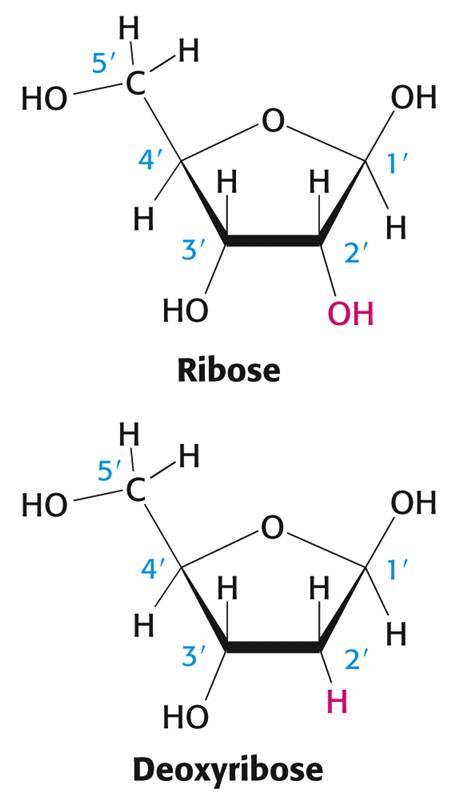
What are the monomer units that are linked to build DNA and RNA?
Nucleotide triphosphates
What is the conventional way in which to write DNA sequences?
In the 3’-to-5’ direction
What are the main features of the Watson-Crick model of DNA?
- Two polynucleotide chains coiled around eachother in a right-handed screw sense. The two chains are antiparallel.
- The sugar-phosphate backbone lies on the outside with the bases on the inside
- The bases lie perpendicularly to the axis and are 3.4Å appart. The helical structure repeats every 34Å. Each base rotates 36º from the one below it.
- The diameter of the helix is 20Å
How does the structure of DNA contribute to its stability?
- The hydrophobic bases are stacked together on the inside where they are shielded, whereas the polar backbone is exposed to the aqueous environment- Hydrophobic effect.
- There is attraction between the stacked bases through Van der Waals forces.
What are the different structures that DNA can be in?
- A
- B
- Z
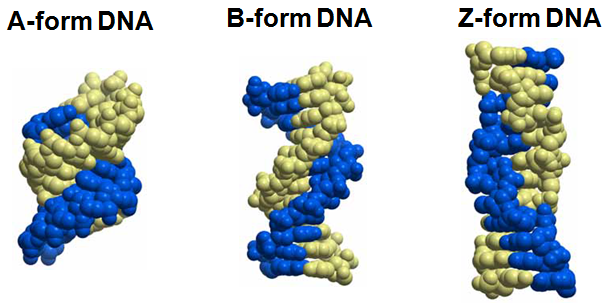
What are the differences between the different structural forms of DNA?
- A DNA: Broadest, 2.3Å rise, 25.5Å diameter, right-handed, 11bp per turn, bases 19º tilt
- B DNA: Intermediate, 3.4Å rise, 23.7Å diameter, right-handed, 10.4bp per turn, bases 1º tilt
- Z DNA: Narrowest, 3.8Å rise, 18.4Å diameter, left-handed, 12bp per turn, bases 9º tilt
What form is most DNA in under physiological conditions?
B-DNA
What type of replication does DNA undergo?
Semiconservative replication
What is the role carried out by DNA polymerases?
DNA polymerases catalyse the step-by-step addition of deoxyribonucleotide units to a DNA chain
(DNA)n + dNTP ⇔ (DNA)n+1 + PPi
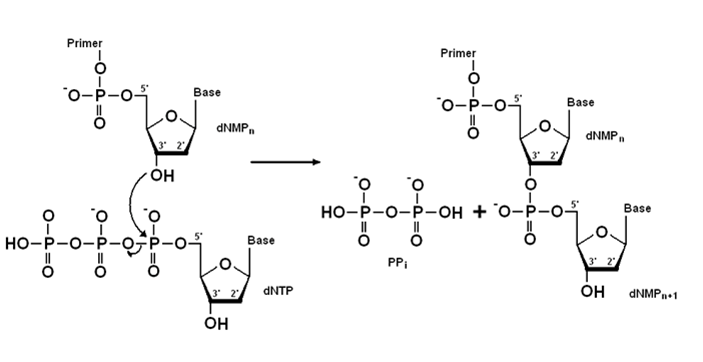
What are the main characteristics of DNA synthesis?
- The reaction requires all four deoxynucleoside 5’-triphosphates and Mg<strong>2+</strong>
- The new chain is synthesized directly onto the preexisting DNA template
- DNA polymerase requires a primer to begin synthesis (5’ to 3’ direction)
- Many DNA polymerases are able to correct mistakes in DNA by removing mismatched nucleotides
List the different types of RNA
- Messenger RNA (mRNA)
- Transfer RNA (tRNA)
- Ribosomal RNA (rRNA)
- Small nuclear RNA (snRNA)
- Signal recognition particle RNA (srpRNA)
- Micro RNA (miRNA)
- Small interfering RNA (siRNA)
The synthesis of RNA from DNA is called ___________ and is catalysed by the enzyme ___ ____________. It catalyses the initiation and elongation of RNA chains.
The synthesis of RNA from DNA is called transcription and is catalysed by the enzyme RNA polymerase. It catalyses the initiation and elongation of RNA chains.
What are the components that RNA polymerase requires?
- A template
- Activated precursors (ATP, GTP, CTP, UTP)
- A divalent metal ion (Mg/Mn2+)
What are promoter sites?
Regions on DNA templates that specifically bind to RNA polymerase and determine where transcription begins.
- TATA box at -25
- CAAT box at -75
What are the main features of the genetic code?
- Three nucleotides encode an amino acid- a codon
- The code is nonoverlapping
- The code has no punctuation
- The genetic code is degenerate- most amino acids encoded by more than one codon
What are the three stop codons? How are they read?
- UAA
- UGA
- UAG
Stop codons are read by release factors which releases the newly sysnthesised protein from the ribosome
Why can eukaryotic genes be described as discontinuous?
Several genes are discontinuous because ther are split up by introns. The average human gene has 8 introns.
What is splicing?
Splicing is a complex operation that is carried out by spliceosomes, which are assemblies of proteins and small RNA molecules.
What is the advantage of having split genes?
Exons can be rearranged to form novel genes, thereby expanding the genetic repertoire.
Alternative splicing allows a variety of similar proteins to be formed without requiring a gene for each protein.



