Shoulder Dystocia
- Failure of fetal shoulders to deliver spontaneously
- Can be catastrophic
- Unpredictable and unpreventable
Should Dystocia Diagnosis
- Turtle sign
- Head delivers, remainder does not
Shoulder Dystocia Pathophysiology
- Size discrepency b/w fetal shoulders and maternal pelvic inlet
- Due to:
*macrosomia
*large chest relative to BPD
*absence of truncal rotation
+shoulders should be oblique (internal rotation fetal head)
*shoulders remain A-P
Shoulder Dystocia Risk Factors
Antepartum
- Macrosomia (>4500g)
- DM/GDM (increases overal risk by 70%)
- Muliparity
Intrapartum
- Prolonged deceleration phase of labor
- Prolonged 2nd stage
- Protracted descent
- Operative delivery (vacuum>forceps)
No evidence based data risk factors for shoulder dystocia
- Male
- AMA (advanced maternal age)
- Short maternal stature
- Abnormal pelvic shape/size
Unpredictability of Should Dystocia
- 25-50% have no defined risk factor
- 50% occur in infants birth weight <4000g
- 84% did not have prenatal dx macrosomia by US
- 82% infants w/ brachial plexus palsy did not have macrosomia
Fetal Macrosomia defintion
- Birth weight of >8lbs, 13oz (4,000grams), regardless of his or her gestational age
Fetal Macrosomia ris factors to fetus during delivery
- Shoulder dystocia/birth trauma
- Brachial plexus injury (C5, C6, Erb-Duchenee paralysis, Klumpke’s palsy)
- Asphyxia/cord compression
- Fracture humerus or clavicle
Klumpke palsy
- Lower plexus injury to the lower roots of the brachial plexus
- Involving C8 and T11 roots
- There is loss of grasp reflex. The hand is supinated, the wrist extended, and the fingers clawed
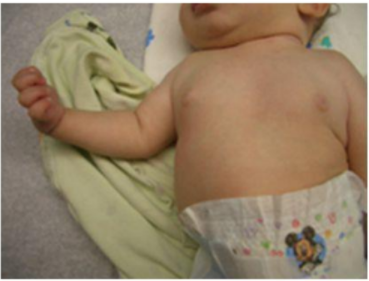
Time frame during delivery before neonatal asphyxia and/or cortical injury
- 7min.
Should Dystocia Treatment
In order of importance:
- Recognition
- Notify nurses, call for help
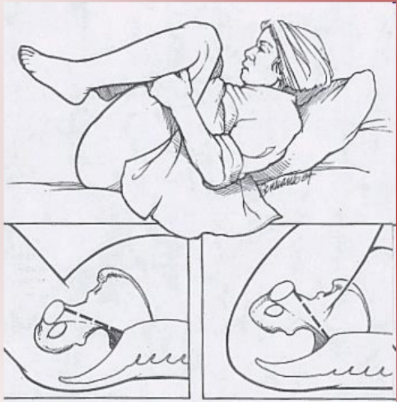
- McRoberts maneuver (first maneuver that should be performed)
- Suprapubic pressure
- Consider episiotomy if you need more room to perform maneuvers or tissue dystocia
- Delivery of posterior arm
- Wood’s screw
- Rubin’s maneuver
- Gaskin
- Fracture of clavicle
- Zavanelli maneuver
- Abdominal rescure
- Symphysiotomy
McRobert’s Maneuver
- 42% success rate
- Pelvic inlet and outlet have more vertical alignment
- Flattens sacrum
- Cephalad rotation of pubic symphysis
- Elevates anterior shoulder and felxes fetal spine
- McRobert’s Plus Suprapubic pressure = 54-58% success rate
Woods Screw
- Maneuver to help w/ shoulder dystocia
- Fingers of first hand remain behind anterior shoulder (Rubin II). OB inserts fingers of second hand in front (chest side) of the posterior shoulder
- Apply pressure as in Rubin II in combination w/ pressure to front of posterior shoulder to rotate into the oblique. If delivery is not achieved, continue rotation thru 180 degress if able
- Attempt delivery
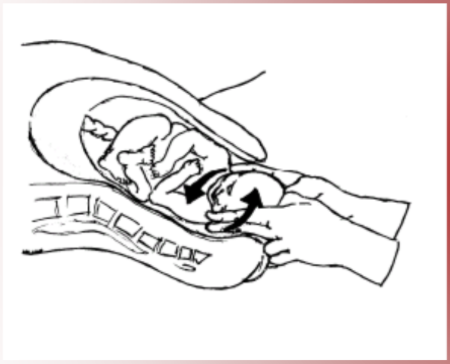
Rubin II Maneuver
- Maneuver to help w/ shoulder dystocia
- Assistant applies downward pressure “CPR” style above pubic symphysis (Rubin I)
- OB inserts fingers of one hand into vagina and applies pressure behind anterior should so anterior should displaced toward fetal chest
- Once shoulders in oblique diameter, attempt delivery
- McRoberts maneuver may be applied throughout
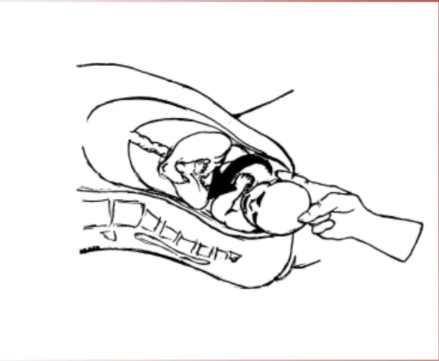
Zavanelli Maneuver
- Last resort techique during delivery
- Fetal head returned to pre-restitution position and slowly replaced in vagina w/ steady upward pressure for delivery by C-section
HELPER Algorithm
Steps taken during shoulder dystocia
- H: Call for Help; should dystocia is called if shoulders cannot be delivered w/ gentle traction
- E: Evaluate for Episiotomy: not routinely indicated; maybe needed when attempting intra-vaginal maneuver
- L: Legs (McRoberts): hyperflexion and abduction of hips- initial maneuver
- P (Suprapubic Pressure): no fundal pressure; combination of McRoberts and suprapubic pressure resolves most shoulder dystocias
- Enter (Internal Maneuvers): Wood’s, Rubin’s
- Remove: Delivery posterior arm
On expulsion of the head, a shoulder dystocia is recognized. Before instituing maneuvers the next step is to:
A) Tell the pt not to push
B) Apply fundal pressure
C) Increase or initate Oxytocin administration
D) Cut a large episiotomy
Answer: Tell the pt not to push
- Initially it is best to do nother that will further impact the anterior shoulder above the pubic symphysis. The Simplest way to avoid further impaction is to ask the pt. to stop pushing (its bone against bone right now and show pushing further is not going to help)
Shoulder Dystocia Prophylactic Cesarean Indication
- Not recommended by ACOG
- Exceptions:
*>5000g in mother w/o DM
*>4500g in mother w/ DM
2nd and 3rd trimester bleeding dDx
- Placenta previa
- Abruptio placenta
- Vasa previa
- Placental implantation issues (accreta/increta,percreta)
- Uterine rupture
- Preterm labor
- “Bloody show” assoc. w/ cervical insufficiency or labor
Bleeding during pregnancy risk factors
- Multiparity
- Pevious previa
- Increaseing maternal age
- Uterine curettage
- C-section
- Prior cesarean section/uterine scar
- Uterine surgery
- Chronic hypertension
- Smoking
- Multiple gestation
- Cocaine use
Placenta Previa
- Placenta is located over or near the internal os of cervix
- Categorized into 4 types:
*complete: placenta completely covers internal os
*partial: placenta partially covers internal os
*marginal: placenta just reaches internal os, but does not cover it
*low-lying placenta: placenta extends into lower uterine segment but does not reach internal os
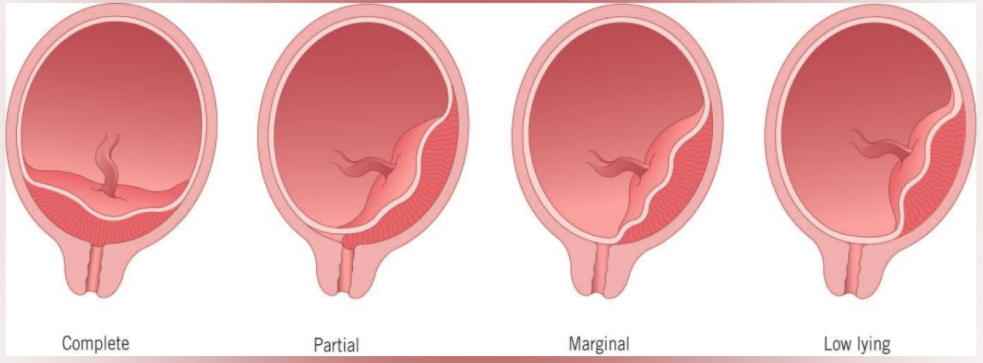
Placenta previa potential consequences
- Antepartum bleeding
- Need for hysterectomy
- Placenta accreta
- Intrapartum/postpartum hemorrhage
- Need for blood transfusion
- Preterm delivery
Placenta Previa Diagnosis
- Screen w/ abdominal u/s, however true diagnosis is made w/ transvaginal u/s
*may see a false pos. if bladder is full
- Presents as painless vaginal bleeding
*w/ dilation of the internal os, placenta begins to separate and causes bleeding
- Perform speculum exam instead of digital exam…NO VAGINAL EXAMS!!!
Placenta Previa Prophylactic Treatment
- Pelvic rest (nothing to be inserted in vagina)
*from diagnosis vs beginning of 3rd trimester
- Cesarean delivery at 36-37wks
*want to take mother to delivery a little earlier so that she doesnt go into labor and begin dilating

-
Physiology of Conception and Placentation39
-
Placental Pathology29
-
Ovarian Pathology69
-
Multiple Gestation27
-
Hemolytic Disease of Fetus and Newborn13
-
Abnormalities of Fetal Growth18
-
Fetal Genetic Abnormalities22
-
Prenatal Care22
-
EFM31
-
PROM and Preterm Labor22
-
Labor and Delivery19
-
Abortion12
-
Medical Complications of Pregnancy33
-
Obstetric and Neonatal Infections37
-
Congenital Infections19
-
Obstetrical Emergencies70
-
Opiods8
-
Hypertension Pregnancy22
-
Pharmacology of Obstetrics68
-
Pathology Breast Lesions68
-
Breast Cancer42



