What does the lens do to an image when it projects it on the retina?
The image is inverted and reversed
What field of vision does each side of the eye receive?
nasal = ipsilateral
temporal = contralateral
What visual field is transmitted throught he left optic tract? The right?
Where is it projected to?
Left = right visual field; projected to left LGB
Right = left visual field; projected to right LGB
–> the ipsilateral nasal fields decussate at the optic chiasm
LGB = lateral geniculate body
What are the two main pathways of the lateral geniculate body?
Magnocellular (layers 1 and 2)
Parvocellular (layers 3-6)
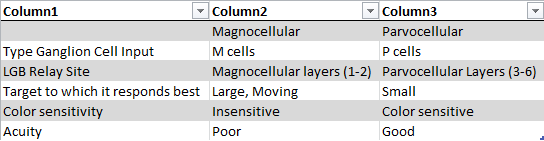
How doe the LBG magnocellular and parvocellular pathways differ in the following visual processing information:
Ganglion cell input
LGB relay site
Target to which it responds best
Color sensitivity
Acuity
What can cause lesions of the visual pathways?
Cerebral vascular accidents to the ICA, Circle of Willis and Posterior Cerebral Artery
Pituitary tumors
Intracerebral tumors (i.e. meningiomas)
What lesion would produce Total blindness in the right eye?
Severing the right optic nerve
What lesion would cause Bitemporal Heteronymous Hemianopsia?
AKA tunnel vision
A lesion to the optic chiasm (i.e. pituitary tumor)
What lesion would cause Left homonymous hemianopsia?
severing the right optic tract (or complete severing of right optic radiations)
What would cause left superior quadrantanopsia?
A lesion in the more posterior arc of the optic radiations (leaving the anterior intact)
What is the dorsal pathway in visual processing?
“Where” or “M-pathway”
- M-ganglion cells of retina –> M layers (1-2) of LGB –> layer IV of V1
Continues as dorsal pathway to the visual cortex
- terminates in superior parietal cortex
What is the ventral pathway in visual processing?
“What” or “P-pathway”
- P-type ganglion cells of retina –> P-layers (2-6) of LGB –> layer IV of V1
Continues as ventral pathway and terminates in Inferior Temporal Cortex (ITC)
What are the functional characteristics of the Dorsal pathway of visual processing?
Characteristics:
- Large receptive fields
- high temporal resolution
- responds to moving or changing stimuli
- Low spatial resolution
Functions:
- Motion detection
- Depth Perception/spatial analysis
- Visual Attention
What are the functional characteristics of the ventral pathway of visual processing?
Characteristics:
- Small receptive fields
- low temporal (frequency) resolution
- high spatial resolution
Function:
- Object recognition
- Visual perception and memory
- Color processing
What is visual agnosia?
inability to recognize and identify objects or persons without a loss of visual acuity
- lack of concious perception of object
- inability to link visual perception with meaningful experience
What can cause visual agnosias?
Infacts of PCA or MCA
tumors
CO poisoning
(often bilateral lesions)
What is Simultanagnosia?
inability to perceive more than one object at the same time
(lesion in the dorsal pathway)
What is akineptopsia?
loss of motor perception (“motion blindness”) or inability to recognize movement
- lesion in dorsal pathway
What is prosopagnosia?
inability to identify faces
(“face blindness”)
- lesion in the ventral pathway
What is Cortical Color Blindness (Achroatopsia)?
loss of color vision despite the presence of normal functioning cones
- lesion in the ventral pathway
What are saccade movements?
- Rapid movements
- Move eyes to a new visual target
- Direction and distance pre-calculated
- No feedback used during movement
What are characteristics of smooth eye movements?
- slow (“continuous”) conjugate movements
- Keep images stabilized on retina
- Require sensory information
How will a patient present with a right abducens nerve lesion when the patient attempts to gaze:
Forward
Right
Left
Converge
Forward:
Right eye is adducted
(strabismus and horizontal diplopia)
Right:
Left eye adducts
Right eye only to mid-point
(strabismus and horizontal diplopia are max)
Left:
Left eye abducts
Right eye adducts
(NO strabismus, NO diplopia)
NOT impaired
Convergence:
NOT impaired
How will a patient present with a right abducens nucleus lesion when the patient attempts to gaze:
Forward
Right
Left
Converge
Forward:
Both eyes deviate to left
(NO strabismus)
Right:
Both eyes only go to midpoint
(paralysis of lateral gaze to side of lesion)
(NO strabismus)
Left:
Left eye abducts
Right eye adducts
(NOT impaired)
Convergence:
Not impaired




