- Following preoperative chemotherapy, the percent of tumor necrosis has been shown to be of prognostic value for which of the following tumors ?
a. Rhabdomyosarcoma
b. Chondrosarcoma
c. Metastatic adenocarcinoma
d. Osteosarcoma
e. Giant cell tumor of bone
Answer: d. Osteosarcoma
Huvos grade 1,2,3,4: grading for histological response to preoperative chemotherapy
- grade-I : little or no necrosis (involving 50 per cent of the tumor or less);
- grade-II : necrosis of more than 50 per cent but less than 90 per cent of the tumor;
- grade-Ill : only scattered foci of viable tumor cells (necrosis of 90 to 99 per cent of the tumor); grade-IV response, by no viable tumor (100 per cent necrosis).
The histological response to preoperative chemotherapy was determined retrospectively by the same pathologist in a blinded fashion.
Huvos grade 3,4 : kemo efektif.
What factor is most likely to be associated with non union of the type II odontoid fracture?
- Fracture displacement greater than 4 mm
- Advanced age of patient
- Posterior versus anterior displacement
- Blood supply to dens fragment
- Presence of neurologic injury
Answer: 4. Blood supply to dens fragment
Classification of Odontoid fracture: (Anderson and Alonzo)
- Type I: Oblique avulsion fracture of the apex (5%)
- Type II: Fracture at the junction of the body and the neck; high nonunion rate, which can lead to myelopathy (60%)
- Type IIA: Highly unstable comminuted injury extending from the waist of the odontoid into the body of the axis
- Type III: Fracture extending into the cancellous body of C2 and possibly involving the lateral facets (30%)
Treatment
- Type I: If it is an isolated injury, stability of the fracture pattern allows for immobilization in a cervical orthosis.
- Type II: This is controversial, because the lack of periosteum and cancellous bone and the presence in watershed area result in a high incidence of nonunion (36%). Risk factors include age >50 years, >5 mm displacement, and posterior displacement. It may require screw fixation of the odontoid or C1-C2 posterior fusion for adequate treatment. Nonoperative treatment is halo immobilization.
- Type III: There is a high likelihood of union with halo immobilization owing to the cancellous bed of the fracture site.
A patient has a burst fracture at L 1 with 70% canal compromise from a single retropulsed bone fragment and complete surgical decompression and stabilization is performed. One month later the bulbocavernosus reflex is still absent, but function of the lower extremity is normal. What is the most likely diagnosis ?
- Residual cord or conus compression
- Conus medullaris injury
- Persistent spinal shock
- Spinal cord infarction
- Cauda equina syndrome
Answer: 1. Residual cord or conus compression
Bulbocavernosus Reflex:
- The bulbocavernosus reflex refers to contraction of the anal sphincter in response to stimulation of the trigone of the bladder with either a squeeze on the glans penis, a tap on the mons pubis, or a pull on a urethral catheter.
- The absence of this reflex indicates spinal shock.
- The return of the bulbocavernosus reflex, generally within 24 hours of the initial injury, hallmarks the end of spinal shock.
- The presence of a complete lesion after spinal shock has resolved portends a virtually nonexistent chance of neurologic recovery.
- The bulbocavernosus reflex is not prognostic for lesions involving the conus medullaris or the cauda equina.
Conus Medullaris Syndrome:
- This is seen in T12-L1 injuries and involves a loss of voluntary bowel and bladder control (S2-4 parasympathetic control) with preserved lumbar root function.
- It may be complete or incomplete; the bulbocavernosus reflex may be permanently lost.
- It is uncommon as a pure lesion and more common with an associated lumbar root lesion (mixed conus-cauda lesion).
- Titanium, an extremely reactive metal, is one of the most biocompatible implant material because :
a. Nothing in the biologic environment reacts with titanium
b. Physiologic condition inhibit titanium reaction
c. Protein coat the titanium and “insulate” it from the body
d. Titanium spontaneously forms a stable oxide coating
e. Titanium alloy are less reactive than metal
Answer : d. Titanium spontaneously forms a stable oxide coating
Reference : Miller 5th edition . Chapter 1 Basic science: biomaterial.
Titanium is extremely biocompatible material; it rapidly forms an adherent oxide coating (self-passivation), TiO2, that covers its surface (a nonreactive ceramic coating), thus makes these material extremely biocompatible. Another advantage of titanium is its relatively low E (most closely emulates the axial and torsional stiffness of bone) and high yield strength.
Orthopaedic implants are typically made of 316L (L = low carbon) stainless steel (iron, chromium, and nickel), “supermetal” alloys (e.g., Co-Cr-molybdenum (Mo) [65% Co, 35% Cr, 5% Mo] made with a special forging process), and titanium alloy (Ti-6Al-4V). Each possesses a different stiffness (E) (Fig. 1–97). Problems associated with certain metals include wear, stress shielding (increased in metals with a higher E), and ion release (Co-Cr causes macrophage proliferation and synovial degeneration)
- Which of the following cell membrane proteins convey chemotherapeutic resistance to tumor cells:
a. CD 44 glycoprotein
b. P-glycoproteins
c. Paracrine peptides
d. Matrix metalloproteinases (MMPs)
e. Stromelysins
Answer: b. p-glycoprotein.
Reference : Ling V (1997). “Multidrug resistance: molecular mechanisms and clinical relevance”. Cancer Chemother. Pharmacol. 40 Suppl (7): S3–8. doi:10.1007/s002800051053. PMID 9272126.
P-glycoprotein also known as multidrug resistance protein
One of the mechanism resistance of cancer cells is through expression of the multidrug resistance gene 1 (MDR1). MDR 1 codes for a membrane phosphoglicoprotein (p-glycoprotein).
At least four basic mechanisms of drug resistance are now recognized under the category of the MDR phenotype.
- changes in glutathione metabolism
- alterations in topoisomerase II
- non-P-glycoprotein (P-gp)-mediated mechanisms
- P-gp-mediated mechanisms (1,2).
- Recent evidence has suggested that P-gp may be of particular relevance to osteosarcoma.
P-gp is a glycoprotein encoded by the MDR-1 gene on the long arm of chromosome 7 in humans .
Lovell & Winter’s Pediatric Orthopedic. 6th ed. Ch 14. 2006. Lippincott Williams & Wilkins.
- Which of the following antibiotic is bacteriostatic at therapeutic serum concentration ?
a. Penicillin
b. Cefoxitin
c. Clindamycin
d. Vancomysin
e. Bacitracin
Answer : c. Clindamycin
Mechanism of action ß lactam antibiotic including penicillin and cephalosporin and so does vancomycin: inhibit peptidoglycan synthesis in bacterial wall result in autolysis bacteries. Thus they are bactericid.
Cefoxitin is 2nd generation of cephalosporin.
Bacitracin also has mechanism of action inhibitin synthesis of bacterial wall. Bacitracin interferes with the dephosphorylation of the C55-isoprenyl pyrophosphate, a molecule that carries the building-blocks of the peptidoglycan bacterial cell wall outside of the inner membrane
Reference Goodman and Gilman’s. The Pharmacological Basic of Therapeutic. 12th ed.
Clindamycin has a bacteriostatic effect. It is a bacterial protein synthesis inhibitor by inhibiting ribosomal translocation, in a similar way to macrolides. It does so by binding to the 50S rRNA of the large bacterial ribosome subunit.
Reference : Lincosamides, Oxazolidinones, and Streptogramins”. Merck Manual of Diagnosis and Therapy. Merck & Co.. November 2005. Retrieved 2007-12-01
- What antibiotic works by inhibiting peptidoglycan synthesis ?
a. Penicillin
b. Gentamycin
c. Rifampicin
d. Tetracycline
e. Clindamycin
Answer : a. penicillin
Penicillin and cephalosporins such as cefoxitin, vancomycin, and bacitracin are all bactericidal by causing loss of bacterial cell viability, either by activating enzymes that disrupt cell membrane or by inhibiting synthesis of cell wall. Clindamycin is bacteriostatic and acts by inhibiting sintesis protein.
- Which of the following organism is (are) most likely to cause hematogenous osteomyelitis in hemodialysis patients ?
a. Escherichia coli and Klebsiella pneumonia
b. Staphylococci
c. Candida species
d. Anaerobic oral organism
e. Anaerobic enteral organism
Answer : b. Staphylococci
Hemodialysis patients and intravenous drug abusers—S. aureus, S. epidermidis, and Pseudomonas aeruginosa are common organisms. The treatment of choice is one of the penicillinase-resistant synthetic penicillins (PRSPs) plus ciprofloxacin; an alternative treatment is vancomycin with ciprofloxacin.
Reference : Miller’s Review of Orthopedics. 5th ed. Chapter 5 :Orthopedic infection and Microbiology. 2008. Elsevier inc.
- The pharmacologic effect of warfarin is caused by what mechanism ?
a. Inhibition of platelet aggregation
b. Inhibition of hepatic enzymes that activates vitamin K
c. Bonding to vitamin K dependent cloting factors II, VII, IX,X
d. Bonding to antithrombin III which increase its affinity for activated factor X and thrombin
e. Direct binding to vitamin K
Answer: b. inhibition of hepatic enzymes that activates vitamin K
Warfarin inhibits the vitamin K-dependent synthesis of biologically active forms of the calcium-dependent clotting factors II, VII, IX and X, as well as the regulatory factors protein C, protein S, and protein Z.
Jawaban buku AAOS comprehensive review ; b. warfarin inhibit hepatic enzymes that activates vitamin K, vitamin K epoxide. This inhibition leads to reduced carboxylation of vitamin K dependent protein (protrombin, and factor VII, IX, X). Warfarin does not act by binding directly to vitamin K or clotting factor.
References :
• Ansell J, Hirsh J, Poller L, Bussey H, Jacobson A, Hylek E (2004). “The pharmacology and management of the vitamin K antagonists: the Seventh ACCP Conference on Antithrombotic and Thrombolytic Therapy”. Chest 126 (3 Suppl): 204S–233S. Doi :10.1378/chest.126.3_suppl.204S. PMID 15383473.
• Freedman MD (March 1992). “Oral anticoagulants: pharmacodynamics, clinical indications and adverse effects”. J Clin Pharmacol 32 (3): 196–209. PMID 1564123
- The risk of human immunodeficiency virus (HIV) transmission via a processed musculoskeletal allograft obtained from an American Association of Tissue Bank (AATB) certified bone bank is estimated to be :
a. 1 in 50,000
b. 1 in 100,000
c. 1 in 500,000
d. 1 in 1,5 million
e. 1 in 5 million
Answer: d. 1 in 1,5 million.
Reference : AAOS Comprehensive Orthopedic Review: Study Questions. 2009.
- Warfarin limit the risk of deep venous thrombosis (DVT) by which of the following action ?
a. Competitive inhibition of vitamin K dependent clotting factors
b. Inhibition of the post translational modification of vitamin K dependent clotting factors
c. Reversible inhibition of platelet function
d. Potentiation of antithrombin III
Answer : b. Inhibition of the post translational modification of vitamin K dependent clotting factors
- Most natural biologic material are anisotropic, meaning that their stress strain curve exhibits:
a. Different moduli for compressive and tensile stress
b. A high degree of nonlinearity
c. A high sensitivity to the size of the test specimen
d. Dependence on the rate loading
e. Dependence of the direction of load application
Answer ; e. Dependence of the direction of load application
Reference Miller’s Review of Orthopedic. 5th ed. Chapter 1 Basic Science. Section 8, subsection 2. 2008. Elsevier inc.
Isotropic materials—Possess the same mechanical properties in all directions (e.g., a golf ball)
Anisotropic materials—Have mechanical properties that vary with the direction of the applied load (e.g., bone is stronger axially than radially)
- Which of the following factors is most commonly associated with late aseptic loosening of cemented acetabular components ?
a. Increased frictional torque
b. Recurrent neck socket impingement
c. Fatique failure of cement
d. Poor initial component fixation
e. Polyethylene wear
Answer : e. Polyethylene wear
Polyethylene wear are foreign body material which elicit hystiocytic (osteoclast) response to begin an osteolytic process.
Osteolytic process—As a result of particle ingestion by the macrophages, the activated macrophage (osteoclast) liberates osteolytic factors, including tumor necrosis factor (TNF)-α, interleukin-1β, interleukin-6, prostaglandins, oxide radicals, hydrogen peroxide, and acid phosphatase. Interleukin-1β, interleukin-6, prostaglandins works paracrine stimulating end nerve fiber, causing PAIN. These factors activate the osteoclast system and together assist in the dissolution of bone. Osteoclastic resorption of bone around the prosthesis allows prosthetic micromotion to occur. This leads to further generation of wear debris. Additional lysis of bone allows for prosthetic macromotion, loosening, and pain. Symptoms pain after hemiarthroplasty even without periprosthetic radioluscent area, is a symptoms that osteolytic process has begin. Give your patient BIPHOSPHONATE to repress osteoclast activity.
Cara kerja biphosphonate :
Bisphosphonates inhibit osteoclast resorption of bone (by preventing the osteoclast from forming the ruffled border necessary for expression of acid hydrolases)
- Methicillin resistant Staphylococcus aureus can be effectively with an oral quinolone and which of the following antibiotics to achieve synergy?
a. Penicillin
b. Probenecid
c. Rifampin
d. Cefoxitin
e. Amoxillin
Answer : c. Rifampicin
Rifampin has been shown to have synergy with quinolones in the treatment of MRSA. Together they lessen development of resistant mutant.
- A fully differentiated osteoclast has receptors for which of the following proteins ?
a. Parathyroid hormone (PTH)
b. Calcitonin
c. Cholecalciferol
d. Bone morphogenetic protein (BMP)
e. Interleukin -2 (IL-2)
Answer : b. Calcitonin
Calcitonin—A 32–amino acid peptide hormone produced by the clear cells in the parafollicles of the thyroid gland; has a limited role in calcium regulation (see Table 1–13). Increased extracellular calcium levels cause secretion of calcitonin, which is controlled by a β2 receptor. Calcitonin inhibits osteoclastic bone resorption (osteoclasts have calcitonin receptors; decreases osteoclast number and activity) and decreases serum calcium
- Cephalosporin are effective antibiotic agents because of their action on what aspect of bacterial metabolism ?
a. DNA gene
b. Cell wall
c. mRNA
d. cell membrane
e. protein
Answer : b. Cell wall
- The structure of cartilage proteoglycan can be described as
a. Multiple hyaluronate molecules bound to core protein, which is subsequently bound to a glycosaminoglycan chain
b. Multiple glycosaminoglycan chains bound to hyaluronate, which is subsequently bound to core protein
c. Multiple glycosaminoglycan bound to core protein, which is subsequently bound to hyaluronate via a link protein
d. Multiple link protein bound to core protein, which is subsequently bound to glycosaminoglycan
e. Multiple hyaluronate chains bound to link protein, which is subsequently bound to glycosaminoglycan
Answer: c. Glycosaminoglycan molecules bound to core protein forming proteoglycan aggrecan, subsequently proteoglycan aggrecan bound to hyaluronate via a link protein, forming proteoglycan aggregate.
Reference Miller’s Review of Orthopedic. 5th ed. Chapter 1 Basic Science. 2008. Elsevier inc.
- Virtually all biological material are viscoelastic, which means their mechanical behavior is dependent on what factor ?
a. Load applied
b. Cross sectional area
c. Rate of loading
d. Mode of loading
e. Direction of loading
Answer : c. rate of loading
Material—Related to a substance or element. Defined by mechanical properties (force, stress, strain) and rheologic properties (elasticity [ability to regain original shape], plasticity [permanent deformation], viscosity [resistance to flow or shear stress], and strength).
a. Brittle materials (e.g., PMMA)—Exhibit a linear stress–strain curve up to the point of failure. Brittle materials undergo only fully recoverable (elastic) deformation prior to failure and have little or no capacity to undergo permanent (plastic) deformation prior to failure.
b. Ductile materials (e.g., metal)—Undergo a large amount of plastic deformation prior to failure. Ductility is a measure of postyield deformation.
c. Viscoelastic materials (e.g., bone and ligaments)—Exhibit stress–strain behavior that is time-rate dependent (varies with the material); the material’s deformation and properties depend on the load and the rate at which the load is applied. Viscoelastic materials exhibit properties of both a fluid (viscosity; resistance to flow) and a solid (elasticity). The modulus of viscoelastic material increases as the strain rate increases. Viscoelastic behavior is a function of the internal friction of the material. Viscoelastic materials also exhibit hysteresis: Loading and unloading curves differ because energy is dissipated during loading. Most biologic tissues (bone, ligament, muscle, etc.) exhibit viscoelasticity.
d. Isotropic materials—Possess the same mechanical properties in all directions (e.g., a golf ball)
e. Anisotropic materials—Have mechanical properties that vary with the direction of the applied load (e.g., bone is stronger axially than radially)
f. Homogeneous materials—Have a uniform structure or composition throughout.
- What is the dominant component of articular cartilage extracellular matrix by weight ?
a. Wear
b. Collagen
c. Keratan sulfate
d. Chondroitin sulfate
e. Nerve and lymphatic tissue
Answer ; a. wear ??. Pasti maksudnya WATER !!
Reference Miller’s Review of Orthopedics. 5th ed. Chapter 1 section 2.
Articular cartilage composition
a. Water (65-80% of wet weight)—Shifts in and out of cartilage to allow deformation of cartilage surface in response to stress. Water is not distributed homogeneously (65% in deep zone, 80% at surface). Water content increases (90%) in osteoarthritis (Table 1–18). Water is also responsible for nutrition and lubrication. Increased water content leads to increased permeability, decreased strength, and decreased Young’s modulus (E).
b. Collagen (10-20% of wet weight; >50% of dry weight) (Fig 1–36)—Type II collagen accounts for approximately 95% of the total collagen content of articular cartilage and provides a cartilaginous framework and tensile strength. Type II collagen is very stable, with a half-life of approximately 25 years. Increased amounts of glycine, proline, hydroxyproline, and hydrogen bonding are responsible for its unique characteristics. Hydroxyproline is unique to collagen and can be measured in the urine to assess bone turnover. Small amounts of types V, VI, IX, X, and XI collagen are present in the matrix of articular cartilage. An overview of all collagen types is shown in Table 1–19. Collagen type VI is a minor component of normal articular cartilage, but its content increases significantly in early osteoarthritis. Collagen type X is produced only by hypertrophic chondrocytes during enchondral ossification (growth plate, fracture callus, HO formation, calcifying cartilaginous tumors) and is associated with calcification of cartilage; a genetic defect in type X collagen is responsible for Schmid’s metaphyseal chondrodysplasia (affects the hypertrophic physeal zone). Collagen type XI is an adhesive holding the collagen lattice together.
c. Proteoglycans (10-15% of wet weight)—Protein polysaccharides provide compressive strength. Proteoglycans are produced by chondrocytes, are secreted into the extracellular matrix, and are composed of subunits known as glycosaminoglycans (GAGs, disaccharide polymers). These GAGs include two subtypes of chondroitin sulfate (the most prevalent GAG in cartilage) and keratin sulfate. The concentration of chondroitin-4-sulfate decreases with age, that of chondroitin-6-sulfate remains essentially constant, and that of keratin sulfate increases with age. GAGs are bound to a protein core by sugar bonds to form a proteoglycan aggrecan molecule. Link proteins stabilize these aggrecan molecules to hyaluronic acid to form a proteoglycan aggregate. Proteoglycans have a half-life of 3 months, provide structural properties for the articular cartilage, provide elastic strength, produce cartilage’s porous structure, and trap and hold water (regulate and retain fluid in the matrix). Figure 1–37 illustrates a proteoglycan aggregate and an aggrecan molecule.
d. Chondrocytes (5% of wet weight)—Active in protein synthesis, possess a double effusion barrier; produce collagen, proteoglycans, and some enzymes for cartilage metabolism, including the metalloproteinases (breakdown cartilage matrix) and tissue inhibitor of metalloproteinases (TIMPs; inhibit the metalloproteinases); least active in the calcified zone. Deeper cartilage zones have chondrocytes with a decreased rough endoplasmic reticulum (RER) and increased intraplasmic filaments (degenerative products). Chondroblasts, derived from undifferentiated mesenchymal cells (stimulated by motion), are later trapped in lacunae to become chondrocytes.
e. Other matrix components
(1) Adhesives (noncollagenous proteins, such as fibronectin, chondronectin, and anchorin CII)—Involved in interactions between chondrocytes and fibrils. Fibronectin may be associated with osteoarthritis.
(2) Lipids—Unknown function
- A 2 week old infant has been referred for evaluation of nonmovement of the hip. History reveals that the patient was delivered 6 weeks premature by cesarean section. Examination reveals no fever, and there is mild swelling of the thigh. Passive movement of the hip appears to elicit tenderness and very limited hip motion. A radiograph of the pelvis shows mild subluxation of the left hip. The next step in evaluation should consist of :
a. Aspiration of the left hip
b. Application of Pavlik harness
c. A gallium scan
d. An MRI scan of the spine
e. Modified Bryan traction
Answer : a. Aspiration of the left hip
Early diagnosis is important : Rule out these differential diagnosis:
Septic arthritis
Transient synovitis
Early coxitis TB
Hip subluxation.
If clinical findings suggest bone or joint sepsis, aspiration is mandatory (for Gram staining and culture). Radiograph may reveal subluxation (due to joint effusion, due to infection). DDH is not painful and not accompany by localized swelling. If no purulent material obtained from aspiration, an arthrogram should be obtained to rule out femoral epiphysiolysis.
- A 12 year old girl has had lower back pain for the past 6 months that interferes with her ability to participate in sports. She denies any history of radicular symptoms, sensory changes, or bowel and bladder dysfunction. Examination reveals a shuffling gait, restriction of forward bending, and tight hamstrings. Radiographs show a grade III spondylolisthesis of L5 on S1, with a slip angle 20°. Management should consist of :
a. Brace treatment
b. Laminectomy, nerve root decompression, and in situ fusion of L4 to the sacrum
c. In situ fusion of L4 to the sacrum
d. Excision of the L5 lamina
e. Physical therapy
Answer : c. In situ fusion of L4 to the sacrum
Indication for surgical treatment of spondilolisthesis:
• pain and/or progressive deformity
• persisten pain or neurologic deficit that not respond to nonsurgical therapy
Choice of surgical treatment :
• insitu posterolateral L5-S1 fusion is adequate for mild spondilolisthesis
• extension of fusion to L4 offers better mechanical advantage for more severe slips (Meyerding gr II)
DO NOT perform laminectomy alone in children It is contraindicated. Nerve root decompression is indicated if radiculopathy present clinically.
Ref. AAOS Comprehensive Orthopedic Review.
Marfan Syndrome is associated with defects in which of the following structural proteins ?
a. Elastin
b. Fibrillin
c. Fibronectin
d. Type II collagen
e. Type III collagen
Answer : b. Fibrillin
Reference Miller’s Review of Orthopedics. 5th ed. Chapter 1 section 4 subsection 3.
COMPREHENSIVE COMPILATION OF INHERITANCE PATTERN, DEFECT, AND ASSOCIATED GENE OF MUSCULOSKELETAL-RELATED DISORDERS
Disorder Inheritance Pattern Defect Associated Gene
Dysplasias
Achondroplasia Autosomal dominant Defect in the fibroblast growth factor (FGF) receptor 3 FGF receptor 3 gene
Diastrophic dysplasia Autosomal recessive Mutation of a gene coding for a sulfate transport protein Sulfate-transporter gene (chromosome 5)
Kniest’s dysplasia Autosomal dominant Defect in type II collagen COL 2A1
Laron’s dysplasia (pituitary dwarfism) Autosomal recessive Defect in the growth hormone receptor
McCune-Albright syndrome (polyostotic fibrous dysplasia, café-au-lait spots, precocious puberty) Sporadic mutation Germ line defect in the Gsα protein Mutation of Gsα subunit of the receptor/adenylyl cyclase–coupling G proteins
Metaphyseal chondrodysplasia (Jansen form) Autosomal dominant
Metaphyseal chondrodysplasia (McKusick form) Autosomal recessive
Metaphyseal chondrodysplasia (Schmid-tarda form) Autosomal dominant Defect in type X collagen COL 10A1
Multiple epiphyseal dysplasia Autosomal dominant (most commonly) Cartilage oligomeric matrix protein
Spondyloepiphyseal dysplasia Autosomal dominant (congenita form)
X-linked recessive (tarda form)
Defect in type II collagen Linked to X p22.12-p22.31 and COL 2A1
Achondrogenesis Autosomal recessive Fetal cartilage fails to mature
Apert syndrome Sporadic mutation/autosomal dominant
Chondrodysplasia punctata (Conradi–Hünerman) Autosomal dominant
Chondrodysplasia punctata (rhizomelic form) Autosomal recessive Defect in subcellular organelles (peroxisomes)
Cleidocranial dysplasia (dysostosis) Autosomal dominant Mutation of a gene coding for a protein related to osteoblast function cbfal
Dysplasia epiphysealis hemimelica (Trevor’s disease) ??
Ellis-van Creveld syndrome (chondroectodermal dysplasia) Autosomal recessive
Fibrodysplasia ossifican progressiva Sporadic mutation/autosomal dominant
Geroderma osteodysplastica (Walt Disney dwarfism) Autosomal recessive
Grebe chondrodysplasia Autosomal recessive
Hypochondroplasia Sporadic mutation/autosomal dominant
Kabuki make-up syndrome Sporadic mutation
Mesomelic dysplasia (Langer type) Autosomal recessive
Mesomelic dysplasia (Nievergelt type) Autosomal dominant
Mesomelic dysplasia (Reinhardt-Pfeiffer type) Autosomal dominant
Mesomelic dysplasia (Werner type) Autosomal dominant
Metatrophic dysplasia Autosomal recessive
Progressive diaphyseal dysplasia (Camurati-Engelmann disease) Autosomal dominant
Pseudoachondroplastic dysplasia Autosomal dominant
Pyknodysostosis Autosomal recessive
Spondylometaphyseal chondrodysplasia Autosomal dominant
Spondylothoracic dysplasia (Jarcho-Levin syndrome) Autosomal recessive
Thanatophoric dwarfism Autosomal dominant
Tooth-and-nail syndrome Autosomal dominant
Treacher Collins syndrome (mandibulofacial dysostosis) Autosomal dominant
Metabolic Bone Diseases
Hereditary vitamin D–dependent rickets Autosomal recessive See Table 1–15
Hypophosphatasia Autosomal recessive See Table 1–15
Hypophosphatemic rickets (vitamin D–resistant rickets) X-linked dominant See Table 1–15
Osteogenesis imperfecta Autosomal dominant (types I and IV) Defect in type I collagen (abnormal cross-linking) COL 1A1, COL 1A2
Autosomal recessive (types II and III)
Albright hereditary osteodystrophy (pseudohypoparathyroidism) Uncertain Parathyroid hormone has no effect at the target cells (in the kidney, bone, and intestine)
Infantile cortical hyperostosis (Caffey’s disease) ???
Ochronosis (alkaptonuria) Autosomal recessive Defect in the homogentisic acid oxidase system
Osteopetrosis Autosomal dominant (mild, tarda form)
Autosomal recessive (infantile, malignant form)
Connective Tissue Disorders
Marfan’s syndrome Autosomal dominant Fibrillin abnormalities (some patients also have type I collagen abnormalities) Fibrillin gene (chromosome 15)
Ehlers-Danlos syndrome (there are at least 13 varieties) Autosomal dominant (most common) Defects in types I and III collagen have been described for some varieties; lysyl oxidase abnormalities COL 1A2 (for Ehlers-Danlos type VII)
Homocystinuria Autosomal recessive Deficiency of the enzyme cystathionine β-synthase
Mucopolysaccharidosis
Hunter’s syndrome (“gargoylism”) X-linked recessive
Hurler’s syndrome Autosomal recessive Deficiency of the enzyme α-L-iduronidase
Maroteaux-Lamy syndrome Autosomal recessive
Morquio’s syndrome Autosomal recessive
Sanfilippo’s syndrome Autosomal recessive
Scheie’s syndrome Autosomal recessive Deficiency of the enzyme α-L-iduronidase
Muscular Dystrophies
Duchenne’s muscular dystrophy X-linked recessive Defect on the short arm of the X chromosome Dystrophin gene
Becker’s dystrophy X-linked recessive
Fascioscapulohumeral dystrophy Autosomal dominant
Limb-girdle dystrophy Autosomal recessive
Steinert’s disease (myotonic dystrophy) Autosomal dominant
Hematologic Disorders
Hemophilia (A and B) X-linked recessive Hemophilia A–factor VIII deficiency
Hemophilia B–factor IX deficiency
Sickle cell anemia Autosomal recessive Hemoglobin abnormality (hemoglobin S)
Gaucher’s disease Autosomal recessive Deficient activity of the enzyme β-glucosidase (glucocerebrosidase)
Hemochromatosis Autosomal recessive
Niemann-Pick disease Autosomal recessive Accumulation of sphingomyelin in cellular lysosomes
Smith-Lemli-Opitz syndrome Uncertain
Thalassemia Autosomal recessive Abnormal production of hemoglobin A
von Willebrand’s disease Autosomal dominant
Chromosomal Disorders with Musculoskeletal Abnormalities
Down syndrome Trisomy of chromosome 21
Angelman’s syndrome Chromosome 15 abnormality
Clinodactyly Associated with many genetic anomalies, including trisomy of chromosomes 8 and 21
Edward’s syndrome Trisomy of chromosome 18
Fragile X syndrome X-linked trait (does not follow the typical pattern of an X-linked trait) Xq27-Xq28
Klinefelter’s syndrome (XXY) Male has an extra X chromosome
Langer-Giedion syndrome Sporadic mutation Chromosome 8 abnormality
Nail-patella syndrome Autosomal dominant Chromosome 9 abnormality
Patau’s syndrome Trisomy of chromosome 13
Turner’s syndrome (XO) Female missing one of the two X chromosomes
Neurologic Disorders
Charcot-Marie-Tooth disease Autosomal dominant (most common)
Congenital insensitivity to pain Autosomal recessive
Dejerine-Sottas disease Autosomal recessive
Friedreich’s ataxia Autosomal recessive
Huntington’s disease Autosomal dominant
Menkes’ syndrome X-linked recessive Inability to absorb and use copper
Pelizaeus-Merzbacher disease X-linked recessive Defect in the gene for proteolipid (a component of myelin)
Riley-Day syndrome Autosomal recessive
Spinal muscular atrophy (Werdnig-Hoffman disease and Kugelberg-Welander disease) Autosomal recessive
Sturge-Weber syndrome Sporadic mutation
Tay-Sachs disease Autosomal recessive Deficiency in the enzyme hexosaminidase A
Diseases Associated with Neoplasias
Ewing’s sarcoma 11;22 chromosomal translocation (EWS/FL11 fusion gene)
Multiple endocrine neoplasia I (MEN I) Autosomal dominant RET
MEN II Autosomal dominant
MEN III Autosomal dominant Chromosome 10 abnormality
Neurofibromatosis (von Recklinghausen’s disease) Autosomal dominant NF1, NF2
Synovial sarcoma X;18 chromosomal translocation (STT/SSX fusion gene)
Miscellaneous Disorders
Malignant hyperthermia Autosomal dominant
Osteochondromatosis Autosomal dominant
Polydactyly Autosomal dominant (a small number of cases of sporadic gene mutations have been reported)
Captodactyly Autosomal dominant
Cerebro-oculofacioskeletal syndrome Autosomal recessive
Congenital contractural arachnodactyly Fibrillin gene (chromosome 5)
Distal arthrogryposis syndrome Autosomal dominant
Dupuytren’s contracture Autosomal dominant (with partial sex limitation)
Fabry’s disease X-linked recessive Deficiency of α-galactosidase A
Fanconi’s pancytopenia Autosomal recessive
Freeman-Sheldon syndrome Autosomal dominant
(craniocarpotarsal dysplasia; whistling face syndrome) Autosomal recessive
GM1 gangliosidosis Autosomal recessive
Hereditary anonychia Autosomal dominant
Autosomal recessive
Holt-Oram syndrome Autosomal dominant
Humeroradial synostosis Autosomal dominant
Autosomal recessive
Klippel-Feil syndrome Faulty development of spinal segments along the embryonic neural tube
Klippel-Trénaunay-Weber syndrome Sporadic mutation
Krabbe’s disease Autosomal recessive Deficiency of galactocerebroside β-galactosidase
Larsen’s syndrome Autosomal dominant
Autosomal recessive
Lesch-Nyhan disease X-linked trait Absence of the enzyme hypoxanthine guanine phosphoribosyl transferase
Madelung’s deformity Autosomal dominant
Mannosidosis Autosomal recessive Deficiency of the enzyme α-monosidase
Maple syrup urine disease Autosomal recessive Defective metabolism of the amino acids leucine, isoleucine, and valine
Meckel’s syndrome (Gruber’s syndrome) Autosomal recessive
Mobius’ syndrome Autosomal dominant
Mucolipidosis (oligosaccharidosis) Autosomal recessive A family of enzyme deficiency diseases
Multiple exostoses Autosomal dominant
Multiple pterygium syndrome Autosomal recessive
Noonan’s syndrome Sporadic mutation
Oral-facial-digital (OFD) syndrome OFD I—X-linked dominant
OFD II (Mohr’s syndrome)— autosomal recessive
Osler-Weber-Rendu syndrome (hereditary hemorrhagic telangiectasia) Autosomal dominant
Pfeiffer’s syndrome (acrocephalosyndactyly) Sporadic mutation/autosomal dominant
Phenylketonuria Autosomal recessive Enzyme deficiency characterized by the inability to convert phenylalanine to tyrosine due to a chromosome 12 abnormality
Phytanic acid storage disease Autosomal recessive
Progeria (Hutchinson-Gilford progeria syndrome) Autosomal dominant
Proteus syndrome Autosomal dominant
Prune-belly syndrome Uncertain Localized mesodermal defect
Radioulnar synostosis Autosomal dominant
Rett’s syndrome Sporadic mutation/X-linked dominant
Roberts’ syndrome (pseudothalidomide syndrome) Sporadic mutation/autosomal recessive
Russell-Silver syndrome Sporadic mutation (possibly X-linked)
Saethre-Chotzen syndrome Autosomal dominant
Sandhoff’s disease Autosomal recessive Enzyme deficiency of hexosaminidase A and B
Schwartz-Jampel syndrome Autosomal recessive
Seckel’s syndrome (bird-headed dwarfism) Autosomal recessive
Stickler’s syndrome (hereditary progressive arthro-ophthalmopathy) Autosomal dominant Collagen abnormality
TAR syndrome (thrombocytopenia–aplasia of radius syndrome) Autosomal recessive
Tarsal coalition Autosomal dominant
Trichorhinophalangeal syndrome Autosomal dominant
Urea cycle defects Argininemia—autosomal recessive
Argininosuccinic aciduria—autosomal recessive
Carbamyl phosphate synthetase deficiency—autosomal recessive
Citrullinemia—autosomal recessive
Ornathine transcarbamylase deficiency—X-linked
A group of enzyme disorders characterized by high levels of ammonia in the blood and tissues
VATER association Sporadic mutation
Werner’s syndrome Autosomal recessive
Zygodactyly Autosomal dominant
- A 7-year old boy with a closed supracondylar fracture of distal humerus is unable to flex the distal interphalangeal (DIP) joint of his index finger and the interphalangeal (IP) joint of his thumb. These findings are most likely due to a deficit involving fibers of which following nerves ?
a. Ulnar
b. Radial
c. Musculocutaneous
d. Anterior interosseous
e. Posterior interosseous
Answer : d. Anterior interosseous
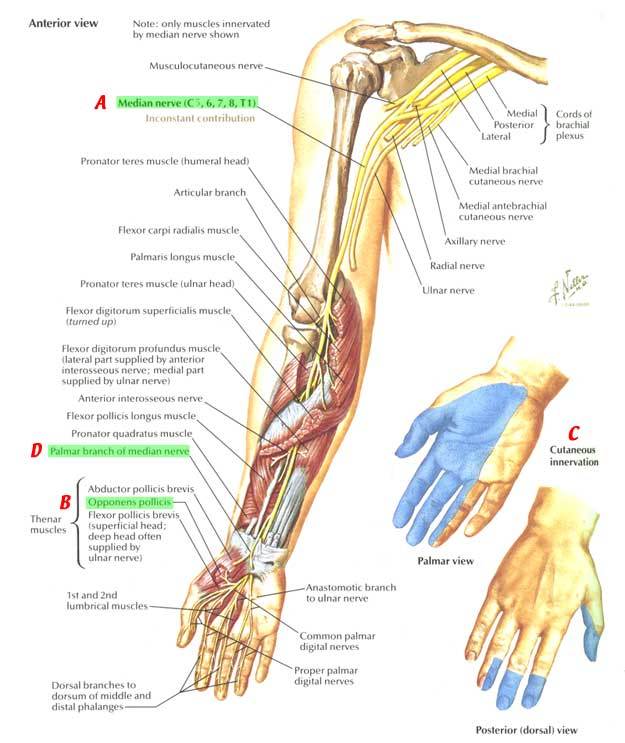
Median(C(5)6-T1): runs between 2 heads of PT[*], through ligament of Struthers[*] and lacertus fibrosus[*], under FDS[*] into carpal tunnel[*] (Martin Gruber formation: ulnar motor branches run with median nerve then branch to ulnar nerve distally). In wrist, median divides to Motor branch and palmar cutaneous (runs between FCR/PL): at risk in CTS release
Sensory: NONE (in forearm)
Motor: ANTERIOR COMPARTMENT OF FOREARM
Superficial Flexors Pronator Teres [PT]
Flexor Carpi Radialis [FCR]
Palmaris longus [PL]
Flexor digitorum superficialis[FDS][sometimes considered a “middle” flexor]
Deep Flexors Anterior Interosseous N. (AIN) AIN compressed by PT in forearm, injured in supracondylar fractures
Flexor digitorum profundus [digits 2, 3]
Flexor pollicis longus [FPL]
Pronator Quadratus [PQ]
* Potential nerve compression site
- Examination of 7 year old boy reveals 20° of valgus following a lawn mover to lateral femoral epiphysis. Treatment consists of total distal femoral epiphysiodesis and varus osteotomy. Following surgery he has a limb length discrepancy of 3 cm and 5° genu valgum. Assumsing that he undergoes no further treatment, the patient’s predicted limb-length discrepancy at maturity would be how many centimeter ?
a. Less than 7
b. 7 to 10
c. 11 to 13
d. 14 to 17
e. Greater than 17
Answer : c. 11 to 13
The distal femoral epiphysis growa approximately 1 cm per year, in boys growth ceases at approximately age 16 years old. Therefore the patient’s limb length discrepancy at maturity would be 12 cm ( 9 cm plus 3 cm discrepancy he suffered from the previous surgery)
Ref: AAOS Orthopedic Comprehensive Review. Page 82. 2009.

