In Lung Volumes, what is TV?
TV is the Tidal Volume - the volume of air exchanged during normal inspiration or expiration
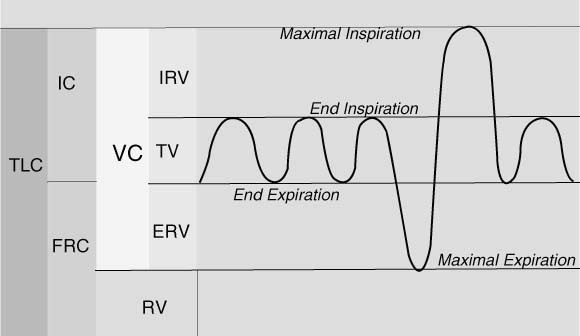
In Lung Volumes, what is IRV?
IRV is the Inspiratory Reserve Volume - the maximum volume that can be inspired in addition to a tidal inspiration.
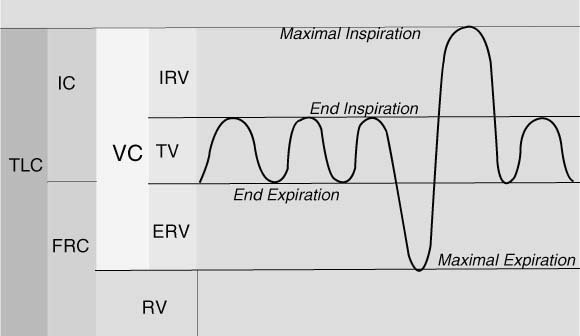
In Lung Volumes, what is ERV?
ERV - expiratory reserve volume: the maximum volume that can be expired in addition to the tidal expiration.
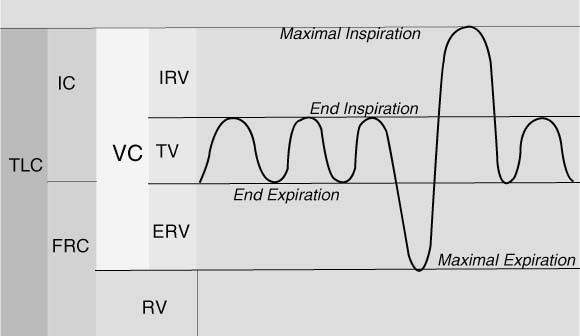
In Lung Volumes, what is RV?
RV - the residual volume: the volume remaining in the lungs at the end of a maximal expiration. Becasue it cannot be breathed out, it cannot be measured using an ordinary spirometer
In Lung Volumes, what is V?
V is the Ventilation, or minute volume, and is the tidal volume multiplied by respiratory frequency (per minute)
In Lung Volumes, what is VC?
VC - vital capacity. This is the maximum volume that can be expired following a maximum inspiration - that is, the largest breath that you can do.
In Lung Volumes, what is FVC?
Forced vital capacity - the largest forced breath (deepest breath in followed by a forced breath out to maximum expiration.)
In Lung Volumes, what is IC?
Inspiratory capacity - the maximum volume that can be inspired after a normal expiration
In Lung Volumes, what is FRC?
FRC - functional residual capacity: the volume remaining in the lungs at the end of a normal expiration, when all the breathing muscles are relaxed
In Lung Volumes, what is TLC?
TLC: total lung capacity: the volume in the lungs at the end of a maximum inspiration.
Explain how you set up the spirometer for measuring Vital Capacity,
- Place a disposable cardboard mouthpiece onto the metal mouthpiece
- Turn the tap so that the spirometer is ‘open to the mouthpiece’ so that you can raise and lower the bell
- Check that there is no basket in the spirometer, or that it is empty
- Fill the spirometer with air until it is approx 75% full
- Turn the tap so that the spirometer is sealed. To check this, blow through the mouthpiece - if the spirometer is sealed, you should be able to feel air expired to the vent to the atmosphere.
How do you set up the computer when you are measuring VC?
- •Set the sampling rate at the top of the screen to 20/s (top right of screen)
- •Set the amplitude to 1V (top right of screen)
How do you do the breathing in a spirometer experiment to measure VC?
- Put on a nose clip
- Breathe through the mouthpiece, when comfortable, turn the tap to connect to the spirometer, and press the START on the screen
- Establish a steady rate of breathing
- When the trace is steady, take a maximum breath in and do a maximum breath out - slow and steady for VC
- Check to see if you need to do 3 VCs and take an average
- Click STOP
What do you do with the value of the vital capacity that you record from the spirometer?
You multiply the volume by the appropriate factor (depending on the room temp) in order to convert the volume to BTPS: body temperature and pressure, saturated.
How do you change the Vital Capacity experiement to measure Forced Vital Capacity?
As inspiration reaches its peak, you expire as fast and as completely as possible.
In which patients would you expect VC and FVC to be different?
In patients with an obstructive disorderr like asthma or bronchitis
What is the FEV1? How do you measure it? What might you be asked to do with it once you have measured it?
The FEV1 is the volume breathed out in the first second of forced vital capacity. You can measure it easily using the computer software. You may be asked to show Fev1 as a percentage of the FVC. Remember to convert all these measurements to BTPS.

-
OSCEs ECG5
-
OSCEs Communication Skills0
-
OSCEs Blood pressure by palpation and auscultation DONE2
-
OSCEs Locating and Recording Pulses DONE13
-
OSCEs Explanation of a metered dose inhaler and spacer DONE2
-
OSCEs explanation and demonstration of Peak Flow meter DONE1
-
OSCEs Spirometer Lung Volume experiments DONE17
-
OSCEs Heart and Chest sounds0
-
OSCEs blood sample0
-
OSCEs Hand washing DONE1
-
OSCEs BLS DONE24
-
OSCEs Spirometer Rebreathing DONE6



