OSPF Network Types
Broadcast: Default setting on OSPF-enabled Ethernet links. DR/BDR: Yes Timers: Hello 10, Wait 40, Dead 40
Non-Broadcast: Default setting on enabled OSPF Frame Relay main interface or Frame Relay multipoint subinterfaces. DR/BDR: Yes Timers: Hello 30, Wait 120, Dead: 120
Point-to-Point: Default setting on enabled OSPF Frame Relay point-to-point subinterfaces. DR/BDR: No Timers: Hello 10, Wait 40, Dead 40
Network Types & Forming Adjacencies
- OSPF network type does not need to match to form adjacency.
- But they do need to be compatible.
- Other Attributes must still match.
- What makes the network types compatible?
- Usage of Type 2 LSA
OSPF Type 2 LSA
- Generated by the DR
- Describes who is adjacent with DR
- Not flooded outside the area they originate in
- Used to optimize OSPF operation on a shared segment
- Reduce number of OSPF adjacencies
- Reduce LSA flooding replication
- Simplify SPF calculation
Network Type Compatibilities
- Network types that use Type 2 LSA
- Broadcast
- Non-Broadcast
- Network types that do not use Type 2 LSA
- Point-to-Point
- Point-to-Multipoint
- Point-to-Multipoint Non-Broadcast
Network Broadcast
- Default on multi-access broadcast medias
- Ethernet
- Sends hellos and updates as multicast
- 224.0.0.5 (AllSPFRouters)
- 224.0.0.6 (AllDRouters)
- Uses DR & BDR
- Uses Type 2 LSA
Network Non-Broadcast
- Default on multipoint NBMA medias
- Frame Relay & ATM
- Sends hellos and updates as unicast
- Manually defined address with neighbor command
- Uses DR/BDR
- Uses Type 2 LSA
How DR/BDR works
- DR
- Forms adjacency with all routers on the segment
- Listens for LSUs (224.0.0.6)
- Re-floods LSUs back to the segment (224.0.0.5)
- Does not modify next-hop value
- BDR
- Used for redundancy of DR
- Doesn’t re-flood LSUs
- DROthers
- All other routers on the segment
- Form FULL adjacency with DR & BDR
- Stop at 2-Way adjacency with each other
DR / BDR Election
- DR / BDR chosen through election process
- Election based on interface priority and Router-ID
- Priority
- 0 – 255
- Higher better
- 0 = never
- Router ID
- Highest loopback / interface IP
- Can be statically set
- Higher better
- Priority
- Uses WAIT timer to stop pre-emption of current DR/BDR
Network Point-to-Point
- Default on point-to-point medias
- E.g. HDLC, PPP, GRE
- Sends hellos as multicast
- 224.0.0.5
- No DR/BDR Election
- Supports only two neighbors on the link
Network Point-to-Multipoint
- Treat network as a collection of P2P links
- Sends hellos as multicast
- 224.0.0.5
- No DR/BDR Election
- Special next-hop processing
- Usually the best design option for partial mesh NBMA networks
Network Point-to-Multipoint Non-Broadcast
- Same as point-to-multipoint, but sends hellos as unicast
- Manually defined addresses with neighbor command
- Allows for per-VC OSPF cost over NBMA
- No DR/BDR Election
- Special next-hop processing
Broadcast
Broadcast media such as Ethernet are better defined as broadcast multi-access to distinguish them from nonbroadcast multi-access (NBMA) networks. Broadcast networks are multi-access in that they are capable of connecting more than two devices, and broadcasts sent out one interface are capable of reaching all interfaces attached to that segment.
The OSPF network type is set to broadcast by default for Ethernet interfaces. A DR is required for this OSPF network type because of the possibility that multiple nodes can exist on a segment and LSA flooding needs to be controlled. The hello timer defaults to 10 seconds.
Nonbroadcast
Frame Relay, ATM, and X.25 are considered nonbroadcast multi-access (NBMA) in that they can connect more than two devices, and broadcasts sent out one interface might not always be capable of reaching all the interfaces attached to the segment.
Frame Relay interfaces set the OSPF network type to nonbroadcast by default. The hello protocol interval takes 30 seconds for this OSPF network type. Multiple routers can exist on a segment, so the DR functionality is used. Neighbors are statically defined with the neighbor command because multicast and broadcast functionality do not exist on this type of circuit. Configuring a static neighbor causes OSPF hellos to be sent using unicast.
Point-to-Point
A network circuit that allows only two devices to communicate is considered a point-to-point (P2P) network. Because of the nature of the medium, point-to-point networks do not use Address Resolution Protocol (ARP), and broadcast traffic does not become the limiting factor.
The OSPF network type is set to point-to-point by default for serial interfaces (HDLC or PPP encapsulation), Generic Routing Encapsulation (GRE) tunnels, and point-to-point Frame Relay subinterfaces. Only two nodes can exist on this type of network medium, so OSPF does not waste CPU cycles on DR functionality. The hello timer is set to 10 seconds on OSPF point-to-point network types.
Interfaces using an OSPF P2P network type form an OSPF adjacency quickly because the DR election is bypassed, and there is no wait timer. Ethernet interfaces that are directly connected with only two OSPF speakers in the subnet could be changed to the OSPF point-to-point network type to form adjacencies more quickly and to simplify the SPF computation.
Point-to-Multipoint
The OSPF network type point-to-multipoint is not enabled by default for any medium. It requires manual configuration. A DR is not enabled for this OSPF network type, and the hello timer is set 30 seconds. A point-to-multipoint OSPF network type supports hub-and-spoke connectivity while using the same IP subnet and is commonly found in Frame Relay and Layer 2 VPN (L2VPN) topologies.
Interfaces set for the OSPF point-to-multipoint network type add the interface’s IP address to the OSPF LSDB as a /32 network. When advertising routes to OSPF peers on that interface, the next-hop address is set to the IP address of the interface even if the next-hop IP address resides on the same IP subnet.
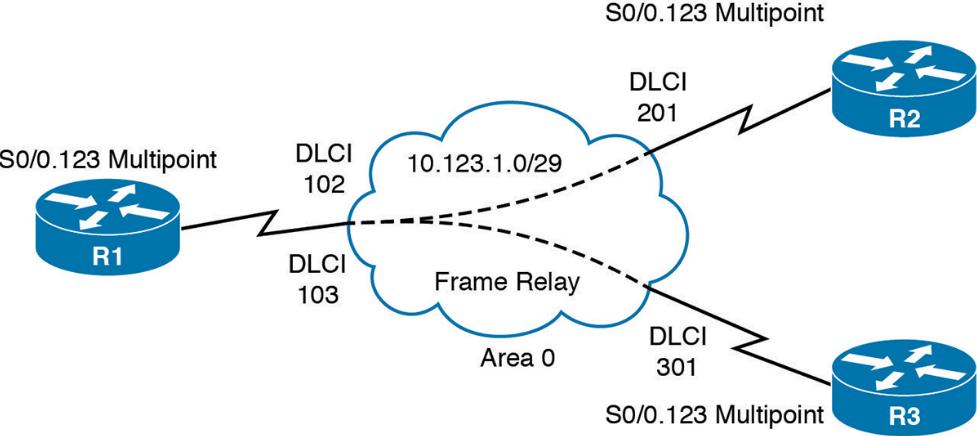
Point-to-Multipoint Topology
Point-to-Multipoint topology using the same subnet.
Loopback
The OSPF network type loopback is enabled by default for loopback interfaces and can be used only on loopback interfaces. The OSPF loopback network type indicates that the IP address is always advertised with a /32 prefix length, even if the IP address configured on the loopback interface does not have a /32 prefix length.




