what does oxidative phosphorylation produce?
ATP
where does oxidative phosphorylation occur?
in the inner membranes of mitochondria, between the intermembrane space (space between inner and outer membranes) and mitochondrial matrix
what are the steps of oxidative phosphorylation?
- reduced substrate donates electron
- electron carriers pump H+ out of the mitochondria as electrons flow to O2
- energy of electron flow is stored inside the mitochondria as electrochemical potential (more hydrogen ions out, causing a more positive charge outside the mitochondria and a more negative charge inside)
- ATP synthase uses electrochemical potential to synthesize ATP from ADP
oxidative phosphorylation contains 4 enzyme complexes along the inner membrane that function in electron transport. what are the enzymes of each complex?
I: NADH dehydrogenase
II: succinate dehydrogenase
III: ubiquitinone:cytochrome c oxidoreductase; cytochrome c
IV: cytochrome oxidase
what occurs at each complex of the electron transport chain?
main points:
- complex I: 4H+ from matrix moved out, 2H+ along chain
- complex II: no H+ movement in or out
- complex III: 2H+ from matrix and 2H+ from chain moved out (4 total); cytochrome c released into intermembrane space
- complex IV: 2H+ from matrix moved out
10 total H+ moved from matrix to intermembrane space
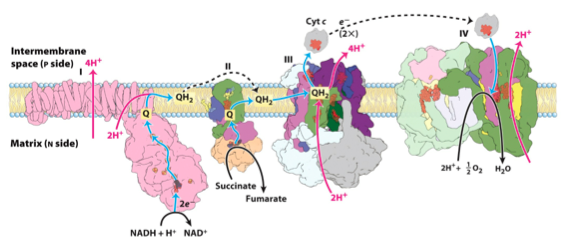
what happens when the electron transport chain pumps hydrogen ions into the intermembrane space?
- ATP synthase takes those hydrogens, utilizes the electrochemical gradient formed by the movement of the H+ ions, and forms ATP from ADP
what is the function of cytochrome c in the electron transport chain?
it stops the electron transport chain from happening
describe 3 electron transfer types
- direct electron transfer (Fe3+ reduced to Fe2+)
- hydrogen atom (H+ + e-)
- hydride ion (H-)
what is unique about NADH and flavoproteins?
they can carry both electrons and protons
what are 3 electron carriers?
- ubiquinone: can carry both electrons and protons; lipid soluble and membrane mobile; moves across membranes and can function as a radical
- cytochromes: types a, b, and c; classified by light absorption; c is mobile; only accepts electrons
- iron-sulfur proteins: only accepts electrons
complex I and II introduce electrons. describe how they do this.
complex I: NADH dehydrogenase
- NADH + H+ provides 2e-, which are passed along iron-sulfur centers in the complex, and are then transferred along with 2H+ to qubiquinone, which is now reduced
complex II: succinate dehydrogenase
- hydrogens are moved through the complex to produce a reduced quinone molecule
- remember this plays a role in the citric acid cycle; if this step is blocked in any way, CAC cannot continue
- fatty acids can feed into the electron transport chain to ultimately reduce quinone
describe how complex III transfers electrons to cytochrome c
the Q cycle
- reduced ubiquinone gives electrons to iron-sulfur complex
- those electrons are transferred to cytochrome c (it is now reduced and carries electrons)
- hydrogens are transported to the intermembrane space via electron energy from reduced ubiquinones
*ubiquinone free radicals are produced*
describe how complex IV transports hydrogen and reduces oxygen
- cytochrome c donates electrons and reduces oxygen, which is the final electron acceptor
- electrical force generated during oxygen reduction pumps 4 H+ from matrix into intermembrane space
what would happen if cytochrome c is not present in the electron transport chain?
- if cytochrome c is removed from this equation, oxygen cannot be produced and therefore cannot become final electron acceptor, and free cytochrome c would spill out into cytoplasmic space which would induce apoptosis
how does ATP synthase use H+ movement to create ATP?
- the movement of H+ ions puts an ADP and phosphate together to produce ATP
- takes 4 H+ ions to produce a single ATP, which is then transported out of the mitochondria via adenine nucleotide translocase (antiport transporter: ATP moves out, ADP moves in)
two shuttle systems allow glycolysis NADH to affect the electron transport chain. what are they, and where do they occur?
- malate-aspartate shuttle happens in the liver, kidney, and heart; moves NADH from the intermembrane space into the matrix via malate-a-ketogluterate transporter and glutamate-aspartate transporter; this is the more efficient of the two shuttles
- glycerol 3-phosphate shuttle happens in the brain and skeletal muscle; NADH causes FADH2 to reduce a quinone which is moved directly into complex III of the electron transport chain
these are important because the inner mitochondrial membrane is impermeable to NADH, so it needs to get into the mitochondria somehow
oxidative phosphorylation generates reaction oxygen species. what two conditions favor ROS formation?
- mitochondria not making ATP (lack of O2, lack of ADP)
- excess NADH
what happens if there is an absence of NADPH?
free radical production; very damaging
describe the proton-motive force of oxidative phosphorylation
chemical potential + electrical potential = ATP synthesis driven by proton-motive force
in respiration, how many ATP molecules are produced from a single glucose molecule?
32 ATP
which enzymes from glycolysis and the citric acid cycle allosterically regulate respiration?
- glycolysis: hexokinase, phosphofructokinase-1, pyruvate kinase
- citric acid cycle: pyruvate dehydrogenase complex, citrate synthase, isocitrate dehydrogenase, and a-ketoglutarate dehydrogenase

-
Biological Membranes & Transport30
-
Amino Acids, Peptides, and Proteins20
-
Central Nervous System14
-
Synaptic Communication76
-
Muscle Physiology45
-
Acid Base Regulation - Columbo22
-
Oxygen and Carbon Dioxide45
-
Cardiac Physiology and ECG59
-
Blood and Hematopoesis27
-
Enzymes34
-
Capillary Permeability31
-
Water, Weak Acids, and Bases6
-
Cell Biology5
-
Carbohydrates74
-
Enzymatic Inhibition9
-
Glucose Regulation and Formation51
-
Glycolysis21
-
Citric Acid Cycle13
-
Oxidative Phosphorylation21
-
Biosignaling45
-
Fatty Acid Metabolism68
-
The Pancreas, Liver, and Gallbladder69
-
Protein Metabolism: Oxidation and Urea40
-
Protein Metabolism: Amino Acid and Protein Synthesis49
-
Endocrine Physiology: Pituitary & Adrenals64
-
Introduction to the Immune System63
-
Pharmacology84
-
Regulation and Integration of Metabolism50
-
Diabetes63
-
Vitamins24
-
Mendelian Genetics and Inheritance47
-
Cellular and Molecular Genetics55



