H pylori
- a helical gram-negative rod with 4-6 flagella that resides in gastric-type epithelium within or beneath the mucous layer; this location protects the bacteria from acid
- shape and flagella aid its movement through the mucous layer & it produces enzymes that help it adapt to the hostile environment
- eg urease which can split urea into ammonia and bicarb, creating an alkaline microenvironment
- 4 potential mechanisms described for H-pylori induced GI injury
- release of toxic products that cause local injury
- breakdown products from urease (eg ammonia)
- cytotoxins (VacA and CagA - vacuolating cytotoxin antigen and cytotoxin-assoc gene A antigen)
- a mucinase that degrades mucus & glycoproteins
- phospholipases that damage epithelial cells & mucous cells
- platelet-activating factor which causes mucosal injury & thrombosis in the microcirculation
- induction of a local mucosal immune response
- attracts neutrophils & monocytes which then produce numerous proinflam cytokines & ROS
- increased gastrin levels w increase in acid secretion
- basal & stimulated gastrin levels are significantly increased, presumably secondary to a decrease in somatostatin release from antral D cells bc of infection w H pylori
- during acute phase of H pylori infection, acid secretion is decreased
- w chronic infection, H pylori has trophic effects on ECL & G cells, which can result in acid hypersecretion
- however, if oxyntic glands are destroyed by chronic infection, will get hypoacidity
- gastric metaplasia in duo
- likely a protective response to decreased duo pH –> allows H pylori to colonise duodenum & cause duodenitis & ulcers
- release of toxic products that cause local injury
- H pylori can lead to gastric adenocarcinoma via the Correa hypothesis which is a multistep process
- theory that there’s a pathway of transformation from normal mucosa –> gastritis –> chronic atrophic gastritis –> intestinal metaplasia –> dysplasia
- one particular strain - Cag-A +ve H pylori strain - has a higher assoc w gastric ca (this strain particularly common in Japan)
- Also strong association between mucosa-associated lymphoid tissue (MALT) lymphoma & H pylori infection - regression of these lymphomas demonstrated after eradication of H pylori
- Test with: mucosal biopsy (urease assay or histo) = gold standard; or serum antibodies
- to check for eradication: stool antigen or urea breath testing
Wound healing
Healing progresses through 3 overlapping phases - inflammation, proliferation and maturation
- inflammation:
- injury leads to platelet adhesion & activation w clot formation (coagulation pathways, PAF)
- stops bleeding but also provides a matrix rich in growth factors and chemokines that acts as a scaffold for migrating leukocytes and stromal cells - within 24hrs, neutrophils appear at the margins & begin to degrade debris and sterilise wound
- inflammation involves IL-1, IL-2, IL-8; chemotaxis involves LB4, C5a, chemokines
- proliferation: VEGF, PDGF, TGF-b, IFN-y, macrophages
- migration and expansion of parenchymal cells (re-epithelialisation), endothelial cells (angiogenesis) and connective tissue cells
- within 1-2 days of wound healing (and peaking at 5-7 days), proliferating fibroblasts and endothelium form granulation tissue, a highly vascularised loose connective tissue
- within 2-4 days, neutrophils are largely replaced by macrophages, which then become the key cellular elements in clearing debris and directing subsequent angiogenesis and ECM deposition
- granulation tissue provides a framework for subsequent scar formation
- maturation:
- eventually granulation tissue scaffolding is converted into a scar composed of fibroblasts & collagen; 2 weeks after the injury the dominant feature is collagen deposition w regression of the vasculature (fibroblasts, MMPs)
- granulation tissue ultimately converted into a rel avascular scar depleted of inflammation & covered by intact epithelium
- wound contraction is a feature of larger wounds, accomplished by myofibroblasts w the synthetic features of fibroblasts & the contractile capacity of SM cells; will cause surface area of wound to be reduced
- eventually granulation tissue scaffolding is converted into a scar composed of fibroblasts & collagen; 2 weeks after the injury the dominant feature is collagen deposition w regression of the vasculature (fibroblasts, MMPs)
Acute pancreatitis
- an inflammatory process occuring within the exocrine tissue of the pancreas characterised by an inflammatory infiltrate which can progress ot a serious systemic inflammatory state
- no matter the inciting event, there is an unregulated activation of trypsin within acinar cells, leading to an autodigestive injury to the pancreas with local inflammation
- the protective intracellular mechanisms that prevent trypsinogen activation are overwhelmed
- calcium influx caused by various signals eg increased pressure within the panc duct, ETOH metabolites or NF-KB causes zymogen granules and lysosomes to coalsece inside acinar cells which allows trypsin to be activated by lysosomal enzyme cathepsin B
- can also be genetic anomalies which inhibit the protective anti-activation process (ie instability of zymogens & lysosomes) - PRSS1 and SPINK1
- release of activated trypsin does 2 things:
- 1) leads to activation of more trypsin and other panc enzymes; intrapanc release of active pancreatic enzymes leads to pancreatic autodigestion –> cycle of active enzymes damaging more cells & destruction spreading along the gland and into peripanc tissues
- there is injury to vascular endothelium resulting in microcirculation injury w vasoconstriction, decreased oxygenation & progressive ischaemia, increased vasc permeability & swelling of gland
- 2) activates other enzyme cascades incl complement, kallikrein-kinin, coagulation and fibrinolysis
- leads to leukocyte chemoattraction, release of cytokines and oxidative stress (TNF, IL-1, IL-6, IL-8, arachidonic acid metabolites, proteolytic and lipolytic enzymes and ROS)
- these substances also interact w pancreatic microcirculation to activate endothelial cells, increase vasc permeability & induce thrombosis and haemorrhage which can cause tissue hypoxia and contribute to panc necrosis (though 80% only get pancreatitis not necrosis)
- 1) leads to activation of more trypsin and other panc enzymes; intrapanc release of active pancreatic enzymes leads to pancreatic autodigestion –> cycle of active enzymes damaging more cells & destruction spreading along the gland and into peripanc tissues
- in some pts there is a systemic inflammatory response from the release of activated panc enzymes & cytokines - fever, ARDS (from microvasc thrombosis +/- activated phospholipase A which digests lecithin, a major component of surfactant), myocardial depression & shock, central haemodynamic dysfunction from 3rd spacing –> CV & renal dysfunction, GI dysfunction from decreased visceral perfusion, hypocalcaemia (from saponification, hormonal imbalance, intracellular translocation), other metabolic abnormalities eg low or high glucose/DKA
- bacterial translocation can occur; after 7-10 days pts transition through to a phase where there is downregulation of immune system which is why infections peak 2-3 weeks after onset
Carcinoid syndrome
- a term applied to constellation of sx mediated by various hormonal factors elaborated by some well-diff NETs of digestive tract & lungs which synthesise, store & release a variety of polypeptides, biogenic amines and prostaglandins
- >90% of pts w carcinoid have metastatic disease, typically to liver
- carcinoid syndrome affects <10% of pts w NETs
- primarily assoc w metastatic tumours originating in the midgut; hindgut and foregut NETs uncommonly produce carcinoid syndrome
- bc of firstpass metabolism of the vasoactive peptides responsible for carcinoid syndrome, hepatic mets or extra-abdo disease are necessary to elicit the syndrome
- classic description: vasomotor, cardiac, GI manifestations
- episodic attacks of cutaneous flushing, bronchospasm, diarrhoea & vasomotor collapse, also hepatomegaly & cardiac lesions most commonly right-sided heart valvular disease
- humoral factors considered to contribute include serotonin, 5-HT (precursor of serotonin), histamine, dopamine, tachykinin, kallikrein, substance P, prostaglandin & neuropeptide K
- carcinoid crisis = life-threatening form of carcinoid syndrome usu precipitated by a specific event eg anaesthesia, surgery or chemo
- manifestations include intense flush, diarrhoea, tachycardia, hyper/hypotension, bronchospasm, altered metnal status
- sx usu refractory to fluid resus & vasopressors
- other functioning NETs of SB that produce specific clinical syndromes = comparatively rare
- gastrinoma of duo - ZES (15% of gastrinomas in duo)
- rarer: duodenal somatostatinomas, paragangliomas, high-grade NECs (rarely functioning)
Small bowel obstruction
- obstruction –> onset of vigorous SB peristalsis (both prox & distal to obstruction) to try & propel luminal contents past obstructing point –> colicky pain, usu in central abdo
- can account for sometimes initial diarrhoea
- later intestine becomes fatigued & dilates; contractions become less frequent & less intense
- proximal dilatation of intestine and with time, bowel wall becomes oedematous, with loss of normal absorptive function & fluid is sequestered into bowel lumen; this & fluid loss thorugh vomiting –> hypovolaemia
- loss of hydrogen & chloride ions –> alkalosis, hypochloraemia & hypokalaemia (from renal compensation)
- ischaemic necrosis of bowel most commonly caused by twisting of bowel and/or its mesentery around an adhesive band or intestinal attachments; alternatively if bowel dilation is excessive, as intraluminal pressure increases in bowel, venous pressure is eventually surpassed –> oedema & congestion –> intramural vessels of SB become compromised so perfusion to intestine reduced –> ischaemia –> necrosis and perforation if process not interrupted
- –> worsened, continuous (cf colicky) pain followed by perforation if left
- if blood supply remains intact & bowel decompressed by vomitign & NG drainage, peristalsis will stop & colicky pain ceases, leaving dilated, non-functioning bowel
- flora of SB changes dramatically in both type of organism (most commonly E coli, Strep faecalis & Klebsiella) & quantity increases markedly
- increased bacteria translocating to mesenteric LNs & even systemic organs
- bacterial translocation amplifies local inflammatory response in gut –> intestinal leakage & increased systemic inflammation +/- systemic sepsis & multiorgan failure
- other consequences of bowel obstruction include increased abdo pressure, decreased venous return & elevation of diaphragm, compromising ventilation
Adhesions
Adhesions can be primary or secondary (post-op or related to inflammation eg Crohn’s, previous diverticulitis)
- The body deposits fibrin onto injured tissues as part of the body’s healing process after surgery
- Usually local plasminogen activators initiate lysis of fibrin strands within 3days of their formation & mesodermal cells regenerate as early as 5 days after injury. Inadeqaute fibrinolysis due to decreased mesothelial plasminogen activity allows fibroblastic proliferation to produce fiborus adhesions.
- surgery diminishes fibrolytic activity dramatically by increasing levels of plasminogen activator inhitiors and by decreasing tissue oxygenation; fibrinolysis can also be impaired by
- thermal injury
- desiccation
- ischaemia
- foreign bodies
- blood
- bacteria
- some drugs
TEG
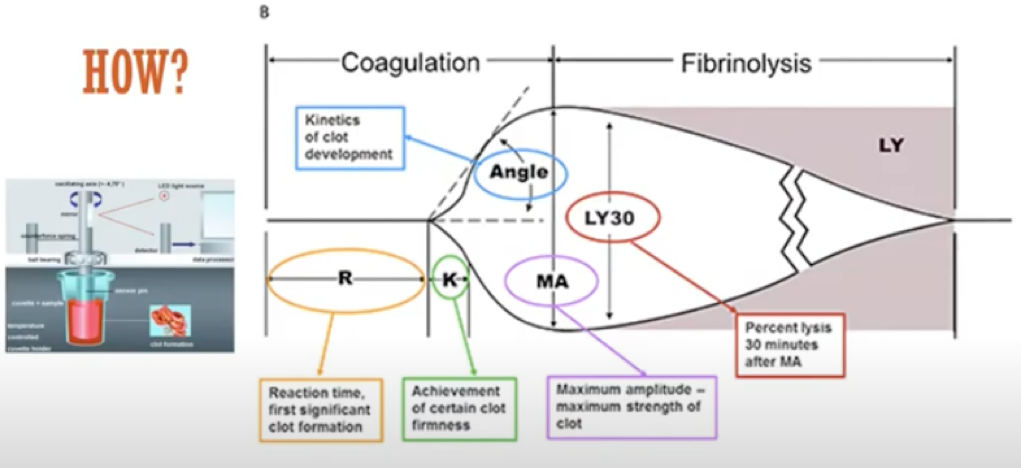
TEG = thromboelastogram - this is a viscoelastic haemostatic assay that measures the global viscoelastic properties of whole blood clot formation under low shear stress; it shows the interaction of platelets with the coagulation cascade (aggregation, clot strengthening, fibrin cross-linking and fibrinolysis)
(Treatment goes in alphabetical order)
R (reaction time) = time to first significant clot formation
- If prolonged means decreased factors – give FFP (CLOTTING FACTORS) or prothrombinex
K value = achievement of certain clot firmness
- If prolonged means lack of fibrinogen – given CRYO or fibrinogen
A (alpha angle) = kinetics of clot development (rate at which fibrin cross-linking occurs)
- If reduced means lack of fibrinogen – give CRYO or fibrinogen
MA (maximum amplitude) = maximum strength of clot (formed by fibrinogen crosslinking with platelets)
- If reduced means reduced platelet count and/or function – give PLATELETS or DDAVP
LY30 (percent lysis 30 minutes after MA)
- If prolonged = increased clot breakdown – give TXA
Necrotising soft tissue infection
- Necrotising soft tissue infections include necrotizing forms of fasciitis, myositis and cellulitis
- Characterized by fulminant tissue destruction, systemic signs of toxicity and high mortality
- Usually begins via a break in the mucocutaneous barrier; usually the skin
- Bacteria, aided by pathogenic factors such as hyaluronidase, lipase, collagenase (many sp.), streptokinase and M-proteins (GAS), and alpha-toxin (clostridial sp.) spread throughout the layers of the skin
- Local inflammatory change also promotes microvascular occlusion which facilitates further spread of the infection
- Necrotising fasciitis can be polymicrobial (type 1), which involves gas in the soft tissue, or monomicrobial (type 2)
- Type 1 tends to occur in older people and those with underlying comorbidities esp T2DM, PVD
- Typically involves at least 1 anaerobic species (eg bacteroides, clostridium) + enterobacteriaese (eg E coli, Enterobacter, Klebsiella) + one ore more facultative anaerobic strep
- Type II may occur in any age & in healthy people
- Usually GAS or other beta-haemolytic strep; in half no clear portal of entry and likely haematogenous translocation from throat to site of blunt trauma or muscle strain
- Vibrio vulnificus – Injury + sea water or contaminated oysters
- Aeromonas hydrophila – injury + fresh water
- Type 1 tends to occur in older people and those with underlying comorbidities esp T2DM, PVD
- Necrotising myositis can be clostridial myonecrosis (gas gangrene) or necrotizing myositis due to strep (group A or other beta-haemolytic strep)
- Necrotising cellulitis can be clostridial or nonclostridial anaerobic (polymicrobial) – both involve gas in soft tissue
- M protein is an important virulence determinant of GAS; necrotizing infection caused by GAS strains with M types 1&3 = assoc w strep toxic shock syndrome in ~50% of cases
- GAS strains of these & other serotypes can produce pyrogenic exotoxins which induce cytokines, contributing to shock, tissue destruction and organ failure
- GAS infection is more often associated with septic shock requiring treatment with inotropes or vasopressors
Pilonidal disease
- An acquired disease resulting from a foreign body reaction to extruded hair in the skin; most commonly at the upper part of the natal cleft of the buttocks, but other areas eg umbilicus and interdigital spaces can be affected
- Presence of hair in the gluteal cleft seems to play a central role in the pathogenesis: as a person sits/bends, the natal cleft stretches, damaging or breaking hair follicles & opening a pore or ‘pit’
- debris and loose hairs from this region tend to gather towards the natal cleft due to anatomy and suction of buttocks on movement
- These hairs migrate into pits/pores and get trapped foreign body reaction and keratin plugs/other debris may contribute further to inflammation creation of sinus tracts
- Cavities may contain hair, debris & granulation tissue; pilonidal cavities aren’t true cyst and lack a fully epithelialized lining, however the sinus tracts may become epithelialized
- Sinuses can become secondarily infected forming an abscess which may rupture spontaneously or require operative drainage
Hydradenitis suppurativa
A chronic, inflammatory skin disorder of the folliculopilosebaceous units characterised by the development of inflammatory nodules, pustules, sinus tracts and scars, primarily in intertriginous areas (groin & axillae, also inframammary, perineal & perianal areas)
Traditionally has been considered the result of occlusion of apocrine glands by keratotic debris leading to bacterial proliferation, suppuration and spread of inflammation to surrounding subcut tissues. Subcut tracts and pits develop; infected tissues ultimately become fibrotic & thickened
Bilirubin metabolism
- Although cholesterol, bile salts & phospholipids play important role in nutritional homeostasis, bile also serves as a major route of exogenous and endogenous toxin disposal – eg disposal of bilirubin
- Bile pigments, eg bilirubin, are breakdown products of haemoglobin and myoglobin
- Heme is cleaved to biliverdin by heme oxygenase
- Biliverdin is cleaved to unconjugated bilirubin by biliverdin reductase
- Bilirubin and biliverdin = two main pigments of bile
- Uncong bilirubin is insoluble so travels in circulation bound to albumin
- Albumin-bili complex enters hepatic sinusoidal blood, enters space of Disse and dissociates
- Free bilirubin taken up by hepatocytes and conjugated with glucuronic acid, then secreted into bile as bilirubin diglucuronide – if biliary excretion impaired, conj bili can re-enter circulation (causing conj hyperbilirubinaemia and jaundice)
- Conj bilirubin is reduced by bacterial enzymes in gut into urobilinogens
- 80% excreted in faeces (as stercobilinogen and urobilinogen)
- 20% reabsorbed in TI & returned to liver à re-excreted into bile
- small amount ‘escapes’ enterohepatic circulation and is excreted in urine
- functions of bile secretion from liver:
- excretion of toxins and metabolites from liver
- absorption of nutrients from intestinal tract
Bile acid circulation
- bile salts (eg cholic acid and deoxycholic acid) originally created from cholesterol in liver & secreted into bile canaliculi
- initially lipid soluble
- conjugated to glycine or taurine to make them water soluble (ampipathic – ie have hydrophilic & hydrophobic poles)
- bc ampipathic, tend to aggregate around droplets of lipid (triglycerides and phospholipids) to form micelles – dispersion of food fat into micelles provides increased surface area for action of pancreatic lipase, which actually digests the triglycerides, and is able to reach the fatty core through gaps between the bile salts
- conjugated bile salts are actively reabsorbed in TI and colon
- bacteria deconjugate some bile salts to make them lipid soluble, which can be passively reabsorbed in gut
- 95% reabsorbed mainly in TI & recycled into enterohepatic circulation up to 10x per day
- 5% lost daily – restored by hepatic synthesis
Gallstone formation
- bile = 97-98% water, 0.7% bile salts, 0.2% bilirubin, 0.51% fats (cholesterol, fatty acids and phospholipids), and inorganic salts
- gallstones form due to imbalance of 3 key products in the bile; bile salts, phospholipids and cholesterol
- 3 major factor explain most gallstone formation:
- supersaturation of secreted bile which causes crystallisation
- cholesterol precipitates out into crystal when the amount of cholesterol exceeds the capacity of bile salts & phospholipids to contain it in micelles
- increased unconjugated bilirubin as a result of increased enterohepatic circulation of bili from excessive breakdown of RBCs –> increased bilirubin conc in bile –> precipitation of calcium bilirubinate to form black pigmented stones
- nucleation: crystal formation is further accelerated by pronucleating agents, including glycoproteins & immunoglobulins/mucin
- hypomotility increases stasis in the GB, leads to absorption of water and concentrated bile; also allows more time for solutes to precipitate
- supersaturation of secreted bile which causes crystallisation
- once formed, the stones persist and enlarge or consolidate over time
- pts with ileal disease/post resection can get
- pigment stones from increased bile salt delivery to the colon (increased enterohepatic cycling)
- or cholesterol stones bc of excessive bile salt excretion in faeces & diminished bile salt pool so cholesterol precipitates out
- brown pigment stones occur due to stasis within CBD with associated bacterial infection usually – obstruction, Caroli’s disease, PSC, biliary infection; mostly seen in south-east asia
GORD
- GORD = troublesome symptoms or complication caused by the reflux of gastric contents into oesophagus
- mechanisms that stop reflux include:
- 10mmHg protective-pressure gradient spans stomach & oesophagus
- intrinsic oesophageal mechanisms
- LOS (together w diaphragmatic sphincter = HPZ) – basal tone, adaptive pressure changes
- Intrinsic epithelial resistance
- Acid clearance
- Extrinsic oesophageal mechanisms
- Diaphragmatic sphincter/R crus (together w LOS = HPZ)
- Distal oesophageal compression – when GOJ firmly anchored in abdo cavity, increased intra-abdo pressure is transmitted to GOJ which prevents spontaneous reflux of gastric contents
- Angle of His – ‘flap valve’ – when stomach gets full, fundus pushes against oesophagus
- Mucosal rosette
- Phreno-oesophageal ligament – anchors oesophagus within +ve pressure environment
- Reflux occurs when gastric pressure overwhelms the HPZ, though whether they are received as symptomatic = modulated by oesophageal sensitivity and volume, composition and clearance time of refluxate
- Pathological reflux episodes due to 3 primary mechanisms:
- Inappropriate TLOSRs
- A persistently hypotensive LOS (frequently assoc w hiatus hernia bc of displacement of GOJ into mediastinum)
- Transient increases in intra-abdo pressure
Zenker’s diverticulum
- a form of false, pulsion diverticula of posterior mucosa between the 2 parts of the inferior constrictor - thyropharyngeus above & cricopharyngeus below (Killian’s dehiscence/triangle which is devoid of muscle in posterior wall)
- aetiology: ?result of loss of tissue elasticity & muscle tone w age, along w abnormal motility which increases intraluminal pressures, as well as the sphincter muscle becoming non-compliant & fibrotic w age
- as diverticulum enlarges, mucosal & submucosal layers dissect down left side of oesophagus into superior mediastinum, posteriorly along prevertebral space
OPSI
- spleen contains numerous antigen-presenting cells and T and B-cells
- it is the only organ in which some bacteria (particularly bacteria with a polysaccharide capsule) can be effectively identified and destroyed; spleen is involved in the opsonisation of encapsulated organisms and splenic macrophages attack and destroy these encapsulated organisms
- these substances resist antibody binding and opsonisation in the rest of the body
- spleen is also an early site of IgM production - important in the acute clearance of pathogens from the bloodstream via opsonisation
- loss of the spleen puts patients at increased risk of infection from: Pseudomonas, Strep pneumoniae, Haemophilus influenza, Neisseria meningitides, E. coli, Salmonella, Klebsiella, group-B strep and Bordatella pertussis (Please SHiNE my SKiS and bordatella)
- in the follicle of the white pulp, infectious antigens and blood-borne pathogens are presented by antigen-presenting cells
- this process initiates the activation of T-cells and B-cells, which eventually leads to production of opsonising antibodies (IgG)
- after opsonisation, macrophages, dendritic cells and neutrophils phagocytose the antigen
- asplenism therefore leads to increase risk of overwhelming sepsis, particularly secondary to encapsulated bacteria
- children are at highest risk - avoid splenectomy in <6yrs if possible
- those who have a splenectomy for haematological reasons are at higher risk, rather than traumatic splenectomy
- how to mitigate risk:
- avoid splenectomy where possible
- deliver vaccines pre-op by at least 2 weeks where possible; 14 days post-op following emergent splenectomy
- patient education
- medic alert bracelet
- back pocket script to start if feel unwell
- prophylactic abx (amoxycillin 250mg daily - case-by-case (age, immune status)
- children until 5 or for one year
- immunosuppressed children to at least 18
- adults - 1-3yrs
Choledochal cysts
- Babbitt’s theory is based on an abnormal biliopancreatic confluence, where the main ducts join abnormally proximal to the ampulla of Vater
- This theory postulates that the long common channel allows mixing of the pancreatic and biliary juices, which then activates pancreatic enzymes
- These active enzymes cause inflammation and deterioration of the biliary duct wall, leading to dilation
- Furthermore, greater pressures in panc duct can further dilate weak-walled cysts
- Competing theories suggest that choledochal cysts are purely congenital in nature, resulting from aganglionosis similar to Hirchsprung’s disease
Life cycle of entamoeba histolytica in humans
- Ingested as cysts via faecal to oral route
- Incubation for 2-4 weeks (may be longer)
- Excystation in the small bowel
- Trophozoites colonise large bowel
- Invade colon – amoebic dysentery
- Invade porto-venous system – abscess
Microscopic consequences of splenectomy (on blood film)
- Howell-Jolly bodies (nuclear fragments)
- Heinz bodies (Hb deposits)
- Pappenheimer bodies (Fe deposits)
- Target cells (increased surface membrane to cell volume ratio)
- Siderocytes (iron not bound to Hb)
- Acanthocytes
- Transient leucocytosis
- Transient thrombocytosis
- Peristent lymphocytosis and monocytosis
PPIs
- Parietal cells in the gastric antrum and cardia express a proton pump on their luminal surface
- This H+/K+ ATPase secretes H+ into the lumen of the stomach, reducing the pH
- Insertion and activity of the H+/K+ ATPase is under neurohormonal control via the vagus nerve, acetylcholine and gastrin
- PPIs irreversibly bind & inhibit the H+/K+ ATPase on the parietal cell
- They are the optimum medical therapy as they reduce expression of the final common pathway of all three variables in acid production
Sepsis and classification
Sepsis is a life-threatening organ dysfunction caused by a dysregulated host response to infection. All sepsis has organ dysfunction by definition; SIRS as a term has fallen out of fashion.
Qsofa identifies patients with suspected infection at risk of poor outcomes typical of sepsis (prolonged LOS or in hospital mortality) based on the presence of 2/3 of any of RR >22, SBP<100, altered mentation - mortality risk of 10% in general hospital population.
SOFA (sequential organ failure assessment) scores 6 organ systems from 0-4 - resp, coag, liver, cardio, CNS, renal - score of 2 or more suggests presence of organ dysfunction. Dysfunction in 2 or more systems = MODS.
Septic shock = a subset of sepsis in which underlying circulatory and cellular/metabolic abnormalities are profound enough to substantially increase mortality (is assoc w in hosp mortality >40%) - requirement of vasopressors to maintain map >65, and serum lactate >2 in abscence of hypovolaemia
Triggering infectious agent sets off inflammatory cascade:
- Macrocirculatory changes (nitric oxide)
- Microcirculatory changes (glycocalyx disruption, endothelial dysfunction, microvascular thrombosis)
- Inflammation (SIRS and CARS - dysregulated inflammatory response)
- Coagulation (triggered by cytokines or tissue factor)
- Neurally-mediated immunosuppression
- Mitochondrial dysfunction
Achalasia
- a primary disorder of oesophageal motility characterised by
- impaired/absent relaxation of LOS with
- abnormal peristalsis of the body - oesophagus is either flaccid, shows pan-oesophageal pressurisations or spastic activity
- type I = median IRP > upper limit normal, 100% failed peristalsis, minimal pressurisation within oesophagus
- type II = median IRP > upper limit normal, no normal peristalsis, panoesophageal pressurisation with ≥20% swallows
- type III = median IRP >upper limit normal, no normal peristalsis, premature contractions with ≥20% swallows
- primary form - due to loss of ganglion cells in myenteric (Auerbach) plexus - more common
- pathophys remains unclear but what is clearly described is an inflammatory infiltrate at the level of the myenteric plexus –> progressive neuronal loss & destruction of the nitric oxide releasing neurohormonal cells responsible for coordinating relaxation –> subsequent loss of peristalsis and appropriate LOS relaxation
- precipitating cause of this not clear although possibly an autoimmune response triggered by a viral infection eg HSV-1
- results in hypertension of LOS & failuer of LOS to relax on pharyngeal swallowing as well as pressurisation of oesophagus, oesophageal dilation and resultant loss of progressive peristalsis
- secondary form
- Chagas’ disease - in South America, caused by Trypanosoma cruzi infection (by bite from infected bug) –> long-term neurological disorders w diffuse ganglion cell involvement (incl destruction of myenteric plexus) –> abnormal motility –> disease in multiple organs, incl cardiomyopathy, megacolon, megaureter and megaoesophagus
- pseudoachalasia = rare presentation of malignancy at GOJ
- classic triad: dysphagia, regurgitation, weight loss
- also chest pain, aspiration pneumonias/lung abscess/bronchiectasis
- later SCC - 8% over 20yrs - chronic stasis with long-standing retained undigested fermenting food in body of oesophagus –> ulceration & continuous irritation of. mucosa –> dysplasia –> SCC
- adenoca can also occur but less common
- management
- aimed at relieving functional obstruction caused at LOS (while minimising risk of reflux) but none able to address issure of reduced motility in oesophageal body so all palliative treatments
- non-operative:
- SL nitrogen, CCBs, nitrogens - temporary relief in few pts (can cause SM relaxation at LOS sphincter but only partially effective, come w side-effects & not used routinely in clincial practice
- endoscopic
- balloon dilatation = most effective non-surgical Rx - involves stretching cardia w 30-40mmHg balloons to disrupt the muscle at the LOS - balloons specially designed for achalasia & different technique to dilating for other conditions; as balloon is dilated a waist can be seen at the pathologically ocntracted LOS & insufflation usu continues til this waist disappears
- 20-35% incidence of GORD, 2-5% risk of perf, 70% effective but 50% symptomatic again after 1-10yrs
- more effective than botox in longterm
- botox = directly into LOS; blocks acetylcholing release, prevents SM ocntraction, effectively relaxes LES
- effective in 85% but 40-50% have recurrent sx by 6mo
- causese inflammation at GOJ tha tmakes subsequent myotomy more difficult; therefore mostly used in elderly/poor surgical candidates who aren’t fit for pneumatic dilatation and the risk of perforation
- peroral endoscopic myotomy (POEM)
- mucosal incision at point prox to where myotomy planned to commence; develop submucosal plane and divide circular muscle fibres in the distal oesophagus down to the stomach; close mucosal defect at end of procedure
- excellent rates of improvement after dysphagia in short-term
- disadvantage = not combined w antireflux procedure & has significant reflux rate
- balloon dilatation = most effective non-surgical Rx - involves stretching cardia w 30-40mmHg balloons to disrupt the muscle at the LOS - balloons specially designed for achalasia & different technique to dilating for other conditions; as balloon is dilated a waist can be seen at the pathologically ocntracted LOS & insufflation usu continues til this waist disappears
- surgical
- Modified Heller myotomy +/- partial fundoplication (to prevent post-op reflux)
- do a lap single anterior myotomy with a partial fundoplication - divide all circular fibres of lower oesophagus (usu 6-8cm) & ~1-2cm on stomach/cardia
- Oesophagectomy occasionally required for end-stage disease or malignancy
- consider if symptomatic w tortuous/mega-oeosophagus, sigmoid oesophagus, failure of >1 myotomy or reflux stricture that isn’t amenable to dilatation
- Modified Heller myotomy +/- partial fundoplication (to prevent post-op reflux)
Tension pneumothorax
- pathophysiology of a tension pneumothorax involves air from an injured lung or airway being trapped within the pleural cavity, resulting in loss of normal negative intrapleural pressure
- a tension pneumothorax occurs when there is a valve mechanism at the site of the leak allowing air to enter but not escape from the pleural cavity
- it is characterised by complete lung collapse, tracheal deviation and mediastinal shift leading to respiratory distress but also decreased venous return to the heart, decreased cardiac output and hypotension
- respiratory decompensation occurs as a rseult of lung injury and changes to pulmonary blood flow and gaseous exchange resulting in hypoxaemia, hypercapnia and respiratory acidosis
- the clinical features are dyspnoea, tachypnoea, hypotension, tachycardia and decreased PaO2
- there is usually asympmetrical expansion of the thorax, the percussion note on the side of the pneumothorax is hyper-resonant and the breath sounds are markedly reduced/absent
- trachea and apex beat are deviated away from the side of the pneumothorax and there is often clinical cyanosis and distension of neck veins
- the diagnosis is clinical and xray confirmation shouldn’t be awaited
Underwater seal drain
- an underwater seal drain (UWSD) allows drainage of haemopneumothorax and restores negative pressure in the pleural space to allow lung expansion
- it has a three-chamber unit, including:
- a collection chamber (receives tube from patient)
- an underwater seal which acts as a one way valve to allow air to escape but not return to the chest
- a suction chamber that places -20cmH2O negative pressure to the pleural space
- the depth of water determines the negative pressure of the chamber
- draw it (p373 white book)

-
Anatomy - Jon66
-
Examinations - Jon13
-
Urology/Gynae6
-
Nerve Injuries14
-
Operations JB84
-
Random54
-
Breast80
-
Oesophagogastric139
-
HPB105
-
Hernia/Abdo Wall26
-
Haematology28
-
Endocrine112
-
Vascular42
-
Skin56
-
Transplant29
-
Nutrition/Obesity71
-
Genetics33
-
Trauma38
-
Small bowel53
-
Appendix24
-
Polyps30
-
Benign anorectal27
-
IBD/other non-malignant/non anorectal73
-
Colorectal polyposis / CRC syndromes24
-
Colorectal and anal cancer72
-
Diverticular disease4
-
Ethics and Professionalism9
-
Pathophysiology157
-
Head&Neck Anatomy54
-
Hernia anatomy30
-
Operative147
-
Operative to sort9
-
Anatomy84
-
Embryology28
-
Random22
-
Head and neck33



