What is the most important risk factor for atherosclerosis development?
Hypercholesterolaemia
What factors contribute to the development of atherosclerosis?
- Smoking
- Age
- Family history
- Alcohol
- Hypertension
- Diabetes mellitus
- Male
- Obesity/Sedentary lifestyle
- Low birthweight
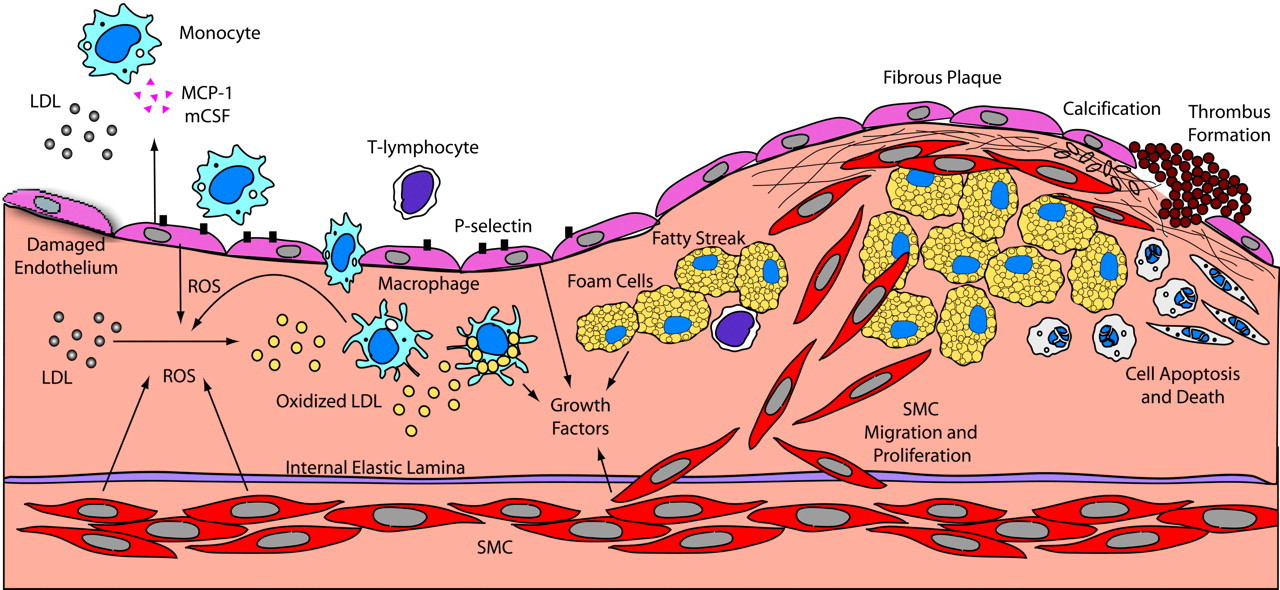
Describe the first main step in the process of atherogenesis (i.e injury to the arterial wall)
- Endothelial injury and dysfunction - enhanced expression of cell adhesion molecules, increase in permeability for LDL, and increased thrombogenicity.
- Accumulation of LDL in vessel walls
- Monocyte adhesion to endothelium → migration into intima and transformation to foamy macrophages
- Platelet adhesion
- Factor release from activated platelets, macrophages → smooth muscle cell recruitment
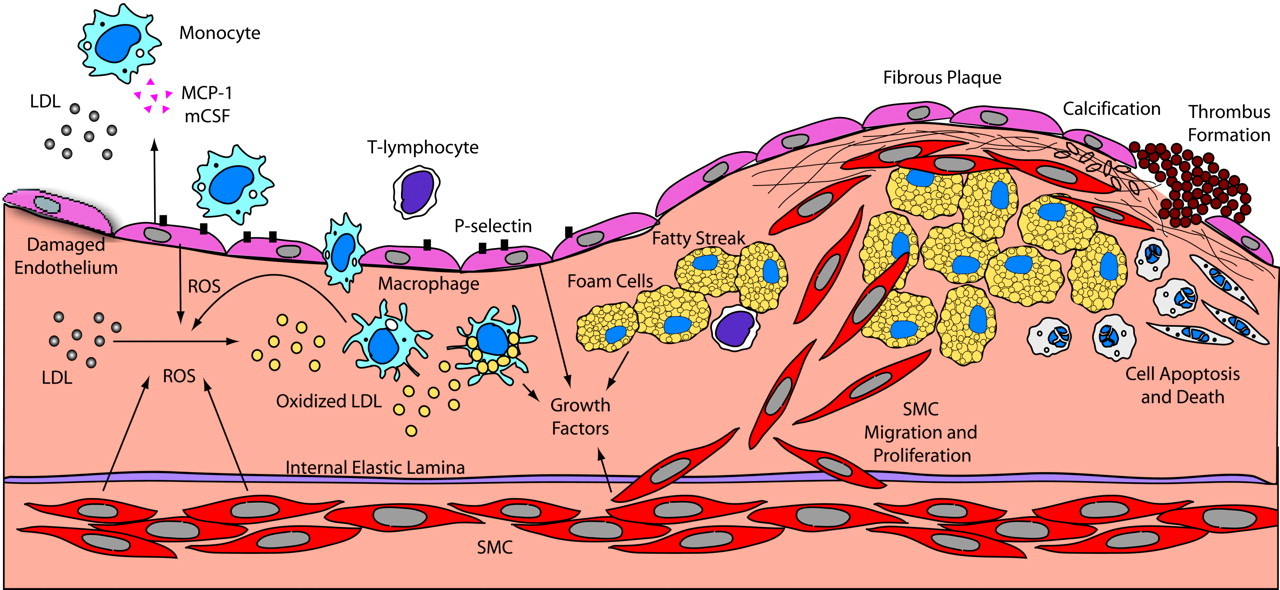
Describe the second main process that occurs in atherogenesis (i.e tissue response to injurous agents)
- Following tissue injury and inflammation, there is a period of tissue repair - Growth factors stimulate smooth muscle proliferation, and deposition of collagen, elastin and mucopolysaccharides.
- Fibrous plaque - with lipid rich core.
- Plaque volume increases - Microthrombi form in the denuded areas of the plaque, which become organised.
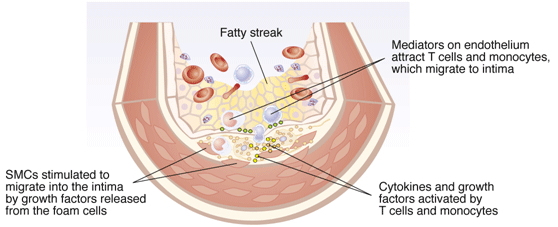
What is a fatty streak?
This is a yellow linear elevation of the intimal lining, which comprises a mass of lipid laden macrophages.
These can disappear, but in patients who are at risk, they may progress to form atherosclerotic plaques.
When does the process of atherosclerosis start?
In childhood
What distinguishes an early athermatous plaque?
These are smooth yellow patches in the intima, full of lipid-laden macrophages, which progress to form established plaques.
What are the features of a fully deeloped athermatous plaque?
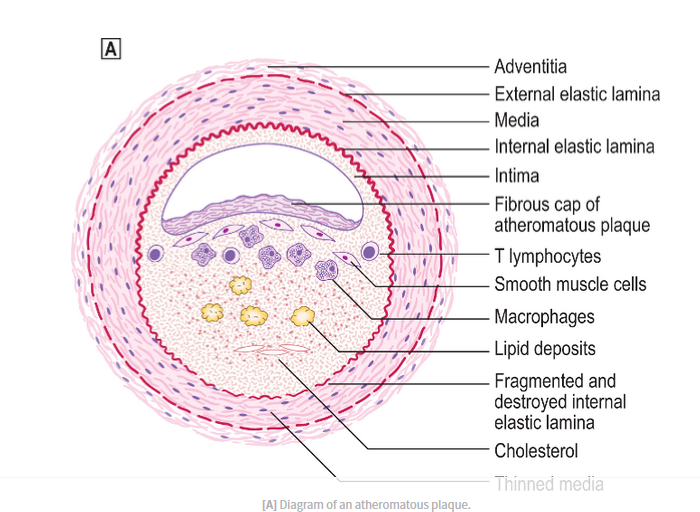
These are lesions with a central lipid core which have a fibrous tissue cap, which is covered by arterial endothelium.
The atheroma itself is soft, highly thrombogenic and often surrounded by a layer of foam cells.
Dystrophic calcification of the plaque can be extensive in late development.
Plaques often occur at arterial branching points where turbulence is highest. In later stages, plaques become confluent and cover large areas.
What are the components of atheromatous plaques?
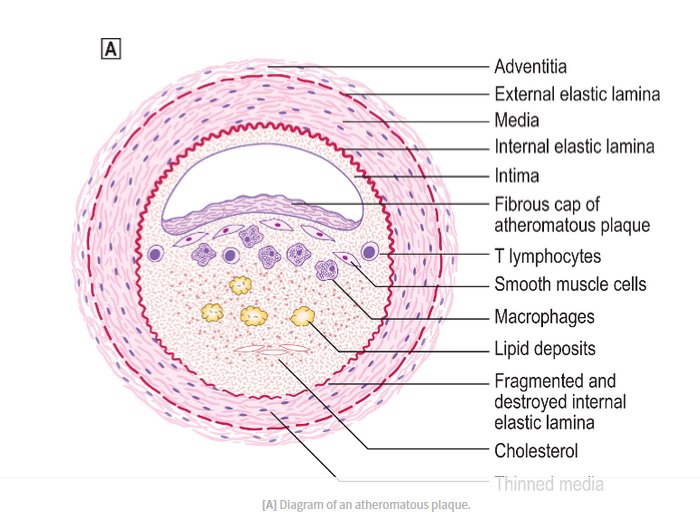
- Fibrous cap
- Smooth muscle
- Macrophages/foam cells
- Lipid deposits
- Elastic lamina destruction
- Cholesterol
What are the different factors considered in Virkow’s triad?
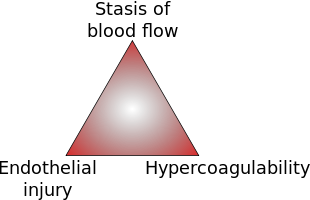
- Vessel damage
- Hypercoagulability
- Stasis/flow through a vessel
How does a thrombus form?
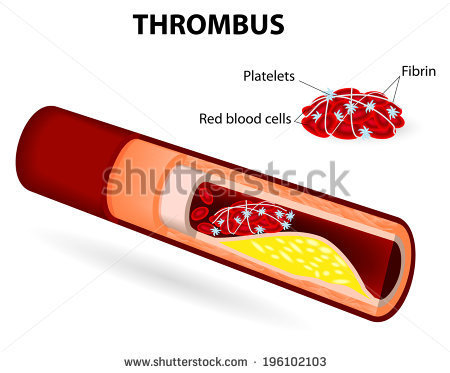
- Endothelial injury -> atheroma -> altered lumenal shape
- Turbulent flow -> loss of intimal cells -> denuded plaque surface
- Platelets adhere to collagen -> activated -> fibrin attachment + RBC
- Thrombus proagates in direction of flow
What are the different types of emboli?
- Arterial
- Venous
- Fat
- Gas/Air
- Tumour
- Septic
- Amniotic fluid
- Bone marrow
- Foreign body
What are the main components of a venous thromboembolism?
Predominantly fibrin and red cells
What are the main components of an arterial thromboembolism?
Predominantly platelets and fibrin
What factors increase the risk of embolism formation?
- Cardiac failure
- Severe trauma/burns
- Post-op/post partum
- Nephrotic syndrome
- Disseminated malignancy
- COCP
- Age
- Immobilisation
- Obesity
- PMH of DVT
What is ischaemia?
Relative lack of blood supply to tissue/organ leading to inadequate O2 supply to meet needs of tissue/organ: hypoxia
What are the different types of hypoxia?
- Hypoxic Hypoxia
- Anaemic Hypoxia
- Stagnant Hypoxia
- Cytotoxic Hypoxia
How does hypoxic hypoxia occur?
- Low inspired O2
- Normal inspired, but low PaO2
How does anaemic hypoxia occur?
Normal inspired O2 but abnormal carrying capacity
How does stagnant hypoxia occur?
Normal inspired O2, but abnormal delivery, due to occlusion or shock
What is cytotoxic hypoxia?
Normal Inspired O2 but abnormal at tissue level
What is infarction?
Ischaemic necrosis within a tissue/organ in living body produced by occlusion of either the arterial supply or venous drainage.
What are the different types of necrosis?
- Coagulative necrosis
- Coliquitive necrosis
What is coagulative necrosis?
Characterised by the formation of gelatinous substance in dead tissue in which the architecture of the tissue is still maintained. Coagulation occurs as a result of protein denaturation, causing albumin in proteins to form a firm and opaque state.
This occurs primarily in tissues such as the kidneys, heart and adrenal glands.

-
Venous disorders - Varicose veins, chronic venous insufficiency17
-
Leg Ulcers57
-
Abdominal Aoritc Aneurysm37
-
PVD - intermittent claudication and critical limb ischaemia66
-
Diabetic foot15
-
Carotid Disease13
-
Pathophysiology26
-
Physiology62
-
Throaci Aortic Aneurysm14
-
Aortic dissection28
-
Acute limb Ischaemia22



