What is acute pericarditis?
Acute inflammation of the pericardium. Classically, fibrinous material is deposited into the pericardial space and pericardial effusion often occurs.
What are the causes of acute pericarditis?
CARDIAC RIND
- Collagen vascular disease
- Autoimmune / Aortic aneurysm
- Radiation
- Drugs
- Infection - Viral, bacterial
- AKI/Uraemia
- Cardiac infarction
- Rheumatic fever
- Injury / Idiopathic
- Neoplasm (malgnancy)
- Dressler’s syndrome
What are viral causes of acute pericarditis?
- Coxsackie
- Flu
- EBV
- Mumps
- Varicella zoster
- HIV
What are bacterial causes of acute pericarditis?
- Pneumonia
- Rheumatic fever
- TB
- Staphlococcus
- Streptococcus
What drugs can cause acute pericarditis?
- Hydralazine
- Penicillin
- Isoniazid
What are the most common causes of viral pericarditis?
Coxsackie B and echovirus
What is dressler’s syndrome?
An autoimmune response to cardiac damage occurring 2–10 weeks’ post-infarct. It is a type of pericarditis.
It is believed to result from an autoimmune inflammatory reaction to myocardial neo-antigens formed as a result of the MI. A similar pericarditis can be associated with any pericardiotomy or trauma to the pericardium or heart surgery.
How does pericarditis occur in uraemic patients?
Uraemia causes irritation of the pericardium due to accumulation of toxin. It can occur in 6–10% of patients with advanced kidney disease if dialysis is delayed.
What conditions is bacterial pericarditis associated with?
- Pneumonia
- Septicaemia
- Thoracic surgery
- Endocarditis
How does TB pericarditis present?
- Low-grade fever - particularly in the evening
- Features of acute pericarditis
- Dyspnoea
- Malaise
- Weight loss
- Night Sweats
What are the most common causes of malignant pericarditis?
- Carcinoma of the bronchus
- Carcinoma of the breast
- Hodgkin’s lymphoma
What are the symptoms of acute pericarditis?
Sharp Central chest pain
What are specific features of pericarditic chest pain?
- Exacerbated by movement, inspiration and lying down
- Relieved by sitting forward
What are the signs seen in pericarditis?
- Pericardial friction rub - LLSE
- Fever
- Features of pericardial effusion
What causes a pericardial friction rub?
https://www.youtube.com/watch?v=J1R8Oxgqhfk
Inflammation causes the pericardial and visceral surfaces of the pericardium (which are normally separated by a small amount of fluid) to rub together. It occurrs in three phases corresponding to atrial systole, ventricular systole and ventricular diastole. It may also be heard as a biphasic ‘to and fro’ rub.
The rub is heard best with the diaphragm of the stethoscope at the lower left sternal edge at the end of expiration with the patient leaning forward.
What symptoms can occur with a pericardial effusion?
Dyspnoea
What are signs of pericardial effusion?
- Raised JVP with prominenet x descent
- Soft heart sounds
- Pericardial friction rub
- Ewart’s sign
- If severe - signs of tamponade
What is Ewart’s sign?
A combination of the following signs:
- Dullness to percussion over the left scapula
- Aegophony (increased vocal resonance)
- Bronchial breath sounds over the left lung
What causes Ewart’s sign?
A large pericardial effusion can compress the left lung, causing consolidation and/or atelectasis, which alters percussive resonance. If the effusion enlarges sufficiently to collapse and/or consolidate the lung, increased vocal resonance and bronchial breath sounds will be heard.
Why can pericardial rub be present initially with a pericardial effusion, but the disappear as the effusion gets bigger?
Becomes quieter as fluid accumulates and pushes the layers of the pericardium apart
What is prominent x descent?
The x-descent occurs in the jugular venous waveform after atrial contraction, during ventricular systole, and is timed with the carotid pulse.
The x-descent represents the decrease in JVP, which occurs due to:
- Atrial relaxation
- Tricuspid valve being pulled downwards during ventricular systole
- Ejection of blood volume from the ventricles.
All of these aspects enlarge or relax the atrium, decreasing the atrial pressure. A prominent x-descent is faster and larger than normal. It is a sign that shows that forward venous flow only occurs during systole.
What is the mechanism behind a prominent x-descent in cardiac tamponade/pericardial effusion?
A prominent x-descent is an exaggeration of the normal waveform descent. In cardiac tamponade, compression of the chambers of the heart leads to elevated RA pressure. This raised pressure eventually blocks the forward flow of venous blood (i.e. filling) from the jugular vein into the atrium during diastole.
When the atrium relaxes and the ventricles contract in systole, the tricuspid valve is pulled down towards the apex of the heart, and there is a momentary increase in atrial volume and decrease in atrial pressure, allowing a rapid descent in atrial pressure and the JVP.
What are signs of cardiac tamponade?
- Tachycardia
- Hypotension
- Pulsus paradoxus
- Increased JVP
- Kussmaul’s sign
- Muffled heart sounds
What is pulsus paradoxus?
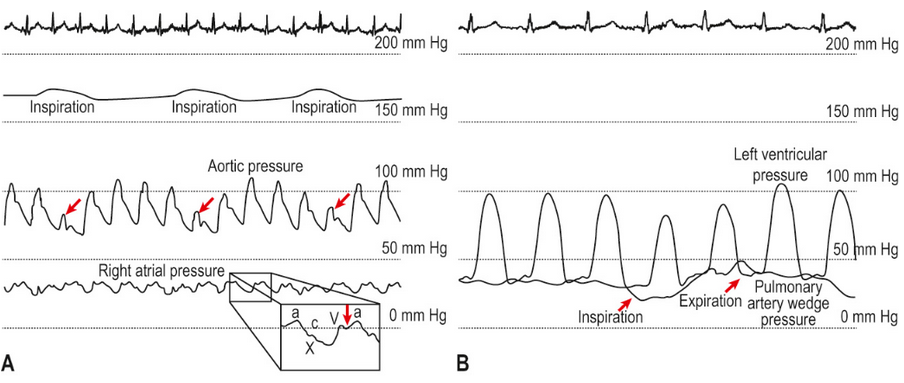
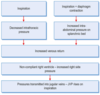
An inspiratory fall in systolic blood pressure exceeding 10 mmHg. It is elicited by inflating the blood pressure cuff to above systolic pressure and noting the peak systolic pressure during expiration. The cuff is then deflated until the clinician can hear the Korotkoff sounds during inspiration and expiration and this pressure value is noted. When a difference between these two pressures of greater than 20 mmHg occurs, pulsus paradoxus is present.




-
Physiology80
-
Anatomy0
-
Hypertension86
-
Angina63
-
Chronic Heart Failure92
-
Infective endocarditis68
-
Valvular disease - Mitral regurgitation38
-
Arrythmias81
-
Myocardial and Endocardial diseases55
-
Pulmonary Embolism55
-
Genetics of Cardiovascular Disease0
-
Acute Coronary Syndromes83
-
Rheumatic heart disease33
-
Valvular disease - Aortic Stenosis30
-
Valvular Disease - Aortic Regurgitation31
-
Valvular disease - Mitral Stenosis31
-
Cardiovascular Signs and Symptoms30
-
Acute Heart Failure and Acute pulmonary Oedema30
-
Pericardial diseases63
-
Atrial Fibrillation44
-
DVT25
-
ECG - Normal ECG51
-
ECG - Cardiac Axis21
-
ECG - Cardiac chamber enlargement18
-
ECG - MI and ischaemia37
-
ECG - Arrythmia Diagnosis67
-
ECG - Cardiac Conduction42
-
ECG - Avoiding error in diagnosis0
-
ECG - Tachycardia Diagnosis15



