Define peritonitis.
Peritonitis is inflammation of the peritoneum, the lining of the inner wall of the abdomen and cover of the abdominal organs.
What are the risk factors for peritonitis?
- Previous history of peritonitis
- History of alcoholism
- Liver disease
- Fluid accumulation in the abdomen
- Weakened immune system
- Pelvic inflammatory disease
What are the two types of peritonitis?
Generalised and Localised
OR Spontaneous and Secondary
Name 2 causes of spontaneous and secondary peritonitis.
Spontaneous
- Kidney disease → ascites
- Liver disease → ascites
Secondary
- Appendicitis
- Pancreatitis
- Ruptured ulcer
- Perforated colon
- Diverticulitis
What is the pathophysiology of peritonitis? (e.g. due to perforated viscus)
With the spillage of the contents, gram-negative and anaerobic bacteria, enter the peritoneal cavity.
Endotoxins produced by gram-negative bacteria lead to the release of cytokines that induce cellular and humoral cascades, resulting in cellular damage, septic shock, and multiple organ dysfunction syndrome (MODS).
What is the aetiology of peritonitis?
Can be split into infectious and non-infectious (or mechanical and chemical)
1.Infectious
- GI perforation e.g. trauma, obstruction, straining/retching. In most cases gram -ve bacilli are found
- Disruption of peritoneum e.g. by micro-organisms entering through wound, peritoneal dialysis, chemotherapy. Mostly staph aureus, staphylococci and fungi like candida.
- SBP from ascites
- Intra peritoneal dialysis
- Pelvic inflammatory disease
2.Non-infectious
- Leakage of sterile body fluids into peritoneum - blood, gastric juice, bile, urine, menstruum, pancreatic juices, dermoid cyst contents
- Sterile abdominal surgery (foreign body reaction/adhesions)
- Familial Mediterranean fever, porphyria, SLE etc
What are the symptoms of peritonitis?
- Abdominal pain exacerbated by coughing/moving etc
- Starts as a generalised abdominal pain involving visceral innervation of visceral peritoneal layer but then becomes localised as it involves somatic innervation of the parietal peritoneal layer.
- Fever
- Nausea, vomiting, bloating (due to ileus paralyticus)
What are the signs of peritonitis?
- Tenderness, guarding
- Pain exacerbated by moving the peritoneum e.g. coughing, flexing hips or eliciting the Blumberg sign (aka rebound tenderness)
- Rigidity (involuntary contraction of the abdominal muscles) - highly specific for diagnosing peritonitis (76-100%)
- Sinus tachycardia
- Other: shock, peritoneal abscess, sepsis, N&V, constipation, confusion.
Peritonitis is an example of acute abdomen.
What is the Blumberg sign?
Rebound tenderness
Pressing the hand on the abdomen elicits less pain than releasing the hand abruptyly (peritoneum snaps back into place)
What investigations should you do for peritonitis?
- FBC - leukocytosis (with immature forms)
- U&E - hypokalaemia, hypernatraemia(dehydration)
- ABG - acidosis
- Amylase/lipase - exclude pancreatitis
- Blood culture
- Serum procalcitonin level
- Urinalysis
- Stool sample - if diarrhoea
Imaging
- Abdominal XR - may reveal dilated, edematous intestines, although such X-rays are mainly useful to look for pneumoperitoneum, an indicator of gastrointestinal perforation
- CT - can help find cause
Invasive
- Peritoneal lavage/laparoscopy - if doubt persists
- Paracentesis - if ascites present, eutrophil count >250 cells/mm³ = SBP
Why do abscesses form in peritonitis?
When host defence is unable to eliminate the infection and attempts to control the spread instead by compartmentalisation
Abscess potentiating agents are required for this (suggestest that these can be found in stool)
How do you diagnose SBP?
Paracentesis - neutrophils > 250 cells/ul
E coli is the most common organism on culture
Which organisms most commonly cause peritonitis?
- E. coli (gram -ve)
- Streptococci (gram +ve)
- Bacteroides (anaerobic)
How do you manage peritonitis?
- Correct the underlying process
- Broad spectrum antibiotics - e.g. IV cefotaxime for SBP
- Supportive therapy - prevent or limit secondary complications due to organ system failure
- Achieved by operative and non-operative means
- Drainage or evacuation of abscess
- Gut dysfunction in most so parenteral but preferably enteral nutrition
- Long term monitoring
What are the complications of peritonitis?
Any delay in treatment of peritonitis produces more profound toxaemia and septicaemia - this may lead to the development of multiorgan failure.
Local abscess formation can occur.
- Tertiary peritonitis
- Infection
- Dehiscence of surgical site
- Enterocutaneous fistula
- Abdominal compartment syndrome - related to acutely increased abdominal pressure (ie, intra-abdominal hypertension) and is associated with the development of multiple organ dysfunction
- Enteric insufficiency
What is the prognosis with peritonitis?
- Divertivulitis is the most common cause
- May require repeat abscess drainage etc.
- Lifelong follow up needed in some conditions like duodenal ulcer, chronic pancreatitis, Crohn’s.
- Surgically correctable peritonitis has mortality rate <10% in otherwise healthy people
- 40% mortality in elderly
How common is peritonitis?
- Approximately 7.5% of people have appendicitis at some point in time.
- About 20% of people with cirrhosis who are hospitalized have peritonitis.
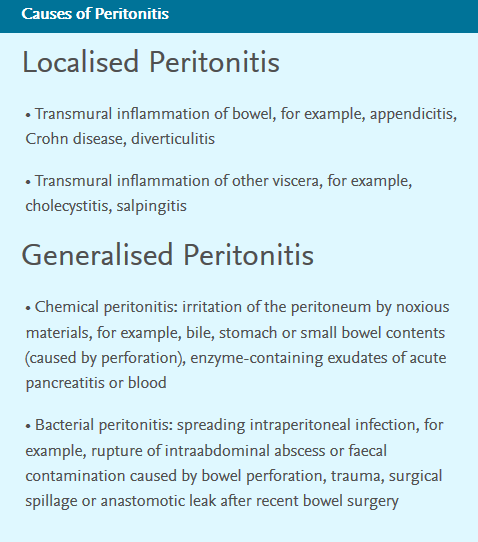
What are the causes of localised peritonitis?
All acute inflammatory conditions of the GIT (eg apendicitis, acute cholecystitis).
Diverticulitis.
Cholecystitis.
Salpingitis.
Appendicitis.
What are some causes of generalised peritonitis?
Perforation of peptic ulcer.duodenal ulcer, diverticulum, appendix, bowel or gallbladder.
What are the indications of abscess involvement in peritonitis? (3)
Swinging fever.
Swelling.
Raised WCC.
Where are abscesses usually formed in a peritonitic patient?
Commonly pelvic or subphrenic.
How do you prevent peritonitis in patients with ascites?
Antibiotic prophylaxis (oral ciprofloxacin) is given in SOME who:
- had previous SBP
- OR fluid protein <15g/L and Child-Pugh _>_9 or hepatorenal syndrome

-
[5] Anal Fissure31
-
[7] Oesophageal Motility Disorders72
-
[9] Dysphagia48
-
[12] Perforated Peptic Ulcer31
-
[13] Gastric Outlet Obstruction21
-
[15] Haemorrhoids60
-
[16] Other Gastric Neoplasms26
-
[17] Diverticular Disease71
-
[18] Acute Appendicitis73
-
[21] Gastro-Oesophageal Reflux Disease69
-
[22] Gastroenteritis127
-
[26] Rectal Prolapse30
-
[32] Upper GI Bleeding53
-
[34] Carcinoid Tumours29
-
[35] GI Polyps13
-
[30] Pilonodal Sinus22
-
[36] Lower GI Bleed27
-
[37] Liver Failure53
-
[38] Jaundice57
-
[39] Cirrhosis53
-
[41] Acute Pancreatitis88
-
[42] Chronic Pancreatitis96
-
[43] Gallstones113
-
[45] Bowel Obstruction68
-
Cholangitis42
-
Coeliac Disease19
-
IGNORE AFTER THIS [31] Anorectal Abscess31
-
[2] Chronic Mesenteric Ischaemia40
-
[5] Acute Mesenteric Ischaemia56
-
Cholangiocarcinoma15
-
Hepatocellular Carcinoma9
-
Oesophageal Cancer16
-
Pancreatic cancer14
-
Primary sclerosing cholangitis12
-
Acute Pancreatitis22
-
Chronic pancreatitis12
-
Mallory-Weiss Tear14
-
Peritonitis22
-
Functional dyspepsia & irritable bowel syndrome (IBS)20
-
Portal hypertension26
-
Pathology of the Acute Abdomen17
-
Colonoscopy and Endoscopy9
-
Vitamin B12 & Folate deficiency30



