Bacterial populations are heterogenous. Define heterogenicity.
Heterogenicity means there is genetic diversity within a population. Within a bacterial population where are differences within the genomes due to the error rate of polymerase.
What are the sources of heterogenicity within a bacterial population?
- Strand slipppage: Polymerase replication errors; this can be quantified as an error rate, RNA transcription errors, RNA translation errors.
- UV radiation, Mutagens
- Horizontal gene transfer: pathogenicity islands on plasmids, conjugation via F pilus, transduction via bacteriophase, and transformation from naked DNA. This is very low frequency variation, pathogens cannot rely on this.
- Insertion sequences
- Recombination events
- Differential methylation
- Site-specific inversion
Why do bacteria need to show heterogenicity?
- To survive changes in the environment
- Outside the host: temperature, humidity, nutrient availability change etc.
- Inside the host: immune response evasion, intra- and extra-cellular survival, nutrient availability, pH.
What are the two main branches of bacterial variation?
- Regulatory: transcriptional changes in response to external signals, e.g. response to lactose initiates Lac operon. All members of a population respond the same way: homogenous phenotype.
- Phase & antigenic variation: genomic changes, heterogenous phenotype.
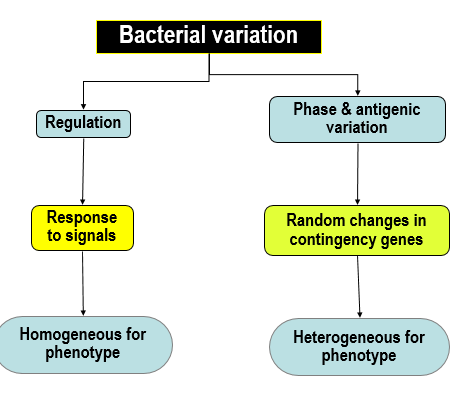
Outline classical gene regulation.
Predictable changes that are in response to external signals, usually under transcriptional control. There is uniform change in population phenotypes.
Outline phase and antigenic variation.
Unpredictable (random) changes in the genome. Can control the gene at a transcriptional and translational level. Causes diversity in phenotypes within a population.
How is phase and antigenic variation different from a mutation?
Phase and antigenic variability occurs at a much higher rate than random mutations at a particular locus. This may be due to the presence of repetitive sequences which have a higher polymerase error rate.
Why does regulation alone not create enough variation in bacteria?
There are too many variables: not every gene can be switched on and off according to stimuli. Not all external signals can be sensed.
What is the difference between phase and antigenic variation?
- Phase variation: the protein that is expressed can be switched on or off, part or all of the molecule. Different mechanisms have evolved to do this. Tends to be antigenic proteins. No change in molecular structure.
- Antigenic variation: changes in the molecular composition of the molecule itself, important in immune evasion. Changes in epitopes.
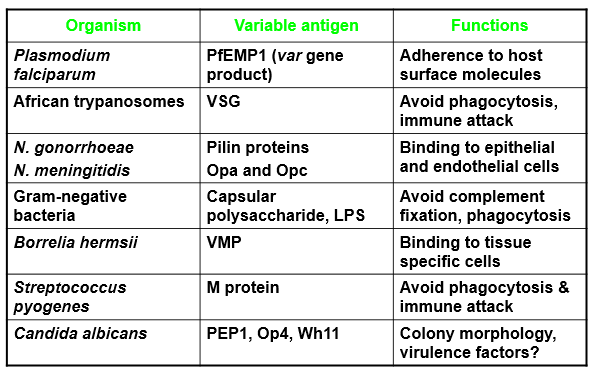
Give an example of three pathogens that have variable antigens. What do they vary and what is their function?
Pathogens have variable antigens, most of them are imvolved in adherence and host-pathogen interactions between ligands and receptors. This is due to the importance of host-pathogen interactions in pathogenesis. This can also be to avoid immune defenses such as macrophage phagocytosis.
What is an example of phase variation in E.coli?
Agglutanin: allows agglutination, clumping of bacteria.
- ON: agglutination takes place, bacteria clump together.
- OFF: no agglutination takes place.
Name a pathogen that is highly variable through phase variation.
Neisseria spp.
Why do Neisseria spp. need to show a high degree of variability?
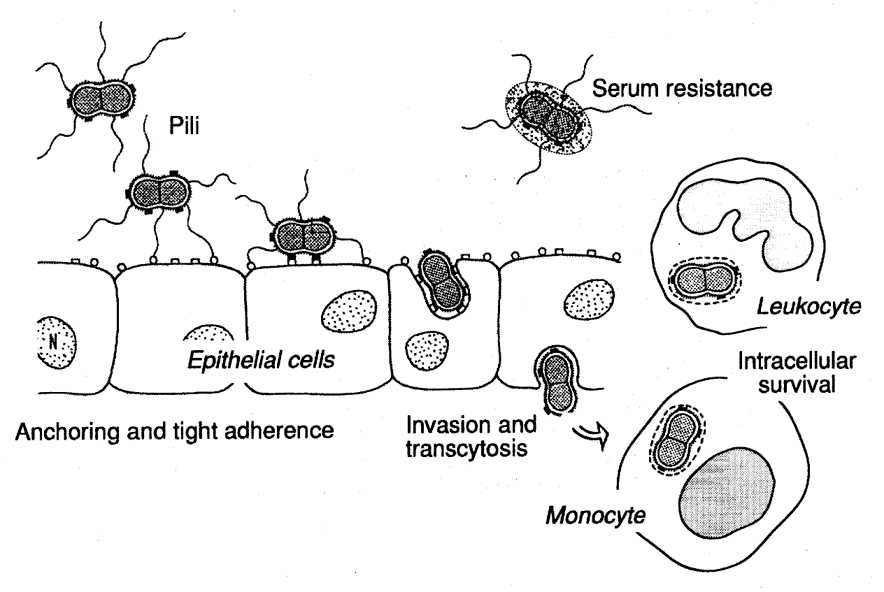
They are obligate human pathogens, only growing when inside a host: this means it is important to be able to flourish in the host and avoid immune response.
It also allows the pathogen to have a variety of habitats within a host, including intra- and extra-cellular environments.
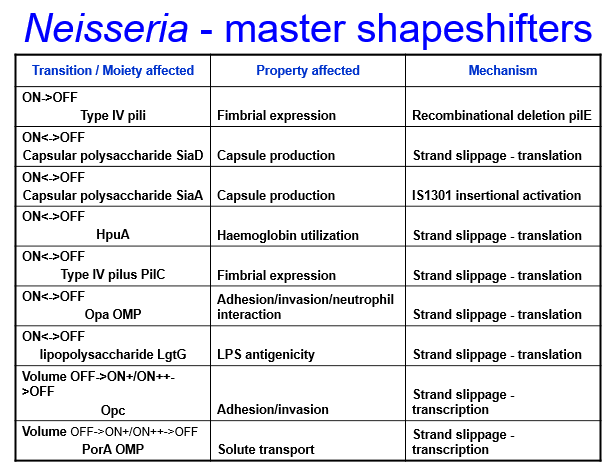
What are some of the phase variants in Neisseria spp.?
- Pili
- Opa
- LOS
- Lactoferrin
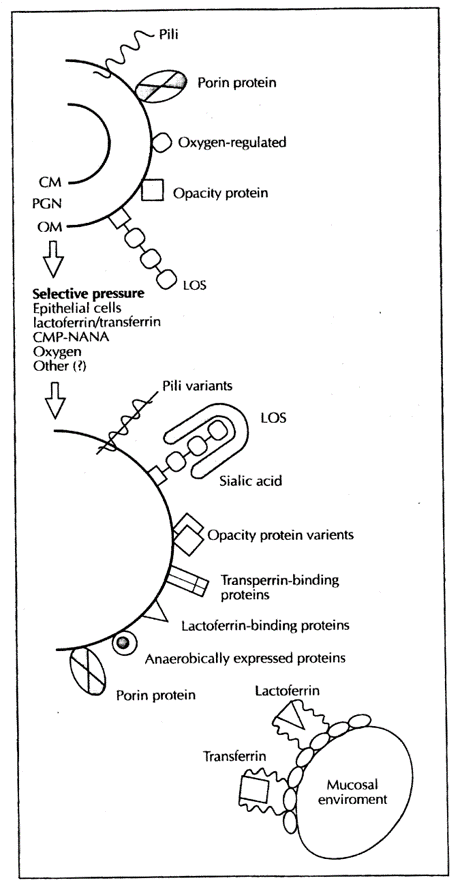
What mechanisms underly Neisseria spp. antigenic variation?
- Genomic rearrangements
- Recombination events: inter- and intra-genomic. Involving the same or different chromosomes.
- Strand slippage: DNA replication, transcription and translation
- Insertion sequences
Outline differential methylation as a source of phase variation. Give an example.
Unlike other mechanisms of phase variation, epigenetic modifications do not alter DNA sequence and therefore it is the phenotype that is altered not the genotype. The integrity of the genome is intact and the change incurred by methylation alters the binding of transcription factors. The outcome is the regulation of transcription resulting in switches in gene expression.
- Uropathogenic E.coli Pap-pili phase variation via Dam methylation of GATC proximal and distal to the pap promoter.
- An outer membrane protein Antigen 43 (Ag43) in E. coli is controlled by phase variation mediated by two proteins, Dam and OxyR. Ag43, located on the cell surface, is encoded by the Agn43 gene and is important for biofilms and infection. The expression of Agn43 is dependent on the binding of the regulator protein OxyR. When OxyR is bound to the regulatory region of Agn43, which overlaps with the promoter, it inhibits transcription. The ON phase of transcription is dependent upon Dam methylating the GATC sequences in the beginning of the Agn43 gene (which happens to overlap with the OxyR binding site). When the Dam methylates the GATC sites it inhibits the OxyR from binding, allowing transcription of Ag43.
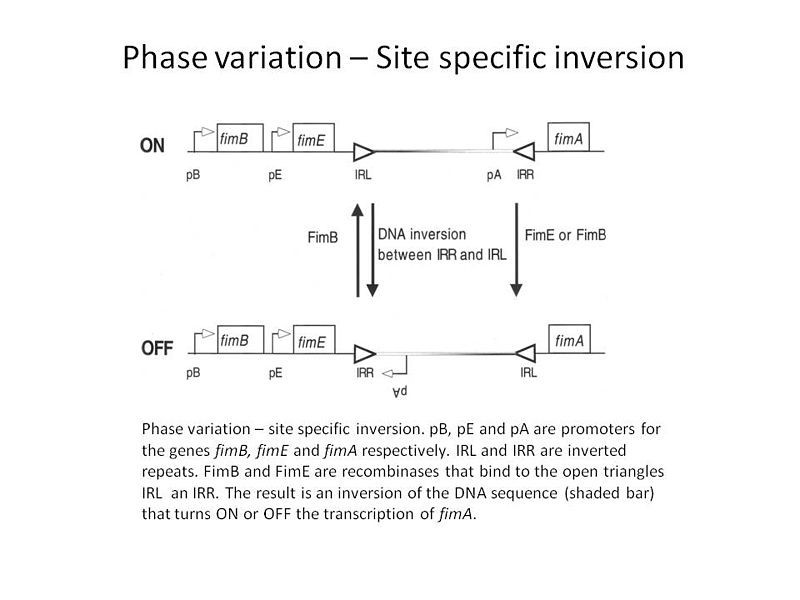
Give an example of site-specific inversion in phase variation.
Type I fimbriae in E. coli: repetitive sequences may be inverted, switcing off a gene. The promoter is switched around.
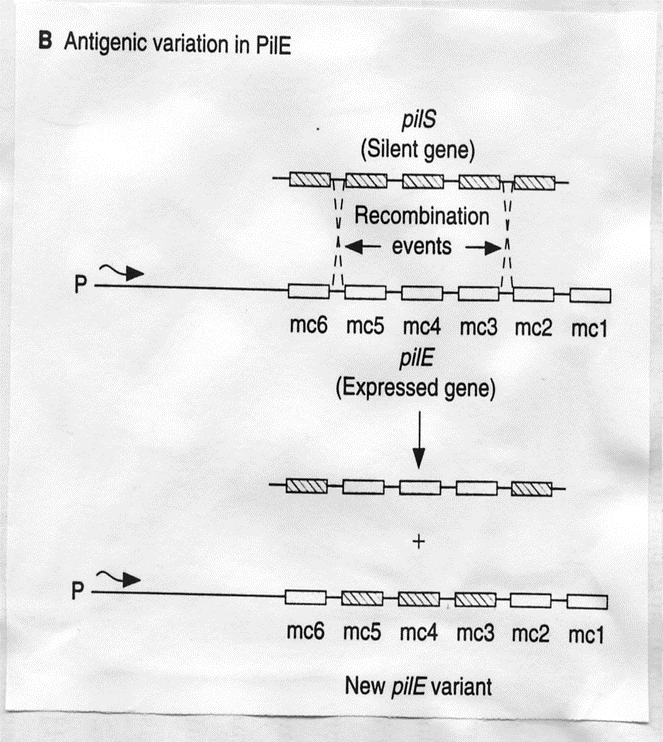
Give an example of recombination-mediated variation.
Pilin proteins of Neisseria form pili of bacteria, which are encoded by PilE genes. Sometimes recombination between PilE and PilS genes from silent to expression sites. PilS does not have a promoter and is silent, so silences expression. Each gene contains mini-casettes, which can be subjected to recombination events. New PilE variants can be made. This can affect the pathogenesis and virulence of the bacteria.
Inter- or intra-genomic recombination via recombination on the same gene or transformation from uptaken DNA, respectively.
The hypervariable region is under the most selective pressure as it is targeted by the immune response.
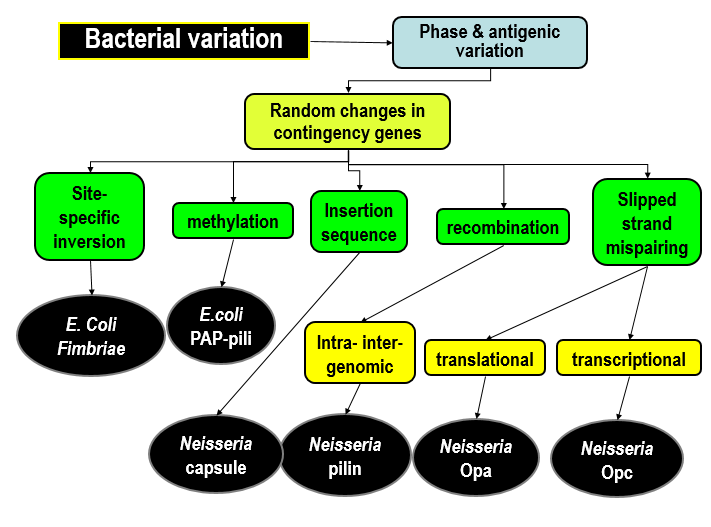
Give examples of different forms of variation.
Outline slipped strand mispairing as a form of genome variation.
Slipped strand mispairing most commonly happens in repetitive DNA sequences.
- Heteropolymeric repeat sequences, e.g. CTTCT pentameric repeats.
- Homopolymeric repeats, e.g. AAAAA pentameric repeats.
Depending upon the number of repeats in a gene, this affects the open reading frame of a gene (when the repeats are not divisible by three). Variation in the number of repeats occurs from mispairing and DNA errors in replocation of repeats. Polymerase struggles to replicate repetitive DNA.
- DDR can lead to reannealing of DNA in the wrong place, potentially leading to one daughter cell gaining a repeat.
Outline Opa protein variation.
Opacity proteins are adhesins, particularly to epithelia. Neisseria has up to 11, which can be switched on/off in different combinations to evade immune response. They can be recombined (recombination). No more than one gene can be switched on at any one time as they all have the same promoter (cassettes). Each gene is controlled independently by translational frameshifting.
Protein: signal peptide, semi-variable region, two hypervariable regions.
Repetitive sequence allow the gene to be in the correct reading frame. When DNA replication occurs, one of the repeats may be lost or gained, leading to phase variation of the gene. This may cause it to be turned off by introducing premature stop codons, or if not the resulting protein will be altered/non-functional (strand-slippage variation).



