What are the structural placental changes with gestational age?
As the placenta becomes adapted for more exchange as the pregnancy goes along.
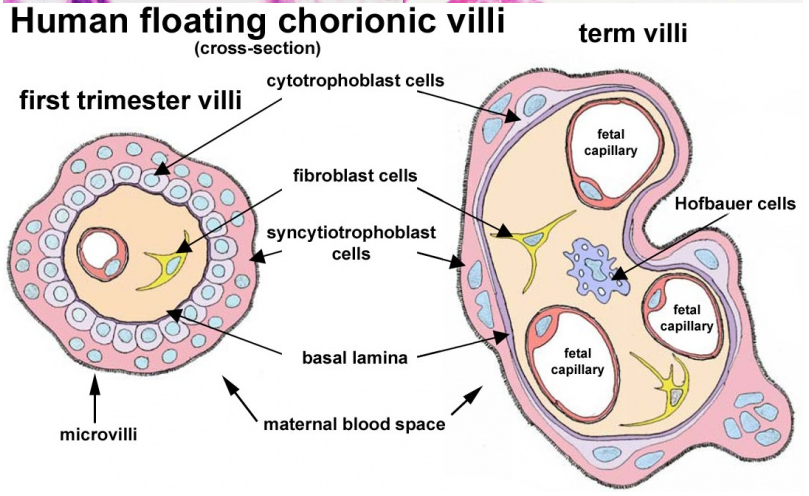
- During early pregnancy, the stromal core of the villi become more cellular and more vascularised. (gettings denser)
- Branching vasculogenesis in the placenta as the fetus sends more of it’s BV’s to get more O2 and nutrients from the maternal blood
- 2nd Trimester: villous cytotrophoblast thins down
- monolayer of cytotrophoblasts thins the distance between placenta and fetus
- 3rd Trimester: villous cytotrophoblast is sparse
- Branching of villi increases
- small branches for extensive exchange
- Size of the placenta increases
How does the size of the plaenta change?
Increases as pregnancy goes along.
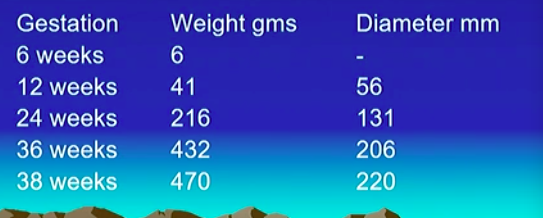
6g at 6 weeks (cant measure diameter as is a ball)
~0.5kg at 38weeks (22cm a side plate)
Although the placenta is primarily a fetal organ, what are the maternal contributions to it (there is maternal tissue attached to it)?
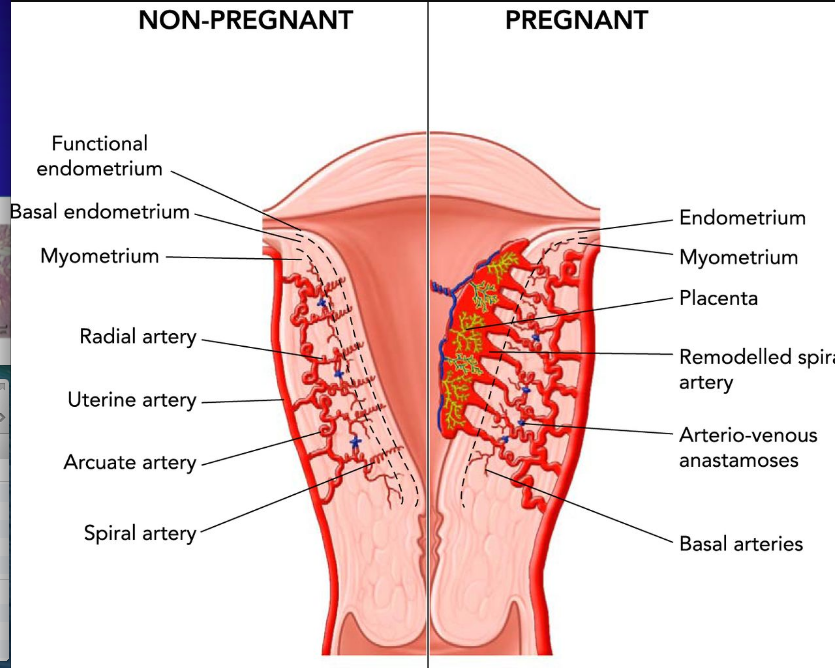
- Endometrium: undergoes changes during during the menstrual cycles called the ‘Decidual Reaction’
- Decidual Reaction: when the stromal cells of the decidua are swollen and store glycogen (energy for implanting embryo) and this gets enhanced upon implantation
Therefore the maternal contribution is the decidua.
**Decidua: tissue pulled away with menstruation + placental birth
Is it just the spiral arteries that are coiled?
No.
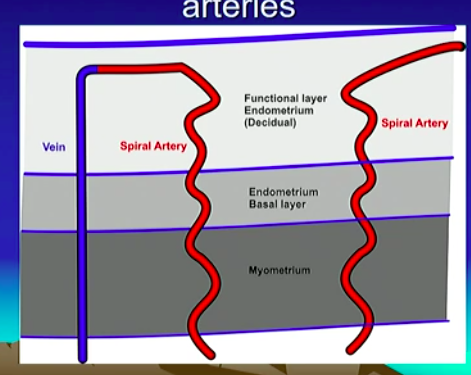
All the arteries, radial/uterine/arcuate are also spiralled!
- This is allows for expansion of the uterus during pregnancy, so these vessels don’t have to grow during huge expansive baby grow.
- Haemodynamic Cause: slows down blood flow and protect the baby
So if the maternal contribution to the placenta is the decidua, how is this layered?
Decidua Basalis: directly on implanation site (where placental disc will form)
Decidua Capsularis: cap between uterine lumen and placenta, overylaying the implantation site
Decidua parietalis: around remainder of the uterus
The decidua capsularis fuses with the deciduaperitalis one the amniotic cavity has enlarged and obliterated the uterine cavity! Now called one of the fetal membranes.
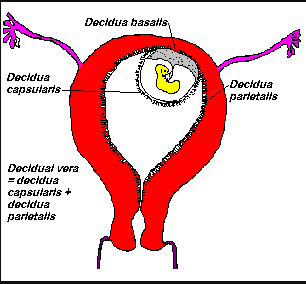
why should we not say the decidua is a fetal membrane?
because its derived from the maternal fused decidua capsularis and parietalis.
Fused when the baby grows and invades more
What are the 3 placental membranes?
all Extra-Placental
- Amnion: closest to the baby, avascular, covers the back of the placent, the umbilical cord all the way to the fetal abdomen (where theres a transition zone)
- Chorion: is fetal membrane (started as villous structure that thinned out to form a membrane) with fetal vessels
- Decidua***: maternal endometrial tissue thats neither a membrane nor is it fetal.
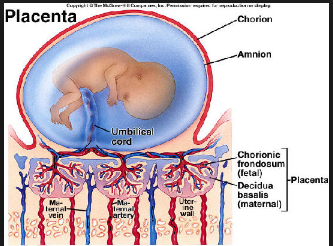
What forms the umbilical cord?
What vessels are contained in this?
The yolk sac and the allantois
Allantois: outgrowth of the primitive fetal gut (extraembryonic mesoderm)
Yolk Sac: where your primordial germ cells and lymphocytes are formed
Umbilical cord has 2 arteries and 1 vein and derived from allantois
Note the arteries are deoxygenated
So just surrounding the umbilical cord is the amniotic membrane, and within are 3 vessels (2a 1v) , so what else is in the cord?
- Whartons jelly
- Network of myofibroblasts
- spaces are filled with mucopolysaccharides
This jelly insulates and protects the umbilical arteries and vein (source). Prevents (to an extent) knotting of the cord
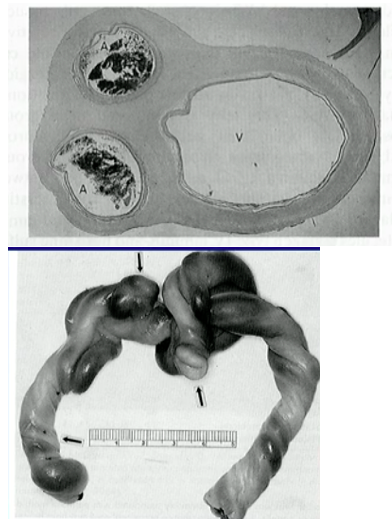
When should we be worried about an umbilical cord knot, and whats the fetals protective adaption against knotting?
There are false knots and true knots
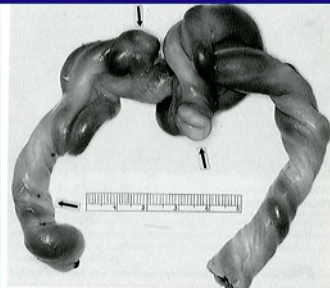
False Knots: simply a varacosity/ballooning of cord, common and not dangerous
True knot: if tight, you’ll occlude art/vein and bloody supply to fetus from placenta is compromised!
Whartons Jelly protects the cord from collapsing, making it harder to pull tight. If you pull the knot that can move/dehydrated. We intervine if jelly is absent around area of knot.
Cord is also very slippery
What adaptations of the placenta allow for maximisation of exchange?
- The villous structure is tortuous with a large SA
- Syncytiotrophoblast has a micro villous surface (increased area/time of transfer)
- in 3rd trimester most villi are small tertiary villi (contain BVs)
- 3rd trimester the fetal cappillaries are closely opposed to the syncytiotrophoblast
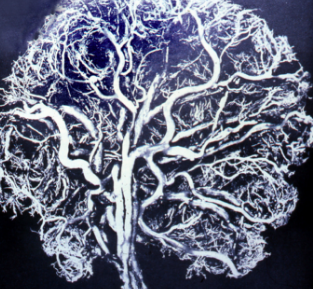
What does this picture of a tertiary villi show?
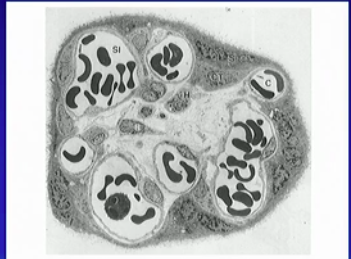
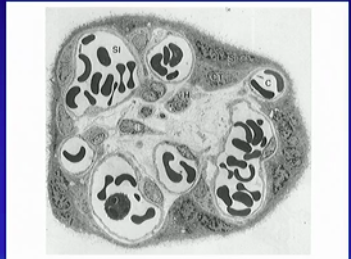
Fetal capillaries pushed right up into the peripheral syncytiotrophoblast to minimise distance of exchange.
Dense stromal core of EEM and cytotrophoblast
How is the fetal blood adapted?
Adapted for maximal exchange.
Has a greater affinity for O2 due to increased HBf.
Fetal blood has more haemoglobin and can carry more O2 then maternal.
At pO2 30 torr:
- *Fetal 80% s**aturated (term fetal: 20-25ml/dl O2)
- *Adult 50%** saturated (maternal: 15.3ml/dl O2)
This is facilitated by the Bohr and Haldane effect
Whats the Bohr effect on fetal exchange?
As maternal blood picks up fetal metabolites, the pH lowers.
Thus the affinity for O2 decreased and dissociation for O2 increase
Converse occurs on fetal side ⇒ double Bohr effect
Whats the Haldane effect? how does it effect fetal exchange?
The capacity of haemoglobin to bind CO2 is related to the amount of bound oxygen.
Thus is oxygen is lost from the maternal blood, the capacity of maternl blood for CO2 increases
Converse effect on fetal side ⇒ DOuble Haldane Effect
What is amniotic Fluid and what is it’s purpose?
Fluid that fills amniotic sac/bag
- buoyant medium allows symmetrical growth (baby face/body not squished)
- Cushions the fetus
- Prevents adhesions of the fetus within membranes (amnion stuck to face)
- Allows movement of fetus → muscle development
- Development of GI/respiratory tracts: practise breathing/swallowing movements
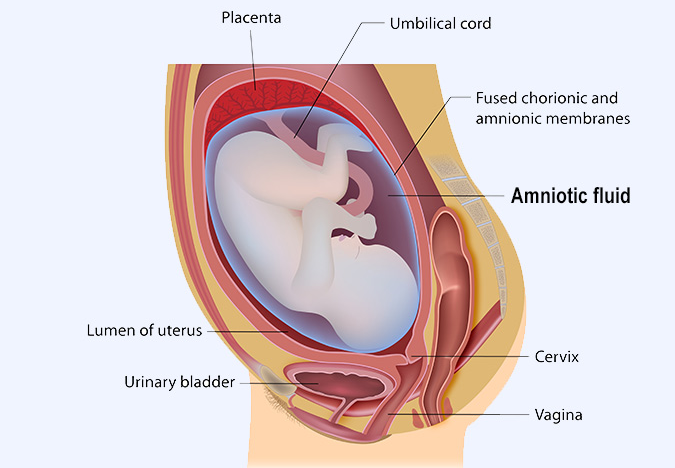
Where does the amniotic fluid originate from?
- Initially ultrafiltrate of maternal plasma
- Major fetal contribution (as pee)
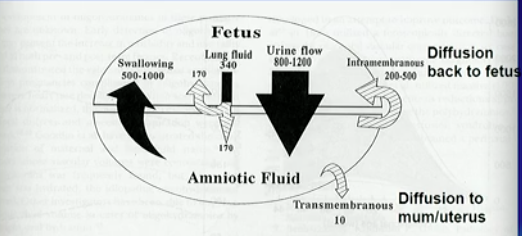
- 20+ weeks fetal urine and surface of placenta/cord: output/day ~500-1200mls/day
- Goes from 30mls at 10 weeks → ~1L term → decreases post term*
- **sheep 200ml/kg/day if this was adult we would be peeing 14L/day!!!*
What happens to the amniotic fluid once produced?
- RECYCLED
- Leaves the amniotic cavity mainly by fetal swallowing (0.5-1L/day)
- Fluid can also move across the fetal skin (prior to keratinisation at 24 weeks)
- Fluid can move across the fetal membranes → maternal circulation (minor) or into fetal vessels of the placenta/umbilical cord (major)
Why are we concerned about amniotic fluid volumes?
Polyhydramnios
- excessive amniotic fluid, possibly due to loss of swallowing
- Found in many cases of diabetic pregnancy
Oligohydramnios
- Lack of amniotic fluid potentially due to kidney issue → low fetal urine output
The amniotic fluid/placenta and fetal diagnostics/screening?
AF can be used to look at the babies karyotype and screen for some congenital abnormalities: amniocentesis and chorionic villi sampling
Amniocentesis (14-16weeks): needle into amniotic fluid; this contains fetal amniocytes → grown in lab → karyotyped
Chorionic Villus Sampling (10 weeks): transabdominally or transcervically
Both involve major invasive biopsy, procedure-related loss-rate (CVS >5%) or limb reduction defects.
Would be better if we could do this earlier!
What’s the idea for a non-invasive way of fetal screening?
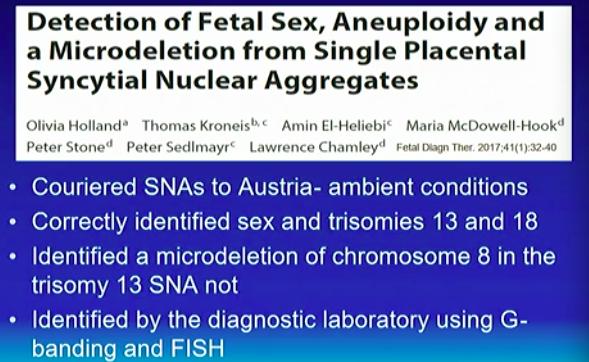
Using syncytial nuclear aggregates for minimally invasive antenatal diagnosis.
These syncitial trophoblst aggresgates bud off the placental surface to enter the maternal blood → accumulate in the lungs.
Stick in lungs as it’s the 1st small vascular bed they meet.
~150,000 TB’s estimated to be shed/day in maternal circulation (~3.2g/day).
AB coated magnetic beads can stick to these, but as they’re all in the lungs it’s really hard to find them.
What is cell-free fetal DNA for minimally invasive antenatal diagnostics.
Introduced very rapidly into clinical practice.
Probably only screening not diagnostic. Short pieces of cell-dree fetal DNA (origin unknown) come off the placenta (probably from trophoblasts) into maternal blood. Comparing parts of this you can see parts of the fetal karyotype.
Not as reliable as we would like, but can be done earlier!!
How is the placenta a barrier?
The fetus hasa poorly developed immune system (even at birth), placenta acts as an important barrier to the transmissions of maternal infections to the fetus.
Prevents (usually) transmission of
- HepB: baby given antiglobulin at/near birth, bc can pick up virus at interpatrition.
- Rabies
- Measles
- Malaria: (but it does cause ‘clogging’ of the placenta at intervillous space due to macrophages)
WHat infectinos/disease does the placenta allow through?
- HIV
- CMV
- Small pox
- Rubella (german measles)
- Toxoplasmosis: from cats + raw meat (has a massive cost in US)


-
Intro and Hypothalamus25
-
The Pituitary25
-
Female Tract, Oogenesis and Endocrine Control 126
-
Female Tract, Oogenesis and Endocrine Control 226
-
The Thyroid28
-
Spermatogenesis and the Male Tract I27
-
Calcium Phosphate Metabolism21
-
Spermatogenesis and Male Tract II33
-
Fertilisation and Implantation28
-
Infertility25
-
Placenta 121
-
Placenta 226
-
Clinical Axis 11
-
Parturition: Normal Birth36
-
Parturition: Preterm Birth29
-
Sexual Differentiation20
-
Sexual Differentiation: internal and External Genitalia differentiation21
-
Calcium Phosphate Metabolism 215
-
Steroid Abnormalities32
-
The Physiology of Pregnancy 125
-
Ovarian and Fetal Imaging0
-
Contraception: working around ovulation29
-
Physiology of Pregnancy II29
-
Fetal Growth and Nutrition39
-
Fertility Preservation and Ethics9
-
Lactation 118
-
Lactation 226
-
Postnatal Growth33
-
Puberty29
-
Menopause28



