1
Q
Chordopoxvirinae
A
- Affects vertebrates
- nine genera…
- Orthopoxvirus
- Parapoxvirus
- Capripoxvirus
- Suispoxvirus
- Avipoxvirus
2
Q
Pox viruses love…
A
Skin (epitheliotrophic)
3
Q
Two main viruses that shaped hx
A
- Flu
- Smallpox
- eradicated
- Mary Wortley Montagu => saw scab vaccination
- Edward Jenner => noticed milkmaids didn’t get dz (cowpox)
- Vaccinia was the vaccine that eradicated it
4
Q
Poxvirus Virion architecture
A
- Large dxDNA viruses
- Large enveloped complex
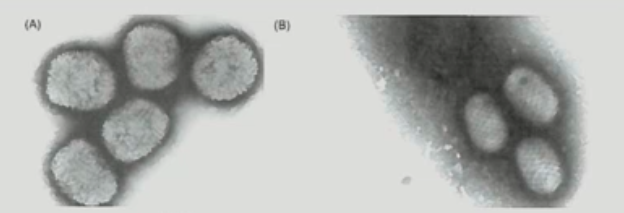
- Ovoid with regular spiral arrangement of tubules on outer membrane
- Brick-shaped virion, lateral bodies
- Can dx looking at EM
5
Q
A
Poxvirus virion architecture
6
Q
Poxvirus Disease Characteristics
Typical Gross & Microscopic lesions
A
- Epitheliotrophic => proliferative lesions
- hyperplasia, neoplasia
- Macule (depigmented), papule (raised), vesicle (fluid), pustule (infected fluid), crust
- Eosinophilic intracytoplasmic inclusions (Bollinger bodies)
7
Q
Poxvirus Disease Characteristics
Host Specificity & Pathogenesis
A
- Viruses of veterinary and medical importance
- Serious dz in immunocompromised
- Some genera with broad host range - zoonoses (ortho and parapoxviruses)
- Large viral genome contains genes for
- intracytoplasmic existence (enzymes) (don’t need the nucleus)
- Immune evasion genes
8
Q
Zoonotic Chordopoxviruses
Test question
A
Orthopoxvirus
Parapoxvirus
9
Q
Reportable chordopoxvirus
A
Capripoxvirus
10
Q
Orthopoxvirus
A
- Zoonotic
- Virus infections
- Cowpox virus
- naturally infected animals
- Numerous: man, cattle, cats, zoologic spp
- Host range in lab animals
- Broad
- Natural geographical range
- Europe
11
Q
Parapoxviruses
A
- Zoonotic
- Virus infections
- pseudocowpox virus
- bovine papular stomatitis virus
- Orf virus (contagious ecthyma)
12
Q
pseudocowpox virus
A
- natural hosts => cattle, humans
- lab animal host range => Narrow
- Geographical range => Worldwide
13
Q
bovine papular stomatitis virus
A
- natural hosts => cattle, humans
- lab animal host range => Narrow
- Geographical range => Worldwide
14
Q
Orf virus (contagious ecthyma)
A
- natural hosts => sheep, goat, humans
- lab animal host range => Narrow
- Geographical range => Worldwide
15
Q
Capripoxviruses
A
- Virus infections
- Sheeppox virus
- Goatpox virus
- Lumpyskin dz virus
16
Q
Sheeppox virus
A
- Animals naturally infected => sheep, goats
- Host range in lab animals => Narrow
- Geographic range => Africa, Asia
17
Q
Goatpox virus
A
- Naturally infected animals => Goats, sheep
- Host range in lab => Narrow
- Geographic range => Africa, Asia
18
Q
Lumpyskin dz virus
A
- Naturally infected animals => Cattle, buffalo
- Host range in lab animals => Narrow
- Geographical range => Africa
19
Q
Suispoxvirus
A
- Virus infections => Swinepox virus
- Animals naturally infected => Swine
- Host range in lab animals => Narrow
- Geographical range => Worldwide
20
Q
Leporipoxvirus
A
- Virus infection => Myxoma virus
- Oryctolagus and Sylvilagus)
- Animals naturally infected => Rabbit
- Host range in lab animals => Narrow
- Geographical range => Americas, Australia, Europe
21
Q
Avipoxvirus
A
- Virus infections => Fowlpox virus
- Animals naturally infected => Chickens, turkeys, birds
- Lab animal host range => Narrow
- Geographic range => Worldwide
22
Q
Cowpox
About
A
- Foreign animal dz => rare, seen only in Europe
- Human infection possible w/o cattle contact
- Reservoir is a rodent
- Domestic cats can be infected
23
Q
Cat infections with Cowpox virus
A
- Uncommon
- Transmission
- contact with subclinical bank voles
- CS
- fever
- skin lesions
- fatal in cheetahs
*human infection rare
24
Q
Cowpox Dx
A
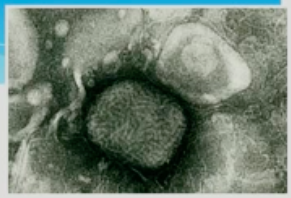
- Rare case we use EM
- brick shaped
- parapoxes => spiral shaped
- Isolation in cell culture
- Isolation on chorioallantoic membrane of chick egg
- cyncitia => multi-nucleated cells
25
Pseudocowpox virus
about
* Mild, recurrent, worldwide in dairy
* Associated with poor hygiene (no teat dipping)
* Proliferative teat lesion =\> horse shoe shaped
* Secondary bacterial mastitis occurs
* Spreads to calves during nursing
26

Milkers nodule
Pseudocowpox virus
27
Diagnosis of pseudocowpox
* EM =\> spiral shape
28
Bovine Papular Stomatitis
about
Dx
* Common incidental infection in beef cattle worldwide
* Suckling calves or up to 1 year of age
* No tx necessary unless anorectic
* Dx =\> EM
29
Orf
Contagious Ecthyma/
Contagious Pustular Dermatitis/
Sore mouth
* Distribution
* goat/sheep populations worldwide
* Clinical Findings
* common in 3-6 month old lambs
* can affect adults
* Lesions develop as papules =\> then pustules =\> then thick tenacious scabs
* Oral mucocutaneous junctions, commissures, muzzle, nostrils
30
Orf: Clinical Dz
* Fissuring occurs and scabs painful
* Affected lambs anorectic
* Systemic invasion rare
* lesions common on ears, nose, cheeks, anus, vulva/prepuce
* Affected lambs may cuase spread to udders of ewes
31
Orf transmission
* Spread in flock rapid
* contact
* infected scabs that persist in environment
* Virus very resistant in environment
* Recovered animals immune for several months
32
Orf human dz
* Can be common
* Lesion is persistent and becomes a nodule =\> often itchy
* Localized with occasional lymphadeopathy
33
Orf Diagnosis
* Pathopneumonic
* Rapid spread in young animals
* Scabs around commissures of mouth
* 90% morbidity/low mortality
* Lab confirmation =\> EM
34
Sheeppox, Goatpox, Lumpy Skin Dz (LSD) of cattle
* Most important poxviruses of domestic animals
* economic loss and high mortality young animals
* morbidity in adults =\> loss of milk/meat
* Diseases expanding geographically
* **notifiable foreign animal disease (OIE & USDA/APHIS)**
35
Capripoxviruses Transmission
* Respiratory, biting insects, scabs (months)
* Animals brought into enclosures at night
* Wild-life reservoir =\> african cape buffalo (LSP)
36
Sheeppox Virus and Goatpox Virus
Etiology
Clinical Findings
* Etiology
* closely related by different species tropisms according to geography
* Clinical Findings
* Incubation period: 2-14 days
* **Malignant form more common: systemic******
* **Devastating in young**
* mortality up to 50%
* skin lesions on unwooled skin, buccal, resp, digestive, urogenital mucosa
* lambs may die before lesions develop
* depression, prostration, high fever, ocular/nasal d/c
* Benign form
* common in adults
* only skin lesions =\> esily seen under tail
37
Sheeppox Virus/Goatpox Virus
Pathogenesis
Diagnosis
Treatment
Control
* Pathogenesis
* replication in respiratory lymph nodes, viremia, secondary lesions in skin
* Diagnosis
* clnical signs are pathognomonic, virus isolation, ID by EM
* Treatment
* supportive
* Control
* prohibit importation, cull, isolate
* efficacy of vaccines challenged by new strains
38
Lumpy Skin Dz
* Remember looks like BHV-2
* Similar to sheep and goatpox
* Spread extensively from SE Africa in 1970s
* Similar respiratory and skin lesions, generalized lymphadenopathy and edema
* almost 100% morbidity
* 1-2% mortality
39
Swinepox
* Incidence/occurence =\> Worldwide
* Clinical Findings
* red papules appear in 4-5 days, become raised hard 1-3 cm in diameter
* Hard crusts develop and drop over 12-14 days
* typically benign dz, slight fever, mild reaction
* Swine louse involved in transmission
* lesions
* lower parts of body, belly, axillae, insides of thighs
40
Swinepox
Transmission
Diagnosis
Control
* Transmission
* pig to pig not common
* louse on axilla
* Diagnosis
* not commonly done
* virus isolation
* EM
* Control
* elimination of lice
41
Avipoxvirus about
* Affect poultry and wild birlds
* name refers to host
* virsuses different genomically, similar biologically
* Transmission mechanical by arthropods or scabs
42
**If you see bumblefoot think....**
**Parapox virus**
43

Fowl pox:
Lesions on comb, wattles, face
44

* Fowlpox microscopic lesions: eosinophilic intracytoplasmic inclusion bodies **(Bollinger bodies)**
* EM: large brick shaped particles
45
**Poxvirus conclusions**
**Test Question**
* **Ancient, successful virus infecting vertebrates and invertebrates**
* **Conserved virion morphology**
* ****large, enveloped complex virion (**Brick** vs. Ovoid)
* **scabs persist in environment**
* **Gross & microscopic lesions**
* Epitheliotropic, inducing proliferative lesions
* Intracytoplasmic inclusions
* **Host specificity & pathogenesis**
* self limiting to lethal
* Narrow to broad host specificity
* zoonotic potential of ortho and parapoxes
* **Diseases caused by Chordopoxviruses**
* Orthopoxvira
* Parapoxvirae
* Capripoxvirae
* Suipoxvirae
* Avipoxvirae




