- Orangutans from Borneo have the same number of chromosomes (2n = 48) as those in Sumatra, but chromosome 2 is acrocentric in Borneo animals but nearly metacentric in those from Sumatra. The sequence of these chromosomes can be represented:
Borneo: ab.cdefg
Sumatra; aedc.bfg
where the centromere is represented as a dot.
In a conservation breeding program, orangutans from Borneo and Sumatra were intercrossed and 14 offspring were produced. The hybrid animals were fertile, but some reduction in fertility is expected. To see why this is expected, answer the following:
(a) Name the type of rearrangement that has occurred in chromosome 2.
Pericentric inversion
- A woman is found to have a rare genetic disorder where she has a 46, XY karyotype. Explain how this might arise (including whether she has inherited the disorder from her mother or father), the likely effect on her phenotype, and the probability it will also occur in a sister of the individual.
- 46, XY females may lack the SRY gene that switches development down the male pathway. Thus, they are effectively females. But with only one X chromosome, they develop as women with characteristics similar to Turner Syndrome. This situation arises when the cross-over that normally occurs in male meiosis between the X and Y chromosomes in the pseudo-autosomal region very occasionally occurs aberrantly lower on the Y, below the SRY male sex determining gene instead of above it. The SRY gene is thus transferred to the X and lost from the Y. If this Y enters a sperm that then fertilises a normal egg, a 46, XY foetus develops as a female because the gonad is not switched down the male developmental pathway. The probability of this occurring in a sister of the individual is very low as it would require another independent abnormal cross-over event to occur again in their father, and such abnormal cross-over events are very rare. This situation could also occur if the SRY gene was mutated and non-functional.
“Partial expression”
Choose the best-matching term(s) from the following list:
Epistasis, pleiotropy, complete dominance, recessive, incomplete dominance, co-dominance
Incomplete dominance
- Orangutans from Borneo have the same number of chromosomes (2n = 48) as those in Sumatra, but chromosome 2 is acrocentric in Borneo animals but nearly metacentric in those from Sumatra. The sequence of these chromosomes can be represented:
Borneo: ab.cdefg
Sumatra; aedc.bfg
where the centromere is represented as a dot.
In a conservation breeding program, orangutans from Borneo and Sumatra were intercrossed and 14 offspring were produced. The hybrid animals were fertile, but some reduction in fertility is expected. To see why this is expected, answer the following:
(f) How could you determine which form of chromosome 2 is likely to be the ancestral sequence?
f. Observe the form of chromosome 2 in the closest living relative of the orangutan. [For information, this is the gorilla, and its chromosomes have the same sequence as that shown by the Borneo race (as does the next closest relative, the chimpanzee). Thus, the Borneo sequence ab.cdefg is likely to be the ancestral sequence in orangutans.]
Consider the following pathway required for making normal orange pigment colour in the petals of marigolds.
As indicated, the pathway is controlled by two enzymes which are the products of two unlinked genes, gene A (two alleles, A dominant to a null allele a), and gene B (two alleles, B dominant to a null allele b). Thus plants homozygous for either of the null alleles will have white flowers. A true breeding plant with white flowers (strain 1) was crossed with a different true breeding plant with white flowers (strain 2), and the resulting F1 progeny were wild type (orange). The F1 were then allowed to self-fertilise to produce an F2 generation which consisted of 160 plants, of which 69 were white and 91 were orange.
b. What is the predicted phenotype of the fully recessive homozygote (aabb)?
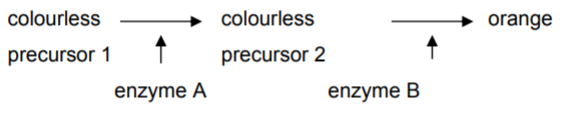
b. white-flowered
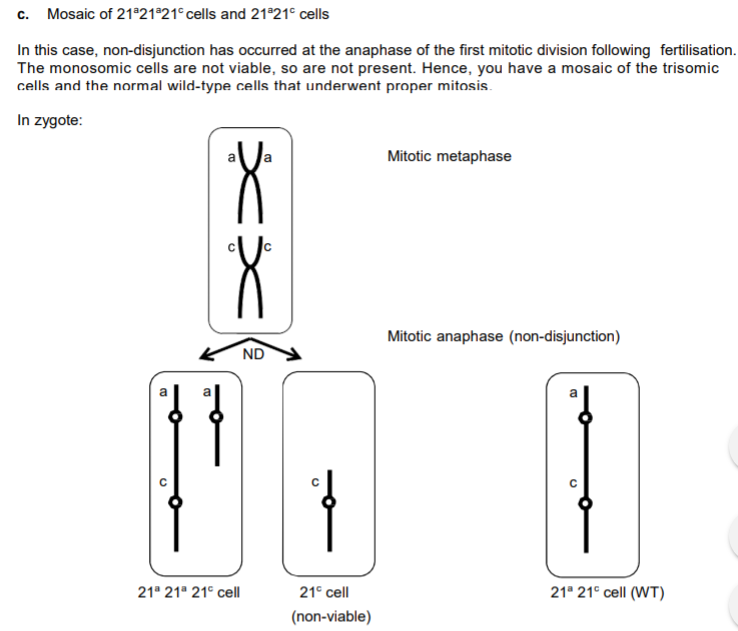
- Certain regions of chromosomes, particularly those carrying constitutive heterochromatin, vary in size between individuals. These chromosomal polymorphisms may allow individual chromosomes to be identified. Human chromosome 21 is often polymorphic in its short arm. Consider parents whose chromosome 21s are distinguishable and can be symbolised 21a 21b x 21c 21d (female x male). Diagram the nondisjunction event which gave rise to the following Down syndrome offspring, identifying the cell division and the individual in which it occurred:
c. mosaic of 21a21a21c cells and 21c cells
“Neither gene is fully expressed”
Choose the best-matching term(s) from the following list:
Epistasis, pleiotropy, complete dominance, recessive, incomplete dominance, co-dominance
Incomplete dominance
In using the polymerase chain reaction (PCR), briefly explain:
b. why the reaction must be heated to more than about 80 degrees at regular intervals;
b) The PCR reaction must be heated to > 80 degrees to denature DNA-DNA bonds so that newly synthesised DNA strands can be separated from their templates and both old and new strands can then act as templates for additional primers to bind to once the reaction has returned to below 80 degrees .
In using the polymerase chain reaction (PCR), briefly explain:
a. why two primers (not one, or more than two) are used for each reaction;
. a) Two primers are needed in a PCR reaction so that both strands of DNA are copied in each round of PCR. One primer is at the start of the sequence to be amplified and is complementary to the lower strand, the other is at the end of the sequence and is complementary to the upper strand.
“Equal expression”
Choose the best-matching term(s) from the following list:
Epistasis, pleiotropy, complete dominance, recessive, incomplete dominance, co-dominance
Co-dominance
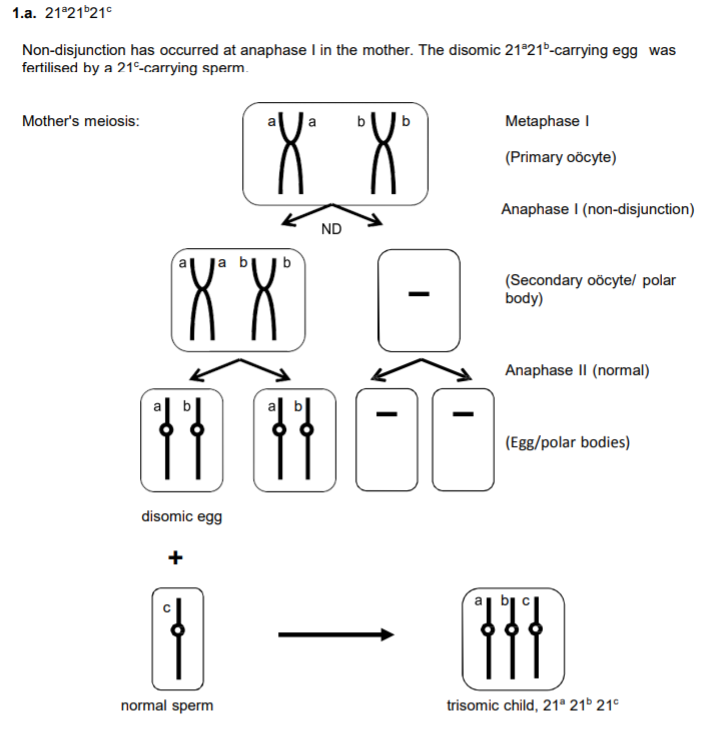
- Certain regions of chromosomes, particularly those carrying constitutive heterochromatin, vary in size between individuals. These chromosomal polymorphisms may allow individual chromosomes to be identified. Human chromosome 21 is often polymorphic in its short arm. Consider parents whose chromosome 21s are distinguishable and can be symbolised 21a 21b x 21c 21d (female x male). Diagram the nondisjunction event which gave rise to the following Down syndrome offspring, identifying the cell division and the individual in which it occurred:
a. 21a 21b 21c
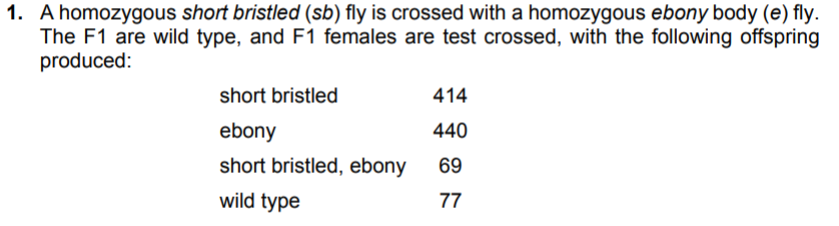
c. If the map distance had been 50 m.u., which of the following statements is most correct?
i. sb and e are on different chromosomes.
ii. sb and e are linked and exactly 50 map units apart.
iii. sb and e are on the same chromosome and at least 50 map units apart.
iv. either i or ii
v. either i or iii
vi. either i, ii or iii
c) The correct answer is (v) – either a or c. If the map distance is 50 m.u. this indicates independent segregation because the genes are either on different chromosomes, or are on the same chromosome but are too far apart to segregate together. Answer (ii) is incorrect because genes that are exactly 50 m.u. apart will show a distance of <50m.u. due to double crossovers
- Briefly explain the differences between the methods of detecting RFLP markers and of detecting microsatellite markers.
- RFLP markers will be detected by cutting genomic DNA with the relevant restriction enzyme, then running it on a gel, then performing a Southern blot. The probe needs to hybridise to a restriction fragment or fragments that will differ in size depending on the presence or absence of the restriction site. Microsatellite markers would usually be detected by PCR using primers that hybridise to genomic DNA on either side of the repeat region. The PCR product size will be different depending on the number of repeats. Note that a Southern could also be used and probed with a sequence that hybridises to the repeat. But PCR is more straight forward.
“a gene that has more than one effect”
Choose the best-matching term(s) from the following list:
Epistasis, pleiotropy, complete dominance, recessive, incomplete dominance, co-dominance
Pleiotropy
A plant breeder has two pure-breeding strains of tomatoes. These were crossed together and the F1 seeds planted in soil containing either nitrogen-rich fertilizer or no fertilizer. 100% of the seeds sprouted in each case. However, when these F1 progeny were intercrossed and the experiment repeated, she observed 93% survival on unfertilized soil and 100% survival on fertilized soil.
a) Devise a genetic hypothesis to explain these results. How many genes and alleles might be involved?
On unfertilized soil, F2 had 93% survival rate, therefore 7% died, which is roughly equivalent to 1/16. This suggests there are duplicate genes and the double recessive is nonviable in the absence of fertilizer.
a) Two genes each with two alleles. P1 = AA; bb, P2 = aa; BB F1 are all Aa; Bb 1/16th of F2 are aa; bb, which are non-viable in the absence of fertilizer
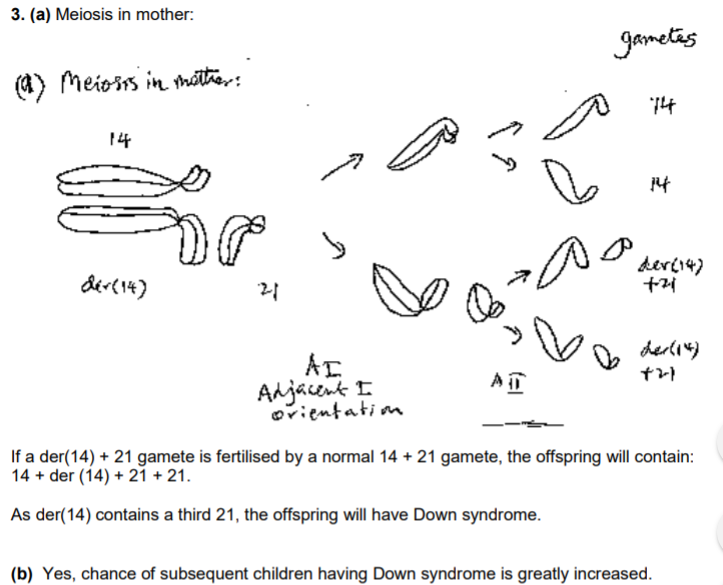
- A baby with Down syndrome is karyotyped and found to have 46 chromosomes in each cell. All chromosomes are present, but one of the two chromosomes 14s has a third chromosome 21 translocated onto it. On further investigation the mother is found to have only 45 chromosomes in each cell, including one normal 14, one normal 21 and the 14,21 Robertsonian translocation. Using a diagram, describe how the Down syndrome offspring may have arisen. Is the likelihood that subsequent offspring will have Down syndrome increased above the usual risk?
- Orangutans from Borneo have the same number of chromosomes (2n = 48) as those in Sumatra, but chromosome 2 is acrocentric in Borneo animals but nearly metacentric in those from Sumatra. The sequence of these chromosomes can be represented:
Borneo: ab.cdefg
Sumatra; aedc.bfg
where the centromere is represented as a dot.
In a conservation breeding program, orangutans from Borneo and Sumatra were intercrossed and 14 offspring were produced. The hybrid animals were fertile, but some reduction in fertility is expected. To see why this is expected, answer the following:
(e) Explain why this would lead to a reduction in the formation of effective gametes.
e. Half the gametes would be balanced and functional as before (one quarter ab.cdefg and one quarter aedc.bfg), but the other half would carry duplication of a region of chromosome 2 and a deficiency of another region (either ab.cdea (dup. for a and def. for fg) or gfedc.bfg (dup. for fg and def. for a). These would lead to offspring with an unbalanced genome, and thus likely lead to lethality. Thus, the number of “effective” gametes is reduced.
- Orangutans from Borneo have the same number of chromosomes (2n = 48) as those in Sumatra, but chromosome 2 is acrocentric in Borneo animals but nearly metacentric in those from Sumatra. The sequence of these chromosomes can be represented:
Borneo: ab.cdefg
Sumatra; aedc.bfg
where the centromere is represented as a dot.
In a conservation breeding program, orangutans from Borneo and Sumatra were intercrossed and 14 offspring were produced. The hybrid animals were fertile, but some reduction in fertility is expected. To see why this is expected, answer the following:
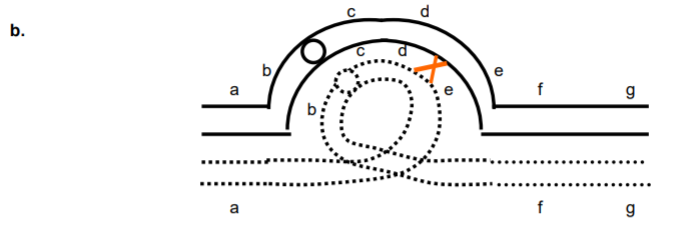
(b) Meiosis occurs in the hybrid animals. Diagram the expected pairing pattern of these two chromosomes at the pachytene stage of prophase I.
b. Was this cross set up with the markers in coupling phase, or repulsion phase? Does this matter for determining map distance? Explain.
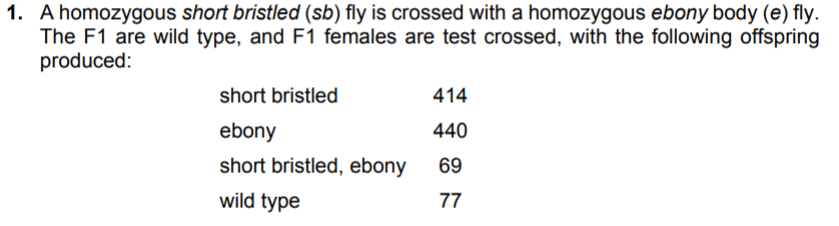
(b) Repulsion phase. No it does not matter, either way we can still recognise parental and recombinant combinations in the progeny. If it was coupling we could get more of the short body, ebony and wild type classes in the F2 as they would be the parental types, but would end up with the same recombination frequency.
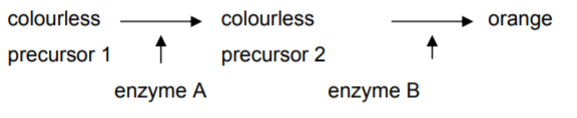
Consider the following pathway required for making normal orange pigment colour in the petals of marigolds.
As indicated, the pathway is controlled by two enzymes which are the products of two unlinked genes, gene A (two alleles, A dominant to a null allele a), and gene B (two alleles, B dominant to a null allele b). Thus plants homozygous for either of the null alleles will have white flowers. A true breeding plant with white flowers (strain 1) was crossed with a different true breeding plant with white flowers (strain 2), and the resulting F1 progeny were wild type (orange). The F1 were then allowed to self-fertilise to produce an F2 generation which consisted of 160 plants, of which 69 were white and 91 were orange.
a. Write down the full genotypes of the two white flowered parents
a. aa; BB and AA; bb
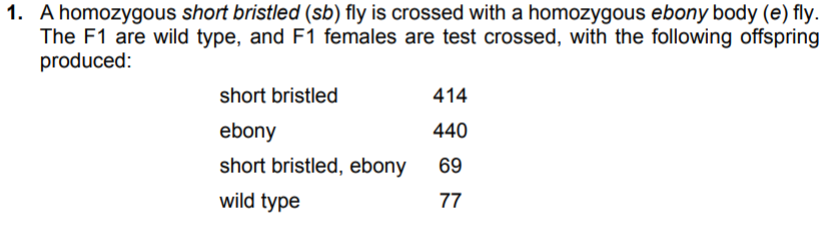
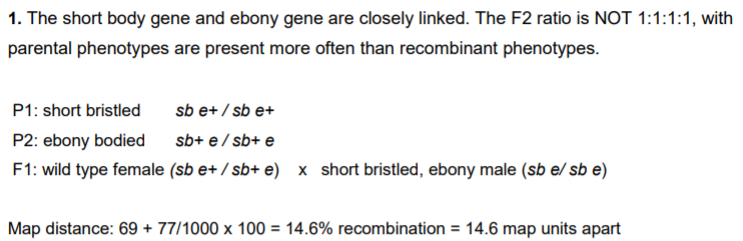
a. Derive and explain a genetic hypothesis that accounts for these results. Estimate the map distance between the loci.
- Orangutans from Borneo have the same number of chromosomes (2n = 48) as those in Sumatra, but chromosome 2 is acrocentric in Borneo animals but nearly metacentric in those from Sumatra. The sequence of these chromosomes can be represented:
Borneo: ab.cdefg
Sumatra; aedc.bfg
where the centromere is represented as a dot.
In a conservation breeding program, orangutans from Borneo and Sumatra were intercrossed and 14 offspring were produced. The hybrid animals were fertile, but some reduction in fertility is expected. To see why this is expected, answer the following:
(c) If there were no cross-overs in the region from b to e, what types of gamete would be formed, and in what proportions? If these gametes were involved in fertilization, would you expect the offspring to be viable?
c. Half the gametes would carry a the Borneo chromosome 2 (ab.cdefg) and half a Sumatran chromosome 2 (aedc.bfg). [In each case, the gamete is balanced and likely to lead to viable offspring.]
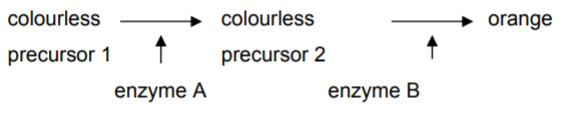
Consider the following pathway required for making normal orange pigment colour in the petals of marigolds.
As indicated, the pathway is controlled by two enzymes which are the products of two unlinked genes, gene A (two alleles, A dominant to a null allele a), and gene B (two alleles, B dominant to a null allele b). Thus plants homozygous for either of the null alleles will have white flowers. A true breeding plant with white flowers (strain 1) was crossed with a different true breeding plant with white flowers (strain 2), and the resulting F1 progeny were wild type (orange). The F1 were then allowed to self-fertilise to produce an F2 generation which consisted of 160 plants, of which 69 were white and 91 were orange.
c. Write down the general genotype of the orange flowered F2 plants.
c. A _; B _
- What is the average length of the restriction fragments generated by EcoRI digestion (5’ GAATTC 3’) of a genome in which all four nucleotides are equally frequent? [Hint: To do this, calculate the chance that any six adjacent nucleotides are the site of digestion of the restriction enzyme. Then calculate the average length of sequence (in nucleotides) that will carry one such site (e.g. if the chance of any six nucleotides being such a site is 1 in 1,200, then a sequence of 1,200 nucleotides will, on average, have one such site).]
There is a 1 in 4 (0.25) chance of a particular nucleotide being present at a specific site. So the chance of a string of 6 specific nucleotides is (0.25)6 or (1/4)6 = (0.00024) or (1/4096). In other words, this event will happen on average once per 4096bp






