1) What are the non-GLP CMC studies?
- Chemical development: Improvement of the synthesis to reduce cost, increase output, safety and quality (purity and consistency).
- Salt and formulation:
- Finding best salt to balance solubility and lipophilicity of the drug (eg. Co-solvents, emulsions, pH adjustment, salt formation etc)
- Finding best formulation for the chosen route of administration (eg. Tablet, capsule, solution, controlled release etc)
2) What are the GLP CMC studies?
- ICH stability
- ICH impurity analysis
- Develop prototype clinical formulation (pill, liquid etc)
3) What are the non-GLP animal studies?
Benchmark in vivo models, validate disease models, models in other disease areas. Finalize animal used for GLP/GMP studies.
4) What are the non-GLP ADME studies?
- Optimized analytical method development:
- important to optimize analytical method to determine exposure levels in toxicology studies:
- For small molecules: quantification of metabolites using HPLC/MS. Identify molecular structure.
- For biologics: classic analytical method for quantifying biologics is ELISA. It does not show structure and does not demonstrate activity because it uses binding as an endpoint.
- Validation of assays: Extraction technique recovery, linearity of standard curve, intra and inter assay precision, bench top and freeze thaw stability, sensitivity (lower limit of quantification), establish QC standards
2. Pk profile
3. Oral bioavailability
4. Determine metabolism of drug
5) What are the GLP ADME studies? why must Pk be done in mutiple animals? (comparitive metabolism)
- GLP Pk profile
. Bioavailability and Pk:
- using optimized bioanalytical method, quantify drug or metabolites usually in plasma
- determine bioavailability via Single dose, iv and intended route
- determine blood brain barrier bioavailability – measure drug accumulation in brain, brain vs plasma levels
- rodent and non-rodent, drug availability by intended route, mean residence time, half-life
2. GLP toxicokinetics profile
3. Comprehensive determination of metabolites
Comparative metabolism (multiple species):
- To account for interspecies differences between animals.
- Done via comparing hepatic microsomes and cytosolic fractions from different species: human, mouse, rat , rabbit, dog, non-human primate, guinea pig etc.
- Study parameters such as half life and identify metabolites produced.
- Interspecies scaling improves Pk predictions and allows identification of toxic metabolites that are specific to each species.
- Metabolic inhibition: to identify certain drugs may inhibit Cyp enzymes or be affected by drugs that inhibit Cyp enzymes
8) What are the requirements in toxicology evaluation? (Species, dosage, length of dosing, endpoints)
- Appropriate species: 1 rodent, one second species (dog, pig or monkey generally). These animals should have good exposure and metabolism similar to humans, they must cover all human metabolites. Also, they should have the same pharmacologic effect as humans (same target binding, effect in disease models, pharmacologic effects). The exposures achieved in the test subjects should be sufficient to cover multiples of the intended human dose/exposure in order to establish a safety margin.
- Higher doses to evaluate possible toxicities: FDA guidance to dose up to 1g/KG
- Administer compound long enough to support intended clinical study
- Endpoints: body weight, clinical observations, serum chemistry, hematology, organ weights, histology, drug exposure (toxicokinetics)
9) What are the non-GLP toxicology studies?
(goal: define upper bounds of safe drug administration)
1. Single dose (acute) toxicity: Determination of adverse effects within short time frame of single dose administration. Animals are observed for 14 days after dosing. Not many endpoints with focus on clinical observation and may be non terminal. Identifies single dose MTD.
2. Repeated dose toxicity: Involves a longer schedule of repeated dosing and establishes dosage levels for subsequent toxicity studies. Duration of dosing should ideally match duration of clinical study. Exception (for non-rodent species: if clinical study is >6 months, minimum duration of repeated dose tox study is 6 months in the EU.
3. Preliminary cardiovascular safety
10) What are the GLP toxicology studies? (acute and repeated dose)?
- Acute and repeated dose toxicity:
- Acute and repeated dose toxicity studies in 2 species (rodent and non-rodent) selected from non-GLP range-finding studies.
- More comprehensive: (greater number/gender/species)
- More complete toxicology study
- Determination of adverse effects resulting from daily dosing to identify MTD and NOAEL (No Observed Adverse Effect Level)
What is the standard toxicology design (GLP toxicity)?
o Standard toxicology design:
1) Plasma: drug analysis,
2) tissue: histopathology,
3) blood: clinical pathology,
4) clinical endpoints: survival, body weight, clinical signs, behaviour
How is genotoxicity/mutagenecity tested? (GLP toxicology)?
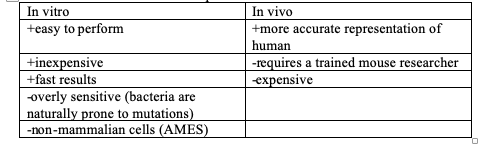
• in vitro non-mammalian cell system
– e.g. Ames Test
– Salmonella typhimurium
- Determine if cells treated with drug can survive without histidine, indicating mutagenicity
• in vitro mammalian cell system
– e.g. CHO (Chinese Hamster Ovarian) cells - Determine % chromosomal aberration across a range of drug concentrations
• in vivo mammalian system
–e.g. mouse micronucleus assay
- Immature mice treated with mutagen for period of 2-4 weeks, RBC’s observed under microscope for increased % of micronuclei
What is required in carcinogenecity testing in GLP toxicology?
Carcinogenicity testing:
• Long term toxicity testing
- ~lifetime exposure • Usually in rats
– 24 – 30 months
- Mouse or hamster may also be used
- 50 / gender / dose level and 100 / gender /control group
- Determine potential tumorigenic effects of drug
How is reproductive toxicology studied in GLP toxicology?
• Fertility and general reproductive performance
– Rats
– Dosing of males for 60-80 days prior to mating
– Dosing of females for 14 days prior to mating and during gestation and lactation
• Potential drug-induced embryotoxicity and teratogenicity
- Rat/mouse and Rabbit -Escalating dosages
- 1 month of treatment in pregnant females during embryonic and fetal development.
• Late fetal development, labour, delivery, lactation and newborn viability (Rat or Mouse)
– pregnant females using escalating dose levels
– Dosing from last gestation day (day 16-17) to end of weaning
– If reproductive capacity of offspring is evaluated, study duration is 5-6 months
What is the safety pharmacology core battery?
- CNS: Irwins test, global nervous system assessment (autonomic, sensorimotor, neuromuscular, behavioural)
- Respiratory system (in vivo): Whole body plethysmograph chambers (put rodents in chamber before and after drug, as the rats breathe in and out the chamber measures the change in volume). Measures tidal volume and respiratory rate before and after drug.
- Cardiovascular: measure QT interval prolongation that is mediated by inhibition of hERG ion channel. (hERG channel involved in pumping of K+ out)
- In vitro: Recording of K+ current from hERG expressing CHO cell line, generate full concentration effect curve to identify dosage of drugs that changes action potential
- In vivo: Telemetry receiver inserted into dogs, measure QT interval change after drug administration and varying dosage.
What are the irritation and sensitization testing in GLP toxicology?
- Rabbits eye test
- Skin tests – rabbit, guinea pig
11) How are dosages translated from animals to humans?
- Maximum Recommended Starting Dose (MRSD) is converted from NOAEL in animal studies converted to HED divided by a safety factor of at least 10.
- Human equivalent dose (HED) can be converted from animal dosage as a ratio of body weight, normalized by body surface area (BSA). (Allometric scaling)
12) Why is allometric scaling better than isometric scaling:
- Isometric scaling (straight conversion based on body weight) may lead to overestimation of human dosage and/or underestimation of toxicity of a given dose.
- Allometric scaling takes into account lower metabolism of larger animals (humans) compared to smaller animals (rodents, dogs, etc.).
- Max Rubner (1883) demonstrated that while the ratio of blood volume to body weight decreases in larger animals, blood volume is constant to body surface area.
13) How is Km calculated?
- Km = body weight (kg) divided by BSA (m2)
- HED (mg/kg) = animal dose (mg/kg) × (animal Km/human Km)
How is combination index calculated?
[(D)1 / (Dx)1] + [(D2) / (Dx)2]
CI =1 combo is additive
CI <1 combo is synergistic
CI >1 combo is antagonistic

-
1102
-
Intro/Target Selection & Lead Identification11
-
Lead Optimization14
-
Preclinical Testing18
-
Biomarkers in Clinical Studies13
-
Clinical Trials12
-
Good Clinical Practice + Ethics in clinical trials6
-
informed consent14
-
Post market surveillance8
-
Overview of Drug Registration in Singapore13
-
group presentation28



