What is the problem with using diffraction patterns to give information on crystal lattice structure?
The x-rays penetrate the bulk of the crystal and therefore the technique isn’t sensitive to the few surface atom layers - we’re only interested in the surface atoms.
How can you combat the problem with diffraction for looking at surface atoms?
Use a shallow angle of incidence which will enhance sensitivity. This is because the shallower angle will cause many more surface atoms to be sampled before probing the bulk atoms.
What is the electron universal escape depth curve?
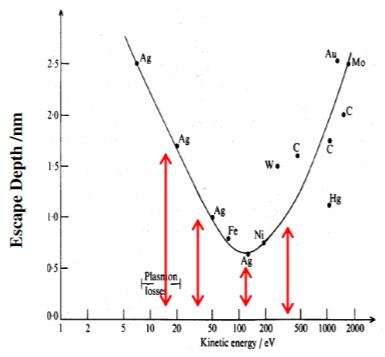
It’s a curve showing how far electrons can travel through various solid materials with varying kinetic energy.
Describe what the electron universal escape depth curve shows.
- at both high and low energies, an electron is able to travel a long way through a material
- electrons with intermediate energies are unable to travel very far through a material and therefore must have come from the surface of the sample
What are low energy electrons (LEEs)?
Electrons with around 100 eV of kinetic energy with an escape depth of around 0.7 nm before they collide and lose energy = low energy electrons. If we observe these electrons then we know they’re from the surface layers.
Describe the features of good surface experiments.
- surface selective - must give information of surface atoms, often use LEE
- sensitive - must be sensitive to the surface which consists of relatively few atoms compared to the bulk, use a glancing angle
- avoid contamination
What is LEED?
It is low energy electron diffraction. It uses the idea of wave-particle duality where electrons have wave properties that lend themselves to diffraction.
The wavelength is from the de Broglie equation in quantum mechanics:
λ = h/p
What are the key features of LEED?
- monochromatic electron beam
- detects elastic back-scattered electrons
- only works for conducting surfaces
What does a 1D LEED pattern consist of?
It consists of parallel lines from constructive interference, which denotes the position of atoms. The pattern spacing decreases with increases interatomic separation (a). This can be related back to the Bragg equation:
2asinθ = nλ
What happens to the LEED pattern when moving on to include the second dimension?
A second interatomic distance, b, is introduced. Another pattern of parallel lines, perpendicular to the first, is yielded from constructive interference.
2bsinθ = nλ
What is the resulting 2D LEED pattern?
The 2D pattern is yielded from the sum of both dimensions. Constructive interference requires both
2asinθ = nλ
2bsinθ = nλ
It generates a 2D spot pattern of a 2D surface with the spots representing the atoms. Pattern spacing still decreases with increasing interatomic seperation, either a or b.
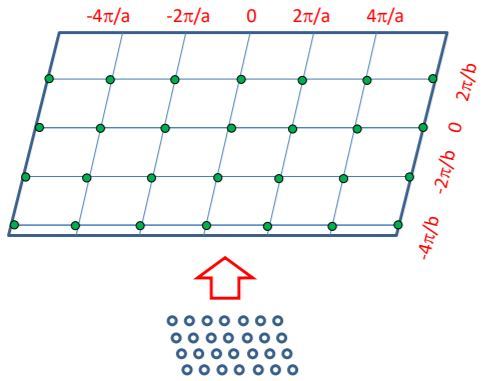
Describe the results of LEED.
One experiment shows an array of spots. The resulting pattern is a regular 2D pattern where the spacing gives an atom density of around 10-19 m2, both of these telling us that (at a glance) the surface atoms look like extensions of the bulk atoms.
Describe Miller indices in terms of the example plane below.
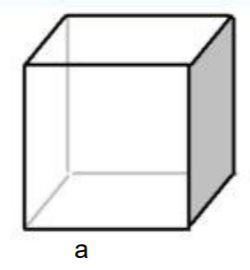
- this plane cuts the x-axis at a and doesn’t cut the y- or z- axes = (a ∞ ∞)
- divide by the unit cell dimensions = (1 ∞ ∞)
- take the reciprocal = (100) plane
- other planes can be found in a similar way
Describe the bulk of face-centred cubic structures and what happens when the structure is cleaved.
- in the bulk of FCC, each atom is surrounded by 12 nearest neighbours which makes the atoms stable
- cleaving to give a (111) plane decreases the number of nearest neighbours to 9
- cleaving to expose the (100) plane decreases it further to 8
- cleaving to expose the (110) plane decreases it to 6
What is surface energy and what is it governed by?
Surface energy is governed by the number of nearest neighbours. Fewer near neighbours means more exposed/reactive atoms and therefore a higher surface energy.
All surface atoms have fewer near neighbours than bulk atoms, so they have a higher surface energy and are more reactive.
What is the order of surface energy for different FCC planes?
(110) > (100) (111)
high to low
What else can LEED be used to observe?
It can also be used to observe surface reconstruction, which is the rearrangement of atoms to a lower surface energy. It causes there to be fewer surface atoms which reduces the overall surface energy.
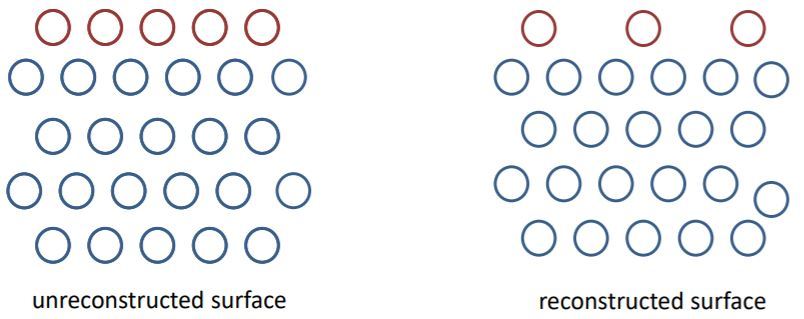
When is surface reconstruction more likely and what does it cause in the LEED pattern?
Reconstruction is more likely to occur for high surface energy arrangements of atom: (110) > (100) > (111).
Evidence from LEED shows that pattern spacing decreases with interatomic separation (a or b increases) so here the 2D pattern of spots gets closer together.
How do you avoid contamination?
When in air, every atom is constantly colliding with N2 or reactive O2. Because of this, the time for a monolayer to form is 3 x 10⁻⁹ s. This means it’s impossible to do any experiment before a monolayer forms e.g. build up of O2 on the surface.
In order to avoid contamination, ulta-high vacuum (UHV) needs to be used to increase the time taken for a monolayer to form. This also means that the probe beam isn’t affected by gases.
How can LEED give 3D information?
Spots converge as eV increases, giving a full 2D geometry - bond angles, unit cell, distinguish e.g. FCC from BCC, different planes, etc. The intensities of the spots change as they fade and new spots appear. This gives information on 3D structure - 1st, 2nd, 3rd, etc. layer. There’s also evidence of surface ‘relaxation’.
What is surface relaxation?
3D LEED shows a surface layer that has relaxed and therefore sits closer to its neighbouring layers. This relaxation causes a decrease in surface energy and the effect is greatest for higher energy surfaces.
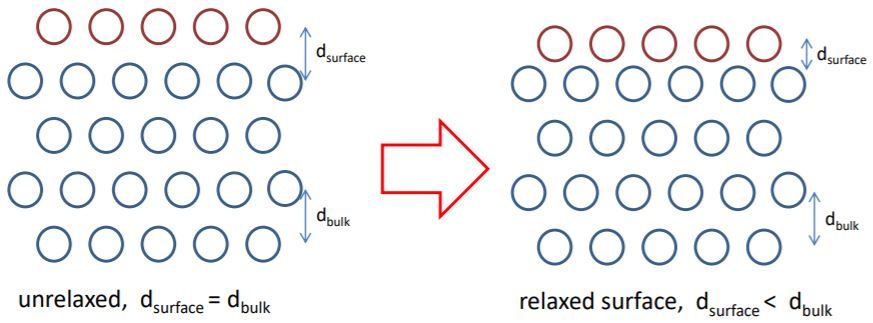
How can surface relaxation be described quantitatively?
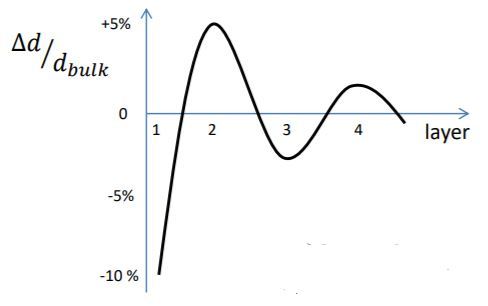
There is a maximum relaxation of around 10% for the first surface layer for ‘open’ surfaces e.g. FCC (110). The relaxation effect also affects deeper layers, but the effect is decreased for each subsequent layer.
Describe the process of adsorption.
A gas-phase molecule (adsorbate) binds to the surface (adsorbent).
- ΔS is negative, so -TΔS is positive
- for ΔG to be < 0, ΔH has to be negative (to be spontnaeous)
- this means that adsorption is always an exothermic process
Describe adsorption for crystal growth.
- special case of adsorption where adsorbate and adsorbent are chemically identical
- speed of growth depends on surface energy of crystal plane
- high surface energy faces grow fastest, e.g. (110)>(100)>(111)
- slowest growing faces dominate the crystal appearance
- low surface energy crystal



