types of side chains
- Non-polar e.g. glycine - have alkyl group.
- Uncharged polar e.g. cysteine - has S, N or OH in side chain.
- Negatively charged polar e.g. aspartic acid - has carboxylic acid group.
- Positively charged polar e.g. histidine - has amine group
peptide bond features
- Joins amino acids.
- 40% double bond character.
- Planar.
- Predominantly trans.
- Display resonance structures
peptide
short stretch of amino acids joined by peptide bonds
protein
long chain of amino acids joined by peptide bonds
primary structure
amino acid sequence of a protein
secondary structure
specific coiling or folding of amino acid residues over a short stretch of sequence into beta strand or alpha helix
tertiary structure
3D structure of a complete protein chain
quaternary structure
3D arrangement and structure of multiple chains within a protein
properties of alpha helix
- Interaction between residues that are 4 apart in the protein sequence.
- 3.6 residues/turn; 5.4Å/turn.
- Spiral is “right handed” (turns clockwise as it goes up).
- Side chains point out from the helix.
- stabilised by H bonds
- often have one side polar residues, other side non-polar
properties of beta strand/sheet
- Hydrogen-bonding occurs between adjacent chains.
- B-sheet = 2 or more B strands (typically 2-10 strands/sheet).
- Can be parallel or antiparallel.
- Sheets have right-handed twist
- often alternating polar and non-polar residues
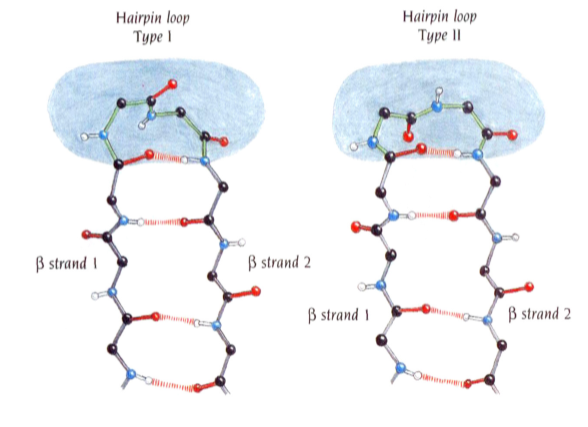
properties of turns
- Hairpin-like, usually involve 3-4 residues.
- High Gly and Pro content.
- 30% of residues involved in turns.
- Normally have H bond across turn.
- More than 16 types, type I and II are common
bond angles limiting protein flexibility
- phi Φ angle = rotation angle around the N–Ca bond
- psi (Ψ) angle = rotation angle around the Ca–C’ bond (C’ = carbonyl carbon)
- omega (ω) angle = rotation angle around peptide bond, not very flexible
These angles take on values from 0 to +/-180 degrees
Phi-Psi angles have restrictions in their values because of steric hinderance
- Phi rotation can lead to O-O collision
- Psi rotation can lead to NH-NH collisions
why are most peptide bonds trans
Steric hinderance is increased for cis peptide bonds
side chain angles
called chi and usually staggered
ramachandran plot of parallel B sheet, antiparallel B sheet, alpha helix and left-handed alpha helix
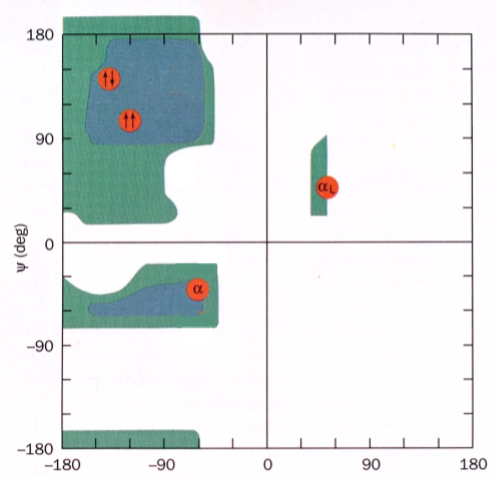
which amino acids are not found in alpha helices
glycine and proline
afinsen experiment
denatured and reduced ribonuclease and then it reformed into its original shape - showed that only instructions needed for folding are embedded in the sequence
stabilisation of protein folding
- Non-covalent interactions, while individually weak in proteins, collectively make a significant contribution to protein conformational stability
- In some proteins additional covalent bonds (eg. disulfide bonds)
- Hydrophobic core contributes most to protein stability in aqueous solution
folding pathway of proteins
- Formation of short secondary structure segments
- Nuclei come together, growing cooperatively to form a domain
- Domains come together (but tertiary structure still partly disordered)
- Small conformational adjustments to give compact native structure
what assists with protein folding
- chaperones help with folding of some proteins
- About 85% of proteins are either chaperone-independent or need a chaperone e.g. Hsp70
- Other 15% need special type of chaperone called chaperonin e.g. GroEL-GroES
unfolding of proteins
Weakening of non-covalent interactions can lead to unfolding and loss of biological function (denaturation). Can result from:
- Change in pH
- Heat
- Detergent
- Organic solvents
- Urea
misfolding of proteins
- Cause problems e.g. in brain, abnormal form of prion protein PrP causes normal PrP protein to change shape, causing brain damage. Cannot be treated
- Alzheimers disease
- Type 2 diabetes
what is phosphorylation, where can it occur and what does it do
- can occur on the side chains of Ser, Thr and Tyr
- catalysed by kinase enzymes and involves ATP
- addition of the larger charged phosphate to a hydroxyl group induces localised conformation changes in the protein
- These changes affect function e.g., the activation of a catalytic activity
phosphorylation of insulin receptor
- Insulin binds to the extracellular protein subunits of the insulin receptor
- conformation change that is communicated to the intracellular side protein subunits
- activates tyrosine kinase domains on the b-subunits
- Specific Tyr residues are then phosphorylated on the b-subunits which then leads to phosphorylation of ‘insulin receptor substrate’ proteins, which act as second messengers in the cell
- transfer of GLUT4 glucose transporter proteins to the cell membrane to enable uptake of glucose




