Function of broncial circulation
- protects lung from infarction
- can “grow into” areas of diseased lung (intercostal arteries
Consequences of bronchial circulation
- usual source of hemopytosis
- much of arterial flow drains into left atrium = shunt
General characteristics of blood flow/circulation as circuit
-R/L sides of heart pump to pulmonary and systemic -capillary beds = source of resistance -driving force ==> voltage = pressure -
Calculating pulmonary vascular resistance
PAP (pulm. artery pressure) - LAP (left atrial pressure) = CO * PVR (pulmonary vascular resistance)
Steps in pulmonary circulation
-arteries -capillary network -veins
Systemic vs. Pulm
-systemic: high resistance vessels, high elastance/low compliance, high pressure system -pulmonary: low resistance, low eslastance/high complaice, low pressure system
Pulmonary artery catheterization
-swan-ganz catheter -flow-directed pulmonary catheter -obstruct small pulmonary artery -make static water colum -measure distal pressures
Cardiopulmonary hemodynamics
[picture/table]
Impact of gravity on pulmonary pressure
-much higher pressure @ base vs. apex -gravity impacts blood pressure but not air pressure -blood flow is intermittent near apex b/c there are points @ which the arterial pressure is lower than alveolar
Physiologic zones of pulmonary blood flow
- Zone 1: PA > Pa > Pv
- PA = alveolar pressure
- Pa = arterial pressure
- Pv = venous pressure
- Zone 2: Pa > PA > PV
- Pa = Pv @ diastole
- Zone 3: Pa > Pv > PA
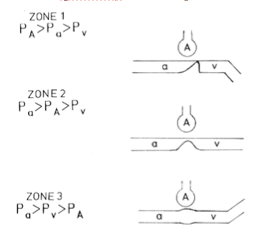
PA > Pa (Zone 1) : no blood flows
-mechanical ventilation -Auto-PEEP (COPD)
Other regulatory mechanisms of pulmonary blood flow
-hypoxic pulmonary vasoconstriction -vasoconstriction @ areas w/alveolar hypoxia -serves to preserve V/Q matching
Pulmonary edema
-originates in capillaries
Major function of pulmonary circulation
- gas exchange
- water and solute balance
major determinants of blood flow distribution in lung
- gravity
- hypoxic vasoconstriction
Major determinants of water and solute balance in lung
- Starling’s Law ==> fluid filtration is determined by difference in hyrostatic pressures inside and outside capillary in balance w/oncotic pressures
Major causes of pulmonary edema + general characteristics
- increased hyrdostatic pressure (i.e. in LHF)
- often occurs rapidly, can respond rapidly to tx
- sign: Kerley B lines = enlarged lymphatic channels along interlobular septa engorged w/edematous fluid
- increased permeability of the capillary membrane (i.e. endothelial damage)
- occurs slowly, slow or no response to tx
- ARDS/acute lung injury = possible cause
Characteristics of ARDS/Acute lung damage
- “Adult respiratory distress syndrome”
- alveolar/endothelial damage ==> fluid leak into aveoli
- ==> shunt past fluid-filled alveoli or V/Q mismatch w/poorly ventilated alveoli
- occurs 6-24 hours after tissue injury
- possible causes: trauma, inhalation of toxic gas, aspiration, embolism
Hydrostatic vs. Non-hydrostatic pulmonary edema
- Hydrostatic
- Hx of recent/fast onset
- Sx of HF
- high LA pressure (pulm. cap wedge pressure)
- responds to diuretic tx
- Nonhyrdostatic
- Hx of slower onset + exposure to traumatic stimulus
- No Sx of HF
- normal LA pressure
- does not respond to diuretics
Pulmonary hypertension definition (+equation for Ppa)
- Pulmonary hypertension = pathologic state characterized by an increase in mean pulmonary arterial pressure
- Normal pulmonary pressure=25/10 with a mean of 15 mmHg
- mean pressure > 25 mmHg = pulmonary hypertension
- Ppa- PLA(drop in pressure across pulmonary capillary beds) = CO x PVR ==>
- Ppa = CO x PVR + PLA
Common mechanisms/causes of pulmonary hypertension
- increased PLA (such as in heart failure or mitral stenosis
- increased PVR
- increased cardiac output
- not normally a major cause of pulmonary HTN due to increased vessel recruitment and dilation
WHO Classification of Pulmonary Hypertension
- Pulmonary Arterial Hypertension
- PH due to Left Heart Disease
- PH due to Lung diseases
- Chronic thromboembolic pulmonary hypertension
- PH w/unclear/multifactorial mechanism

-
Overview of the Pulmonary System13
-
Mechanics of Breathing/Compliance11
-
Surface Tension/Airway Resistance12
-
Ventilation17
-
Gas Transport in Airways11
-
Acids & Bases24
-
Control of Respiration7
-
Diffusion & Perfusion16
-
Arterial Blood Gasses9
-
Pulmonary Circulation22
-
Pulmonary Physical Exam18
-
Pulmonary Function Tests15
-
Assessment of V/Q7
-
Lung Microanatomy/Lung Histology11
-
Acute Respiratory Failure & ARDS8
-
Pulmonary Defense Mechanisms13
-
Obstructive Lung Disease26
-
Treatment of Obstructive Lung Disease20
-
Restrictive/Inflammatory Lung Disease15
-
Pulmonary Manifestation of Systemic Disease16
-
Imaging of the Lung I & II14
-
Pulmonary Pathology I31
-
Pulmonary Pathology II22
-
PNA/Influenza27
-
Cough20
-
Carcinogenesis & Lung Cancer18
-
Upper Airways/Larynx16
-
Occupational Lung Disease29
-
Pharmacotherapy of Upper Airway14
-
Tobacco Prevention/Intervention8
-
Sleep Disordered Breathing7
-
TB: Worldwide Testing/Control3
-
Diseases of Mediastinum & Pleura10
-
High Altitude/Diving Adaptations23
-
Pediatric Lung Disease14



