What is mydriasis?
Widening of the pupil
What is miosis?
Constriction of pupil
What is anisocoria?
The condition of one pupil being more dilated than the other
What muscle is responsible for pupillary dilatation?
The radial muscle
What nervous system controls the radial muscle?
SNS- activation –> pupillary dilatation (fight or flight- advantageous to see more if running away from predator etc)
What muscle is responsible for pupillary constriction?
The circular muscle
What nervous system controls the circular muscle?
PNS
Where is the afferent limb of the pupillarylight reflex?
Within CN II
Where is the efferent limb of the pupillary light reflex?
WIthin CN III
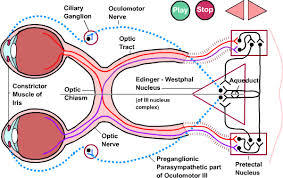
What nuclei are involved in the pupillary light reflex?
Pretectal
Edinger-Westphal
Describe the pathway involved in pupillary light responses
- Afferent: Optic nerve –> lateral geniculate body –> pretectum (midbrain)
- Efferent: Edinger-Westphal nucleus (midbrain) –> oculomotor nerve
What are the signs and symptoms of Horner’s syndrome?
Partial ptosis
Enophthalmos
Anhydrosis
Small pupil (miosis)
What is the pathology causing Horner’s syndrome?
Interruption of the sympathetic pathway starting at the hypothalamus
Will the pupillary reflexes (light and accommodation) be impaired in Horner’s syndrome?
No, however there is reduced or delayed dilatation of the eye due to interruption of the sympathetic pathway pupillodilator muscles.
What are the causes of Horner’s syndrome?
- Central:
- Demyelination e.g. MS
- Brainstem or sc tumour or haemorrhage/infarct
- Pre-ganglionic:
- Pancoast’s tumour: T1 nerve root lesion
- Trauma: Central venous catheterisation or carotid endarterectomy
- Neck surgery (thyroid or laryngeal)
- Post-ganglionic:
- Cavernous sinus thrombosis: Associated with CN 3,4, 5 and 6 palsies.
- Herpes zoster
How could you differentiate a post-ganglionic cause of Horner’s syndrome? (advanced q!)
Post ganglionic has no anhidrosis and is sensitised to 1:1000 adrenaline eye drops (cause mydriasis) unlike normal eyes or Horner’s with central or pre-ganglionic causes.
How would you differentiate congenital Horner’s syndrome from acquired causes?
Congenital Horner’s- look for heterochromia of irides (iris pigmentation requires sympathetic control, which is complete after 2 years)
What other features should you look for/examine in a patient with Horner’s syndrome?
Neck: Scars- central line insertion or carotid endarterectomy
Hands: Complete claw hand + intrinsic hand weakness, reduced or absent sensation in T1–> Pancoast’s tumour
What are the cause of unliateral ptosis?
III nerve palsy
Myasthenia gravis
Horner’s syndrome
Congenital
What are the causes of bilateral ptosis?
MG
Myotonic dystrophy
Bilateral Horner’s syndrome (e.g. syringomyelia)
Nuclear III nerve palsy
Miller Fisher syndrome
Congenital
What signs and symptoms would you see in an oculomotor nerve palsy?
Complete ptosis (due to levator palpebrae superioris losing innervation)
Eye points down and out- unopposed superior oblique and lateral rectus
Dilated pupil- unless pupil spared (e.g. early medical cases). Doesn’t react.
Ophthalmoplegia and diplopia
What is the most important thing to determine with a 3rd nerve palsy?
If the cause is medical or surgical
How can you tell a medical and surgical 3rd nerve palsy apart?
Medical- pupil sparing
Surgical- pupil affected early (mydriatic)
Why is the pupil spared in early medical 3rd nerve palsies?
- The parasympathetic fibres are responsible for pupillary constrition
- PNS fibres run from Edinger-Westphal nucleus on the periphery of the oculomotor nerve
- PNS blood supply from external pial vessels (not the vasa vasorum and nervorum that are affected by medical causes)
- The PNS fibres are therefore compressed early in surgical cases (compression by aneurysm from outside) –> permanent mydriasis of pupil only receiving SNS input
- However they are affected late by the ischaemia associated with medical causes

-
Parkinson's34
-
CN exam33
-
Visual Fields29
-
Hearing14
-
Speech28
-
Stroke24
-
Motor Function33
-
Sensation9
-
Autonomic Function4
-
Benign Intracranial Hypertension13
-
Cerebellar Disease31
-
Charcot-Marie Tooth Disease14
-
Myasthenia Gravis23
-
Facial Palsy26
-
Horner's Syndrome4
-
Hydrocephalus9
-
Meningitis17
-
Pupils36
-
Ophthalmoplegia13
-
Nystagmus11
-
Motor Neurone Disease12
-
Tremor7
-
Peripheral Neuropathy26
-
Dystrophia Myotonica8
-
Multiple Sclerosis38
-
Chronic Inflammatory Demyelinating Polyneuropathy5
-
Friedrich's Ataxia9
-
Dermatomes10
-
Cord Disease14



