variance and standard deviation equations and relationship to each other
LOS 10.a
Variance: σX2 =E(i=1 to n) (Xi - Xmean) / (n-1)
standard deviation is the square root of variance:
σX = sqrt(σX2)
Fill in the terms to this ANOVA table:
Source df SS MS
Regression ? ? ?
Error ? ? ?
Total ? ?
LOS 10.i
Source df SS MS
Regression k RSS MSR
Error n-k-1 SSE MSE
Total n-1 SST
NOTE: MSR = RSS / k; MSE = SSE / (n-k-1); R2 = RSS / SST; SEE = sqrt(MSE) ≈ sforecast for large n
Construct equations for MSE, MSR, R2, F, and SEE to show their relationship with terms in the ANOVA table:
Source df SS MS
Regression k RSS MSR
Error n-k-1 SSE MSE
Total n-1 SST
LOS 10.i
mean squared error: MSE = SSE / (n-k-1)
mean regression sum of squares: MSR = RSS / k
coefficient of determinantion: R2 = RSS / SST
F-statistic: F = MSR / MSE
standard error of estimate: SEE = sqrt(MSE)
standard error of forecast (large n): sforecast ≈ SEE
Compute the residual ^e “e-hat” for observation “i” from the observation data and the multi-variate regression
LOS 10.a
^ei = Yi - ^Yi = Yi - (^b0 + ^b1X1i + ^b2X21 + … + ^bkXki)
T-statistic used for testing regression coefficients for statistical significance
LOS 10.c, LOS 10.d
t = (^bj - bj) / s^b,j
df = n - k - 1
where:
- ^bj = coefficient to be tested
- bj = significance value to be tested (= 0)
- s^b,j = estimated standard error for bj
- n = number of observations
- k = number of independent variables
Interpret estimated regression coefficients
LOS 10.b
intercept term - value of dependent variable when all independent variables are zero.
(partial) slope coefficients - estimated change in the dependent variable for a one-unit change in that independent variable, holding all other independent variables constant.
Interpret the p-value of an estimated regression coefficient
LOS 10.b
The p-value is the smallest level of significancefor for which the null hypothesis can be rejected.
Comparing p-value to the significance level:
- If p-value < significance level, H0 can be rejected
- If p-value > significance level, H0 cannot be rejected
Example: if ^b1 = 0.40 and its p-value = 0.032, at 1% significance level:
- p (0.032) > 0.01, so we cannot reject H0, so ^b1 is not statistically signficant from 0 at 1% level of significance.
- However, we can conclude that ^b1 is statistically signficant from 0 at any significance level greater than 3.2%.
heteroskedasticity
LOS 10.k
- arises when residual variance is non-constant
- 2 types of heteroskedasticity:
- Type 1: “unconditional”
- residuals not related to X’s
- type 1 causes no major problems
- Type 2: “conditional”
- residual are related to X’s
- type 2 is a problem!
- Type 1: “unconditional”
- Impact / effect:
- std errors (sb’s) unreliable estimates
- coefifficient estimates (b’s) are not affected
- t-stats are too high (sb’s too small)
- F-test unreliable
detecting heteroskedasticity
LOS 10.k
- scatter diagrams: plot residuals vs each X & time
- Breusch-Pagan test: regress squared residuals on “X” variables to test significance of Rresid2
- H0: no heteroskedasticity
- Chi-square test: BP = Rresid2 * n (w/ df = k)
correcting heteroskedasticity
LOS 10.k
- 1st Method: White-corrected (“robust”) std errors; makes std errors higher, t-stats lower, and conclusions more accurate
- 2nd Method: use “generalized least squares” - modifying original equation to eliminate heteroskedasticity
serial correlation
LOS 10.k
- positive autocorrelation: each residual trends in same direction as previous term; common in financial data
- impact: t-stats too high
detecting serial correlation
LOS 10.k
- scatter plot: visually inspect error terms
- Durbin-Watson statistic
- formal test of error term correlation
- for large samples: DW ≈ 2(1 - r), where r = correlation of residuals from one observation to the next
interpreting Durbin-Watson values
LOS 10.k
- for DW ≈ 2(1-r):
- no autocorrelation (rho = 0): DW =2
- positive autocorr. (rho=1): DW = 0 (common)
- negative a.c. (rho=-1): DW=4 (uncommon)
- How close to “2” does DW have to be to conclude “no autocorrelation”? Look at ranges in DW tables
- table gives critical values “dl” and “du”
- H0 = no positive serial correlation
- 0 l: reject H0, is + autocorrelated
- dl u: inconclusive
- du 0
correcting serial correlation
LOS 10k
preferred method: “Hansen Method”
- adjust standard errors upwards and then recalculate t-stats
- also corrects for conditional heteroskedasticity
- result: t-stats decline, chance of Type I error (false positive) declines
multicolinearity
LOS 10.l
multicolinearity - two or more “X’s” are correlated to each other
- effects: inflates std errors; reduces t-stats, increases chance for Type II errors (false negative)
- i.e. t-stats look artificifially small, so variables look unimportant
detecting/correcting multicolinearity
LOS 10.l
Tell-tale signs from regression data:
- significant F-stat (and high R2) but all t-stats insignificant
- high correlation between “X” variables (for k=2 case only)
- sign of coefficient is unexpected
correction: omit one or more X variables
summary of regression analysis problems
LOS 10.k,l
Conditional Heteroskedasticity
- define: non-constant residual variance
- effect: Type I errors (false positive)
- detect: Breusch-Pagan; chi-square test
- correct: White-corrected standard errors
Serial Correlation
- define: residuals are correlated
- effect: Type I errors (false positive)
- detect: Durbin-Watson test
- correct: Hansen method to adjust standard errors
Multicolinearity
- define: two or more X’s are correlated
- effect: Type II errors (false negative)
- detect: conflicting t and F stats; correlation among X’s (for k=2)
- correct: drop one of the correlated X’s
regression model misspecification
LOS 10.m
model specification: process of variable selection and transformation; determines/affects quality of regression
- Effect of misspecification:
- regression coef’s will be biased and inconsistent
- lack of confidence in hypothesis tests of coef’s or in model predicitions
Types of Model Misspecification:
- omitting an important variable
- variables not transformed appropriately
- incorrect pooling of data
- using lagged dep. var. as indep. var.
- forecasting the past
- inaccurate measurement of indep. var. data
multiple regression model flow chart
LOS 10
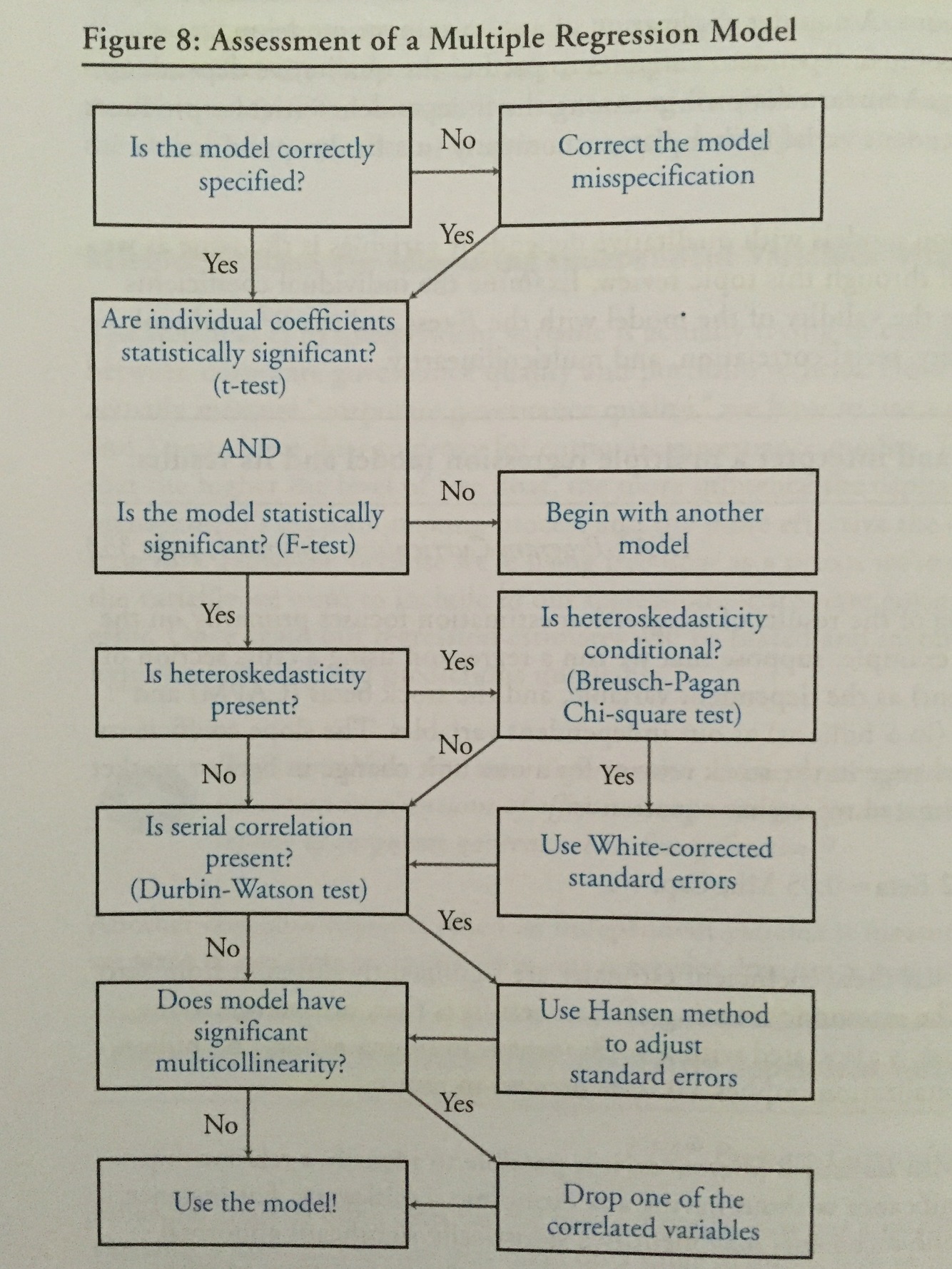

-
Equity #32 - Your Strategy Needs a Strategy14
-
Equity #33 - Industry and Company Analysis33
-
Equity #34 - Discounted Dividend Valuation17
-
Equity #31 - The Five Competitive Forces That Shape Strategy13
-
Quant Methods #9 - Correlation and Regression23
-
Quant Methods #10 - Multiple Regression & Issues in Regression Analysis19
-
Ethics #1 - Code of Ethics and Standards of Professional Conduct2
-
Ethics #2 - Guidance of Standards I-VII21
-
Economics #13 - Currency Exchange Rates: Determination and Forecasting28
-
Financial Analysis #16 - Inventories: Implications for Financial Statements and Ratios9
-
Financial Analysis #17 - Long Lived Assets: Implications for Financial Statements and Ratios18
-
General Exam-Related Items1
-
Financial Analysis #18 - Intercorporate Investments18
-
Financial Analysis #19 - Post-Employment and Share-Based Employee Compensation7
-
Financial Analysis #20 - Multinational Operations5
-
Financial Analysis #21 - Evaluating Quality of Financial Reports0
-
Financial Analysis #22 - Integration of Financial Statements Analysis Techniques0
-
Corporate Finance #23 - Capital Budgeting22
-
Corporate Finance #24 - Capital Structure14
-
Corporate Finance #25 - Dividends and Share Repurchases: Analysis15
-
Corporate Finance #26 - Corporate Performance, Governance, and Business Ethics0
-
Corporate Finance #27 - Corporate Governance10
-
Corporate Finance #28 - Mergers and Acquisitioins27
-
Alt Investments #39 - Private Real Estate Investments24
-
Alt Investments #40 - Publicly Traded Real Estate Securities20
-
Alt Investments #41 - Private Equity Valuation14
-
Alt Investments #42 - A Primer on Commodity Investing12
-
Fixed Income #43 - The Term Structure and Interest Rate Dynamics39
-
Fixed Income #44 - The Arbitrage-Free Valuation Framework8
-
#454
-
#460
-
#470
-
#480
-
Derivatives #49 - Option Markets and Contracts12
-
Derivatives #50 - Swap Markets and Contracts0
-
Equity #37 - Residual Income Valuation22
-
Equity #30 - Return Concepts8
-
Quant Methods #11 - Time-Series Analysis18
-
Portfolio Management #53 - Introduction to Multi-factor Models9
-
Portfolio Management #54 - Analysis of Active Portfolio Management8
-
Equity #35 - Free Cash Flow Valuation2
-
Equity #36 - Market Based Valuation20
-
Economics #14 - Economic Growth and the Investment Decision7



