Define a photon
a packet (quanta) of energy
State the order of the electromagnetic spectrum, in terms of increasing frequency
Radiowaves
Microwaves
Infrared
Visible
Ultraviolet
X-rays
Gamma rays
What do all electromagnetic waves have in common?
- They all travel at the speed of light in a vacuum
- They are transverse waves.
How are electromagnetic waves emitted?
From a charged particle when it loses energy, this can happen when:
An electrom moves from a higher to a lower energy state
A fast moving electron is stopped e.g. x-rays
What is the relationship between photon energy and frequency?
Directly proportional
What is the relationship between photon energy and wavelength?
inversely proportional
Define an eV
1 eV is the energy gained by an electron passing through a potential difference of 1 V
Describe the photoelectric effect experiment?
- An insulating rod is given a negative charge.
- The negative charge is passed onto a zinc plate.
- The charge moves down onto the gold leaf
- The gold leaf repels and deflects away from the center
- Various light source are shone onto the zinc plate
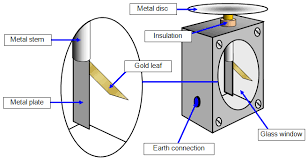
Describe the observations of the photoelectric experiment
- When UV light (high frequency) light is shown on the zinc plate the leaf falls immediately so electrons are being lost from the plate
- If a filament lamp (lower frequency) is used the electroscope doesn’t discharge (gold leaf doesn’t move)
- When very intense visible light is used, no electrons are emitted (gold leaf doesn’t move)
- If very low intensity UV light is used the discharge starts immediately
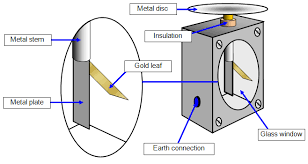
Describe the conclusions of the photoelectric experiment
- There is a threshold frequency (minimum frequency) below which no photoelectrons are released
- The light is not interacting as a wave as enough energy would be eventually be transferred and photoelectrons would be released
- light is interacting as single photons** with the **surface electrons in an one to one interaction
- If the photons have enough energy/frequency (E=hf) then a photoelectron is released.
- If the frequency of the wave is to small it won’t have enough energy to release a photoelectron with a one to one interaction
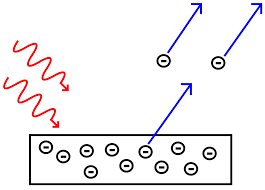
Define threshold frequency
Threshold frequency – minimum frequency of radiation needed to release photoelectrons
Define work function
Work function – energy an electron must gain to be released from the metal
Define intensity
The amount of energy arriving per second per m2
In the photoelectric effect what is the affect of increasing the intensity of visible light?
No effect, the frequency will be below the threshold frequency so no electrons will be released
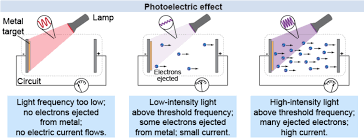
In the photoelectric effect , if UV radiation is used with a constant frequency but the intensity is increased, what is the effect?
More photoelectrons are released each second - If intensity is increasing but each photon has a constant energy (E = hf) then more photons must be arrving and interacting with electrons per second.
Each photoelectron will have a constant kinetic energy as the energy of the incoming photons is constant (E=hf)
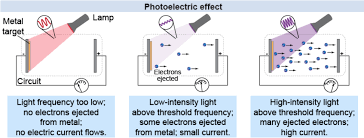
In the photoelectric effect, if UV radiation of constant intensity was used but its frequency was increased what would be the effects?
Less electrons would be released each second - the same energy must be arriving per second but each photon has more energy - so less photons must be arriving per second
Each released photoelectron will have more kinetic energy as the incoming photons have more energy (E = hf)
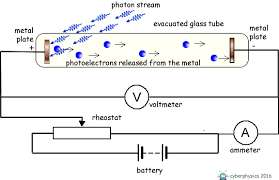
Describe the stopping potential experiment
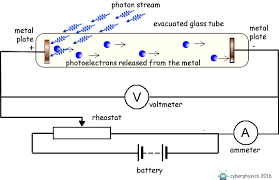
- Photoelectrons are emitted from a metal surface.
- They then have to travel towards the negative terminal of a battery.
- This means they have to do work against the potential difference.
- The stopping potential is the p.d. needed to stop the fastest electrons with the maximum kinetic energy.
- The work done by the p.d. is equal to the initial energy of the electrons.
- W = VQ
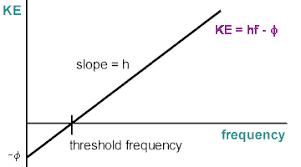
From a graph of kinetic energy against frequency what can be found out?
Gradient = h
x intercept = threshold frequency
y intercept = - work function
Describe excitation
An electron can move up an energy level by gaining energy (e.g. via heating or collisions with other particles). This is called excitation.
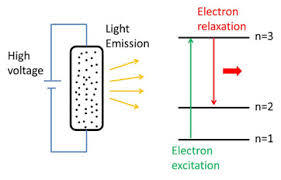
Describe how excitation happens via collision with electrons
Electrons collide with atom transfering some or all of its energy.
If the electron has more energy than the energy difference between the energy levels, then the eletron will take the excess energy away as kinetic energy.
If the electron has the same energy as the difference between energy levels then it will transfer all of its energy and the electron will stop.
If the electron has less energy than then difference between the energy levels then it will be deflected by the atom with no loss in kinetic energy or excitation.
Describe excitation by using photons
Electrons in an atom absorb a photon and all of its energy. This can only happen if the energy of the photon is exactly equal to the energy the electron would need to gain to move to a higher energy level.
If the photons energy is smaller of larger than the difference between the two energy levels then it wont be absorbed.
Describe relaxation
An electron can move down to a lower energy level by losing energy. This is done by releasing a photon. This is called relaxation.
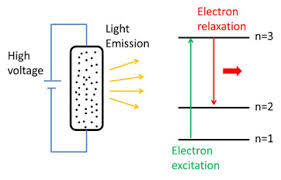
Define ionisation
If an electron gains enough energy it can escape the atom. This is called ionisation.
Why do energy levels have negative values?
- For an electron that is bound to the atom, energy has to be added to release it.
- Work has to be done to move an electron to a higher energy level
- But we define an electron as just being ionized as having zero energy.
- So we say that the electron in an energy level has negative energy.



-
Electricity26
-
Prefixes11
-
Thermal physics47
-
Gravitational fields44
-
Electric Fields37
-
Capacitors27
-
Magnetism40
-
Fields Exam Questions52
-
Nuclear Physics Exam Questions17
-
Particle Physics65
-
Quantum Mechanics35
-
Mechanics and Materials53
-
Waves and Optics80
-
Practical skills20
-
Nuclear Physics30
-
Definitions96
-
Circular Motion26
-
SHM revision40



