sx of radiculopathy
acute stabbing pain/electrical sensation at the level of the compression - dermatomal
radiates to legs (sciatica) or arms
parasthesia of dermatome
numbness, dull reflex, LMN weakness and wastage at level of root
pain increases with pressure
short walks and changing position reduces the pain
what is radiculopathy
root compression
which root is affected
the one below the herniation eg L4L5 herniation = L5 radiculopathy
S1 root compression
calf pain
weak foot plantar flexion
reduced pinprick sensation over sole of foot and back of calf
reduced ankle jerk
L5 root compression
hallux extension is weak
reduced sensation on outer dorsum of foot and lateral leg
Ix for radiculopathy
MRI or CT
plain XR - exclude other dx
straight leg raise test (lasegue sign) - straight leg raised = increased pain on ipsilateral with radiation to motor and sensory of affected root
bragard sign - straight leg raised = increased pain in ipsilateral leg - leg lowered to just below this point + ankle dorsiflexed = reproduction of the pain
crossed straight leg raise test - opposite straight leg raised = pain in contralateral in root area
spurling manouvre (neck compression test) - cervical spine radiculopathy - forward flexion, tilting and rotation of neck to affected side and application of downward pressure to head = reproduction of pain or parasthesia with radiation
aetiology of radiculopathy
degenerative disc changes
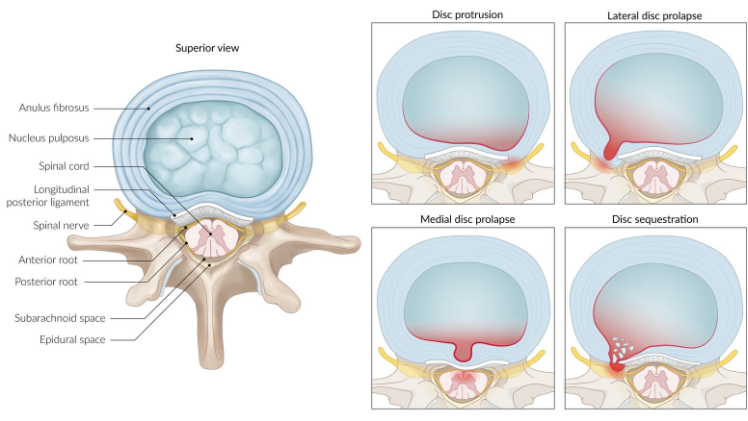
- disc protrusion - protrusion of the vertebral disc nucleus pulposus through annulus fibrosus
- disc herniation - (disc extrusion ot prolapse) - complete herniation of the nucleus pulposus through a tear in anulus fibrosis
- disc sequestration - extrusion of nucleus pulposes and separation of a fragment of the disc
trauma
OA
epidemiology of radiculopathy
30-50yrs
female
cervical and thoracic herniations - rare
lumbosacral L5-S1 most common site
MRI for radiculopathy
confirm dx
disc degeneration - sclerosed, dehydrated disc - hypointense on T2 weighted image
disc prolapse/herniation - herniation and oedema
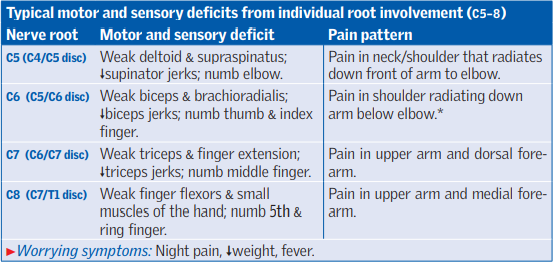
c3/4 radiculopathy
level of lesion - c2-4
sensory loss - shoulder and neck
scapular wing
c5 radiculopathy
level of lesion - c4-c5
sensory - anterior shoulder
motor - biceps and detoid
biceps reflex reduced
c6 radiculopathy
lesion - c5–c6
sensory - upper lateral elbow -> radial forearm -> thumb and radial side of index
motor - biceps and wrist extensor
reflex - biceps, brachioradial
c7 radiculopathy
level - c6-c7
sensory
- palmar - ulnar side of finger 2, all 3, radial side of 4
- dorsal - medial forarm up to 2-4
motor - triceps and wrist flexors, finger extensors
reflex - triceps
c8 radiculopathy
level c7-c8
sesnory - dorsal - forarm and up to dorsal and palmar area of fingers: ulner part of 4 and all 5, hypothenar eminence
motor - finger flexors
l3 radiculopathy
lesion - l2-3
sensory - anterior lateral area of the thigh, stretching diagonally from the thigh to the upper area of the medial knee
motor - hip flexion
reflex - adductor, patella
l4 radiculopathy
lesion - l3-4
sesnory - distal anterolateral thigh ober patella to inner side of lower leg
motor - knee extension
reflex - patella
l5 radiculopathy
lesion - l4-5
sensory - lateral sides of the thigh and knee, anterolateral leg, dorsum of foot, big toe
motor
- tibialis anterior (foot dorsiflexion) = difficulty heel walking ie foot drop
- extensor hallucis longus - first toe dorsiflexion
reflex - posterior tibial reflex (medial hamstring)
S1 radiculopathy
lesion - l5-S1
sesnory - dorsolateral thigh and lower leg, lateral foot
motor - peroneus longus and brevis muscle (foot eversion) and gastrocnemius muscle (foot plantarflexion) = difficulty walking
reflex - achilles, lateral hamstring
s2 3 and 4 radiculopathy
lesion - s1-s4
sensory - posterior aspect of thigh and lower leg (s2), perineum (s3), perianal (s4)
reflex - bulbocavernosus, perineal
mx of sciatica
STarT back screening tool - assess disability
1. self mx - continue normal activities - usually settle within months
2. analgesia (NOT opioids) - lowest NSAID dose for shortest time
3. gp exercise program
4. physio
5. psychological therapy - CBT
self mx for sciatica
- return to work
- hot water bottle
- keep active
- pain doesnt = injury
mx of cervical radiculopathy
- if less than 4-6 wks = conservative
- if >4-6wks or neuro signs - MRI, iterlaminar cervical epidural injections
conservative mx for cervical radiculopathy
- reassure good px
- activity
- dont drive if range of neck motion reduced
- firm pillow
- oral analgesics
- consider amitriptyline, duloxetine, pregabalin, or gabapentin
- physio
indications for surgery for cervical radiculopathy
unremitting pain despite 3 mo conservative rx
disabling sx
progressive motor weakness
mri shows root compression

-
wernicke's encephalopathy13
-
MS39
-
MND17
-
myasthenia gravis23
-
Parkinson's14
-
Epilepsy43
-
migraine21
-
spinal cord compression29
-
radiculopathy24
-
Bell's palsy13
-
CNS tumours23
-
cluster headache11
-
neurofibromatosis21
-
GBS9
-
extradural haemorrhage7
-
Horner's syndrome8
-
huntington's8
-
hydrocephalus12
-
ICP7
-
subdural14
-
stroke29
-
SAH7
-
tension headache10
-
trigeminal neuralgia7
-
TIA9
-
encephalitis21
-
malaria19
-
meningitis25
-
muscular dystrophies17
-
essential tremor8
-
stroke by anatomy13
-
brief brain tumours19



