What is rectal bleeding?
Also known as haematochezia
The passage of fresh blood per rectum, typically caused by bleeding from the lower GI tract.
Large upper GI bleeds can present as haematochezia… When do you assume a rectal bleed is due to an upper GI bleed?
A patient with a large fresh rectal bleed who is haemodynamically unstable has an upper GI bleed until proven otherwise
Describe the blood supply of the large bowel.
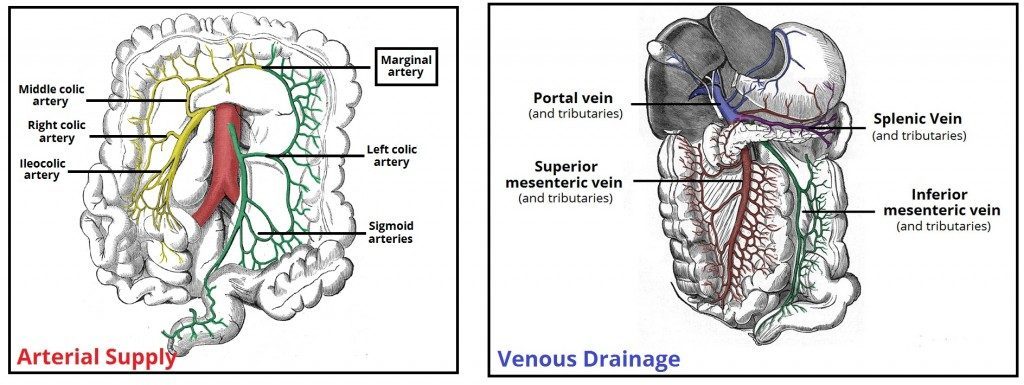
What are differentials for rectal bleeding?
- Diverticulosis
- Ischaemic or infective colitis
- Haemorrhoids
- Malignancy
- Angiodysplasia
- Inflammatory bowel disease
- Radiation procititis
What are diverticulum? & Where do they most commonly occur?
Out-pouchings of the bowel wall that are composed only of mucosa
Most commonly in the descending and sigmoid colon.
What are the characteristic features of a rectal bleed due to diverticulosis?
- Older patient
- Painless (typically)
- Diverticulitis bleeds are often painful, due to the localised inflammation.
What are haemorrhoids?
Pathologically engorged vascular cushions in the anal canal.
How do haemorrhoids present?
- Mass
- Pruritus (itching)
- Fresh red rectal bleeding.
- Classically on the surface of the stool or toilet pan, rather than mixed in with it
- Extreme pain (sometimes)
- Due to thrombosis of large haemorrhoids
When should you suspect malignancy as a cause for rectal bleeding?
Any case of PR bleeding (esp. in the elderly!) malignancy should be suspected, as this may be a colorectal cancer.
What features are suggestive of bowel malignancy when assessing a patient with haematochezia?
- Lower GI symptoms
- Weight loss
- Relevant family history
What are key aspects to ascertain from clinical assessment of a patient with rectal bleeding?
- Nature of bleeding
- Duration
- Frequency
- Colour
- Relation to stool and defecation (e.g. streaks / mixed in)
- Associated symptoms
- Pain (especially association with defaecation)
- Haematemesis
- PR mucus
- Prev. episodes
- Fam Hx of bowel cancer or IBD
What examination is essential for every patient presenting with haematochezia (rectal bleed)?
- PR examination
- To assess for any rectal masses or anal fissures
What investigations are useful for a patient presenting with rectal bleeding?
- Routine bloods (FBC, U&Es, LFT, coagulation studies)
* Elevated serum urea:creatinine ratio suggests an upper GI bleed - Group and Save requested (as a minimum).
- Stool cultures
* To exclude infective causes. - Flexible sigmoidoscopy
- To exclude left-colonic pathology (esp. malignancy) for patients who are haemodynamically stable
- Can often be performed as an outpatient.
- Full colonoscopy
* If flexible sigmoidoscopy proves inconclusive, - OGD
* To look for further sources of bleeding in stable patients with PR bleeding and no abnormality identified on colonoscopy - Urgent CT angiogram (Haemodynamically unstable patients)
* To establish source of bleeding, as well as permitting potential therapeutic intervention with embolisation.
What are risk factors for adverse outcomes from any acute rectal bleed?
- Haemodynamic instability
- Ongoing haematochezia
- Age > 60yrs
- Serum creatinine > 150µmol/L
- Significant co-morbidities
How is rectal bleeding managed?
- Resuscitation (For any acute large rectal bleed)
- A to E approach
- IV access with 2 large bore cannulae
- IV fluid
- Blood products crossmatches (as required).
- Endoscopy (for patients haemodynamically unstable or have ongoing bleeding
- Injection of diluted adrenaline
- Thermal devices
- Mechanical therapies (e.g. band ligation & endoscopic clips
- Arterial embolisation
Can be trialled for those who undergo angiography esp if the vessel is identifiable and sufficient diameter
- Surgical intervention
* For some patients with ongoing lower GI bleeding with instability (or requiring continued transfusion), where above options have failed.
What percentage of cases will resolve spontaneously?
95% of cases will settle spontaneously.




