Define the role of the FS in the refractive surgery program.
Pre-op: Application, pre-surgical criteria
Post-op: DNIF, RTFS and waiver
How much of refraction power is from the cornea?
2/3
Describe where the image is focused in myopia, hyperopia and astigmatism.
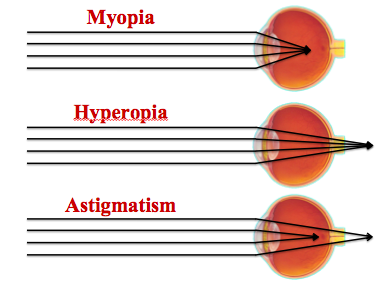
What is done to the cornea during refractive surgery in myopia, hyperopia, and astigmatism?
- Myopia– central cornea flattened
- Hyperopia– peripheral cornea flattened
- Astigmatism– asymetric treatment
List the types of refractive surgery and give examples. What is PRK and LASIK classified as? Why do you need to know these?
- ASA (advanced surfce ablation)– PRK, Epi-LASIK, LASEK
- ISA (Intra-stromal ablation)– LASIK
Must know these as these are the only procedures approved for aircrew.
Discuss refractive effect on presbyopia, particularly in relation to mild/moderate myopia.
CRS will not correct presbyopia.
List 3 complications of CRS and their management.
- Corneal haze– steroid drops and re-scrape epithelium
- Striae ad microstriae
- Flap dislocation (LASIK)
Discuss altiude effects with PRK and LASIK.
- PRK– none
- LASIK– change in visual acuity reported in climbers
How long are steroid eye drops required post-CRS? Why does this matter aeromedically?
- PRK– 2-4 months
- LASIK– 1 week
Required to be DNIF while on steroid eye drops. However, must be minimum of 1 month, even though off steroid drops earlier with LASIK.
List 9 pre-surgical requirements for CRS.
- > 6 months retainability
- > age 21
- Rx stability (< 0.50 diopter change over 1 yr)
- Normal corneal topography (no kerataconus)
- Adequate corneal thickness
- Discontinue contacts
- SCL– 1 month prior (14 days for non-aircrew)
- Hard– 90 days
- Contraindicated ophtho & systemic comorbidities
- Not on contraindicated meds
- 6-months post-pardum and not breastfeeding
List refraction limits for CRS in myopia, hyperopia and astigmatism
- Myopia: -8.00
- Hyperopia: +3.00
- Astigmatism: 3.00
Must ensure that conversion calculations done
What must aircrew have prior to CRS regardless of where the surgery is done?
Permission to Proceed
When can aircrew RTFS?
Following MAJCOM waiver
List 6 required exam items required for RTFS waiver.
- 20/20 on OVT
- 20/50 on Precision Vision 5% chart
- OVT-DP
- Refraction
- Rx stability
- Normal exam (slit lamp, DFE, IOP)
What is the median RTFS time for PRK and LASIK? Why does this matter in AFSOC?
50% RTFS
- PRK @ 4 mo
- LASIK @ 3 mo
AFSOC deployment cycles are 90 days, therefore only approving LASIK
Why is there concern about CRS at altiude?
Cornea is avascular. Gets oxygen from atmosphere.
What causes the perceived halo following CRS?
The area of ablation is the area of good refraction. Light that comes in at edge is perceived as a halo. Incidence has decreased with increasing area of ablation zone.

-
Ophthamology for the Flight Surgeon78
-
Aeromedical Impact of Selected Ophthamologic Conditions70
-
Lasers21
-
Aeromedical Certification of the Visual System5
-
Ocular Motility and Stereopsis37
-
Night Vision12
-
Color Vision in Aircrew14
-
Refractive Surgery Program19
-
Aviation Vision and Options for Correction48



