Test-Retest Reliability
- Coefficient: test-retest reliability coefficient
- Common with self-report survey instruments
- ie: a subject takes an identical test on two different occasions under identical testing conditions
- Considerations:
- Test-retest intervals
- Carryover and testing effects
Very important to talk about the Test-retest intervals. Like how long since we last took the test. (like I probably cannot take the cognitive tests Dr. Esmat used in her study for a long time if ever)
Testing effect. Did I do better because I learned the test or because I improved?
Carryover and testing effects.
Internal Consistency
A type of Reliability
- Generally used with questionnaires, written exams, and interviews (more for qualitative research)
- Use correlations among all items in the scale
- Want to see some relationship among the items on an exam, interview….as they should measure the same attribute
- Reliability coefficient: correlations
Criterion-Related Validity
- Most practical and objective approach to validity testing
- Ability of one test to predict results on an external criterion
- High correlation indicates the test is valid based on the external criterion
- External criterion must be valid, reliable, independent and free from bias (Must make sure the gold standard is really a gold standard if you are going to use it for this)
- May also be called reference standard or gold standard or
- Can be tested using concurrent or predictive validity
ICC
- Reliability coefficient: intraclass correlation coefficient (ICC)
- The reliability coefficient for Rater Reliability tests (both Intra- and Inter- rater)
Relationship between validity and reliability
- Validity implies that a measurement is relatively free from error
- Inherently means that a valid measurement is also reliable
- A test can be reliable, but not valid
- A test cannot be valid, but not reliable
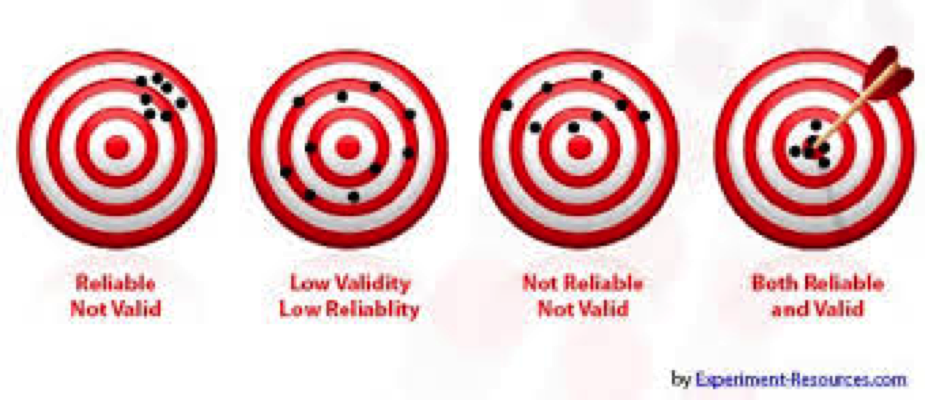
What is the validity counterpart to internal reliability?
Content Validity
Random Errors
Random errors: Due to chance and can affect scores in unpredictable ways
- Decrease random errors= increase reliability
- Reliability focuses on amount of random error a measurement has
- Example: fatigue
Three main Types of Reliability
- Test-retest reliability: Stability of the measuring instrument
- Rater reliability: Stability of the human observer
- Inter-rater versus Intra-rater
- Internal consistency: extent to which items measure various aspects of the same characteristic and nothing extraneous
- more for when using questionnaires
Inter-rater reliability
Inter-rater reliability: variation between 2+ raters who measure same subject
- Best if all raters measure a response during one trial
- Ensure blinding of other assessors
Reliability coefficient: intraclass correlation coefficient (ICC)
Three Sources of Measurement Error
- Individual taking the measurements
- Called tester or rater reliability
- Measuring instrument introduces error
- Variability of the measured characteristic
Validity: Convergence and Discrimination
Convergent validity: two measures believed to reflect the same underlying phenomenon will have similar results or correlate highly
- Implies that the theoretical context behind the construct will be supported when the test is administered to different groups in different places at different times
Discriminant validity: different results (low correlations) are expected from measures which are believed to assess different characteristics (Discriminant validity is when two measures that measure different things should not correlate well.)
Construct validity is related to convergent and divergent
Four Types of Measurement Validity
- Face validity
- Content validity
- Criterion-related validity
- Concurrent validity
- Predictive validity
- Construct validity
Systematic errors:
Systematic Errors: predictable errors of measurement
- Consistently overestimates or underestimates the true score
- Constant and biased
- More of a problem with validity than reliability
(Systematic error is a reliable error: For example, an uncalabrated scale is always the same amount off each time you measure it. It causes problems with validity but not reliability.)
Predictive Validity
- Establishes that the outcome of a test can be used to predict future score or outcome
- ie: GPA used to predict success in PT school or BERG balance test used to predict falls
- Criterion and target test are tested at different times
Target test = new test that is untested so far
Responsiveness to Change
- Responsiveness: ability of an instrument to detect minimal change over time
- Used to assess the effectiveness of interventions
- Minimal clinically important difference (MCID): smallest difference in a measured variable that signifies an important difference in a subject’s outcome
- Statistical versus clinically meaningful change
Intra-rater reliability
Intra-rater reliability: stability of data recorded by one individual over 2+ trials
- Rater bias: when raters are influenced by their memory of the first score
- Best to blind tester
Reliability coefficient: intraclass correlation coefficient (ICC)
Face Validity
- Least rigorous form of validity
- Instrument appears to test what it is supposed to test
- ie: ROM, strength, sensation, gait, balance
- Considered subjective and scientifically weak
Concurrent Validity
- Establishes validity when two measures are taken at the same time. One measure is used as the gold standard
- Both reflect the same incident of behavior
- Commonly used with diagnostic or screening tests for determining presence or absence of a disease
- Also used with a new or untested measure may be more efficient than a more established method
Concurrent is if the two measures are taken at the same time (gold standard and comparison test) when testing the criterion-related validity
Also used with a new or untested measure (target test) may be more efficient than a more established method – IntegNeuro
Measurement error
(include formula)
Relates to Reliability
Measurement error: difference between observed and true scores
- Observed score - true score = error
- Reliability is an estimation of how much of a measurement represents error and how much is the true score
(The formula she had was observed score = true score – error, but she keeps talking about that measurement error is the difference between observed score ant true scores (so I changed the formula)
Reliability
Validity
Reliability: How consistent and free from error is the instrument.
- Reliability is an estimation of how much of a measurement represents error and how much is the true score
Validity: Does the test measure what it intends to measure
Reliability Coefficient (formula and interpretation)
Reliability coefficient= True score variance/(true score variance + error variance)
- Ranges from 0.00-1.00.
- These numbers are arbitrary, but they are used in literature. As a researcher, we have to decide what level of reliability is reliable or not.
-
- .50-.75= moderate reliability
- >.75= good reliability
Zero is poor reliability (0% reliable à none is attributal to true difference)
One is the best reliability (100% reliable à all is attributed to true difference)
Reliability Coefficient
Estimate reliability based on statistical concept of variance
- Measure of variability or differences among scores within a sample
- Some variance is attributed to true differences among scores and some is attributed to random error
- Difference among the scores will all of us (if we were going to have a pop quiz today). Random error Variance would be from how much we slept last night. Then results of the test that reflects what we acually remembered (instead of bad answers because of sleep deprivations) would be the true difference Variance.
Reliability= how much of total variance is attributed to true differences between scores
Rater Reliability
Intra-rater reliability: stability of data recorded by one individual over 2+ trials
- Rater bias: when raters are influenced by their memory of the first score
- Best to blind tester
Inter-rater reliability: variation between 2+ raters who measure same subject
- Best if all raters measure a response during one trial
- Ensure blinding of other assessors
Reliability coefficient: intraclass correlation coefficient (ICC)
Intra-rater –> same person
Inter-rater –> between more than one person
Must be same subject being tested and same setup
Test-retest is looking more at the test (or the person taking the test), whereas Intra-rater reliability would be more about the person giving the test.
Rater bias: see how much they got before and try to get to the same value the second time. (overcome by blinding tester to the outcome of the test).
Regression Towards The Mean
- Observed scores move closer to the mean with repeated tests
- A phenomenon which occurs more with outliers and increased random error
- Example: extreme high and low scores on a pre-test which may not indicate true knowledge move closer to the class average on the post-test
- More of a problem with less reliable test

-
Research Design PowerPoint Lecture, Dr. Wofford80
-
Parametric Statistics - Dr. Wofford77
-
Introduction to Research Presentation - Dr. Wofford48
-
Critiquing Research Lecture - Dr. Wofford31
-
Statistics Lecture - Dr Wofford23
-
Glossary Portney & Watkins431
-
Reliability Versus Validity Lecture Dr Wofford30
-
Sampling Design Lecture Dr Wofford16
-
Interpreting Outputs and Threats Lecture - Dr Wofford16
-
Asking The Research Question - Dr. Wofford17



