Any Pega Platform class with ________ can be mapped to a DB table.
Any Pega Platform class with concrete instances can be mapped to a DB table
Reports use ________ to locate the data from one or more DB tables
Reports use class mappings to locate the data from one or more DB tables.
Pega Platform uses two rule types to identify the DB table the class is mapped to: ________ and ________
Pega Platform uses two rule types to identify the DB table the class is mapped to: Database and Database Table
_________ identify how Pega Platform connects to specific DBs and contains the connection information for Pega Platform to access to DBs
Database records identify how Pega Platform connects to specific DBs and contains the connection information for Pega Platform to access to DBs
- This record is an alias that can be referred to elsewhere, such as in a DB table record
- DB records can be configured to use either JNDI or JDBC URL for the DB connection
By default, Pega Platform always contains the following DB records:
PegaRULES: Maps to the DB where all Pega Platform ______ and ______ are saved
_________: Maps to either DB where data and work instances.
By default, Pega Platform always contains the following DB records:
PegaRULES: Maps to the DB where all Pega Platform rules and system data are saved
PegaDATA: Maps to either DB where data and work instances.
___________ exist for every Pega Platform class and identify the corresponding DB and table
DB table records exist for every Pega Platform class and identify the corresponding DB and table
Pega Platform uses this record to identify which table to write case data to when a user creates or updates a case or data instance
What do we use if we want to save instances of several classes in the same table?
Class Group
- Also known as a work pool*
- Rather than create a DB table for each case type you designate a class (typically the parent class) as a class group*
_________ cause the system to store instances of similar or related case types together in a single DB table
Class Groups cause the system to store instances of similar or related case types together in a single DB table
A report created in a specific case type returns only records in the case type, while a report created in the class group returns all instances in the classes that belong to that class group
True or False? Concrete classes can be mapped to a DB table.
TRUE
You create a report that uses data from two classes. Which of the following reporting requirements requires the use of a subreport?
- Columns to display are: Manager, Name, and Count of operators that report to each manager. Filter by Managers with more than five direct reports.
- Columns to display are: Operator Name, Operator Division, Count of Purchase Requests created.
- Columns to display are: Operator Name, Operator Division, and Count of Purchase Requests created by the operator. Filter the results by unresolved status.
- Columns to display are: Operator Name, Last updated Case ID, Last updated Case Status, and Update Date.
1. Columns to display are: Manager, Name, and Count of operators that report to each manager. Filter by Managers with more than five direct reports.
- You use an aggregate function in a subreport to determine the count of direct reports for each manager*
2. Columns to display are: Operator Name, Operator Division, Count of Purchase Requests created. - You can use a join and a summary function to create this report.*
3. Columns to display are: Operator Name, Operator Division, and Count of Purchase Requests created by the operator. Filter the results by unresolved status. - You can use a join, a summary function, and a filter in order to meet this requirement*
4. Columns to display are: Operator Name, Last updated Case ID, Last updated Case Status, and Update Date. - You can create this report in the case type class*
You create a report in a work class that displays the assigned operator and task name for each open case. Which two ways can you combine data in the Assign-Worklist class for your report? (Choose Two)
- Use a Worklist Assignment association rule to join to the Assign-Worklist class. Specify a join filter where the pxRefObjectKey in the join class is equal to an object identifier in the work class.
- Use a class join to the Assign-Worklist class. Specify a join filter where the Worklist Assignment association rule is equal to an object identifier in the work class.
- Use a class join to the Assign-Worklist class. Specify a join filter where the pxRefObjectKey in the join class is equal to an object identifier in the work class.
- Use a Worklist Assignment association rule to join the Work class to the Assign-Worklist class.
- Use a Worklist Assignment association rule to join to the Assign-Worklist class. Specify a join filter where the pxRefObjectKey in the join class is equal to an object identifier in the work class.
* When you use an association rule, you do NOT specify a join filter* - Use a class join to the Assign-Worklist class. Specify a join filter where the Worklist Assignment association rule is equal to an object identifier in the work class.
* You do not use association rules as filters in class joins*
3. Use a class join to the Assign-Worklist class. Specify a join filter where the pxRefObjectKey in the join class is equal to an object identifier in the work class.
The class join specifies the class you are joining and a filter describes how the data between the classes is joined
4. Use a Worklist Assignment association rule to join the Work class to the Assign-Worklist class.
The association rule defines the join operation and enables you to select data objects in the class
Which report requires joining classes?
- A list of all child cases showing the work urgency of their parent case
- A list of flow actions and average turnaround time, categorized by Performer
- A list of all cases created by the operator along with the work status of each case
- A list of all worklist assignments grouped by the operator who is performing the action
1. A list of all child cases showing the work urgency of their parent case
- You would join the case and subcase classes by matching the subcase cover ID (pxCoverInsKey) to the case identifier (pzInsKey)*
2. A list of flow actions and average turnaround time, categorized by Performer - This report can be created in a History class*
3. A list of all cases created by the operator along with the work status of each case - This report can be created in a Work class*
4. A list of all worklist assignments grouped by the operator who is performing the action - This report can be created in an Assign class*
To optimize performance, properties referenced in reports must be __________ _\_ _\______ in the DB table.
To optimize performance, properties referenced in reports must be exposed as columns in the DB table.
The two main types of assignment objects created are worklist and workbasket (class Assign-WorkList/WorkBasket) which are mapped to the DB tables _____________ and _____________ respectively by using the associated class mappings.
The two main types of assignment objects created are worklist and workbasket (class Assign-WorkList/WorkBasket) which are mapped to the DB tables _pc_assign_worklist_ and _pc_assign_workbasket_ respectively by using the associated class mappings.
- When an assignment is completed the assignment object is deleted and another is created following the processing in the steps and stages of a case type*
- There are many standard assignment reports and these reports are often speciaalized to meet specific business requirements (for example, a join to the class of a case type to return associated case data)*
- When joining to the class of a case type, the asasignment class pyRefObjectKey is used to match with the pzInsKey of tthe case type*
Which set of class properties are commonly used to generate reports?
- Work
- Assignments
- History
What are 3 examples/methods of combining classes/tables to assist in reporting?
- Parent + Child Case Relationship
- Shows child case data along with parent in reports
- Ex: We want a report that shows all the purchase orders in a purchase request. We match the case ID of Parent with the case ID of child class
- Case + Assignment Relationships
- Show how the system processes assignmentst for a case
- Ex: Want to show the operators working on specific cases.
- Match operator ID in the case DB table with operator ID in the assignment table
- Case + History Relationships
- Monitor performance
- Ex: Want to show the total amount of time required to resolve specific cases
- Match case ID in the case data table with the case ID in the history table
You can create class or DB table relataionships in a ____________._
You can create class or DB table relataionships in a Report Definition.
You can combine data from different classes by configuring _______, __________________, or creating _________.
You can combine data from different classes by configuring class joins, referencing association rules, or creating subreports.
What are the 4 steps to create a class join?
- Determine the class to which you are joining
- Create a prefix that in combination with the class name, serves as an alias for the joined class
- Include or exclude instances that do not match
- Create a filter that describes how you relate the classes
In a report definition the ________** combined with the **_______\_ services as an alias for the joined class and its properties.
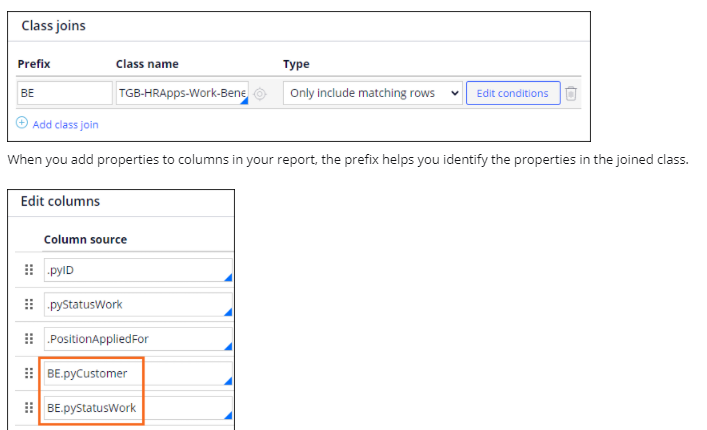
In a report definition the prefix combined with the class name servces as an alias for the joined class and its properties.
- To join to a work class that describes benefits enrollment cases, you might provide the prefix ‘BE’*
- Properties in columns of your report will look like BE.pyID*
__________ define the relationships between classes in reports.
Filter conditions define the relationships between classes in reports.
Unlike a class join (unique to each report), _______\_ can be reused in any report.
Unlike a class join (unique to each report), associations can be reused in any report.
Unlike associations (reusable across multiple reports), ___________ are unique to each report.
Unlike associations (reusable across multiple reports), class joins are unique to each report.
A ________ is called by another report to provide data.
A subreport is called by another report to provide data.
- Subreports enable results from any report definition in tthe main report.*
- You can run a report definition that is used as a subreport like any other report.*



