What is respiration?
- Getting O2 to tissues 2. Taking up CO2
Fick Equation
Gases move via diffusion according to the Fick Equation
R = D*A*(deltaP/d)
Rate of diffusion = diffusion coefficient x area over which we are diffusing x (partial pressure differential/distance over which gas has to diffuse)
Where does gas exchange occur?
- Lung–> blood 2. Blood –> tissues
Inhalation
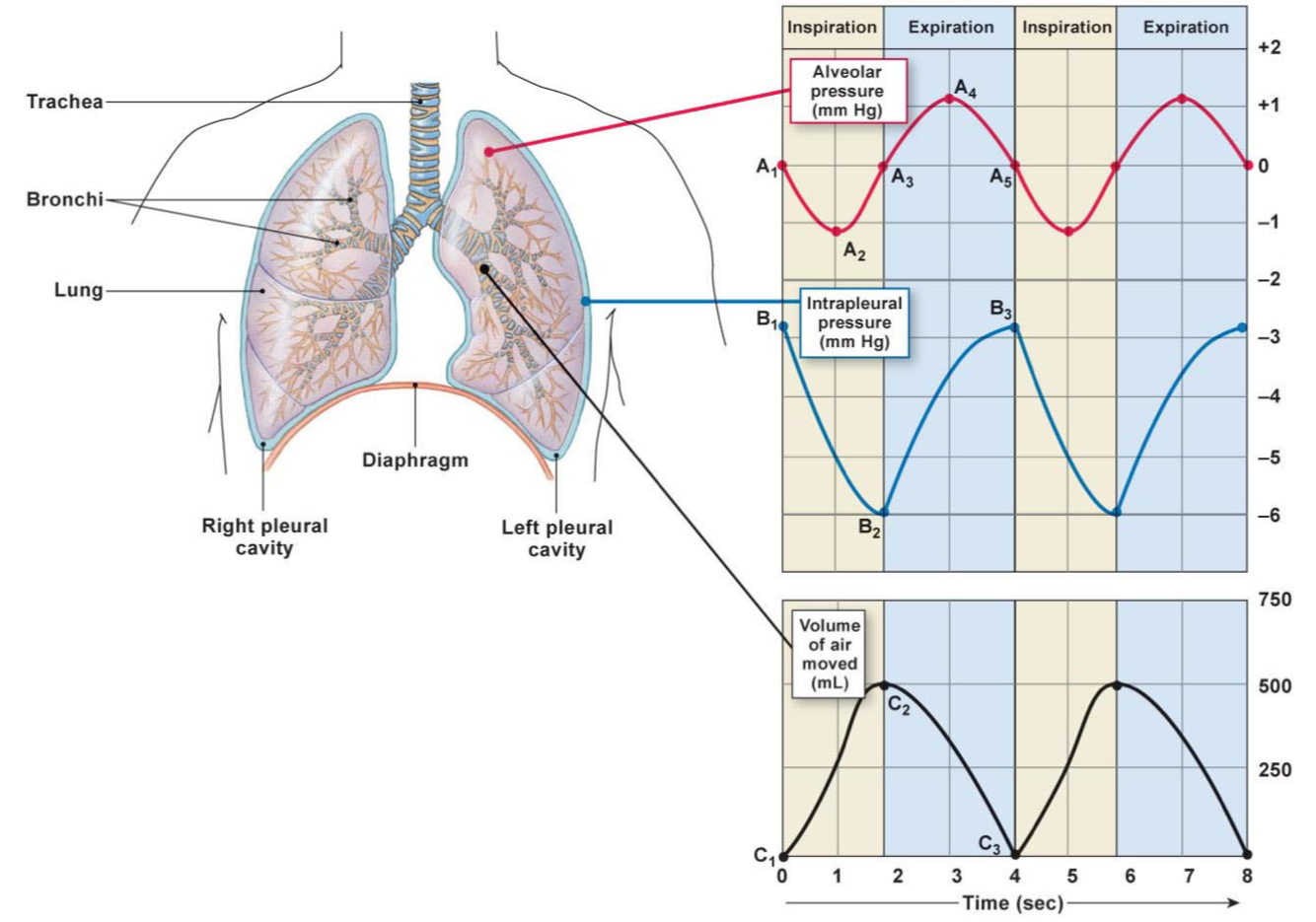
Diaphragm contracts –> thoracic cavity space increases –> intrapleural pressure decreases –> alveolar pressure decreases Drop in pressure creates a gradient where atmospheric pressure is greater than alveolar pressure, so air is suctioned into lungs
Exhalation
Diaphragm relaxes –> thoracic cavity space decreases –> intrapleural pressure increases –> alveolar pressure increases When alveolar pressure is greater than barometric pressure, air is pushed out
external intercostal muscles
help expand thoracic cavity during inhalation by moving ribs up
scalenes
help expand thoracic cavity during inhalation
abdominal muscles
used during active expiration to push diaphragm further up and decrease thoracic volume even more
internal intercostal muscles
used during active expiration to push diaphragm further up and decrease thoracic volume even more
3 main pressures during inhalation/exhalation
- Intrapleural space pressure 2. Intraalveolar pressure 3. Barometric pressure Intrapleural space is always negative. When you inhale, you decrease the pressure in the thoracic cavity, and drop the intrapleural space even lower, which makes the intraalveolar pressure go negative. Then the pressure in the alveoli is below barometric pressure and air rushes in. During exhalation, the diaphragm relaxes, which causes thoracic cavity pressure to go up. This makes intraalveolar pressure increase above barometric pressure and you can exhale.
Alveoli
Surrounded by capillaries, which is how gas exchange occurs from lungs to blood Contain elastic fibers that resist stretch – once we inhale, elastin takes over and no energy is required to exhale. The result is that we are able to spend very little of our total energy budget on respiration. Contain pulmonary surfactant
Pulmonary surfactant
A mixture of lipids and proteins secreted into alveolus to lower surface tension. This stabilizing the alveoli.
Law of La Place
P = 2T/r
Pressure = surface tension/radius
The smaller the alveolus, the more unstable b/c larger pressure is exerted inward
trachea
Contains goblet cells that make mucus, which sit atop cilia - this allows us to move particulate up and out so we don’t take in too much particulate matter
Respiratory minute volume
volume of air/minute
breaths/minute x volume/breath
Partial Pressures come to equilibrium in the lung
How do we carry oxygen in the blood
- Hemoglobin
- Myoglobin
Hemoglobin
contains 2 alpha subunits and 2 beta subunits. Each subunit carries a heme (which contains Fe 2+) and oxygen binds the Fe 2+ in heme. Each hemoglobin can carry 4 oxygens.
Erythropoietin (EPO)
A hormone produced in the kidney that responds to a decrease in pO2 and increases the number of Red Blood cells, so we can carry more oxygen.
What shifts the oxygen dissociation curve?
- Increase in partial pressure of CO2 - shifts curve right to facilitate more unloading at the tissues. CO2 binds allosterically to oxygen which discourages O2 binding.
- Increase H+ - occurs due to the increase in CO2 in the blood - When we need more O2 in the tissues, curve shifts right to facilitate unloading. H+ binds allosterically to oxygen which discourages O2 binding.
- Temperature - goes up during exercise, which is when we need more O2 at the level of the tissues
- increase in 2,3 BPG - increases at high altitude to ensure tissue still gets enough O2. BGP binds to Hb to reduce Hb’s affinity for O2 - shifts curve right to facilitate more unloading at the tissues.
fetal hemoglobin
–has a higher affinity for oxygen than regular hemoglobin
–Structure: 2 alpha and 2 gamma subunits
carbon monoxide poisoning
carbon monoxide binds to Hb at the same place O2 binds, but Hb has higher affinity for CO than for O2
myoglobin
–Found in skeletal tissue
–Can only bind one O2
–Easily saturated and myoblogin releases O2 at a low pO2 (level of the tissues) - acts as an O2 reservoir at the level of the tissues
Low pO2
Found in the tissue




