What is chronic obstructive pulmonary disease? What is its pathophysiology? How is it different to asthma? What may COPD patients experience? What are the two main types?
- NON-REVERSIBLE long-term deterioration in air flow through the lungs, caused by damage to lung tissue (almost always due to SMOKING)
- Px: obstructed airflow through the airways → difficulty ventilating the lungs → short of breath and prone to infection
- Unlike asthma, NOT REVERSIBLE with bronchodilators i.e. salbutamol.
- Patients may experience exacerbations; if due to infections, these are called INFECTIVE EXACERBATIONS (IE COPD)
- 2 main types:
– Chronic Bronchitis
– Emphysema
What are the risk factors for COPD?
- Smoking
- Age - symptoms usually present between 40-60
- Secondhand smoke exposure
- Occupational exposure - mining, dust, cotton, wood
- Pollution - heating fuel, outdoor pollutants
- Genetics - Alpha-1-antitrypsin deficiency. A1AT is a protein made by the liver and functions to protect the lungs from damage caused by infection, inflammation and smoking
What are the classic presenting features of COPD? What does COPD not cause?
- LONG-TERM SMOKER
- SHORTNESS OF BREATH
- Cough
- Sputum production
- Wheeze
- RECURRENT RESPIRATORY INFECTIONS
- COPD does NOT cause clubbing
How is COPD graded?
- Grade 1: Breathless on strenuous exercise
- Grade 2: Breathless on walking up hill
- Grade 3: Breathless that slows on the flat
- Grade 4: Stop to catch breath after 100m walking on flat
- Grade 5: Unable to leave house due to breathlessness
How is COPD diagnosed? What is the value of the FEV1/FVC ratio in COPD? What does COPD not respond to? How can the severity of airways obstruction be measured?
- COPD diagnosed by using CLINICAL PRESENTATION + SPIROMETRY
- Spirometry will show an ‘OBSTRUCTIVE PICTURE’ - overall lung capacity is better than their ability to forcefully expire air quickly
- FEV1/FVC ratio = <0.7
- Does not respond to reversibility testing with SABA, e.g. salbutamol
- FEV1 can be used to grade severity of airways obstruction i.e. Stage 1 = >80% of predicted, Stage 4 = <30% of predicted
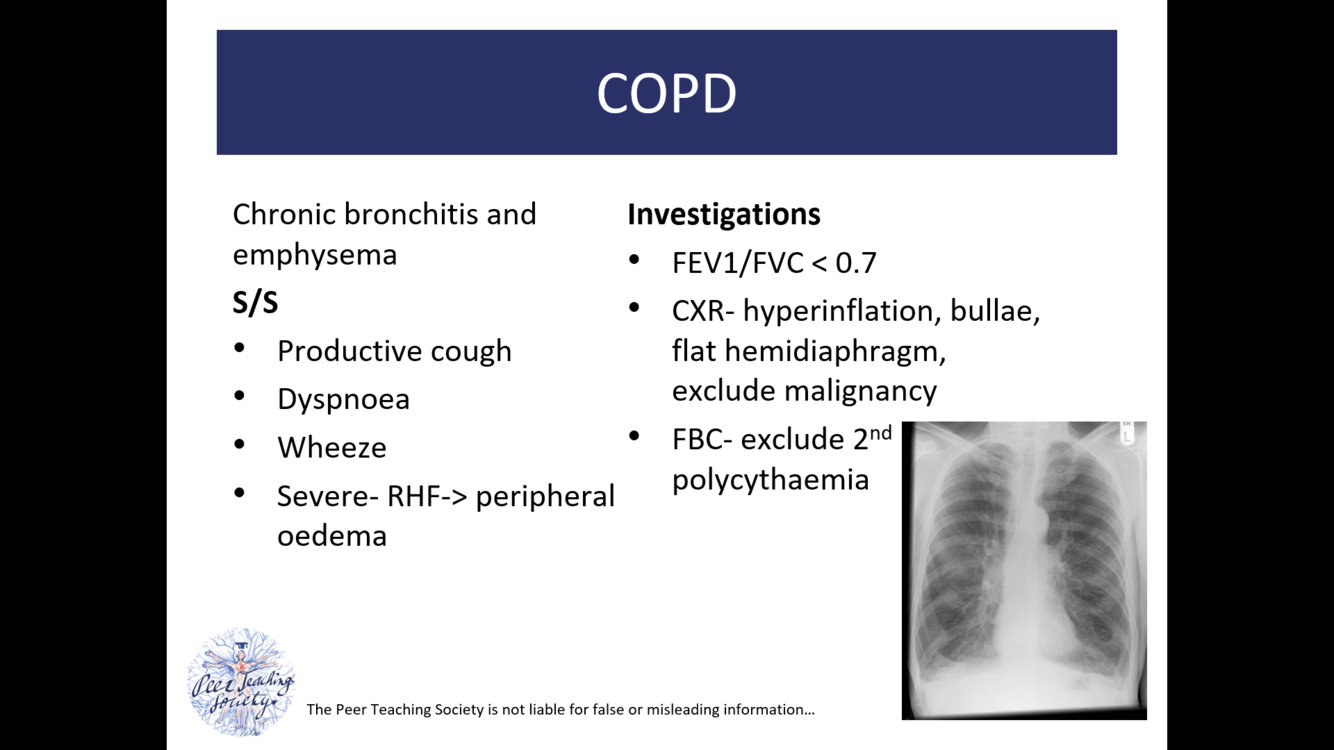
Apart from clinical presentation and spirometry, what are the other investigations for COPD?
- Chest X-ray (exclude lung cancer/other pathologies)
- FBC (chronic hypoxia → polycythemia)
- BMI (weight loss i.e. Lung Ca)
- ECG - if concerns with cardiac function
- Serum Alpha-1-antitrypsin levels
What would be shown on a CXR for COPD?
- Hyperinflation
- Bullae
- Flat hemidiaphragm
What are the symptoms and complications of emphysema?
- ‘Pink puffers’
- Symptoms:
- Dyspnoea/tachypnoea
- Minimal cough
- Pink skin, pursed-lip breathing
- Accessory muscle use
- Cachexia
- Hyperinflation (barrel chest)
- Weight loss (due to increased work of breathing and cachexia)
- Complications = pneumothorax due to bullae
What are the symptoms of chronic bronchitis?
- ‘Blue bloaters’
- Symptoms:
- Chronic productive cough - purulent sputum
- Dyspnoea
- Cyanosis (hypoxaemia) - can cause secondary polycythemia, may develop pulmonary hypertension (reactive pulmonary vasoconstriction)
- Peripheral oedema
- Obesity
- Haemoptysis
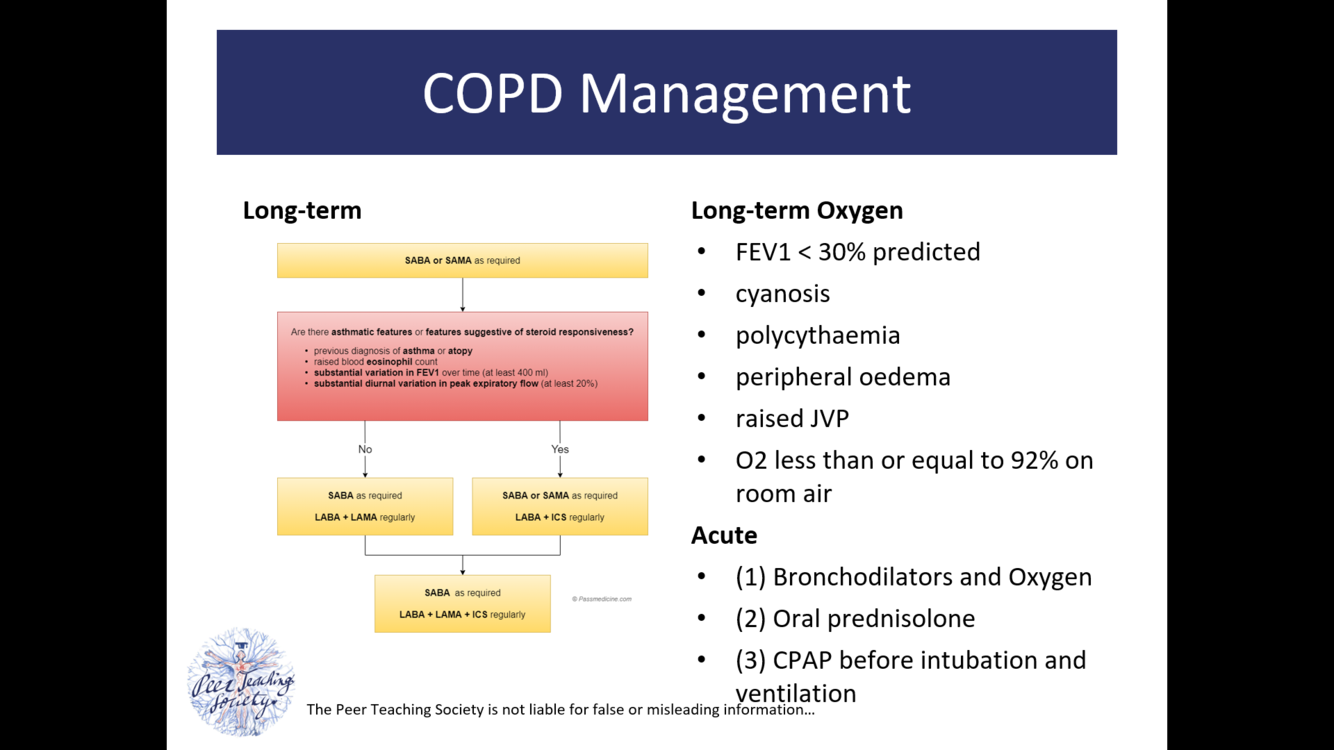
What is the long-term management of COPD?
- General:
- STOP SMOKING!!! Refer to smoking cessation
- Pneumococcal vaccine
- Annual flu vaccine
- Step 1:
- SABA (i.e. salbutamol or terbutaline) OR SAMA (ipratropium bromide)
- Step 2:
- If no asthmatic / steroid response:
- LABA (i.e. salmeterol) + LAMA (i.e. tiotropium), switch SAMA to SABA
- If asthmatic / steroid response:
- LABA (i.e. salmeterol) + ICS (i.e. budesonide), switch SAMA to SABA. If still S.O.B. then LAMA + LABA + ICS
- Step 3:
- Long-term oxygen therapy (LTOT)
Under what circumstances would we give long-term oxygen therapy?
- FEV1 < 30% predicted
- Cyanosis
- Polycythaemia
- Peripheral oedema
- Raised JVP
- O2 less than or equal to 92% on room air
What is the acute management for COPD?
1) Bronchodilators and O2
2) Oral prednisolone
3) CPAP before intubation and ventilation
What is the clinical presentation of IE COPD?
Presents with acute worsening of symptoms i.e. SoB, sputum, wheeze. Usually triggered by infection
What are the investigations for IE COPD?
- ABG:
- CO2 retention → acidosis
- Are they in type 1 or 2 failure?
- Normal pCO2 + low pO2 = T1RF
- Raised pCO2 + low pO2 = T2RF
- Chest X-Ray, sputum culture + sensitivities for antibiotic therapy, FBC + U&E
Describe the management for IE COPD.
- STEROIDS (hydrocortisone / prednisolone) + NEBULISED BRONCHODILATORS (salbutamol / ipratropium bromide) + ANTIBIOTICS
- Physiotherapy → sputum clearance
- If severe: IV aminophylline (bronchodilator), non-invasive ventilation (CPAP / BIPAP)
What is tuberculosis caused by? What are its features?
- Tuberculosis (TB) is caused by mycobacterium tuberculosis bacteria:
- Aerobic, non-motile, non-sporing, slightly curved bacilli with a thick waxy capsule
- Acid-fast bacilli – turns red/pink with Ziehl-Neelsen stain
- Slow growing
- Resistant to phagolysosomal killing and able to remain dormant
What is the epidemiology of tuberculosis?
- Majority of cases in Africa and Asia (India and China)
- Cause of death for most people with HIV
What is the pathophysiology of TB?
- TB spread via respiratory droplets as it is an airborne infection
1. Alveolar macrophages ingest bacteria and the rods proliferate inside
2. Drain into hilar lymph nodes 🡪 present antigen to T lymphocytes 🡪 cellular immune response
3. Delayed hypersensitivity reaction 🡪 tissue necrosis and granuloma formation: caseating
a. PRIMARY GHON FOCUS - seen as a small, calcified nodule in the upper parts of the lower lobes or the lower parts of the upper lobes
b. GHON COMPLEX – Ghon focus + lymph nodes
What is the clinical presentation of tuberculosis?
- Systemic symptoms: weight loss, low grade fever, anorexia, drenching night sweats, malaise
- Pulmonary symptoms: productive cough, haemoptysis, cough >3 weeks (dry or productive), breathlessness, sometimes chest pain
- Signs: signs of bronchial breathing, dullness to percuss, decreased breathing, fever, crackles
What are the investigations for tuberculosis?
- Ziehl-Neelsen stain on Lowenstein-Jensen agar
- CXR: primary or reactivated = patchy consolidation, fibronodular opacities on upper lobe, disseminated military TB = ‘millet seeds’
- Biopsy: shows caseating granuloma
- Diagnosing latent TB:
- MANTOUX TEST - tuberculin injected into intradermal space, >5mm = positive result
- INTERFERON-GAMMA RELEASE ASSAYS (IGRA) - person with previous contact with TB will have WBCs that release interferon-gamma
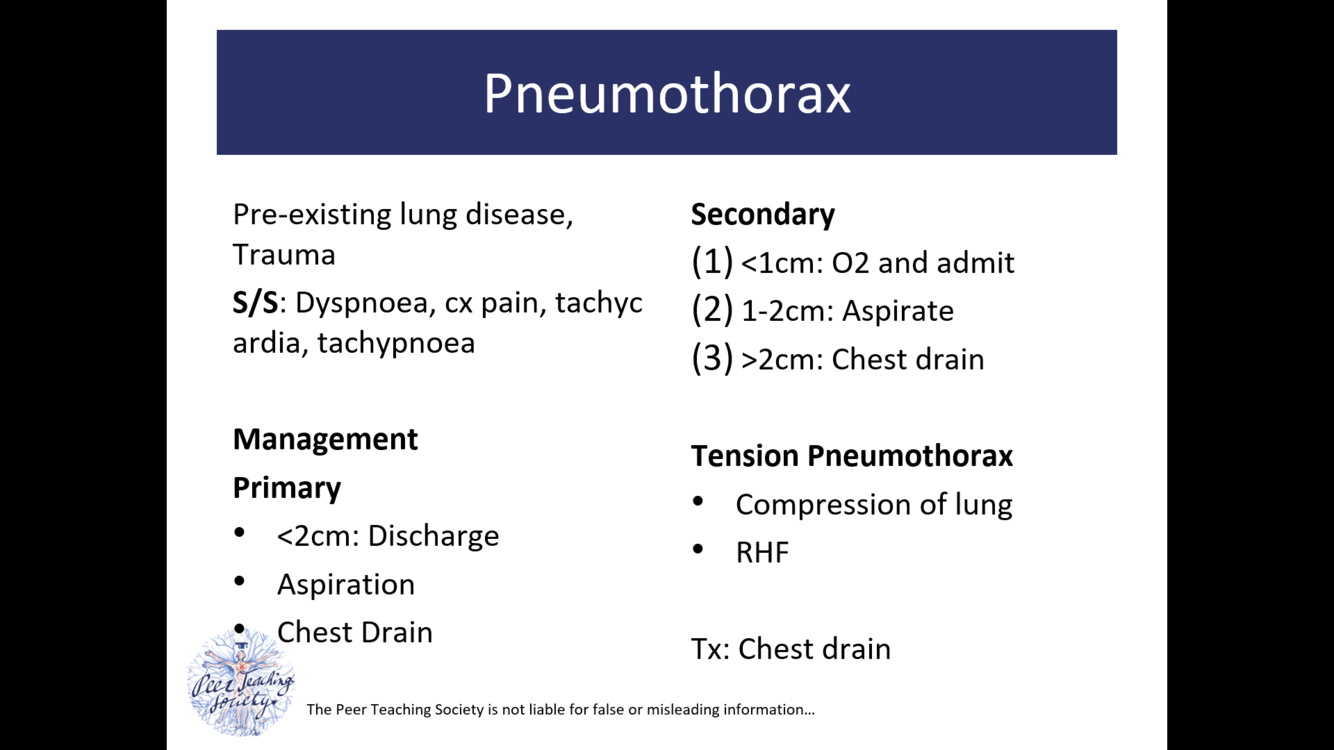
What is the appearance of different types of TB on a chest x-ray?
- Primary TB: patchy consolidation, pleural effusions and hilar lymphadenopathy
- Reactivated TB: patchy or nodular consolidation with cavitation (gas filled spaces in the lungs) typically in the upper zones
- Disseminated Miliary TB: MILLET SEEDS
Describe the management for TB.
- Acute pulmonary TB (RIPE):
- Rifampicin for 6 months. Bacteriacidal - blocks protein synthesis. SE: RED URINE, hepatitis
- Isoniazid for 6 months. Bacteriacidal - blocks cell wall synthesis. SE: neuropathy
- Pyrazinamide for 2 months. Bacteriacidal initially, less effective later. SE: gout, arthralgia, rash, hepatitis
- Ethambutol for 2 months. Bacteriostatic, blocks cell wall synthesis. SE: optic neuritis
- Latent TB - otherwise healthy patients do not need treatment, but isoniazid can be used for patients at risk of reactivation of TB
A patient is started on RIPE for acute pulmonary tuberculosis. What should also be prescribed? Why?
Pyridoxine (vitamin B6). This is because isoniazid has a side effect on peripheral neuropathy
What is cystic fibrosis? What is it caused by?
- Cystic fibrosis = an AUTOSOMAL RECESSIVE genetic condition affecting the mucus glands
- It is caused by a genetic mutation of the CYSTIC FIBROSIS TRANSMEMBRANE CONDUCTANCE REGULATORY GENE on chromosome 7



