What are the pulmonary function tests?
- Spirometry
- Respiratory muscle function testing
- Single breath diffusion capacity testing
What does spirometry measure?
- Breath volume
- Air flow rate
What values does spriometry measure?
- Peak expiratory flow rate (PEF)
- Forced expiratory flow rate (FEV1)
- Vital capacity (Forced vital capacity)
- FEV1/FVC (Tiffeneau-Pinelli index, relative FEV1)
- Forced expiratory flow rate at 75%, 50%, and 25%of vital capacity (FEF75%, FEF50%, FEF25%)
What does the peak expiratory flow rate (PEF) measure?
What is considered normal?
- The maximum airflow rate attained during forced expiration (in L/s)
- Normal: ≥ 80% of the predicted average value based on race, height, gender, and age
What is the FEV1 ?
What is considered normal?
- The maximum volume of air that can be forcefully expired within 1 second after maximal inspiration
- Normal: ≥ 80% of the predicted average value based on height, gender, and age (or >75% of vital capacity)
What is the vital capacity?
What is normal?
The difference between the volume of air in the lungs after maximal inspiration and after maximal expiration
Normal: Depends on race, height, age, and gender; approximately 4.5–5 L in healthy young adults
How is Vital capacity measured in spirometry?
Slow respiratory maneuvers
- Inspiratory vital capacity (IVC): The maximum volume of air that can be inspired after maximal expiration.
- Expiratory vital capacity (EVC): The maximum volume of air that can be expired after maximal inspiration.
Forced respiratory maneuvers
- Forced vital capacity (FVC): The maximum volume of air that can be forcefully expired after maximal inspiration.
What is the normal value for FEV1/FVC (Tiffeneau-Pinelli index, relative FEV1)
> 70%
What is the definition of obstructive lung diseases?
- Increased resistance to air flow caused by narrowing of airways
What is the definition of restrictive lung disease?
- Impaired ability of the lungs to expand (as a result of reduced lung compliance)
What are the causes of obstructive lung disease?
COPD (chronic bronchitis, emphysema)
Bronchial asthma
Bronchiectasis,
cystic fibrosis
What are causes of restrictive lung disease?
Intrinsic causes (parenchymal diseases)
Interstitial lung disease (e.g., sarcoidosis, pneumoconioses, idiopathic pulmonary fibrosis)
Alveolar (e.g., pneumonia, pulmonary edema or hemorrhage)
Extrinsic causes (extrapulmonary causes)
Diseases of the pleura and pleural cavity (e.g., chronic pleural effusion, pleural adhesions, pneumothorax)
Deformities of the thorax/mechanical limitation (e.g., kyphoscoliosis,ankylosing spondylitis, obesity, ascites, pregnancy)
Respiratory muscle weakness (e.g., phrenic nerve palsy, myasthenia gravis, ALS, myopathies): See respiratory muscle function for more details.
What are the features of obstructive lung disease on spirometry?
FEV1↓
FEV1/FVC↓
Vital capacity↓
Residual volume↑
Total lung capacity Normal or ↑
Resistance to air flow↑
Lung compliance: Normal
Spirometer tracing: scalloping” of the expiratory limb in conditions such as emphysema or in patients who have undergone a pneumectomy
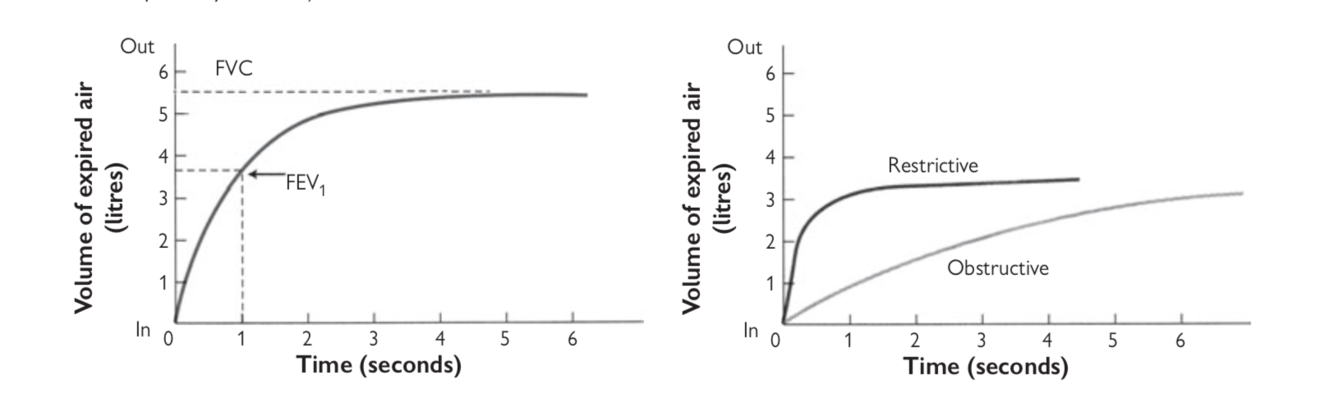
What are features of restrictive lung disease on spirometry?
Normal or ↓
FEV1/FVC Normal or ↑
Vital capacity↓
Residual volume Normal or ↓
Total lung capacity↓
Resistance to air flow Normal
Lung compliance Normal (extrinsic causes) or ↓ (intrinsic causes)
See lung taces:
What are the three main types of lung function disturbance?
- Ventilatory impairment: mechanical damage to the lungs or chest wall that make the breathing more difficult).
2. Damage to the gas exchanging surface: a reduction of the number of pulmonary capillaries in contact with healthy alveoli.
3. Abnormalities of blood gases
Why does the flow of air decrease throughout forced vital capacity?
The airways decrease in size as the lung volume diminishes
What is the forced vital capacity?
FVC: forced vital capacity is the volume of air that can be delivered by a forced expiration from total lung capacity to residual volume (RV).
How is diffusion capacity of the lung measured?
Single-breath diffusing capacity measures the ability of the alveoli to exchange gases with pulmonary capillaries.
Measures diffusion of inspired cardbon monoxide
When is diffusion capacity testing required?
- Differentiate between intrapulmonary or extrapulmonary causes of restrictive lung disease
- Monitor progression of with intraparenchymal lung diseases
What does carbon monoxide diffusing capacity testing measure?
KCO (carbon monoxide transfer coefficient): the amount of CO per unit time per unit partial pressure that is transferred from the alveolus to the pulmonary capillary
DLCO (diffusion capacity of the lung for carbon monoxide) : the product of KCO and total alveolar volume (VA)
How is respiratory muscle function tested?
Test of inspiratory muscle function (e.g., diaphragm):
- maximal inspiratory pressure (MIP):
- The patient is asked to inhale with as much force as possible against a closed mouthpiece and the pressure that is generated near the mouth is recorded.*
- sniff nasal inspiratory pressure (SNIP): A pressure transducer is placed in one nostril and the patient is asked to sniff forcefully through the unobstructed nostril. SNIP is easier to measure than MIP but is not useful in patients with chronic obstructive lung disease.
Test of expiratory muscle function
- maximal expiratory pressure:The patient is asked to exhale with as much force as possible against a closed mouthpiece and the pressure that is generated near the mouth is recorded.
What are causes of pulmonary muscle weakness?
Depression of the respiratory center
- Severe metabolic encephalopathy
- Opiate poisoning
- Brainstem stroke
- Traumatic brain injury
Phrenic nerve palsy due to:
- Anterior horn cell disorders (e.g., amyotrophic lateral sclerosis)
- Peripheral neuropathies (e.g., Guillain-Barre syndrome)
Myasthenia gravis
Myopathies (e.g., thyrotoxic myopathy, muscular dystrophy)
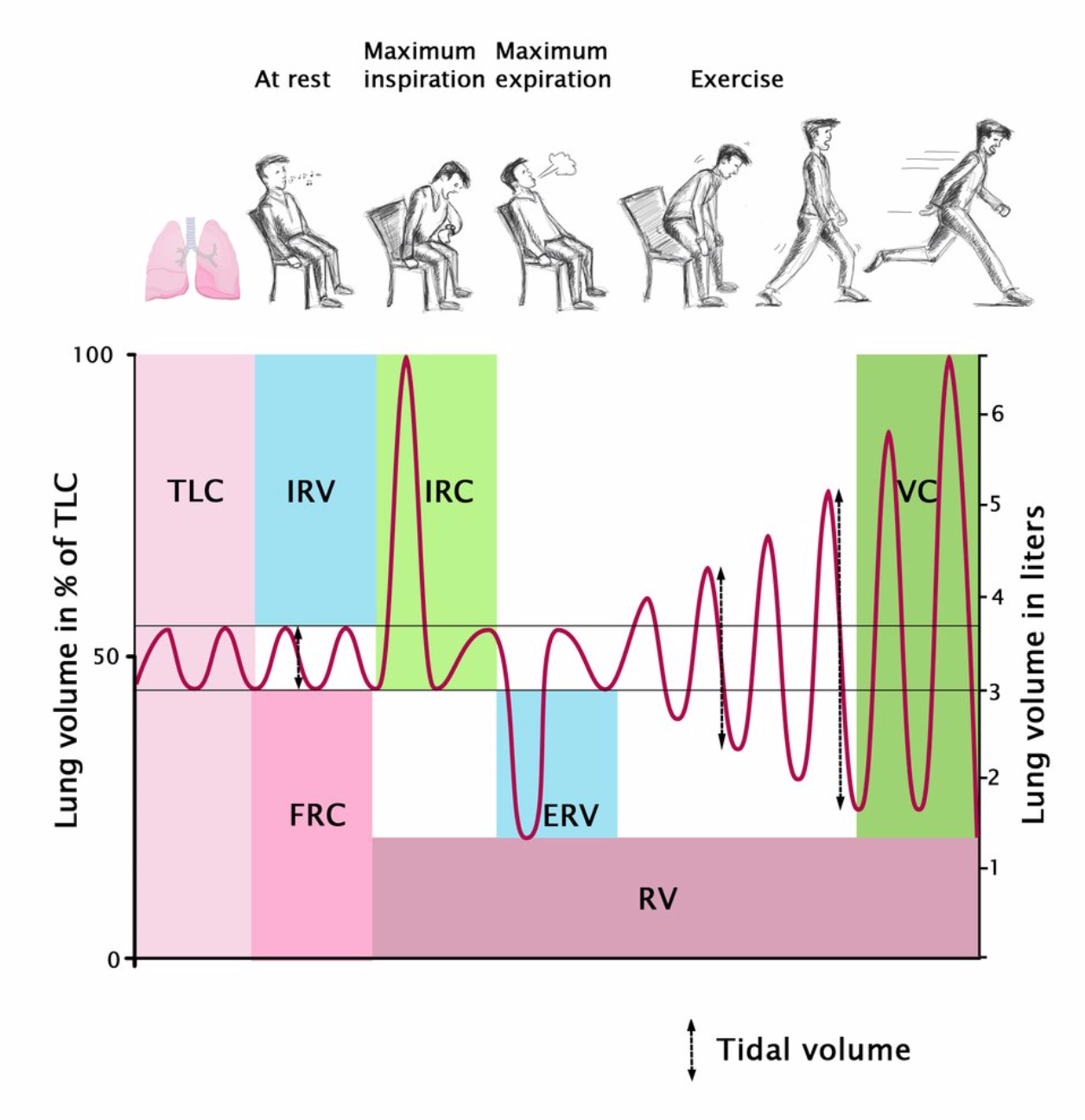
Describe the lung volumes?
What are bronchial challenge tests and when are they used?
Use: Distinguish between bronchial asthma and other obstructive diseases
Tests:
- Bronchial challenge test: provoke bronchospasm
- Bronchodilator reversibility test: spirometry following bronchodilator treatment




