Oxidation- reduction proteins are located within the
mitocondrial membrane
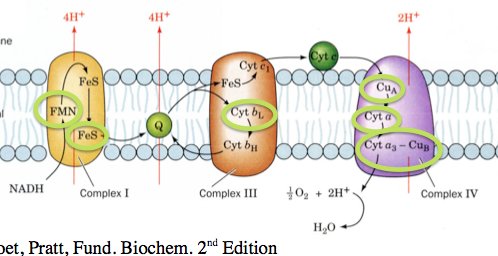
This respiratory chain serves to break up the 52 kcal/mole available from the flow of ___from NADH to O2 into approximately three equal amounts.
2 electrons
This respiratory chain serves to break up the 52 kcal/mole available from the flow of 2 electrons from NADH to O2
the majority of this energy is used to
form atp
The rate of respiration is controlled by the availability of ___
ADP
Advantages of a membrane-bound respiratory chain chain
(1) Kinetics: Not limited by the rate of diffusion; no mobile carrier needed.
(2) Stability of intermediates: reduced fuel will be converted to energy stored in an electrochemical gradient. For a gradient you need two compartments. The membrane provides such a boundary.
Flavins:___donor/acceptor
two-electron
Flavins have a ___ addition
1,4
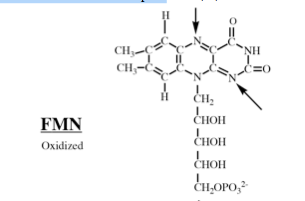
NADH dehydrogenase contains tightly bound
FMN
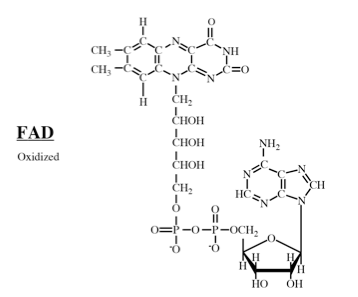
Succ. Dehyd. contains covalently bound ___
FAD
Iron-Sulfur Centers: Accept e-1s from
Flavins and Q
iron sulfate centers may have ___ irons per
center
2-4
Iron-Sulfur Centers have how many electron donor/acceptors?
They may have 2-4 irons per
center, but they are _one-electron donor/acceptors. _
Acidification of iron sulfar centers leads to →
H2S gas
Ubiquinone: ___-electron donor/acceptor
two
ubiquinone Functions as an electron ___.
buffer
Ubiquinone has ___ additon
1,6
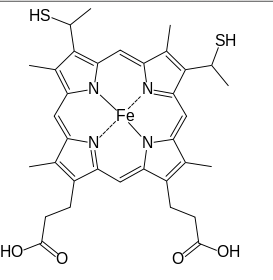
Hemes: ___-electron donor/acceptors
one
The heme is covalently attached to two ____ side chains in cytochromes c and c1.
cysteine
The iron atom of the heme group in cytochrome c coordinates to a
methionine and a histidine side chain in addition to the 4 porphyrin-ring nitrogens.
Copper Centers: one-electron donor/acceptors in
cytochrome oxidase
Copper center A contains ___ Cu
two
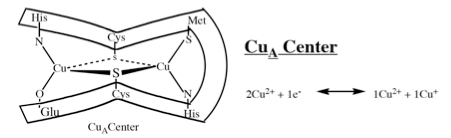
what forms the forms the O2 binding site at the end of the Respiratory Chain?
- Copper center B
- the heme iron of Cyt a3
in cytochrome oxidase
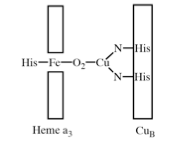
what is in cytosohome oxidase?
CuA, CuB, Cyt a, Cyt a3
path of electron flow in cytochrome oxidase?
to CuA -> cytocrhome a -> cytochrome 3 -> cuB
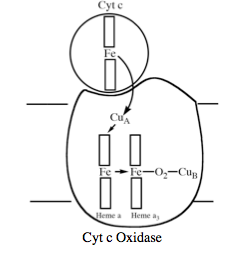



-
Introduction to Carbs U6L0116
-
ATP36
-
Glycolysis70
-
CItric Acid Cycle48
-
Pentose Phosphate Shunt78
-
Respiratory Chain45
-
Oxidative Phosphorylation81
-
Regulation of Carbohydrate Metabolism70
-
Energetics of Key Metabolic Steps36
-
MCP u6 images31
-
ECG 212
-
Amino Acid Metab and Urea Cycle102
-
U6 High Yield14
-
Fatty Acid Synthesis74
-
Amino Acid Metabolism91
-
Complex lipids8



