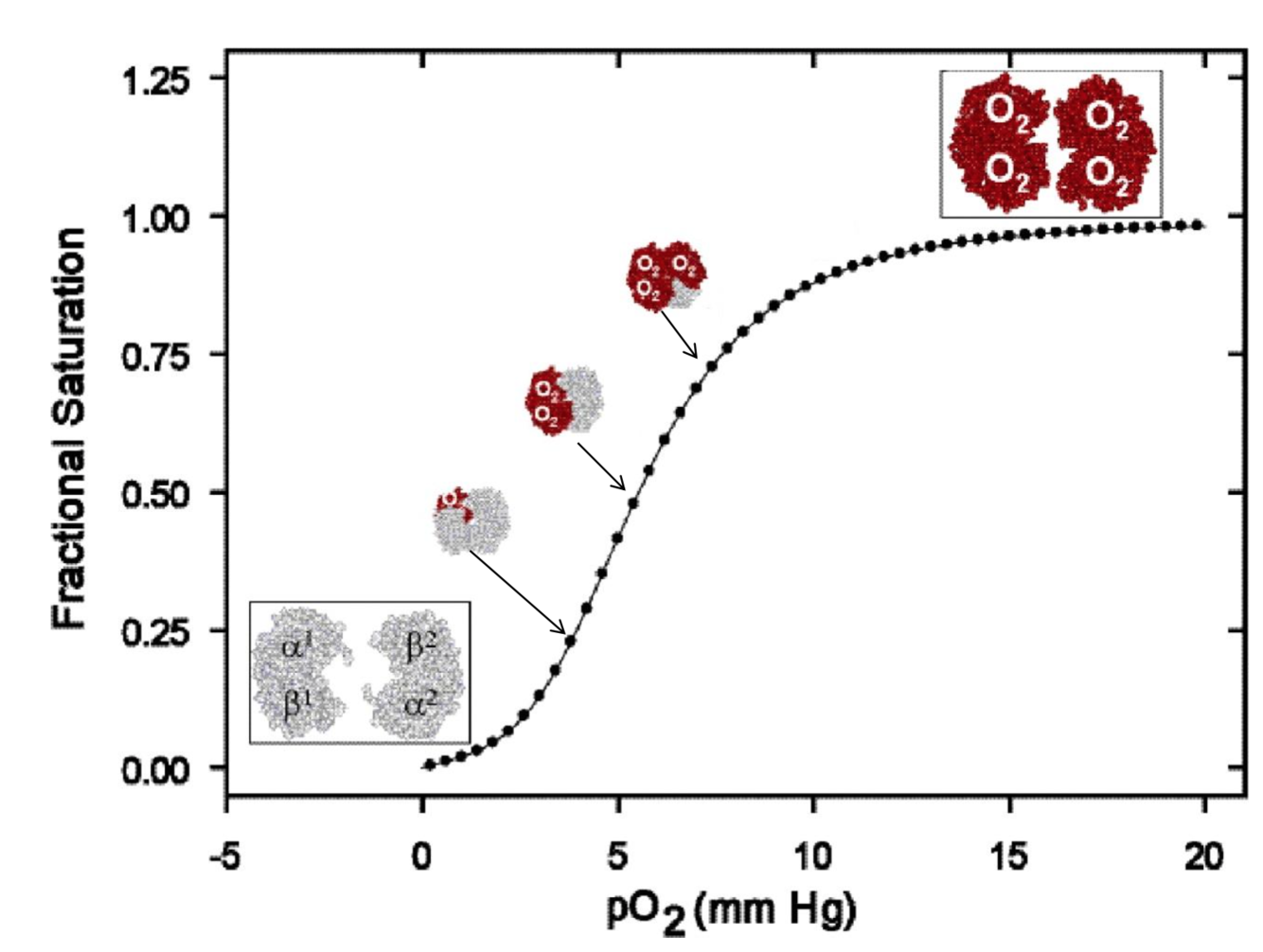
Describe the functions of the respiratory system
- Provides O2 to the blood
- Removes CO2 from the blood
- Regulates [H+] (blood pH)
- Speech
- Microbial defense
- Influences arterial [] of chemical messengers
- Traps and dissolves small blood clots
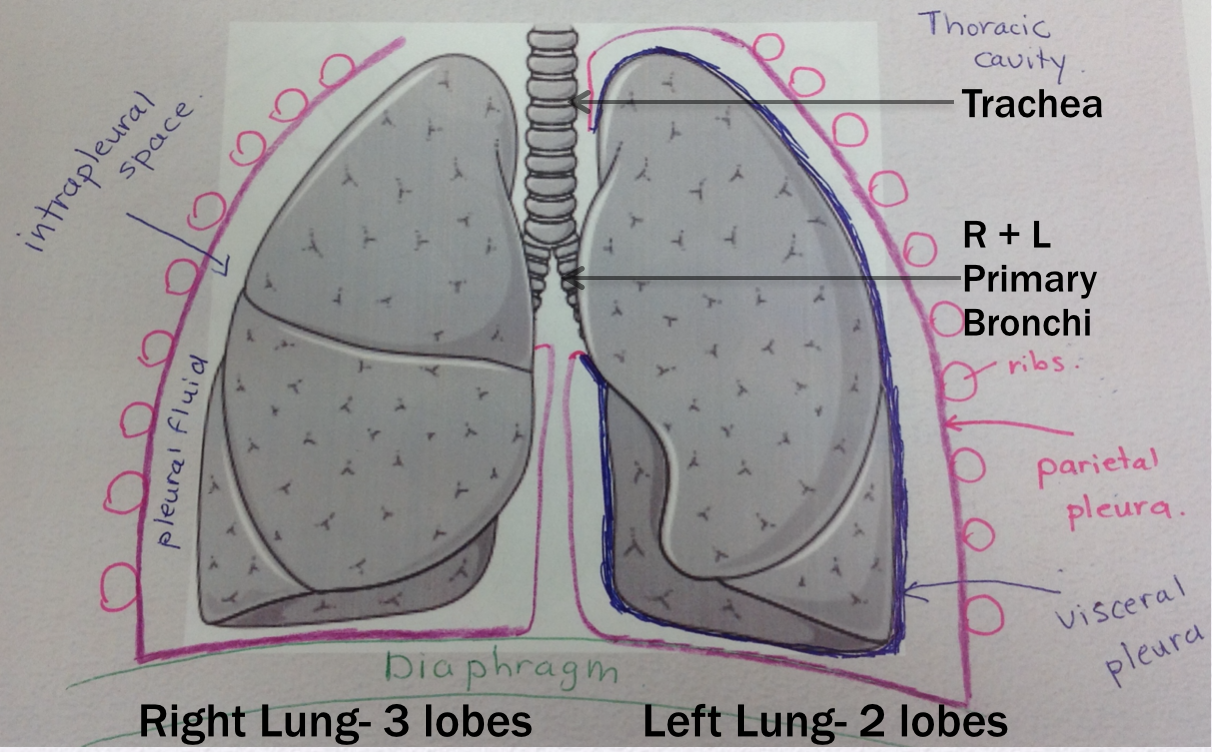
Describe the anatomy of the lungs.
- Suspended in thoracic cavity
- thoracic cavity separated from abdominal cavity by diaphragm (skeletal muscle)
- Surrounded by chest wall
- Space b/w lung & chest wall = intrapleural space
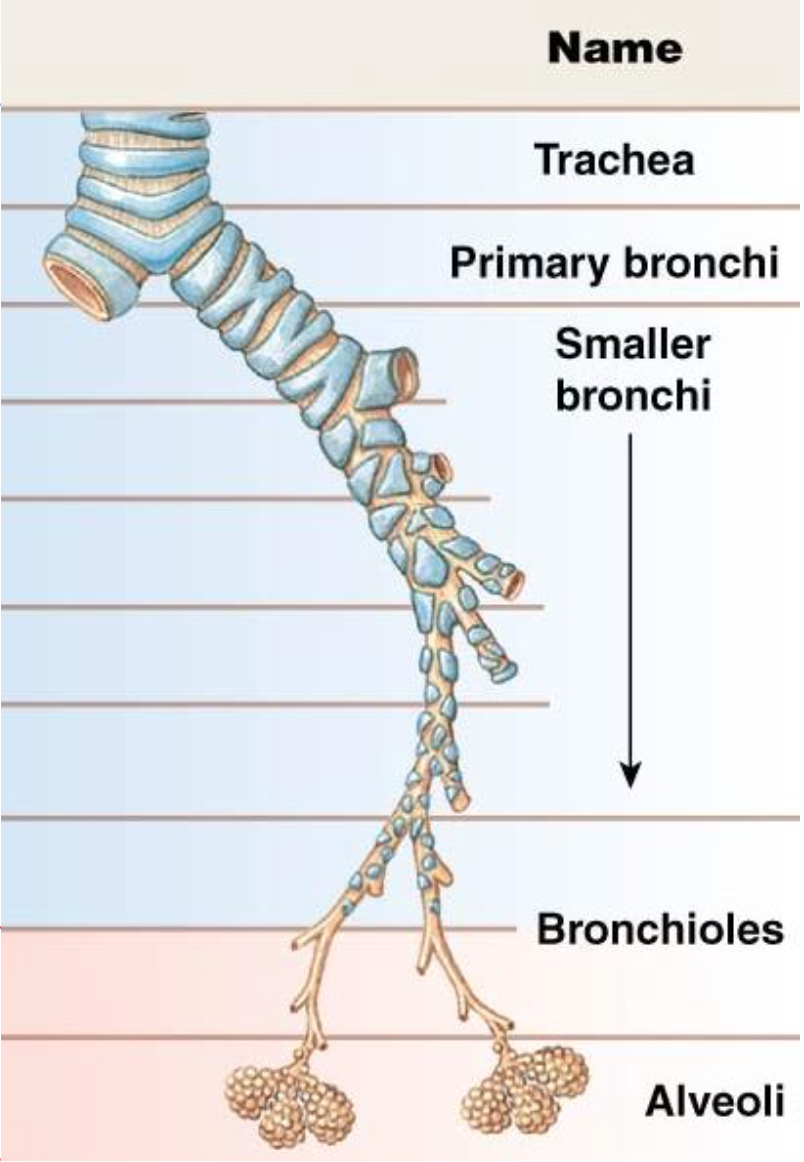
Differentiate between 2 major divisions of the lungs:
- Conducting zone
- Respiratory zone
Conducting zone:
- Air travels through and is conditioned to be safe for gas exchange. Includes…
- humidification
- filtration
- temperature change
Respiratory Zone:
- where the actual gas exchange occurs
Note: Bronchioles exist in both zones:
- Terminal Bronchioles (conducting zone)
- Respiratory Bronchioles (respiratory zone)
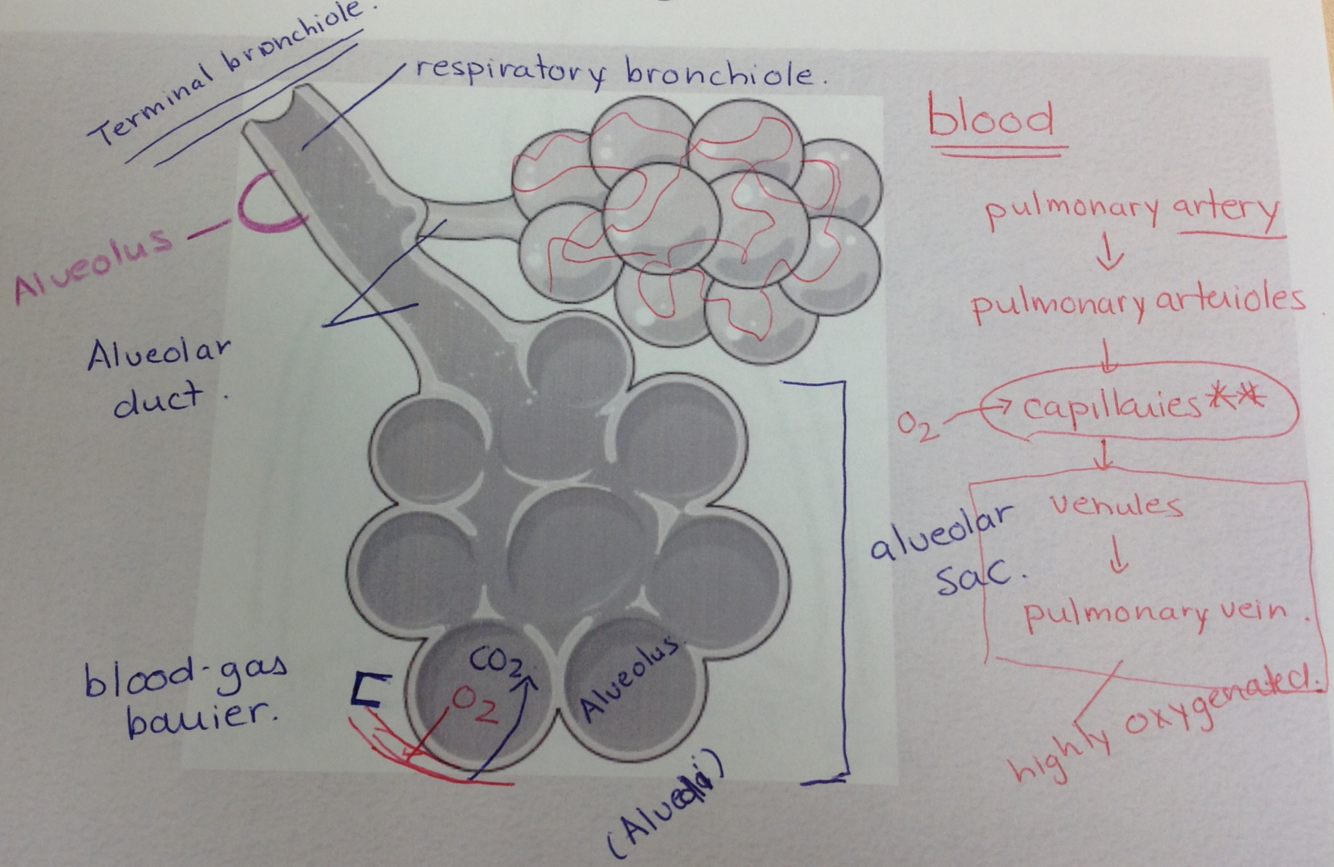
Describe the blood vessels and the blood flow in the pulmonary artery.
- Pulmonary artery branches extensively
- Forms a dense network of capillaries
- Capillaries wrap around alveoli
- To maxmize diffusion of gases, the blood is exposed to the largest SA and lowest velocity of blood flow in the capillaries
- Gas exchange thakes place in the alveoli at the blood-gas barrier (BGB)
- BGB separates blood in pulmonary capillaries from air in alveoli
- Air to one side of barrier by ventilation;
- Blood to other side through pulmonary circulation
- Gas exchange thakes place in the alveoli at the blood-gas barrier (BGB)
What is…
- Pulmonary ventilation (VE)
- Alveolar ventilation (VA)
- Anatomical dead-space ventilation (VD)
What is the equation used to calculate each?
Pulmonary ventilation (VE):
- volume of air entering the entire lung (both conducting & respiratory zones) in one minute
- VE = tidal volume x respiratory rate
Alveolar ventilation (VA):
- volume of air entering only the respiratory zone in one minute
- represents volume of fresh air available for gas exchange
Anatomical dead-space ventilation (VD):
- volume of air found in the conducting zone
(not involved in gas exchange) - measured in mL for a normal person in upright position = ~body weight in pounds
i.e. body weight of 100lbs = dead space volume of 100mL
To calculate VA:
VA = VE - VD
Note:
Tidal volume - volume in one breath
Respiratory rate - # of breaths per minute
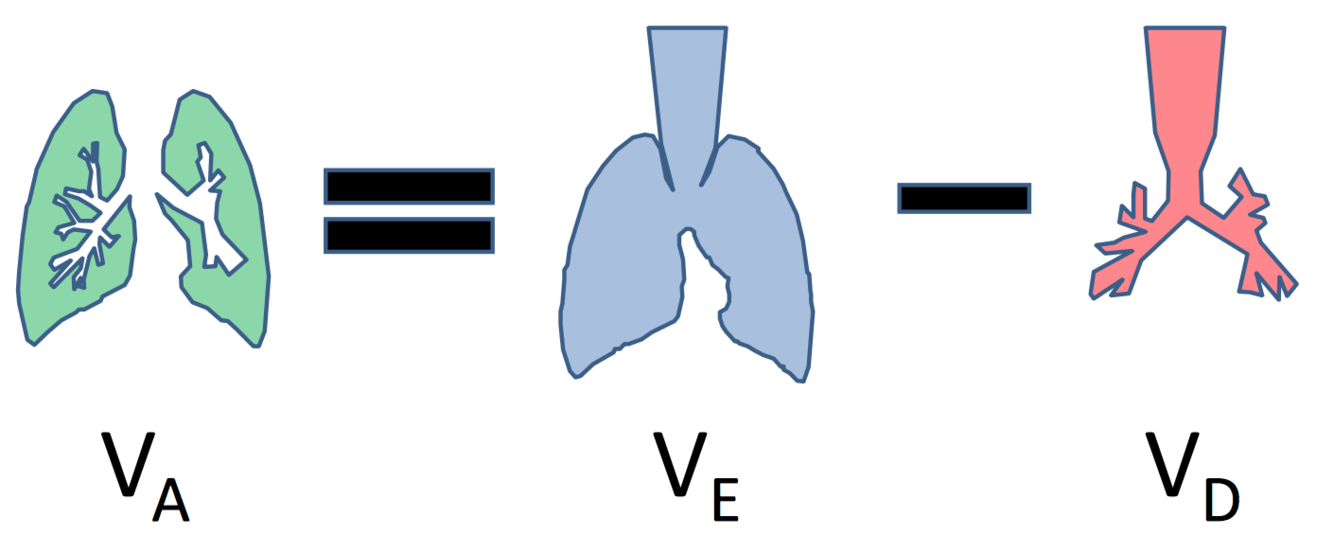
Calculate VA given:
- Body weight 150 lb
- Respiratory Rate: 10 breaths/min.
- Tidal Volume: 600 mL/breath
- VE: 6000 mL/min
VA = VE - VD
- Tidal Volume of 600mL inhaled
- ~ 150 mL remains in conducting zone (no alveoli)
- 600mL - 150mL = 450 mL
- Remainder 450 mL reaches the respiratory zone (alveoli present) and participates in gas exchange
- 450mL x 10 breathes/min = 4500 mL/min
OR,
= VE - (Dead space x RR)
= 6000 - (150 x 10)
= 4500
What does Boyle’s Law state and how does it apply to respiratory physiology?
Boyle’s Law:
- For closed volume of gas (at constant temperature), pressure is inversely proportional to volume
- Pressure ∝ 1/volume
- when volume decreases, pressure increases v.v.
Application to respiratory physiology:
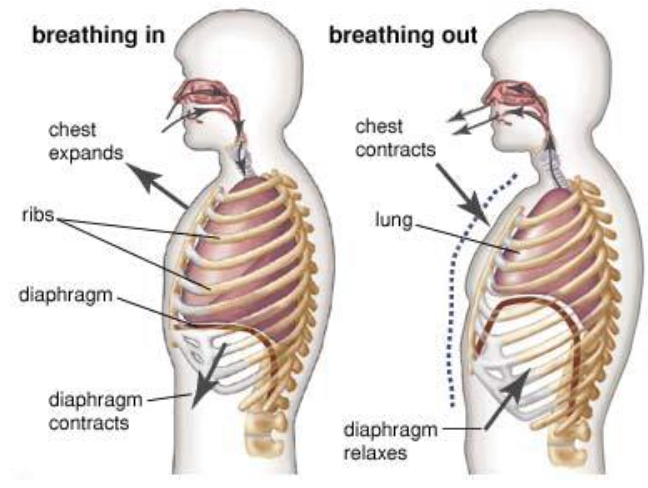
Changes in the volume of thoracic cavity results from the action of respiratory muscles:
- Inflation of lung during inspiration & deflation of lung during expiration are brought by changing the volume of the thoracic cavity
Describe the process involved in inspiration and expiration at rest and during exercise.
Inspiration:
- Diaphragm & external intercostals contract
- Bigger pleural cavity
Expiration:
- Diaphragm & external intercostals relax
- Smaller pleural cavity
- During exercise:
- internal intercostals, obliques and rectus abdominus contract
What is transpulmonary pressure and how is it calculated?
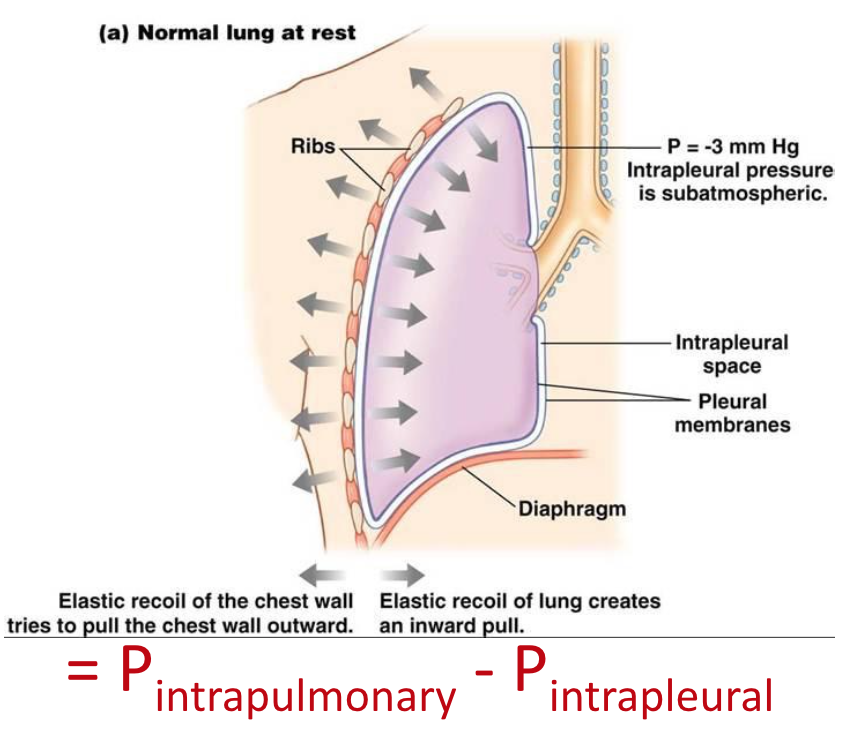
Transpulmonary pressure:
- Pressure generated due to the elastic recoil forces of both lungs and chest wall
- During inhalation:
lungs slide against the chest wall - After exhalation:
lungs have the tendency to pull inwardly away from the chest wall- Lungs pull inwardly away from the chest ⇔ Chest wall pulls the chest wall outward
- To calculate:
Transpulmonary pressure = difference b/w intrapulmonary pressure and intrapleural pressure
What happens during a pneumothorax?
Pneumothorax is a collapsed lung. When air enters the fluid-filled intrapleural space, the build-up of air puts pressure on the lung so it cannot expand as much as it normally does when taking a breath, causing shortness of breath and chest pain.
What is lung compliance?
Compliance is a measure of “stretchability” of the lungs
- more compliant the lung, easier it will stretch, increasing in volume during inhalation
Compliance =
change in lung volume/change in lung pressure
What are the 2 factors that influence lung compliance?
Factors:
- Elastic tissue components of the lung itself (~1/3)
- fibers of elastin (elastic lung tissue) and collagen present in alveolar walls throughout the lung
- Fibers start in submucosal airways and become more and more distinct as they get closer to alveoli
- 2 major competing models on how Elastin works:
- Pierce and Ebert: Elastin and collagen are intertwined and encircle alveoli in a coiled fashion. When expanding, they “fold out” to let tissue expand.
- Setnikar-Mead model: Collagen and elastin operate in parallel. At low volume, elastin stretches and collagen is loose. At high volume, collagen becomes taut and prevents elastin from snapping.
- Surface tension inside alveoli (~2/3)
- Surface Tension: Force developed at the surface of a liquid due to the attraction b/w water molecules
(think of putting drops of water on glass and putting another glass on top and trying to pull the two glass apart) - Lungs have thin film of liquid that lines the inside of the alveoli; inside the intrapleural space. Due to this surface tension, the lungs and the chest wall have an elastic recoil force:
- Lungs have the tendency to pull inwards
- Chest wall have the tendency to pull outwards
- Due to this surface tension, the lungs always holds a residual volume of air, which is why the lung doesn’t collapse upon exhalation.
To prevent alveolar collapse, surfactant is used. What is it, and what occurs as a result of a deficiency of surfactant?
Properties of pulmonary surfactant:
- reduces surface tension
(prevents alveolar collapse) - Microbial defense
Deficiency of surfactant leads to…
- Neonatal Respiratory Distress Syndrome (nRDS)
- occurs in premature infants
- poor lung function
- alveolar collapse
- hypoxemia
- Lack mature surfactant system
- To treat: administer surfactant
- occurs in premature infants
Spirometers help measure lung volumes as well as help diagnose some respiratory diseases. Define the following lung volumes:
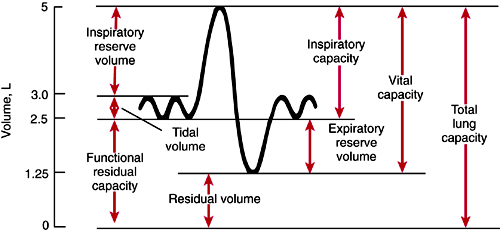
- Tidal volume
- Inspiratory Reserve Volume
- Expiratory Reserve Volume
- Residual Volume
- Total Lung Capacity
- Inspiratory Capcity
- Expiratory Capacity
Tidal Volume
- Volume of inhalation and exhalation during normal breathing
Inspiratory Reserve Volume
- Difference between maximum lung volume and resting inhalation volume
Expiratory Reserve Volume
- Difference between minimum lung volume and resting exhalation volume
Residual Volume
- Volume that we are incapable of exhaling
Total Lung Capacity
- The total volume of air in your lungs
Vital Capacity (aka Force Vital Capacity)
- The total volume of air that you can move in and out of your lungs on maximum inhalation/exhalation
Inspiratory Capacity
- Total volume of maximum inhalation starting from resting exhalation
Expiratory Capacity (aka Expiratory Reserve Volume)
- Total volume of maximum exhalation starting from resting exhalation
FVC and FEV-1 are used to diagnose obstructive and restrictive diseases. What are they are how are they calculated?
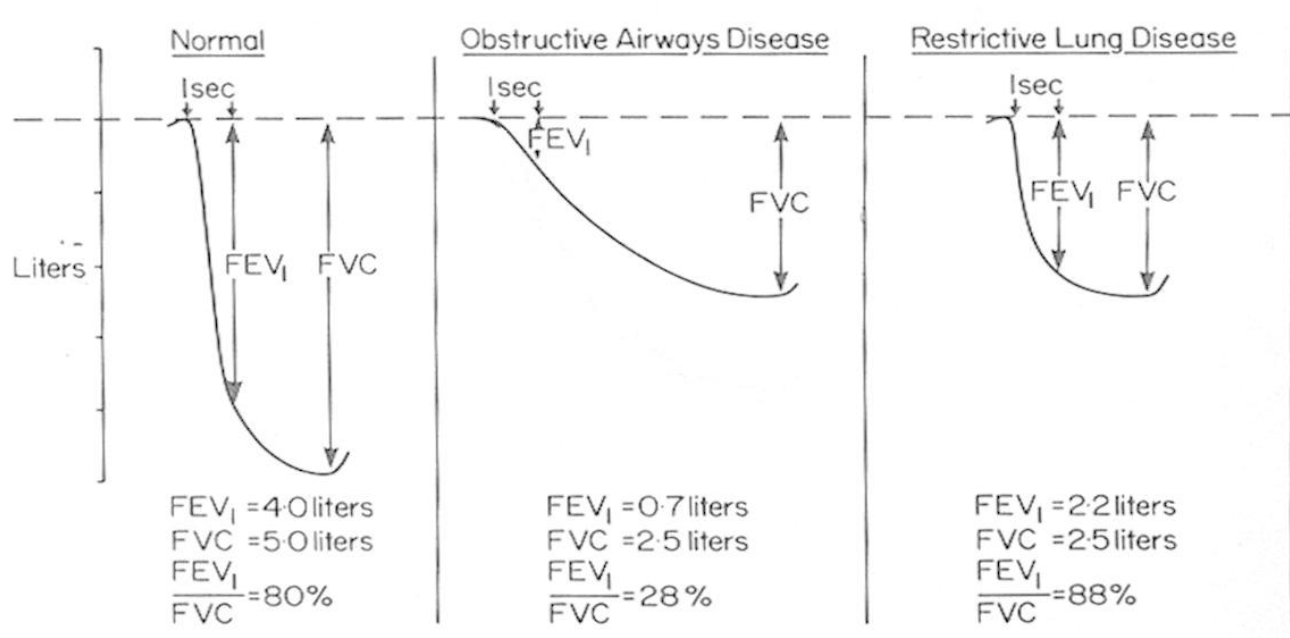
Forced Vital Capacity (aka Vital Capacity)
Forced Expiratory Volume (in one second) (FEV-1):
– Maximum volume of air that can be exhaled in one second
FEV/FVC
= percentage of total breath that can be exhaled in one second
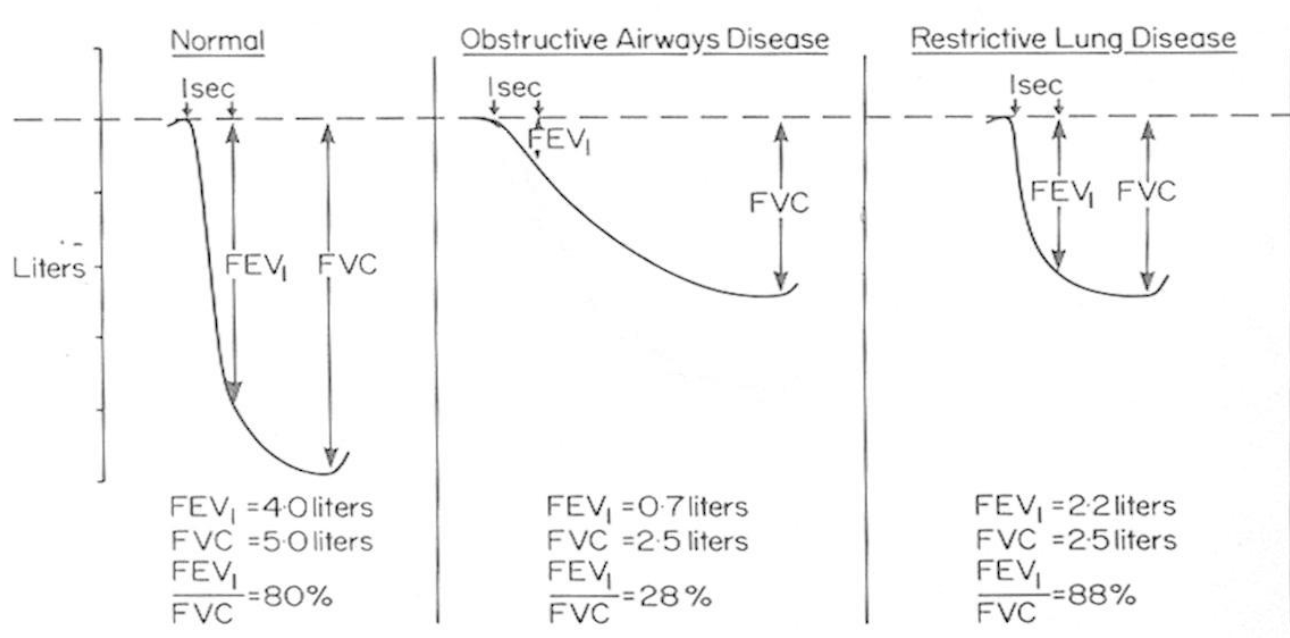
Distinguish between obstructive and restrictive diseases and give examples of both.
Obstructive Disease
– FEV/FVC < 70% (80 according to class)
– Reduction in the speed at which air can move out of the lungs
- asthma: airway spasms in smooth muscle triggered by exercise, air pollution, allergies, cold air, viral…etc.
- airway inflammation
- airway hyperresponsiveness
=airway narrowing
- chronic bronchitis: excessive mucus & inflammation in airways (smoking=chief cause!)
- airway inflammation
- enlarged mucus glands
- excessive mucus in airways
- emphysema: walls between alveoli brea down, creating large air sacs (decreasing SA)
(smoking=chief cause again!)- destruction of alveolar walls
- loss of elastin
- reduces elastic recoil
Restrictive Disease
– FEV/FVC > 85% (80 according to class)
– Reduction in amount of air that can be held in lungs
- pulmonary fibrosis: less compliant lung (stiff) due to fibrous scar tissue that forms in the alveoli and other lung tissue
(increases collagen (ineasticity) in alveolar walls)- caused by…
- chronic inhalation of asbetos
- coal dust
- pollution
- caused by…
- Define partial pressure
- What is the atomspheric pressure and what is the atmosphere made up of?
- State the formula for calculating the partial pressure of a gas.
- Calculate PO2 and PCO2 of air at sea level
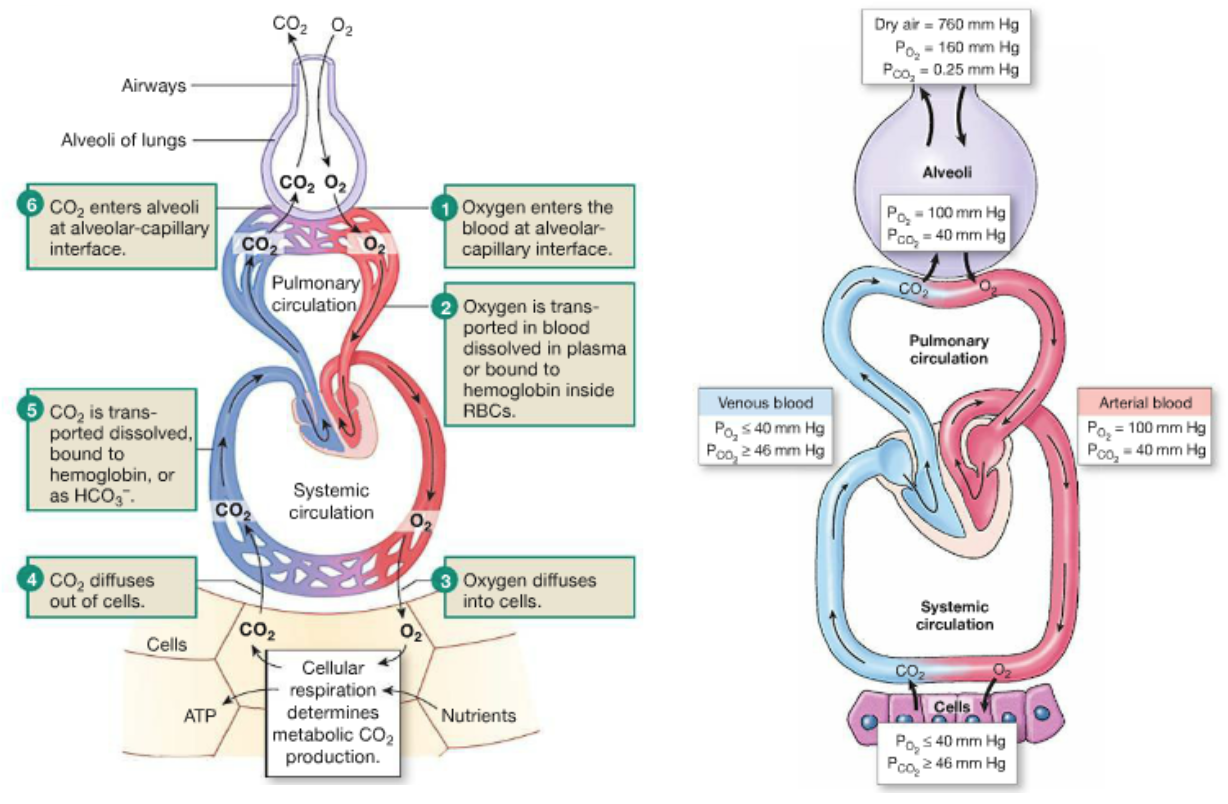
Partial pressure of a gas is the pressure exerted by a single gas in a mixture of gases while dissolved in a liquid.
Air at sea level exerts an atmospheric pressure of 760mmHg and is roughly made up of…
- 20.93% Oxygen
- 78 % Nitrogen
- 0.03% carbon dioxide, and other inert gases
Partial pressure =
total pressure of all gases x fractional [] of one gas
Ex. PO2 = 760 mmHg x (20.93/100) = 159 mmHg
Ex. PCO2 = 760 mmHg x (0.03/100) = 0.228 mmHg
Circle the correct answer:
Gases must move down a pressure gradient. For oxygen to enter blood, it must have a higher/lower pressure in the alveoli, and a higher/lower pressure in the capillaries. Gas exchange occurs at the capillaries and cells of tissues.
What does Fick’s Law state?
List the 5 factors to maximize diffusion across BGB.
Gases must move down a pressure gradient. For oxygen to enter blood, it must have a higher pressure in the alveoli, and a lower pressure in the capillaries. Gas exchange occurs at the capillaries and cells of tissues.
Fick’s Law states…
Rate of diffusion= (gradient x SA) / thickness
5 factors:
- Thin membrane
- High SA
- High pressure gradient
- Slower blood velocity
- Lipid solubility
Draw a diagram that shows the partial pressures of O2 and CO2 in the lungs and throughout circulation when the body is at rest.
Describe the effects of changing ventilation on arterial PO2, PCO2 and pH:
- Holding breath without changing metabolic activity
- Hyperventilating without changing metabolic activity
- Increasing metabolic activity without changing ventilation
Holding breath without changing metabolic activity:
- Decreased PO2
- Increased PCO2
- Increased H+
Hyperventilating without changing metabolic activity:
- Increased PO2
- Decreased PCO2
- Decreased H+
Increasing metabolic activity without changing ventilation:
- Decreased PO2
- Increased PCO2
- Increased H+
Name 6 components of blood:
6 components of blood:
- Red blood cells (RBCs; aka erythrocytes)
- White blood cells (WBCs; aka leukocytes)
- platelets
- plasma
- protein
- ions
Describe 2 ways in which oxygen is transported in the blood.
- Dissolved form in plasma
(1. 5%):
- Normal blood with an arterial PO2 of 100 mmHg contains only 3mL O2/L blood.
- Total blood volume of average individual is 5L, meaning only 15 mL of oxygen is carried in plasma
- Very inadequate bc even at rest, body consumes total of 250 mL O2/min, requiring a cardiac output of 90 mL/min to survive
- Bound to oxyhemoglobin insisde RBCs (HbO2) (98.5%)
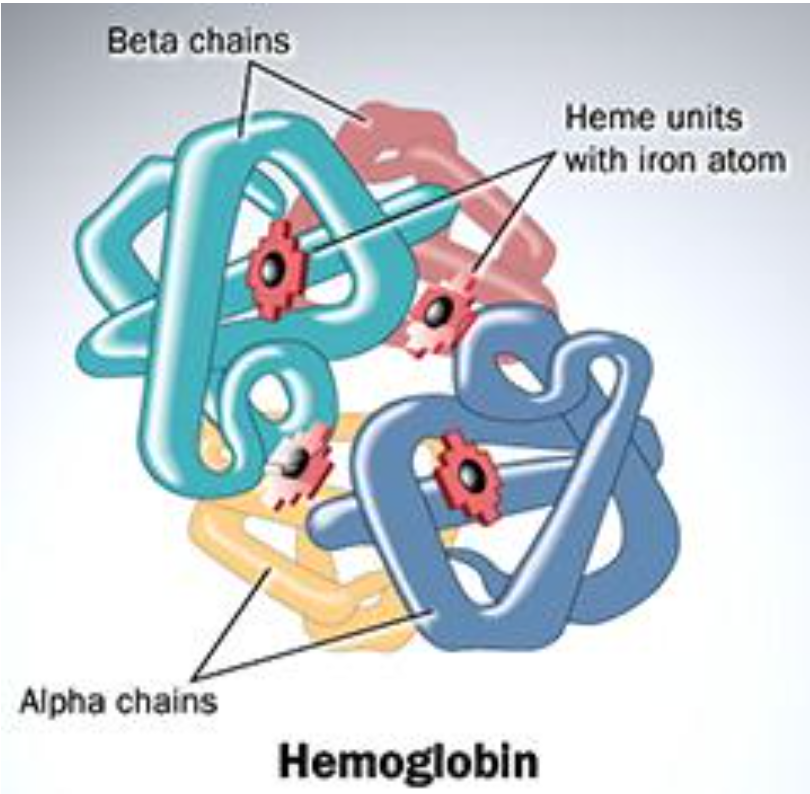
- Through combination with hemoglobin (Hb):
- Hb is a protein complex found inside RBCs
- 2 alpha chains, 2 beta chains -
each has a heme group that carries oxygen - Maximumof 4 oxygen carried per Hb (depending on [] of O2 surrounding Hb)
- 2 alpha chains, 2 beta chains -
- O2 easily forms a reversible combination with Hb to give oxyhemoglobin.
- O2 + Hb ⇔ HbO2
- Hb is a protein complex found inside RBCs
What are the 4 necessary functions of Hb?
- Bind lots of O2 at the lungs
- Be able to dissociate O2 at the cells of the body’s tissues for use
- Pick up waste products (CO2) from the cells
- Bring CO2 back to the lungs for disposal
O2 + Hb ⇔ HbO2
What causes the direction of this equation?
Explain the concept using a hemoglobin dissociation curve and the Bohr Effect.
[PO2]:
- Hb will have different amount of O2 attached to it depending on the [] of O2 surrounding Hb
- Lower PO2 results in less O2 on Hb
- When saturation occurs, Hb is “full”
Bohr Effect: In the presence of CO2 or H+, Hb has a decreased affinity for O2:
- pH decreases:
- Lower pH = more H+ (more acidic blood)
- CO2 increases
- Temperature increases
CO2 + H2O ⇔ H2CO3 ⇔ HCO3- H+
i.e. from exercise (aerobic respiration):
When CO2 is released from cells of body tissues into blood, it is converted into carbonic acid by carbonic anhydrase then is quickly converted into bicarbonate molecules and protons