What is the main optic pathway?
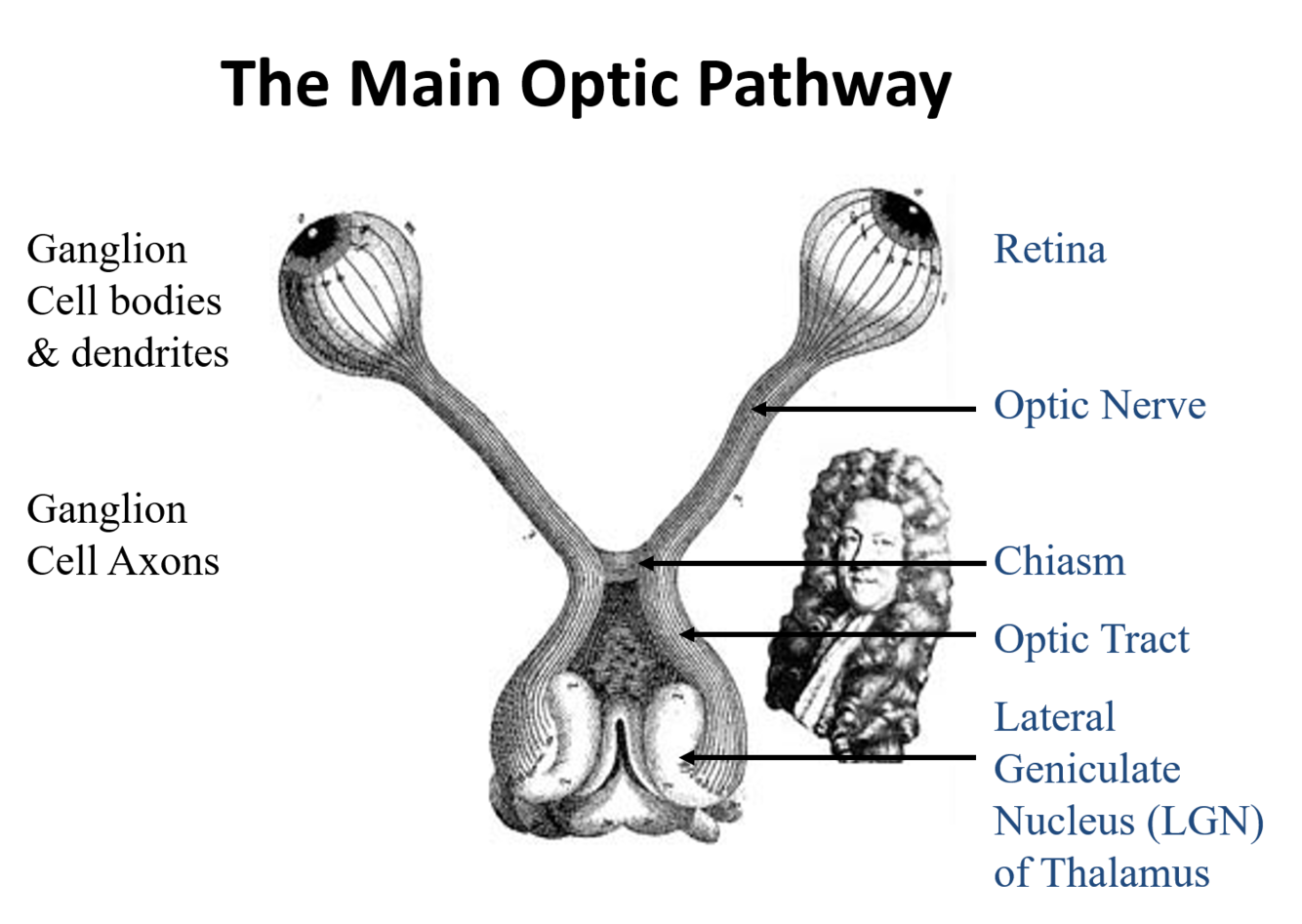
What are the three classes of retinal ganglion cells and how are they specialised for visual perception?
- Midget/Parvo (latin for small)–> Detailed Form/High Acuity & Colour Vision (Red/Green)
- Parasol/Magno (Latin for big)–>Global Form (i.e. rough sketch)/Low Acuity & Motion Vision
- Small Bi-Stratified/Konio–>Colour (Blue/Yellow)
[Note that there are some RGCs that arent concerned with visual perceptions and so don’t send their axons to the Lateral geniculate nucleus thus are refered to as sending theirn axons to ‘non-geniculate’ nuclei. These RGCs are interested in Visual REFLEXES.
Name the three main classes of retinal ganglion cells and their anatomical properties (i.e. structure and where they project to).
[1] The ‘Midget’ or Parvocellular sub-class (= the majority, ~80%)
- Small cell bodies, short dendrites, small diameter axons
- Concentrated in central retina, fewer peripherally
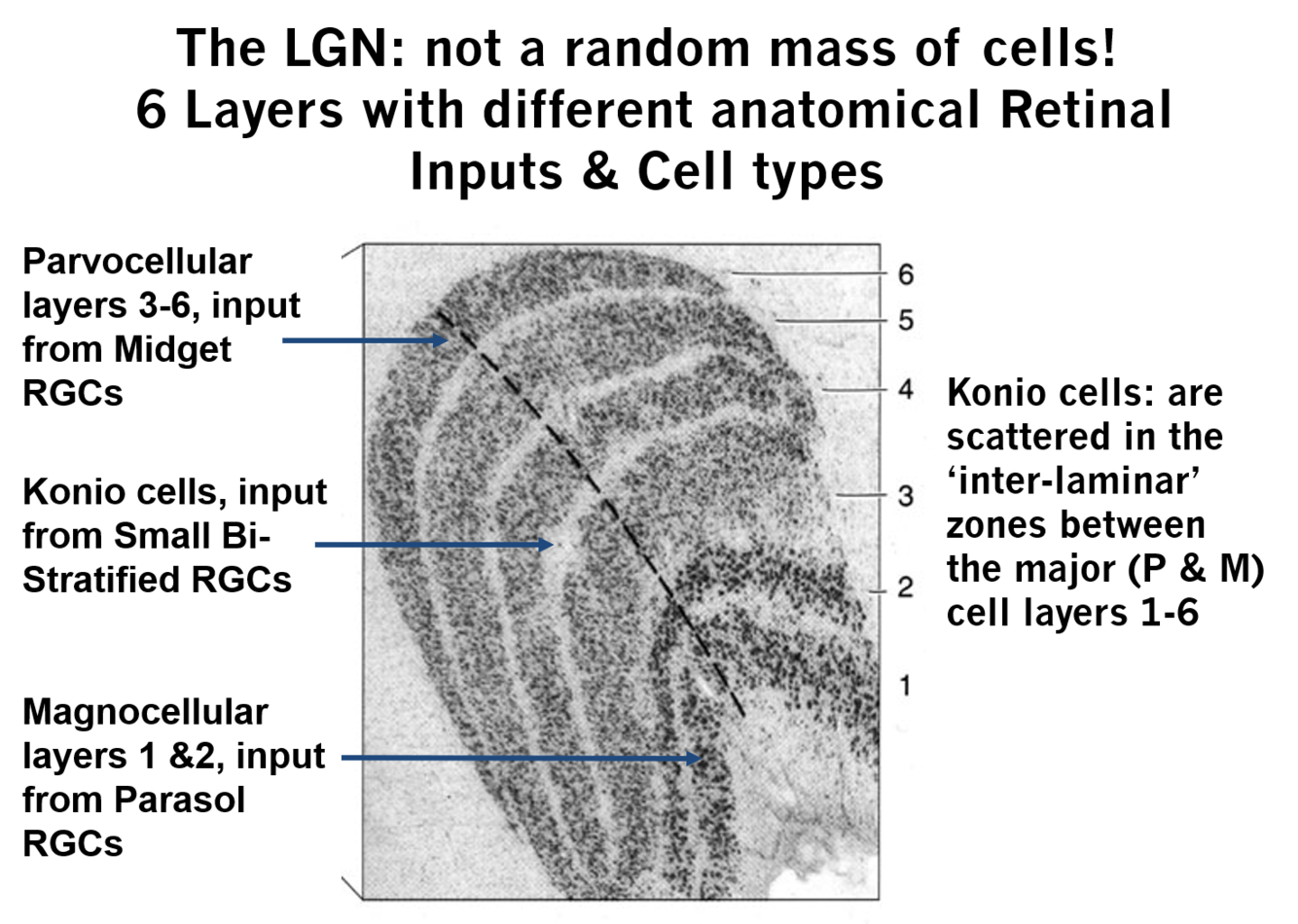
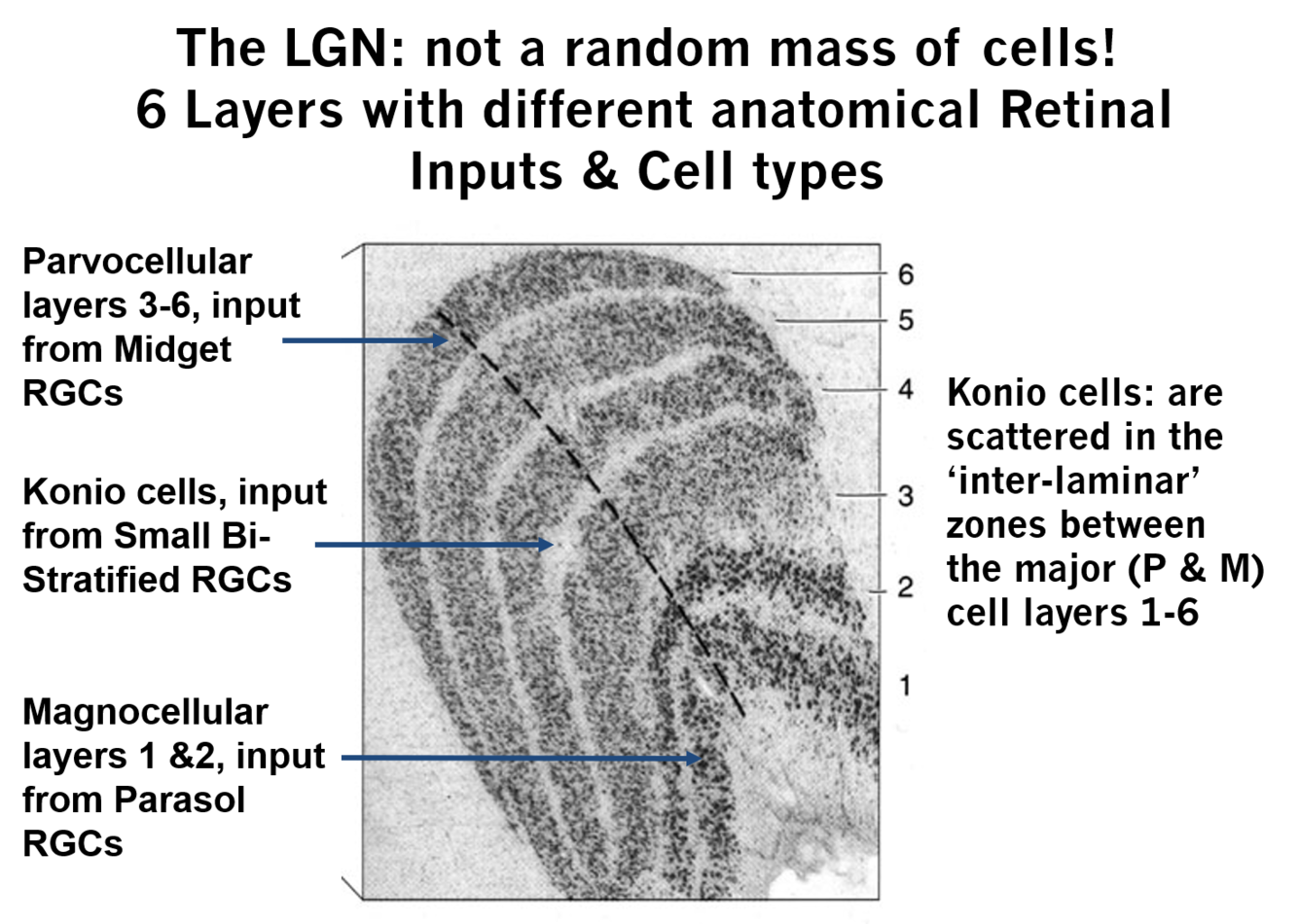
- Project to the Parvocellular layers (3-6) of LGN
[2] The ‘Parasol’ (name comes because they look like an umbrella) or Magnocellular sub-class (~10%)
- Large cell bodies & wide dendritic trees
- Wide diameter axons, heavily myelinated (fast conduction)
- Even distribution across central-to-peripheral retina
- Project to Magnocellular layers (1 & 2) of LGN
[3] The ‘Small Bi-Stratified’ or Koniocellular sub-class (~5%)
- Small cell bodies & wide dendritic trees, very thin axons
- Concentrated in central retina, few periphery
- Project to Konio cells in ‘Inter-laminar zones’ of LGN
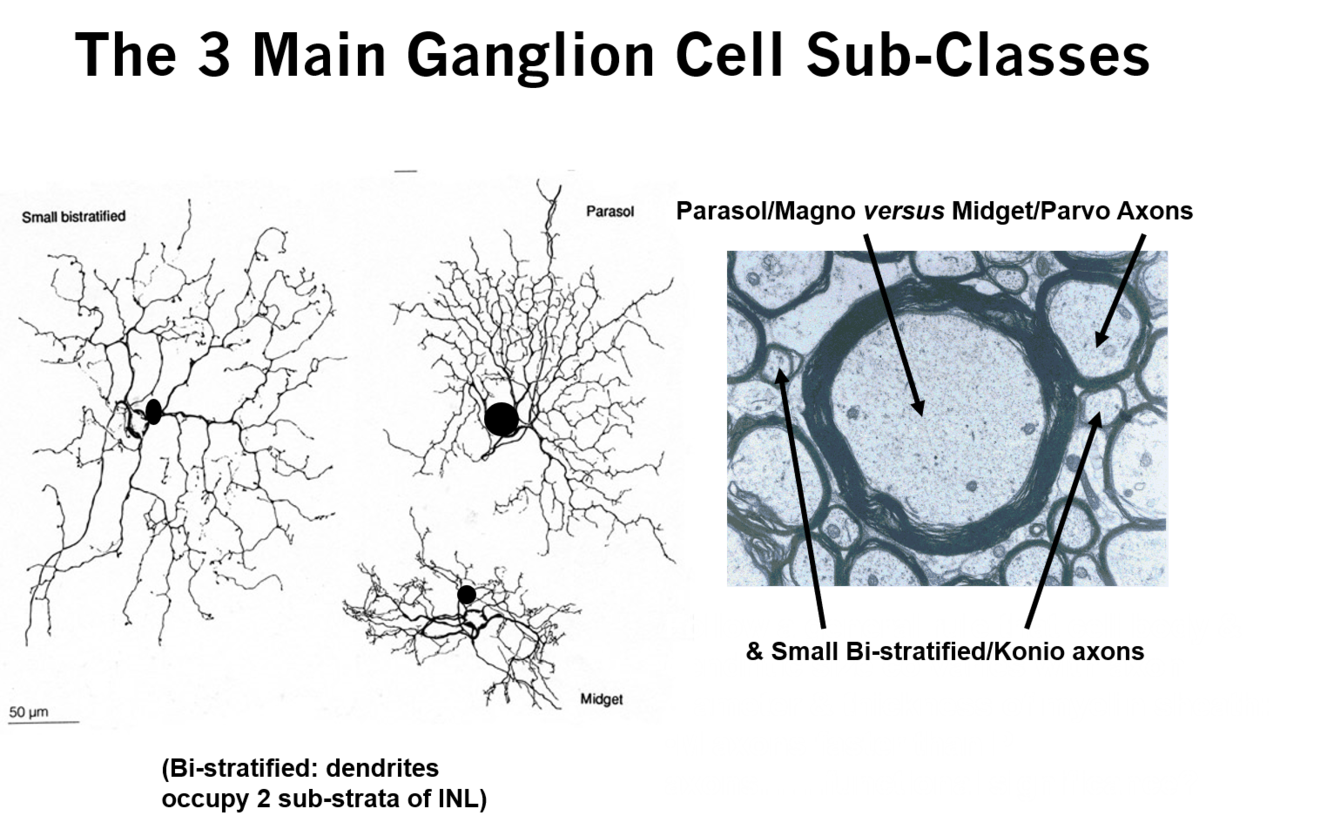
What are the three main classes of retinal ganglion cells and their functional properties (i.e. physiology - how their anatomy is related to its function)?
1] The ‘Midget’ or Parvocellular sub-class (= the majority, ~80%)
- Small receptive fields, respond to stimuli by giving sustained/long responses
- They come in two types: ON-centre/OFF-surround & OFF-centre/ON-surround— both these types are interested in luminance/brightness and red-green contrasts
- In terms of Luminance what they are really interested in is: high spatial frequencies (fine detail),
- They have a low contrast sensitivity (i.e. they need a high contrast to get them interested- thus respond well to high contrast).
- To summarise: High acuity (‘detailed form’) & RED-GREEN Colour
[2] The ‘Parasol’ or Magnocellular sub-class (~10%)
- Larger receptive fields,
- They give transient (brief) responses
- They come in two types ON-centre/OFF-surround & OFF-centre/ON-surround– both types are interested in luminance/brightness contrasts only (achromatic – they don’t care about colour)
- In terms of Luminance they are concerned with low spatial frequencies (“Global” Form- i.e. holistic image)
- They have high contrast sensitivity (i.e. they are receptive to even the smallest changes in “contrast)
- They also have high temporal contrast sensitivity (i.e., to flicker & image change- thus can detect change in image really quickly so goud for motion perception.)
- To summarise: Low acuity (‘global form’), high contrast sensitivity & Good Motion perception
[3] The ‘Small Bi-Stratified’ or Koniocellular sub-class (~5%)
- Small receptive fields, sustained responses
- Don’t have a centre-surround structure – instead they are uniform
- They are not focussed on luminance; blue-yellow contrasts only
What is the ‘prefered’ spatial frequency of the two types of retinal ganglion cells involved in luminance contrast?
Midget and prasol cells are involved in luminance contrast.
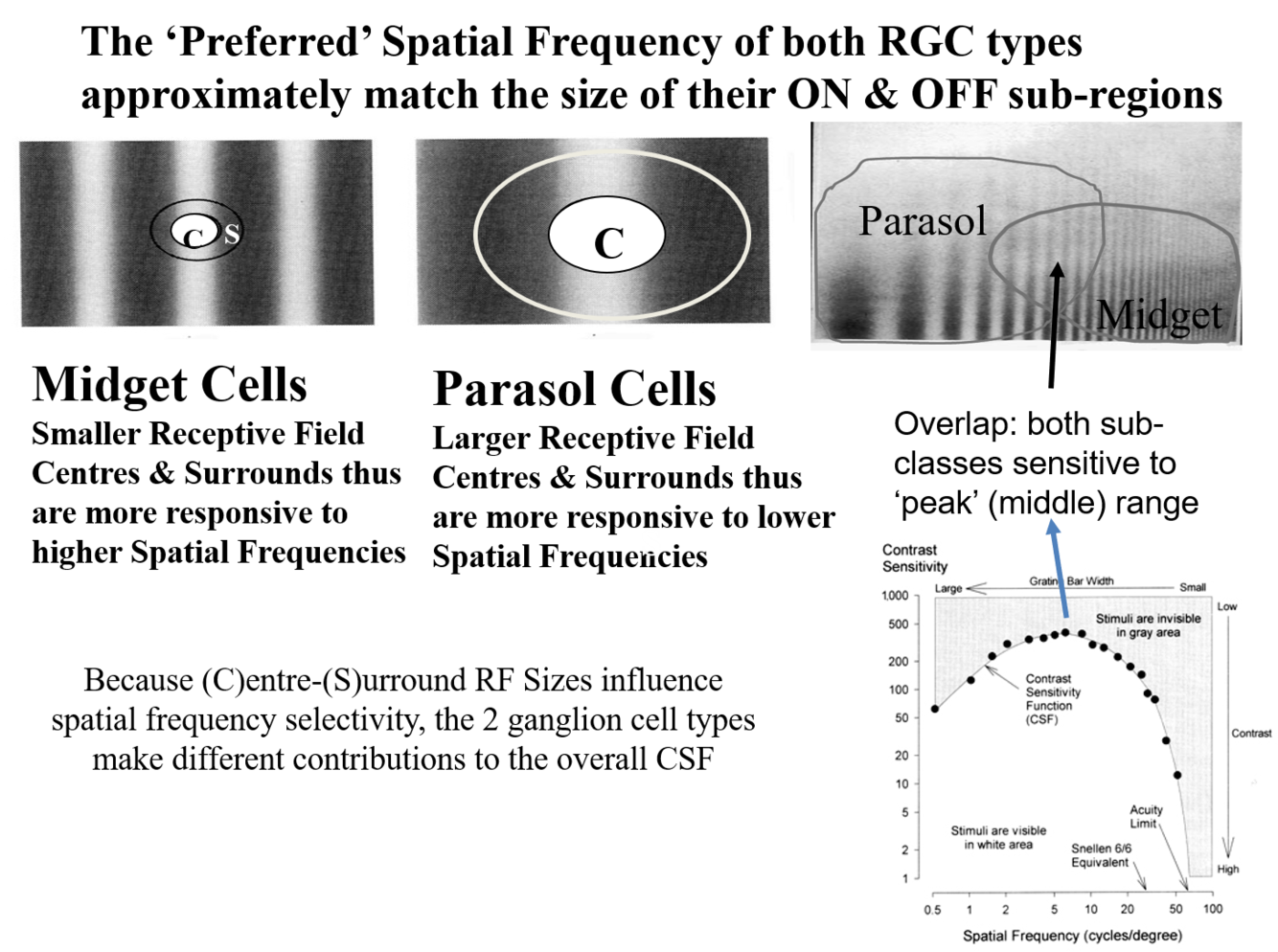
The ‘Preferred’ Spatial Frequency of both RGC types approximately match the size of their ON & OFF sub-regions.
What are the differences in temporal contrast sensitivity between midget and parasol cells, and why?
Temporal contrast sensitivity - is basically the ability to pick up flickering images.
The thing with midget cells is that they give long responses i.e. light is shone on them and they would be sending out a response to that light for a significantly long period of time before stopping.
However, with parasol cells if a light is shone on it, it sends out a quick response then stops.
Thus if an image flickered really fast the midget cell wouldn’t pick it up because by the time the image has reapeared the midget cell has just finished its response to the image having been there in the first place - so from a perception point of view from the midget cell, its as if the image never flickered in the first place.
However, if an image flickered infront of a parasol cell it would pick it up because it gives off transient (quick time) responses.
Define temporal
Can either mean denoting to the sides of the head (on the side of the ears) or it can mean relating to time.
What flciker rate is our peak threshold?
40Hz - we can’t detect anything flickering above 40Hz
Is the lateral geniculate nucleus (LGN) randomly organised- if not describe its structure?
Compare the receptive fields of Parvo , Magno and Konio cells in the LGN compred to those of the retinal ganglion cells.
The Receptive Fields of Parvo-, Magno- or Konio LGN cells:
- Very similar to those of the (P, M or K) retinal ganglions that supply their specific synaptic inputs
- Except, they are slightly larger (due to convergence from several ganglion cells of one type) & even less responsive to diffuse light (due to stronger ‘lateral’ inhibition in the LGN itself)
How does the LGN organise input from Parvo, Magno and Konio cells?
Function-specific layers (including the interlaminar zone)
•Before sending the information on, still in parallel, to the Primary Visual (V1) Cortex in the Occipital lobe.
[Konio is latin for spotty]
Which one is true- Midget retinal ganglion cells:
a) Are concentrated in central retina
b) Have large, heavily myelinated axons
c) Are particularly sensitive to blue/SW light
d) Give transient responses to light stimulation
A)Are concentrated in central retina
What happens to RGC sub-classes that are not involved in visual perception?
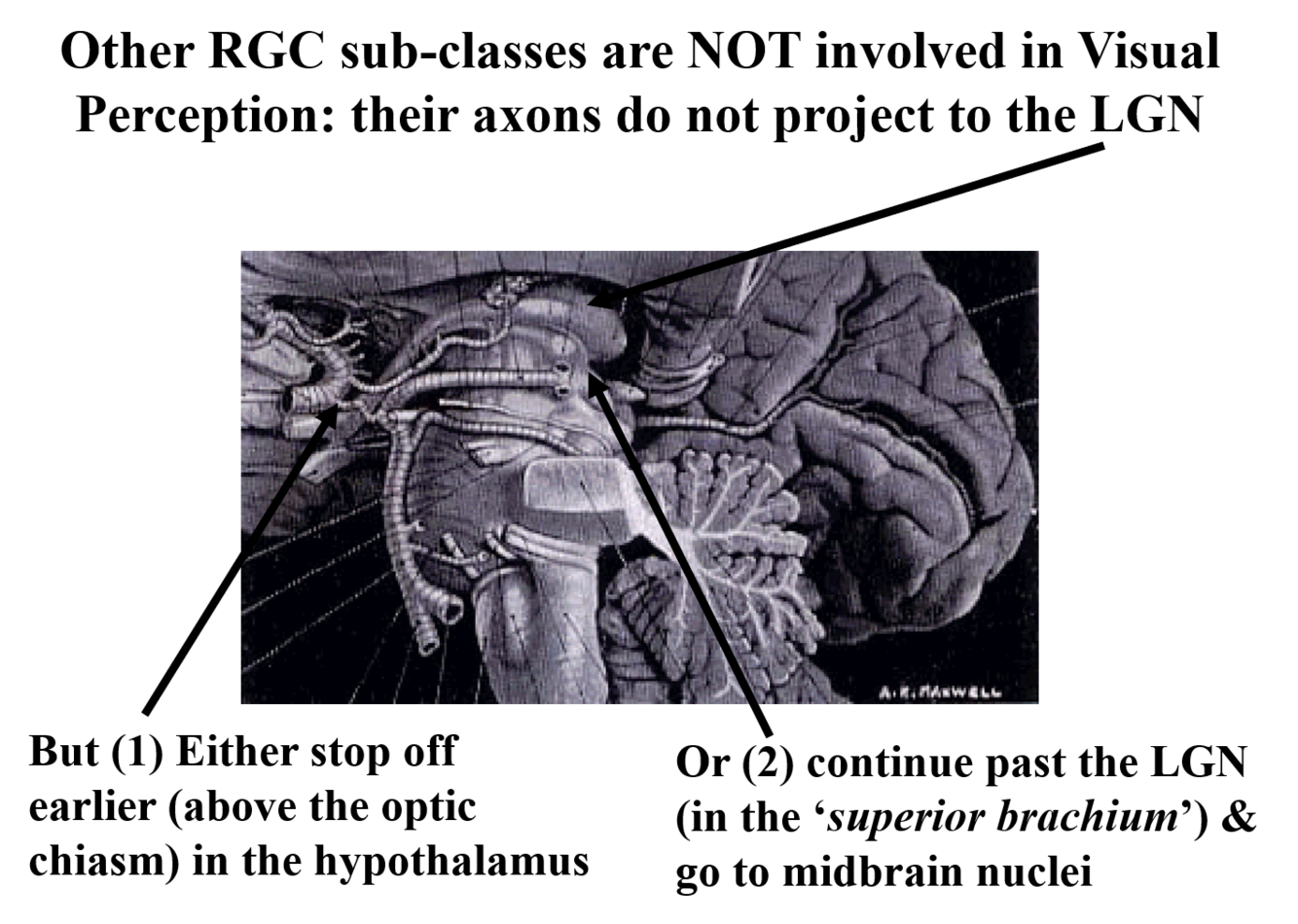
What do non perceptual Parallel Processing Pathways include?
- Projections from specialized Photosensitive (melanopsin-containing) ganglion cells to the Suprachiasmatic Nucleus of hypothalamus
- Basically all these cells do is detect relative light levels (radiance detector) in the environment thus they contribute to your biological clock and circadian rhythms.
And the pathways in the slide.
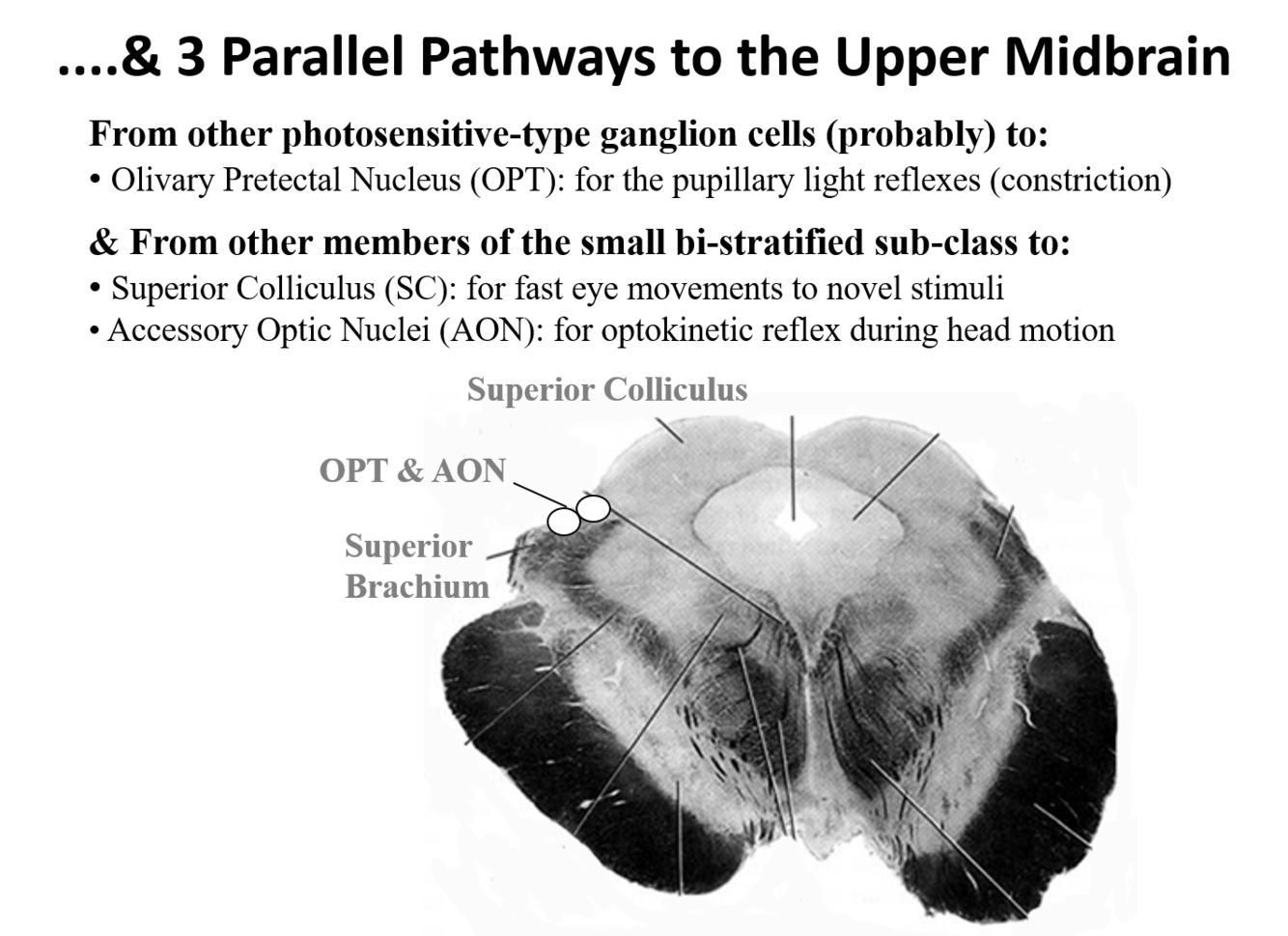
What are non-geniculate RGCs involved in mediating?
Things called visual ‘reflexes’:
A.KA:
•Circadian Rhythms; Pupillary Light Responses; Eye Movements

-
The Human Brain79
-
The Brain and Relations62
-
Cerebral Cortex35
-
Cerebellum18
-
Visual System - Essential Concepts41
-
Retina & Fovea Specialisations42
-
Retinal Image Processing and Receptive Fields17
-
Retinal Processing Pathways ( to the Thalamus and Midbrain)15
-
Visual Field Representations in the Primary Visual System29
-
Primary Visual (V1) Cortex - Location & Organisation27
-
Extrastriate Cortex17
-
Colour Processing and Perception20
-
How to Assess Human Visual Function26
-
ERG41
-
VEP25
-
Contrast Sensitivity28
-
Dark Adaptation52
-
Limits of Vision: Image Formation31
-
Limits on Vision: Spatial Resolution and Acuity25
-
Limits of Vision: Absolute Luminance Detection17
-
Temporal Vision: Flicker Detection44
-
The Ocular Motor Nuclei and Nerves17
-
Temporal Vision: Motion Perception36
-
Visual Adaptation and After Effects12
-
Illusions17



