what is the role of hypokalemia in a hypochloric metabolic alkalosis?
to increse of the blood pH, the intracellular H is exchanged by the extracellular K which lowers the blood K.
kidney increases the excretion of H in exchange of K and HCO3 (aldosterone)
paradoxical aciduria despite the alkalemia
- Which of the following statements is false?
- Normal filling of the reticulum activates the primary/mixing cycle
- Normal saliva production is not dependent on the time the animal spends cud chewing (ruminate)
- Normal rumen emptying is dependent on an intact primary cycle
- Volatile fatty acids are absorbed through the rumen wall along a concentration gradient
- Activation of stretch receptors in the dorsal rumen wall initiates the eructation reflex
Normal saliva production is not dependent on the time the animal spends cud chewing (ruminate)
- Ventral subcutaneous edema is least likely to be caused by:
- Decrease oncotic pressure
- Increased hydrostatic pressure
- Bladder rupture
- Increased capillary permeability following generalized vasculitis
- Chronic congestive heart failure
Bladder rupture
- Which of the following is not associated with cud chewing?
- Saliva production
- Mechanical breakdown of lignin
- Mechanoreceptor induced increased in mixing cycles
- Decrease the formation of stable foam through saliva production
- Drops rumen pH by increasing rumen acidity
Drops rumen pH by increasing rumen acidity
- All statements are true except
- Lepto, Clostridium, copper cause anemia through intravascular hemolysis
- A PCV of <12 is one of the indications for a blood transfusion
- Amprolium may predispose to polioencephalomalacia because it acts a thiamine analog
- A goats blood volume is equal to 12% of its body weight
- Fetal manipulation is not indicated until 30 minutes after onset of labor in goat
A goats blood volume is equal to 12% of its body weight
- Which of the following statements is false?
- A large fluid filled rumen is commonly associated with acute grain overload
- A high lignin content in hay is one of the predisposing causes of abomasal impaction
- Lymphoma involving the wall of the abomasum is one of the predisposing causes of pyloric outflow obstruction
- Type 1 vagal indigestion is characterized by a papple shaped abdomen
- Hypokalemia and hypocalcemia is often associated with an RDA
Type 1 vagal indigestion is characterized by a papple shaped abdomen
The normal rumen Ph is: 1 3-4 ]
2 5-6
3 6-7
6-7
- You perform a venous blood gas on a 60 kg calf. The calf is severely acidotic and has a base deficit of - 15mmol/liter. What volume isotonic bicarb (156 mmol/l) would you administer to correct the entire bicarb deficit? For purposes of calculation assume a 0.4 bicarbonate space.
- 1.2
- 2.3
- 3.4
- 5.1
- 6.0
2.3
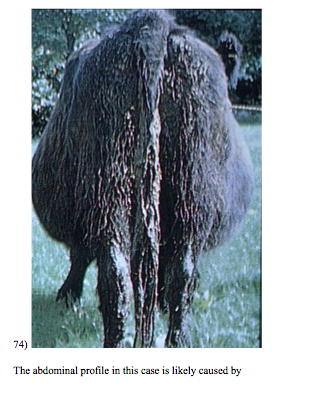
free abdominal fluid
- Apart from Ca – H exchange on protein what other mechanism contributes to the lowered Ca with an alkalosis?
- Increased Ca excretion in the milk
- Calciuria induced by the alkalosis
- Decreased affinity of osteoclastic receptors to bind with PTH
- Insufficient Ca binding protein in gut
- Rumen hypomotility
Decreased affinity of osteoclastic receptors to bind with PTH
- A cow (body condition score 4.5) with an RDA which is severely dehydrated, hypocalcemic and hypokalemic (1.9mEq/L – normal 3.8-5) and ketotic and has a blood pH of 7.28 and high anion gap is best treated with which of the following?
- 20l iv fluids (.9 % Saline) and bicarb; 2x 500ml 50% dextrose; KCl at 20mEq/L and 750 ml Ca IV
- 20l iv poly-ionic, isotonic fluids; 2x 500ml 50% dextrose; 20mg dexamethasone; KCl at 20mEq/L and 750 ml Ca IV
- 1liter hypertonic saline; 20l iv (.9% saline + 2.5% dextrose); 1 x 500ml 50% dextrose; KCl at 20mEq/L; 150g KCL orally and 750 ml Ca IV
- 1liter hypertonic saline; 20l iv (.9% saline + 2.5% dextrose); KCl at 20mEq/L; 20mg dexamethasone, 150g KCL orally and 750 ml Ca IV
- 1liter hypertonic saline; 1 x 500ml 50% dextrose bolus then CRI fluids (.9% saline + 2.5% dextrose); KCl at 20mEq/L; 150g KCL orally and 750 ml Ca IV and insulin CRI
Cow needs a lot of K (IV and oral) because it is hypokalemic, needs bicarb because of the acidosis, and dextrose because of ketosis. Do not give hypertonic saline in this situation because it is an acidic solution. Not an appropriate question because the most correct answer does not have bicarb as part of the treatment.
- Which of the following statements is false?
- Acetate is one of the main precursors of butter fat
- Buffalo milk has a high butter fat content making it suitable for type B dairies
- Heat stress is linked with lowered fertility
- Open mouth breathing results in lowered rumen buffering
- Providing cooling through water via mist is ideal for heat stress control
Providing cooling through water via mist is ideal for heat stress control
- Which of the following is not a complication of RVA after correction?
- Abomasal ileus
- Abomasal ulceration
- Vagal indigestion type 2
- Vagal indigestion type 3
- Persistent hypochloremic metabolic alkalosis
Vagal indigestion type 2
- Regarding a positive pinch test, which statement is true?
- Is a reliable test for all stages of traumatic reticulo-peritonitis
- Pain is caused by the foreign body penetrating into the heart
- The foreign body has likely penetrated into the pericardial sac
- Is caused by tearing fresh fibrin strands attaching peritoneal surfaces
- The animal bends her back ventrally in response
Is caused by tearing fresh fibrin strands attaching peritoneal surfaces
- Which of the following should you do to expedite a diagnosis and prognosis for a 12-month old blocked goat which lives on pasture/browse?
- Take an x-ray to check for calcium stones in urethra (pearl string effect)
- Ultrasound bladder and kidneys
- Amputate the urethral process
- Check blood potassium
- Do retrograde catheterization
Take an x-ray to check for calcium stones in urethra (pearl string effect)
- From the following select the most effective treatment to prevent pregnancy toxemia in sheep?
- Identify triplet carrying sheep and feed separately
- Feed only roughage prior to lambing
- Determine liver Mg levels and supplement Mg
- Feed extra potassium
- Make sure all sheep body condition score is 4.5 – 5.0
Identify triplet carrying sheep and feed separately
- Which of the following infectious agents does not cause mouth lesions in cattle?
- BVD
- Actinobacillus lignereisi
- Fusobacterium necrophorum
- Bovine papular stomatitis
- Clostridium perfringens type A
Clostridium perfringens type A
Which findings listed strongly indicates severe fermentation failure
a) Absence of cud chewing
b) Rumen ping
c) Rumen atony
d) Rumen pH 7
e) Methylene blue reduction test - 3 minutes to discolor
rumen ping
when is LDA more likely to occur?
right after calving
- Which of the following statements is false?
- As age of castration increases, weight loss increases
- Castration at less than 500 lb had less marbling than castrated at more than 700 lb
- Calves castrated at feedlot have higher morbidity and mortality
- Early castration with implant better production than late castration in backgrounding program
- Intact calves fetch less money at conventional markets
Castration at less than 500 lb had less marbling than castrated at more than 700 lb
name 4 groups of organism that proliferates in an acidic rumen environment and their associated abnormal conditions
lactobacili- lactic acidosis
mucor- mucomycosis in the rumen abomasum and rectum
C. PERFRINGENS a- ACUTE DEATH/BOWEL SYNDROME
C. perfringens D- overeating dz, pulpy kidney
\B thiaminolyticus- polio
Which condition is typically not associated with Fusobacterium necrophorum in cattle.
a) Necrobacillosis (Necrotic stomatitis)
b) Caudal vena cava syndrome
c) Diffuse peritonitis
d) Foot rot
e) Liver abcsesses
Diffuse peritonitis
- Which of the following would be most indicative of intestinal parasitism in a sheep flock?
- Loss of body condition
- Bottle jaw as result of decreased vascular oncotic pressure
- Rumen atony
- Constipation
- Famacha score 2 in the majority of sheep
Bottle jaw as result of decreased vascular oncotic pressure






