Rheumatology cases:
Case 1
1) Other questions:
- Are both hands affected?
- Is it worse on rest?
- Fever or weight loss
- Family history of other autoimmune diseases
- Where exactly on hand is affected, eg PIP joints
- Have you had any recent trauma?
- Any other symptoms other than those mentioned?
- Past medical history
- is there spinal involvement?
Early morning stiffness in and around joints is very important symptom. You should think of inflammatory causes of joint disease when a patient reports this symptom
2) Clinical examination (LOOK, FEEL, MOVE):
- Check if symmetrical joint abnormalities
- Look for skin nodules especially on elbows
- Look for redness, swelling, heat, pain
- Look for deformities
- Is there restriction of movement eg ask her to try and make fist
- Check for other extra-articular features like eye problems and systemic involvement eg vasculitis-might see digital ischaemia
3) Tests:
- Rheumatoid factor and anti-CCP antibody test
- inflammatory markers from blood tests (ESR and CRP)
- X-ray the hands and the wrists-boney erosions (might be too early to show X-ray changes as only had symptoms for 12 weeks)
- Ultrasound scan of hand is much better at detecting inflammation, the X-ray only shows damage which is from long standing disease.
4) Differential diagnosis: Rheumatoid arthritis-as female, prolonged morning stiffness (so definitely not OA-likely inflammatory arthritis), hands and wrist, PIP-as wedding ring (less likely psoriatic arthritis (check for pitting in nails and skin involvement) or fracture or gout (but gout is usually acute so less likely) not likely to be reactive arthritis as that’s more acute too)
5) Treatment plan:
- First line: DMARDs-Methotrexate in combination with hydroxychloroquine or sulfasalazine
- Steroids acutely eg pregnisolone
- Second line and if quite aggressive-biologics eg Inflixumab
- Physiotherapy and occupational assessment to check she is okay at home
NSAIDs help the pain and stiffness but do not prevent joint damage. So NSAIDs are not ‘disease-modifying’.
Case 2
1) What other questions would you ask?
2) What clinical signs would you look for on examination?
3) What tests would you do?
4) What are the differential diagnoses? State the one you think is most likely
5) For your most likely differential diagnosis, outline the likely management plan
For each question, nominate 1 person in your group to be the spokesperson to summarise your discussion
1) Other questions:
- Is it worse on exertion?
- Any recent trauma?
- Is the pain symmetrical
- Are any other joints affected?
- Any autoimmune conditions in family?
- Any spinal involvement?
- How bad is the pain? SOCRATES for pain
- Check for recent infections eg gastroeneteritis like salmonella and campylobacter so ask about diarrhoea and vomiting, other big group is sexually transmitted diseases eg syphillis and HIV (for reactive arthritis)
- Ask about systemic involvement eg fever, nodules
2) Clinical examination: Look, feel, move
- Look at nails for pitting
- Look for any other extra-articular involvement
- Signs of inflammation: Heat, swelling, pain, redness
- Symmetry
- Extensor surface plaques eg behind on elbow, indicative of psoriasis
- Limited range of motion
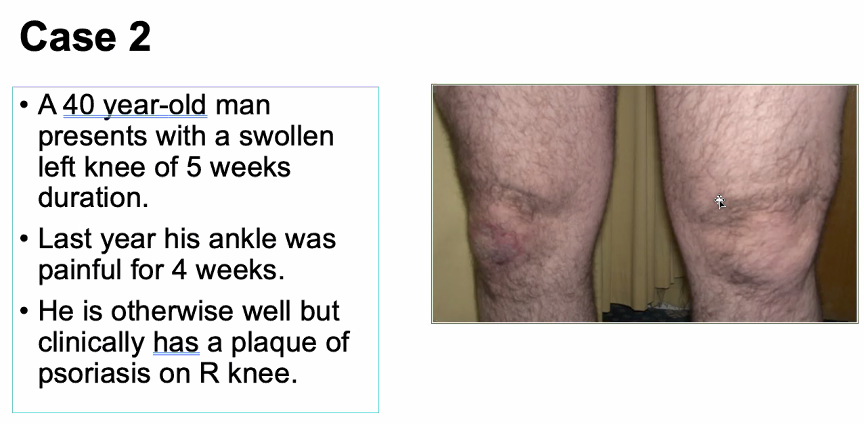
- See photo on right shows psoriatic plaque and can see suprapatellar knee effusion ie swelling above knee. Unlikely to be bursitis as this would be more on knee
3) Tests:
- Rheumatoid factor
- inflammatory factors eg CRP, ESR
- ANCA, ANA
- Ultrasound to look at inflammation
- X-ray-pencil in cup abnormality, specifically of ankle and knee as these are affected
- HLA-B27
- MRI
- Try and aspirate the knee by putting needle in and send fluid to lab
4) Differential diagnosis: Most likely= Psoriatic arthritis (injury), (reactive arthritis-as not many joints involved so could be this, gout can affect large joints but usually affects big toe first so there is a history of this usually)
5) Treatment plan:
- DMARDS, not oral steroids for skin as makes it worse
- When aspirate knee, could inject steroid at same time if no pus is coming out.
Case 3
1) Other questions:
2) Clinical examination:
3) Tests: Rheumatoid factor, inflammatory factors
4) Differential diagnosis:
5) Treatment plan:

-
Management of specific fractures28
-
Injuries and management51
-
Children's orthopaedics44
-
Back Pain40
-
Introduction to Bone Year 1 recap27
-
Injury and Healing (extra-recap)35
-
Yr 2 management of common orthopaedic conditions (main lecture)68
-
Introduction to rheumatology (extra)34
-
Introduction to rheumatology actual32
-
Rheumatoid disorders tutorial3
-
Rheumatology: diagnostics and tests28
-
Rheumatoid arthritis and SLE/systemic manifestations22



