- What are sounds caused by?
All sounds are caused by a vibrating object.
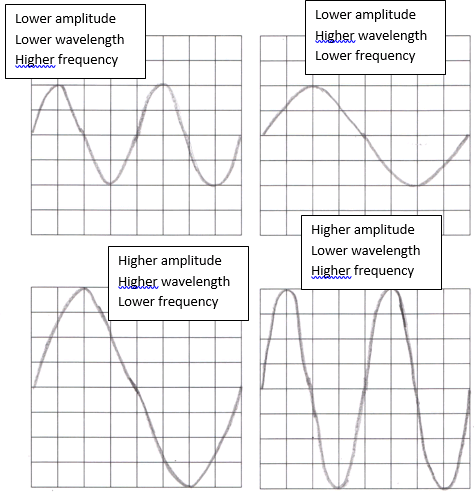
- Describe what happens to a wave trace when the amplitude, wavelength and frequency changes.
When the amplitude of a wave increases it gets taller.
When the wavelength of a wave increases it gets longer.
When the frequency of a wave increases there are more waves in the same time.
These can be seen on the following images:
- Describe how a sound changes when the frequency or amplitude is changed.
Higher pitched sounds have a higher frequency.
Louder sounds have a larger amplitude.
- State the frequency range of human hearing
The range of human hearing is approximately 20 Hz to 20 kHz (20 0000 Hz)
- Describe what happens when the frequency of sound gets above the range of human hearing.
When the frequency of sound gets above the range of human hearing (above 20 kHz) it is called ultrasound. It still exists but humans can no longer hear it.
- Describe what happens to light when it undergoes refraction.
When light enters a different medium (material) it undergoes refraction. This means it changes speed and usually changes direction.
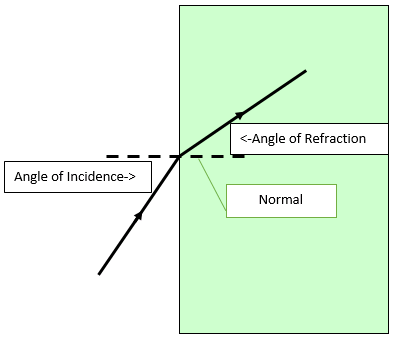
- Use the following terms correctly; normal, angle of incidence and angle of refraction.
The normal is a line at right angles to the surface where the light strikes it
The angle of incidence is the angle between the incident ray and the normal.
The angle of refraction is the angle between the refracted ray and the normal.
See Image.
- Describe the path of light as it passes from one medium to another at an angle to the surface.
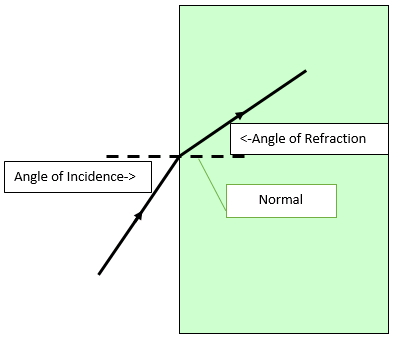
When lights enters glass at an angle, it will bend towards the normal. (See image)
When light leaves glass at an angle it will bend away from the normal.
- Describe the path of light as it passes from one medium to another perpendicular to the surface.
When light enters glass perpendicular to the surface (along the normal), it goes straight through.
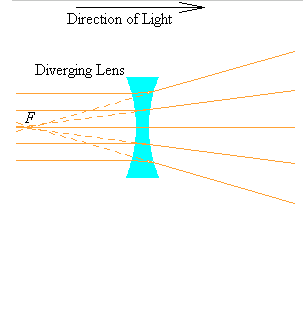
- Describe the shape of a diverging lens, and describe its effect on parallel rays of light.
A diverging lenses is thinner in the middle than the outside. It makes parallel rays diverge.
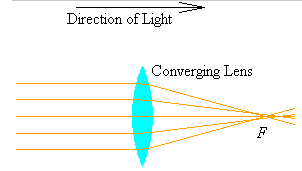
- Describe the shape of a converging lens, and describe its effect on parallel rays of light.
A converging lens is thicker in the middle than the outside. It makes parallel rays converge to a focus.
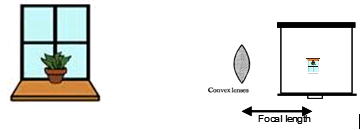
- Describe the image of a distant object produced by a converging lens
The image of a distant object produced by a converging lens is
a) smaller than the object,
b) vertically inverted and
c) horizontally inverted
- Describe how to measure the focal length of a converging lens.
The focal length of a converging lens can be measured as follows:
Start with the lens at the screen. Move it away until a sharp image of a distant object is obtained. Use a metre stick to measure the distance between the lens and the screen. This is the focal length of the lens.
- What effect does the curvature of a lens have on its optical power?
A lens with a greater curvature has a higher optical power.
- Explain the relationship between optical power and focal length.
A lens with a greater curvature will bend the rays more, so that they will come to a focus in a shorter distance. This means the focal length is shorter for a more powerful lens.
- State what the symbols stand for and what units go with each, for the formulae
P = 1/f
and
f = 1/P
P - Optical Power (D Dioptres)
f - Focal Length (m)
- What do negative and positive values of Optical Power indicate?
Negative values of Optical Power indicate a diverging lens.
Positive values of Optical Power indicate a converging lens.
- Example
Calculate the focal length of a lens with an optical power of 4 D.
f = ?
P = 4 D
f = 1/P
= 1/4
f = 0.25 m
(NB No need to convert to cm unless a question asks for the answer in cm.)
- Example
Calculate the optical power of a diverging lens with focal length 20cm.
f = 20 cm = 0.2 m
P = ?
P = 1/f
= 1/0.2
P = 5 D
Final answer is - 5 D since it is a diverging lens.
- Describe the function of the pupil of the eye.
The pupil lets light into the eye.
- Describe the function of the cornea of the eye.
The cornea is the covering over the front to protect the eye. It also starts to focus the light.
- Describe the function of the lens of the eye.
The lens brings the light to a focus on the retina.
- Describe the function of the retina of the eye.
The retina is the screen of the eye where a sharp image should be produced. It is filled with light sensitive cells.
- Describe the function of the optic nerve of the eye.
The optic nerve carries image information to the brain.



