Define auto-immunity
Autoimmunity is an immune response against the host due to the loss of immunological tolerance of self-antigen(s)
What are autoimmune diseases?
Autoimmune diseases are diseases caused by tissue damage or disturbed physiological responses due to an auto-immune response
What are the two types of autoimmune disease?
- Organ specific
- Non-organ specific
Distinguish between organ specific and non-organ specific autoimmune diseases
Organ specific: 1/more self antigens within one single organ or tissue
Non-organ specific: self antigens widely distributed throughout the body
Which systems in the body do auto-immune diseases commonly affect?
- Nervous disease
- Respiratory disease
- Endocrine disease
- Joint diseases
- Haematological disease
Identify the two mechanisms of tissue damage in autoimmune diseases
- Autoantibodies
- Autoreactive T Cells
How do autoantibodies cause tissue damage?
- Complement activation
- Antibody-mediated cell cytotoxicity
- Neutrophil activation
What do autoreactive T cells use to cause tissue damage?
- Cytotoxic T cells
- Macrophages
Identify the six criteria for diagnosing an autoimmune disease
- Presence of (1) autoantibodies/autoreactive T cells at the (2) site of tissue damage
- Levels of cells (3) correlate with disease severity and (4) transfer of cells to a healthy host induces the autoimmune disease
- Clinical benefit provided by (5) immunomodulatory therapy and there is (6) family history
Identify the three steps involved in the induction of autoimmunity
- Breakdown of central tolerance
- Breakdown of peripheral tolerance
- Activation of autoreactive B cells
What causes the breakdown of central tolerance?
Failure to delete autoreactive T cells
What causes the breakdown of peripheral tolerance?
- Regulatory T cells defects
- Impaired immunomodulation
- Altered self-antigens
What causes the activation of autoreactive B cells?
- T cell-independent activation of B cells
- Carrier effect (complex foreign-self antigens)
Which two types of factors trigger autoimmunity?
- Genetic factors
- Environmental factors
Identify the three environmental factors that trigger autoimmunity
- Hormones
- Infections
- Drugs
Identify 3 genetic factors that trigger autoimmunity
- Increased risk with an affected sibling
- Increased risk with an affected identical twin
- Associated with some MHC variants
Which therapeutic strategies can be used to target autoantibodies in the pathogenesis of auto-immune diseases?
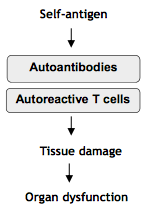
- Plasma exchange
- Monoclonal antibodies
Which therapeutic strategies can be used to target autoreactive T cells in the pathogenesis of auto-immune diseases?
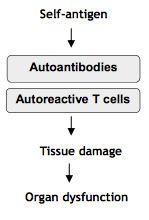
- Immunosuppresive drugs
- Monoclonal antibodies
Which therapeutic strategy can be used to target tissue damage in the pathogenesis of auto-immune diseases?
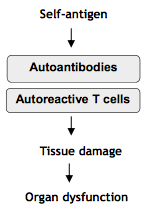
Anti-inflammatory drugs
Which therapeutic strategies can be used to target organ dysfunction in the pathogenesis of auto-immune diseases?
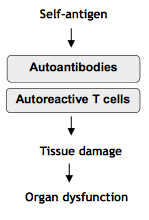
- Replacement therapy
- Surgery
Identify 5 common symptoms of SLE and RA
- Pain: pleuritic chest pain, joint pain
- Stiffness
- Swelling
- Fatigue
- Fever
The ‘glove and sweater’ approach is used to take history for autoimmune rheumatic diseases.
Describe the glove component
History:
- Raynauds
- Hand rash
- Joint pains and swelling
The ‘glove and sweater’ approach is used to take history for autoimmune rheumatic diseases.
Describe the sweater component
History:
- Hair loss
- Eye and mouth dryness
- Nose bleeds
- Truncal rash/photosensitivity
- Limb weakness
In the examination for ARDs, what should one check for when examining the hand?
- Raynauds
- Synovitis
- Hand rash



