How can we detect diseases?
- Spontaneous presentation
- Opportunistic case finding
- Screening
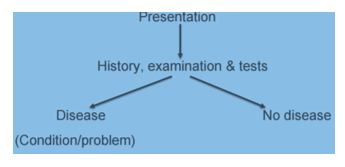
Define diagnosis
Diagnosis is the definitive identification of a suspected disease or defect by application of tests, examinations or other procedures to definitely label people as either having a disease or not having a disease
What is screening?
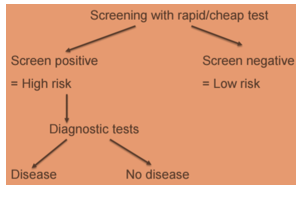
Screening is a systematic attempt to detect an unrecognised condition by the application of tests, examinations, or other procedures to identify healthy people who may be at increased risk of disease or condition
Outline the screening process
What is the purpose of screening?
To give a better outcome compared with finding something in the usual way (having symptoms and self reporting to health services)
One of the criteria for implementing a screening programme is Condition.
Explain this
Condition: an important health problem (frequency/severity) with epidemiology, incidence, prevalence and natural history understood
One of the criteria for implementing a screening programme is Test.
A screening test is going to make two types of error: false positive and false negative. What are these?
- False positive – refers well people for further investigation, putting them through stress, anxiety and inconvenience
- False negative – fails to refer people who have an early form of the disease, inappropriately reasurring them
What are the four features of test validity?
- Sensitivity
- Specificity
- Positive predictive value
- Negative predictive value
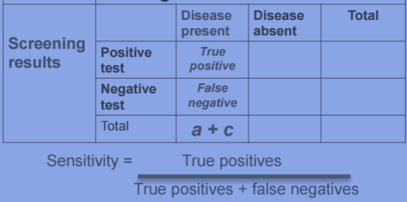
What is sensitivity?
Sensitivity is the proportion of people with the disease who test positive (aka detection rate)
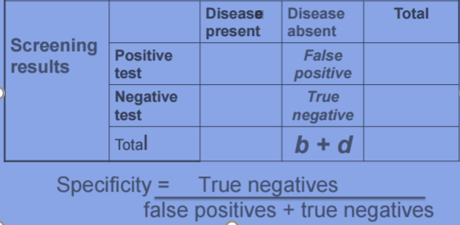
What is specificity?
Specificity is the proportion of the people without the disease who test negative
What is positive predictive value?
Positive predictive value is the probability that someone who has tested positive actually has the disease
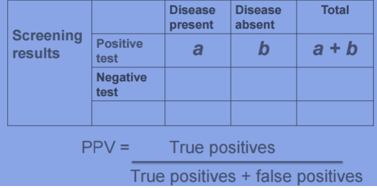
What influences PPV?
Positive Predictive Value is strongly influenced by the prevalence of the disease
What is negative predictive value?
Negative predictive value is the proportion of the people who test negative and actually do not have the disease
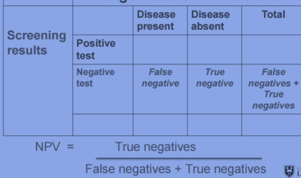
What are the implications of false positive results?
- Offered diagnostic testing with all its anxieties and risks for an absent condition
- May lead to lower uptake of screening in future and greater risk of interval cancer
What are the implications of false negative results?
- Not offered diagnostic testing when in fact they may have benefited from it
- False reassurance – may present late with symptoms as a consequence
One of the criteria for implementing a screening programme is Intervention.
Explain this
- Effective intervention for patients identified through screening
- Intervention at a presymptomatic phase leads to better outcomes for the screened individual
One of the criteria for implementing a screening programme is Screening programme.
Explain this
- Screening programmes have proven effectiveness in reducing mortality or morbidity
- Benefit gained should outweigh any harms e.g. overdiagnosis, overtreatment, false positives, false reassurance, uncertain findings and complications
One of the criteria for implementing a screening programme is Implementation.
Explain this
- Clinical management and patient outcomes should be optimised
- Evidence-based information available to potential participants (informed choice)
- Public pressure should be anticipated
Identify 2 advantages of screening for disease
- Detect many diseases at birth, with no risk to the child
- Avoid serious and permanent consequences for the child (presymptomatic treatment)
Identify 4 disadvantages of screening programmes
- Specimens may need to be taken a second time
- False positives
- False negatives
- Complications could still arise
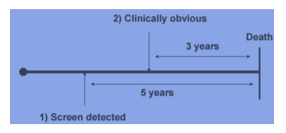
One evaluation difficulty is lead time bias.
What is this?
- Lead time bias is when early diagnosis falsely appears to prolong survival
- Screened patients appear to survive longer, but only because they were diagnosed earlier
One evaluation difficulty is length time bias.
What is this?
Length time bias involves the easy detection of slow growing, unthreatening cases rather than aggressive, fast-growing ones
Another evaluation difficulty is selection bias.
What is this?
- Studies of screening often skewed by ‘healthy volunteer’ effect
- Those who have regular screening likely to also do other things that protect them from disease
Give examples of 4 screening programmes in the UK

-
S1) Biopsychosocial Model7
-
S1) Lay Beliefs17
-
S1) Socioeconomic Inequalities in Health10
-
S2) Health-related Quality of Life17
-
S2) Emotional Responses to Chronic Illness7
-
S2) Sociological approaches to LTCs10
-
S2) Coping9
-
S3) Stereotypes8
-
S3) LGBT19
-
S3) Cultural diversity10
-
S4) Evidence-based Practice8
-
S4) Resource Allocation5
-
S4) Healthcare Economics21
-
S5) Health Promotion24
-
S5) Population-based Screening24
-
S6) Health-related Behaviour14
-
S6) Substance Misuse and Treatment Options20



