What is diuresis?
Diuresis is the increased formation of urine by the kidney
What is a diuretic?
A diuretic is a substance/drug that promotes a diuresis by increasing the renal excretion of Na+/H2O, reducing ECF volume
When are diuretics used clinically?
Clinical use is in conditions where Na+ and H2O retention cause expansion of ECF volume and oedema eg. heart failure
Briefly, describe how diuretics act on the nephron/kidney
Diuretics act by blocking reabsorption of Na+ and H2O by the tubule and increase the fractional excretion (FE) of Na+
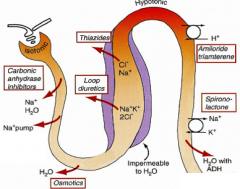
Describe the 4 pathways in which diuretics can act on the nephron
- By blocking Na+ transporters in the luminal membrane
- By antagonising the action of aldosterone
- By modification of filtrate content (osmotic diuretics)
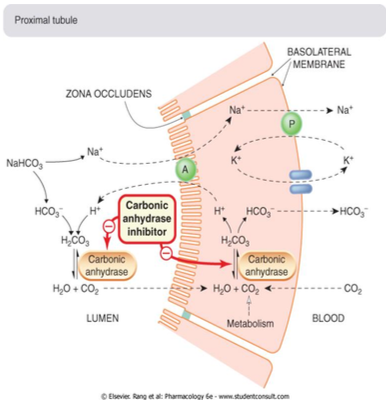
- By inhibiting activity of enzyme carbonic anhydrase in the PCT
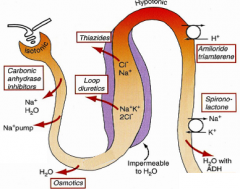
Identify the 3 types of diuretics which act on cells to block Na+ transporters in the luminal membrane
- Thiazide diuretics
- Loop diuretics
- K+ sparing diuretics
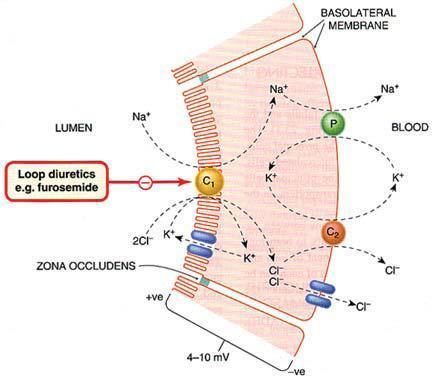
Describe the action of loop diuretics
- Drug is secreted into the lumen in the PCT
- Acts on Loop of Henle
- Blocks NaKCC co-transporter
Describe the action of thiazide diuretics
- Drug is secreted into the lumen in the PCT
- Acts on the early Distal Tubule
- Blocks Na–Cl cotransporter
Describe the action of K+ sparing diuretics
- Drug is secreted into the lumen in the PCT
- Acts on Late DT & CD
- Blocks Epithelial Na channels
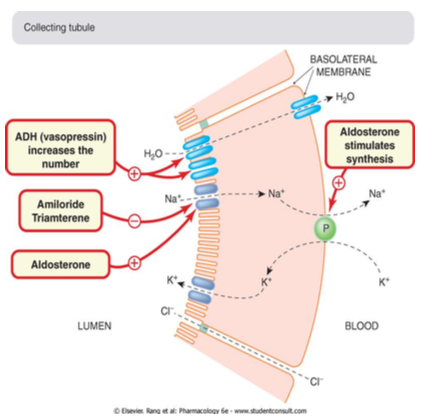
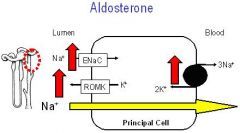
Describe how aldosterone acts on the kidney nephron
Aldosterone acts on principal cells of Late DT & CD to increase Na+ reabsorption via ENaC
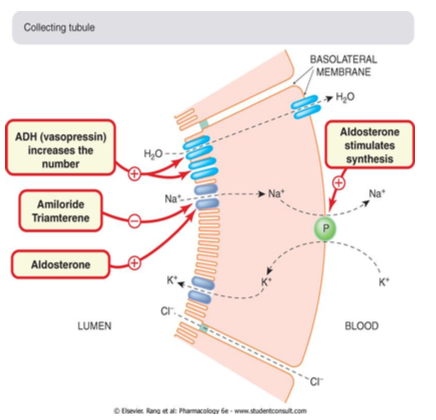
Identify and describe the mechanism of action of diuretics which antagonise the action of aldosterone
- Aldosterone antagonists act through competitive inhibition of the aldosterone receptor, decreasing Na+ reabsorption
- They also have a K+ sparing effect
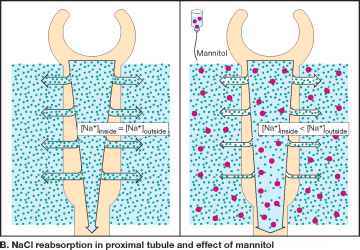
Osmotic diuretics act by modifying the filtrate content.
Describe this
Small molecules are freely filtered at glomerulus but not reabsorbed:
- Increased osmolarity of filtrate
- Reduced water & Na+ reabsorption throughout the tubule
Describe the action of carbonic anhydrase inhibitors
Carbonic anhydrase has an inhibiting effect and interferes with Na+ & HCO3- reabsorption in PCT
Loop diuretics block apical Na-K-2 Cl transporter.
In 5 steps, explain how this leads to diuresis
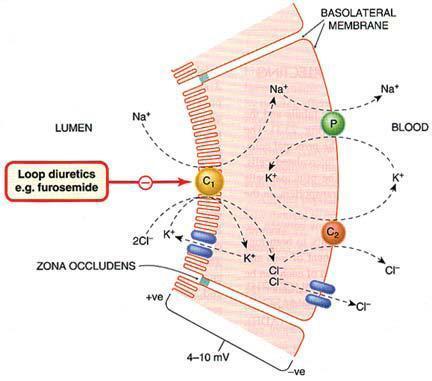
⇒ Na+ and Cl- is not absorbed resulting in less H2O absorption
⇒ Result is: Na+ and H2O loss
⇒ K+ carried across apical membrane drifts back into lumen via K+ channels
⇒ Creates a (+) lumen potential
⇒ This decreases the absorption of Ca2+ and Mg2+
Provide 2 examples of loop diuretics
- Furosemide
- Bumetanide
Loop diuretics are very potent.
What is the impact of this?
- Affects 25 - 30% of filtered sodium reabsorption
- Segments beyond have limited capacity to reabsorb the resulting flood of Na+ & H2O
Describe the use of loop diuretics in heart failure
- Treats of symptoms of breathlessness & oedema
- Causes vaso and venodilatation (decreases after/preload)
- No effect on reducing mortality
Describe the use of loop diuretics in treating acute pulmonary oedema
IV Furosemide given for rapid action
Loop diuretics are used to treat fluid retention & oedema in a number of clinical conditions.
Identify 3
- Nephrotic syndrome
- Renal failure
- Cirrhosis of liver (spironolactone preferred)
Loop diuretics are also used in treatment of hypercalcaemia.
Explain the benefit of this
- Impairs calcium absorption in the Loop of Henle
- Increases urinary excretion of calcium
- Furosemide given together with IV fluids
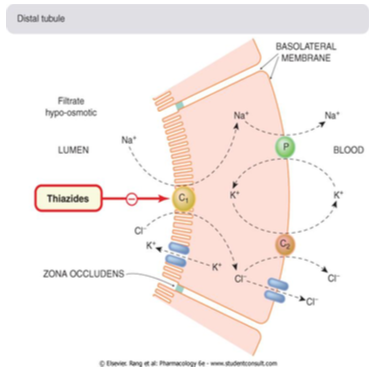
Thiazide diuretics block Na–Cl transporter in DCT.
In 4 steps, explain how this leads to diuresis
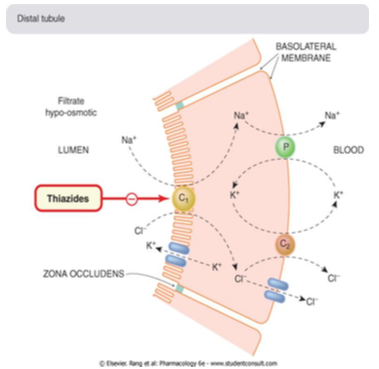
⇒ Diuretic secreted into lumen in PCT and travels to act on DCT
⇒ Blocks Na+ absorption and increases Ca2+ absorption
⇒ Increases Na+ (and H2O) loss in urine
⇒ Reduces Ca2+ loss in urine
Provide an example of a thiazide diuretic
Bendroflumethiazide
Thiazide diuretics are less potent diuretics than loop diuretics.
How does this manifest?
- Only 5% of sodium reabsorption inhibited
- Ineffective in renal failure
Where are thiazide diuretics most commonly used?
Widely used in hypertension (vasodilatation)


-
S1) Introduction to the Urinary System26
-
S1) Epithelial Transport19
-
S1) Anatomy of the Urinary System29
-
S2) Development of Urinary System37
-
S2) Measurement of Kidney Function, GFR and Clearance30
-
S3) GFR and Glomerulus53
-
S4) Basic Renal Processes47
-
S4) Blood Pressure and The Kidney30
-
S5) Corticopapillary Gradient and Countercurrent Exchange36
-
S6) Regulation of Ions52
-
S6) Diuretics47
-
S7) Neuronal Control of Micturition43
-
S7) Urinary Incontinence21
-
S8) Pathology of the Glomerulus31
-
S8) Diabetes and Other Systemic Conditions Affecting the Kidney38
-
S9) Signs and Symptoms of Renal Disease39
-
S9) Urinary Tract Infections27
-
S9) Infection in People with Renal Disease26
-
S10) Obstruction26
-
S10) Acute Kidney Injury39
-
S11) Urological Cancers42
-
S12) Chronic Kidney Disease43
-
Clinical Conditions44



