- *Immunodeficiency:**
- Definition of immunocompromised host
- Why is immunodeficiency an unmet clinical problem?
Definition of immunocompromised host:
State in which the immune system is unable to respond appropriately and effectively to infectious microorganisms
- Due to defect in one or more components of the immune system
- *Why is immunodeficiency an unmet clinical problem?**
- Large spectrum of PIDs - need a better diagnostic criteria
- Failure to recognise and diagnose PIDs leads to: greater number of years of symptoms, many will have permanent tissue/organ damage due to delayed diagnosis, many patients are an adult when there diagnosis is made
- *Types of immunodeficiency (explain the difference between these, give examples)**
- Primary immunodeficiency
- Secondary immunodeficiency
Primary Immunodeficiency Disease PID (congenital)
e.g. missing protein, missing cells, non-functional components
Secondary Immunodeficiency Disease (acquired)
Due to underlying disease or treatment
- reduced production/function of immune components
- increase loss or catabolism of immune components
e.g. HIV, chemotherapy, immunosuppression drugs given after transplants e.g. corticosteroids, cancer infiltrating the bone marrow, malnutrition e.g. absorption issues
What three things would you check if someone is immunosuppressed?
When to suspect immunodeficiency?
- acronymn
- *What three things would you check if someone is immunosuppressed?**
- is the cell present?
- right number of cells?
- functioning of the cells?
When to suspect immunodeficiency?
SPUR
Severe (life-threatening, very severe diseases)
Persistent (despite treatment, patient does not respond or takes longer to respond)
Unusual (site of infection, type of microbe, deep tissue infection e.g. opportunistic infection)
Recurrent (very frequent)
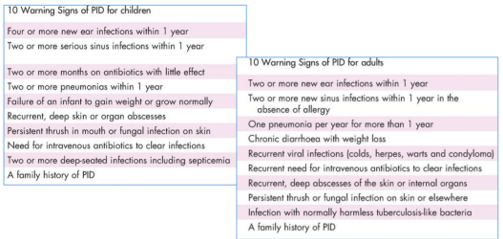
Recognition and diagnosis of PIDs – 10 warning signs (don’t need to learn)
Limitations of “10 warning signs”
Recognition and diagnosis of PIDs – 10 warning signs (don’t need to learn)
pic
- *Limitations of “10 warning signs”**
- Not population-based evidence - They have been worked out from children with PID. Also, it includes family history, but only 25% of PID patient’s have a family history of a PID
- PID patients have different defects/presentations
- PID patients with non-infectious conditions e.g. autoimmunity, malignancy, inflammatory response, are not included.
Investigations you would do if suspect PID
- list of 7
COUNT AND FUNCTION
- *Investigations:**
1. Go through past-medical history to look to see if there is a cause of a secondary immunodeficiency cause
2. Carry out FBC
3. Test humoral (antibody) immunity e.g. IgG, IgA, IgM, IgE, IgG levels to previous vaccines e.g. MMR
4. Test for cell-mediated immunity – lymphocyte count, lymphocyte subset (CD4+, CD8+, T, NK, B cells)
5. Test for phagocytic cells – neutrophil count, neutrophil function test
6. Test for complement
7. Definitive tests – molecular testing and gene mutations
Immunodeficiency caused by T cell defects
- *Combined B and T cell defects**
- Severe Combined Immunodeficiency (SCID): T cells are defective, so B cells are not activated
Immunodeficiency caused by T cell defects
- *T cell defects**
- Di George Syndrome: Absence of the thymus, so T cells can’t mature (as the thymus is where the T cells mature)
Immunodeficiency caused by phagocytic defects
Defects in Respiratory burst
- Chronic Granulomatous Disease (CGD): Phagocytes lack the killing machinery, so are inefficient
This is X-linked
—- lots of Staph. skin infections and Pulmonary Aspergillosis
Immunodeficiency caused by Antibody defects
Defects in B cell development
Bruton’s disease (X-linked agammaglobulinaemia - XLA): no B cells, so no antibodies are produced (at all!)
- *Immunodeficiency caused by Antibody defects**
- 3
Defects in antibody production
Have B cells, but an issue with antibodies
- Common Variable Immunodeficiency (CVID): the patient has B cells, but they do not produce any antibodies
- Selective IgA deficiency: most present asymptomatic – only a slight raised risk of autoimmune conditions, as no IgA, some develop anti-IgA, so when give a patient with this disease some blood, they may have a reaction to the IgA)
- Hyper-IgM Syndrome: no type switching in B cells, meaning IgG is not produced. IgM continues to be produced, so it’s levels are very high in the blood serum
How to differentiate between PID?
1st way
How to differentiate between PID?
1st way is to look at the age of onset of first symptoms
- Onset less than <6 months: T cell or phagocyte defect (still protected by mother’s antibodies for first months of life)
- Onset between 6months-5 years: B cells or phagocyte defect
- Onset 5 years +: B-cell/antibody/complement or secondary immunodeficiency
How to differentiate between PID?
2nd way
Type of infection the patient gets
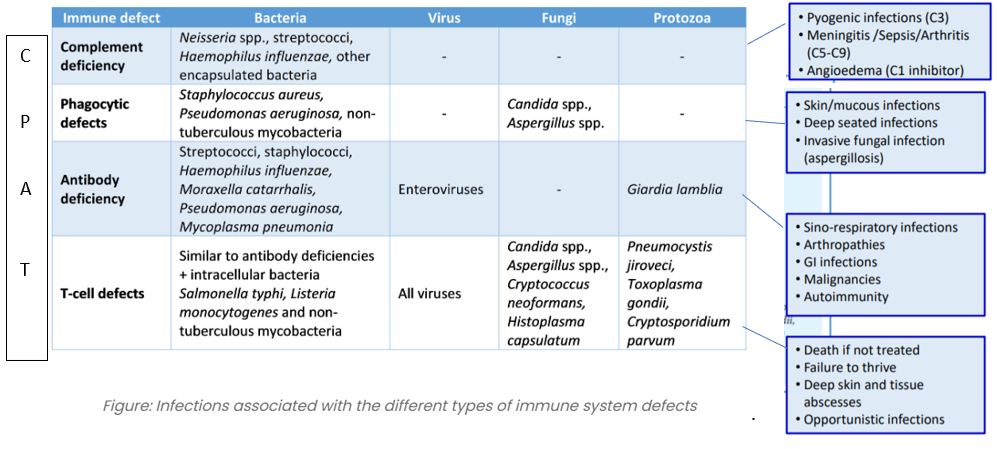
Management of PID has three components
- Supportive treatment:
- Infection prevention – prophylactic antibiotics
- Treat infections promptly and aggressively – passive immunisation
- Nutritional support e.g. vitamin A/D
- UV-irradiated CMV negative blood products only
- Avoid live attenuated vaccines - Specific treatment:
- Regularly immunotherapy (see immunoglobin replacement therapy IRT)
- Haematopoietic Stem Cell Therapy (HSCT) e.g. for SCID - Co-morbidities:
- Autoimmunity and malignancy treatment if disease arises
- Assess organ damage (e.g. lung function assessment)
- Avoid non-essential exposure to radiation
- *Immunoglobulin replacement therapy (IRT)**
- Goal
- Different forms of this
- Conditions used with…
Immunoglobulin replacement therapy (IRT)
Goal – to restore IgG levels to 8g/l, life-long treatment
Different forms of this – IV form and subcutaneous form
Conditions – CVID, Bruton’s disease, Hyper-IgM Syndrome, IgA deficiency
- *Secondary immunodeficiency**
- Overall causes of secondary immunodeficiency
- 3 main reasons for immunosuppression with Chemotherapy
- Examples of opportunistic infections (3)
Decrease production of immune components:
malnutrition, infection of HIV, liver diseases, haematological malignancies, therapeutic treatments e.g. corticosteroids, cytotoxic drugs, splenectomy
Increased loss of immune components:
Protein-losing conditions (Nephropathy, Enteropathy)
Burns
- *Chemotherapy – three main reasons for their immunosuppression:**
- Chemotherapy-induced neutropenia
- Chemotherapy-induced damage to mucosal barriers
- Vascular catheters
- *Example of opportunistic infections:**
- Varicella Zoster
- Candida Albicans
- Aspergillus

-
S1 L1 - Intro to Infection8
-
S1 L2 - Intro to Microbes10
-
S2 L1 - Infection Model, Candidiasis, Cellulitis, Full blood count, microbiome8
-
S2 L2 - Innate Immunity14
-
S3 L1 - Sepsis, pneumonia and aspiration pneumonia10
-
S3 L2 - Adaptive immunity part 112
-
S4 L1 - Antimicrobials and Resistance14
-
S4 L2 - Antimicrobial Stewardship and Meningitis, Encephalitis, Peritonitis, Ascites, DIC9
-
S5 L1 - Healthcare infections, Adenovirus, UTI10
-
S5 L2 - Infections Prevention, C.diff9
-
S6 L1 - HIV, Norovirus, MRSA7
-
S6 L2 - Jaundice, Hepatitis8
-
S7 L1 - Adaptive immune response - Effector phase15
-
S7 L2 - Infections on surfaces, Endocarditis18
-
S8 L1 - Travel related infections: Malaria, Legionnaires, Typhoid, Paratyphoid, Schistomiasis, Ebola, Zika, Myiasis15
-
S8 L2 - COVID-19 infection10
-
S9 L1 - Immunocompromised host, PID and SID disorders15
-
S9 L2 - Vaccines1
-
S10 L1 - Influenza and Virology12
-
S10 L2 - E.coli, Neutropenic sepsis, Shingles14
-
S11 L1 - Streptococci incl. pharyngitis, acute rheumatic fever, scarlet fever, toxic shock syndrome, skin conditions, EBV8
-
S11 L2 - Overview1
-
Overview of Pathogens30



