The shoulder joint of the dog is stabilised by passive (static) and active (dynamic) stabilisers.
List all stabilising structures of the shoulder and indicate if they are active or passive. The use of a table may facilitate your response.
(6 marks)
Passive (static) mechanisms (those for which muscle activity is not required);
- limited joint volume
- adhesion/cohesion mechanisms
- concavity compression
- capsuloligamentous restraints (defined as the glenohumeral ligaments, joint capsule, labrum, and the tendon of origin of the biceps brachii muscle)
- +/- A slightly negative intra-articular pressure exists in the normal shoulder joint but is considered to have little functional impact on joint stability during weight bearing.
Active (dynamic) stabilizers;
- infraspinatus & supraspinatus
- subscapularis
- teres minor muscles
- to a lesser extent, the biceps brachii
- long head of the triceps brachii
- deltoideus
- teres major muscles
- These mechanisms are modulated, at least in part, by reflex arcs between nerve fibers in the joint capsule and periarticular muscles. Reflex arcs serve to promote synergistic activity between ligamentous structures of the joint and associated musculature to maintain joint stability.
Source: Tobias (2018)
In your answer booklet, draw a labelled cross-sectional diagram showing the histological layers of adult articular cartilage.
(4 marks)

Provide a brief definition of osteochondrosis. (2 marks)
Provide a brief definition of osteochondritis dissecans (OCD). (2 marks)
Osteochondrosis is a disturbance in endochondral ossification that leads to cartilage retention.
OCD, in which a flap of cartilage is lifted from the articular surface, is a manifestation of a general syndrome called osteochondrosis.
Detached pieces of articular cartilage are often referred to as joint mice.
Source: Fossum
Describe the proposed aetiopathogenesis of osteochondrosis and OCD. Include in your answer the associated risk factors for OCD and the role of vasculature within the disease.
(12 marks)
The pathophysiology of OCD is multifactorial and poorly understood process. The most accepted theory involves the impediment of vasculature to a component of epiphysieal /subchondral bone during endochondral ossification resulting in an area of non-ossified bone remaining (a cartilage core). This is an OC.
The osteochondrosis leads to poor nutritional and basal support of the overlying articular cartilage inducing a rift between the two. The movement and chondromalacia results in vertical cracks in the articular cartilage which communicate with the underlying rift. This is further exacerbated by synovial fluid coming into contact with the subchondral bone and damaged articular cartilage, producing a pro-inflammatory state.
Risk factors for OCD in dogs;
- Breed (large and giant breeds) / Heritability
- Age (4-8 months)
- Gender (male)
- Rapid growth
- Nutrient Excess
- Over use/activity
List the four (4) synovial joints commonly associated with OCD in dogs and name the anatomical region of each joint that is commonly affected.
(4 marks)
Shoulder – Caudal [medial to central] aspect of humeral head
Hock – Medial (or lateral) trochlear ridge of tallus
Elbow – The distal aspect of the medial humeral condyle
Stifle – The distal aspect of the medial or lateral femoral condyles
Name and briefly summarise the phases of integration of a free mesh skin graft. Include in your answer the expected timeframes for each.
(10 marks)
See image:
- Plasmic imbibition (Day 0-3)
- Inosculation (Day 3-7
- Regeneration (Day 7+)
- Reinervation (Day 14+)

Identify the anatomical features of canine and feline skin (in contrast to human skin) that allow for the creation of axial pattern flaps.
(1 mark)
“Axial pattern flaps incorporate a direct cutaneous artery and vein, terminal branches of which supply blood flow and drainage for the subdermal plexus.”
Source: Tobias
Canine and Feline skin has large direct cutaneous arterioles and loose subcutaneous connections allowing free movement of skin over the underlying structures with a dedicated blood supply. Additionally, across the trunk there are paniculi muscles which contain complex vascular connections.
Conversley, Human skin has multiple small arterioles and close subcutaneous connections preventing free movement of the skin over the underlying structures and direct cutanous blood supply.
Name six (6) examples of axial pattern flaps in the dog.
(3 marks)
- Temoral
- Caudal auricular
- Omocervical
- Cranial epigastric
- Caudal epigastric
- Thoracodorsalus
- Dorsal superficial circumflex iliac
- Superficial brachial
- Medial genicular
- Reverse saphenous
- Caudal-lateral (‘tail’)
List four (4) patient factors that may affect cutaneous wound healing and briefly describe how each factor affects healing.
(8 marks)
- Endocrine diseases
- Metabolic disease
- Hypoalbuminaemia (malnutrition)
- Sepsis
- Hypothermia – reduced skin perfusion
- Infection of skin with resistant bacteria
- Immune suppression
- Anaemia
List four (4) intrinsic (local wound) factors that may affect cutaneous wound healing and briefly describe how each factor affects healing.
(8 marks)
- Size
- Location
- Chronicity
- Bacterial count
- Perfusion
- Moisture
- Temperature
- Necrotic tissue
- Cause – Trauma vs Surgical
List the basic principles of surgical arthrodesis.
(4 marks)
The best laid principles for achieving a successful joint fusion have been outlined by Glissan [9] in his article discussing ankle arthrodesis. These principles are
(1) complete removal of all cartilage, fibrous tissue, and any other material that may prevent the contact of raw bone surfaces;
(2) accurate and close fitting of the fusion surfaces;
(3) optimal position of the joint; and
(4) maintenance of the bone apposition in an undisturbed fashion until the fusion is complete.
List four (4) indications for pancarpal arthrodesis.
(4 marks)
Carpal arthrodesis is commonly used as a salvage procedure for a joint that has been damaged as the result of a;
- collateral ligament injury
- hyperextension injury with or without luxation
- shearing injury
- articular fracture that is not repairable
- severe degenerative joint disease causing pain
- immune-mediated arthritis leading to joint collapse or pain
- neurogenic injury that affects only the distal limb.
For each of the following modes of bone plate application, provide a brief description of the function of the plate, list the fracture configurations it is appropriate for and state whether it provides load sharing:
- (10 marks)*
i. bridge plating
ii. compression plating
iii. neutralisation plating
i. bridge plating
- Function of the plate: To span the fracture gap. Often as the fracture gap cannot be reconstructed.
- List the fracture configurations: Comminuted fractures
- Load sharing: No
ii. compression plating
- Function of the plate: To apply axial compression over an anatomically reduced fracture. NB: ‘Pre-stressing’ the plate is improtant to achieve effective symettrical compression across the fracture gap.
- List the fracture configurations: Transverse.
- Load sharing: Yes
iii. neutralisation plating
- Function of the plate: To further stabalise an anatomically reduced fracture that has been stabalised with a trans-fracture screw (lag-screw) and/or cerclage wire.
- List the fracture configurations: Oblique
- Load sharing: Yes
Describe the advantages of the locking compression plate (LCP) system compared to the dynamic compression plate system for fracture repair. Include in your answer a brief description of the likely mode of failure of each implant system.
(12 marks)
A LCP system functions like an external skeletal fixator as the apparatus functions as one unit. This is achieved by the ‘locking’ of the screw into the plate creating a more rigid fixation method.
In these systems ‘screw backout’ should not occur, preventing this mode of failure. For the screws to ‘backout’, all screws will simultaneously pull though the bone or fracture it.
DCP plates rely on the bone-screw interface
LCP plates rely on the core diametre of the screw and the screw-plate interface
Likely mode of failure:
- DCP:
- Screw(s) backing out
- Plate failure (undersizing the plate)
- LCP:
- Plate failure
- Bone fracture (bone pull out)
- Screw breaking at the level of the plate due to small screw core diametre (i.e. in SOP system)
List the anatomical components that comprise the common calcaneal tendon.
(3 marks)
Achillies tendon;
- Common tendon
- Bicep femoris m.
- Semitendinosus m.
- Gracilis m.
- Gastrocnemius m.
- Medial
- Lateral
- Superficial digital flexor m.
Partial disruption of the common calcaneal tendon is described most commonly in medium-to-large breed dogs. Outline the proposed pathophysiology of this condition.
(5 marks)
Strains result in disruption of the normal architecture of the muscle-tendon unit secondary to interstitial edema, hemorrhage, or overstretching.
With mild contusions and strains, cells and the endomysial sheath are not destroyed, and their preservation allows complete healing.
However, if the contusion is severe and causes extensive cell death and hemorrhage precluding muscle regeneration, healing occurs with fibrous interposition between muscle ends. Excessive scarring may impede muscle fiber regeneration and interfere with muscle contraction.
Explain why the digits in the affected limb are flexed when there is hyperflexion of the tarsocrural joint, in a patient with disruption of the common calcaneal tendon.
(2 marks)
If the entire tendon complex is involved, the tarsus and the digits hyperflex
If the tendon of the superficial flexor muscle is not involved, the tarsus will hyperflex and the digits will flex
Source: Fossum
List the two (2) main goals of tendon repair. Briefly describe the intra-operative and post-operative considerations that can optimise tendon healing.
(8 marks)
Surgical repair involves:
- Primary anastomosis of the tendon (tenorrhaphy) or
- Reinsertion of the tendon on the calcaneus.
Goals of tendon repair:
- Anatomical re-apposition of tendons
- Promote healing
- Support the ligament through to the remodelling phase
Post-operative:
The cast and transfixation pin, or external fixators are placed for 3 to 6 weeks, after which both may be removed. The limb should then be supported in a padded bandage to prevent full dorsal flexion of the tarsus. If an external fixator was used, it may be dynamized by the use of hinges or resistance bands. Hinges placed at the center of rotation of the joint can be adjusted to increase the range of motion and subsequently the tendon load. Elastic bands placed between the pins above and below the joint to replace the sidebars allow partial loading of the tendon.
Activity should be limited to leash walking for 10 weeks.
Name and draw two (2) recommended suture patterns described for approximating tendon ends.
(5 marks)
- Near-far-near-far suture
- Bunnell-Mayer technique
- Three-loop pulliey
- Locking loop
- Krackow suture (Flat tendons)
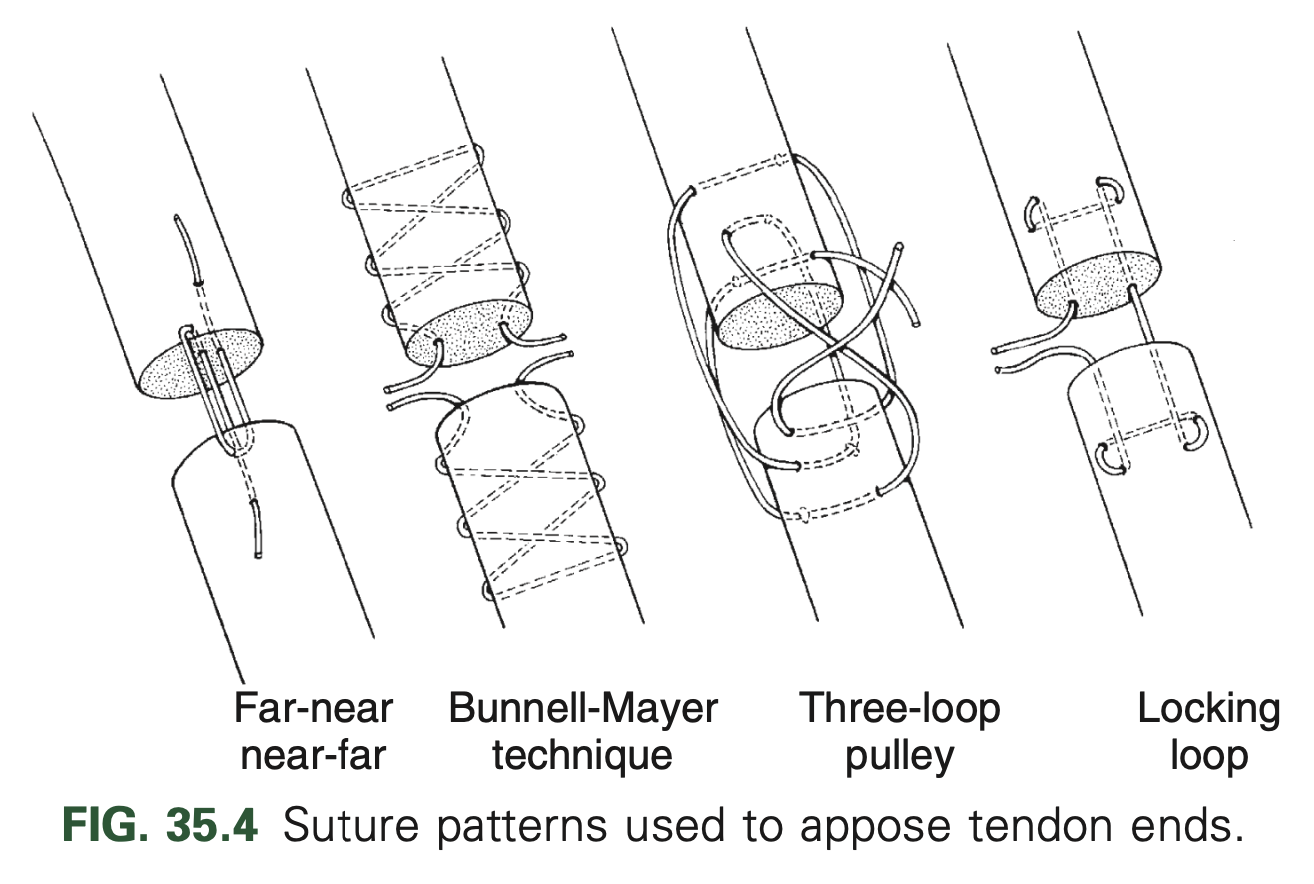
Identify the suture pattern recommended for apposition of round tendons.
(1 mark)
- Bunnell Mayer tendonsuture pattern
- Locking loop
- Three loop pulley suture
With reference to tendon healing, describe the differences between tendons with a paratenon versus tendons with a tendon sheath. Include in your answer an example of each.
(4 marks)
True tendon sheaths are only found in areas with an increased friction or sharp bending of the tendons (e.g., flexor tendons of the hand).
A simple membranous thickening of the surrounding soft tissue, called the paratenon, usually surrounds tendons without a true synovial tendon sheath, such as the Achilles tendon.
Examples:
- Tendon with tendon sheath: Digitial flexors
- Paratenon; Achilles tendon
State the expected strength (as a percentage of normal tendon strength) of a tendon that is primarily repaired:
i. at six weeks post-operatively (1 mark)
ii. at one year post-operatively. (1 mark)
At 6 weeks post repair, the tendon will have achieved 56% of its original strength
This slowly increases to a figure of 79% of normal strength at 1 year post repair
Source: Tobias
You are presented with a five-year-old, male neutered Yorkshire terrier with a four-day history of lethargy and anorexia. His owner has witnessed two episodes of vomiting today and describes the vomitus as yellow liquid. You perform abdominal radiographs as part of your diagnostic process.
a) List four (4) findings on plain abdominal radiography that would support the diagnosis of a small intestinal foreign body obstruction.
* (4 marks)*
- Two distinct populations of SI
- Vistable foreign body in SI
- Tapering of gas in SI (around FB)
- SI gas dilation:
- Dogs:
- >1.6x L5 = Distension
- > 2x L5 = Highly likely
- Cats:
- > 3x L2 endplate = Strongly associated with obstruction
- > 4x L2 endplate = Nearly always obstruction.
- Dogs:
You are presented with a five-year-old, male neutered Yorkshire terrier with a four-day history of lethargy and anorexia. His owner has witnessed two episodes of vomiting today and describes the vomitus as yellow liquid. You perform abdominal radiographs as part of your diagnostic process.
You elect to perform an exploratory laparotomy for suspected small intestinal foreign body obstruction.
b) List four (4) methods by which viability of the small intestine can be assessed during surgery (4 marks). For each method, describe the features that should be assessed to indicate viability or non-viability
* (4 marks).*
- Colour
- Pink and red = Viable
- Black = Non-viable
- Peristalsis
- Peristalsis = Viable
- No-peristalsis = Questionable viability
- Bleeding when cut
- Bleeding = Viable
- Not-bleeding = Non-viable
- Palpable pulses:
- Pulses = Good
- No-bulses = Bad
- Capillary refil:
- Present = Good
- Delayed = Bad





