Name the three main ascarids of SA and their primary hosts.
Which are considered zoonotic?
Toxocara canis, cati, Toxascaris leonia
Canis and cati are zoonotic
Describe the morphology of Toxocara spp.
- Large, white, up to 10cm adults
- Inflated cuticle forms allae - more pronounced in cati
- Toxocara (xx toxascaris) have a cuticular protrusion
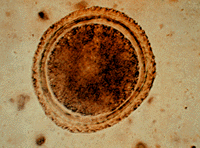
Describe the morphological features of Toxocara eggs.
- Large, thick pitted shell
- Spherical
- Filled with dark brown undifferentiated morular
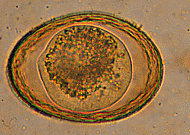
Describe the morphological features of Toxascaris eggs.
- Oval
- Inside morular doesn’t fully fill the egg
- Difficult to differentiate in a mixed population
What clinical signs are associated with Toxocara/ Toxascaris related disease?
- Asymptomatic in adults
- With heavy puppy burdens
- Pot bellied
- Poor wt gain
- Intestinal/ bilary obstruction
- No diarrhoea
- May show worm hypersensitivity - coughing
How can Toxocara/ Toxascaris be diagnosed/ controlled in dogs?
- Diagnosis - Clinical signs, signalment, salt flotation, adult worms passed in vom/faeces
- Control -
- Intestinal stages - BZ/ML
- TPT - FBZ from 42 days gestation
- Regular worming
- 2,4,6, weeks of age
- 3,6 months
- Then every 3-6 months
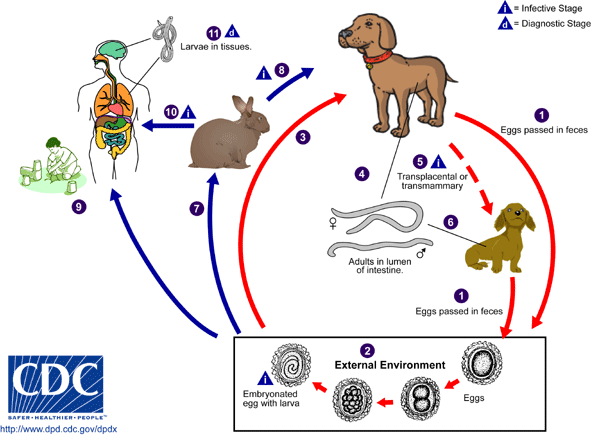
Outline the lifecycle and modes of transmission of Toxocara canis.
Describe the migratory pattern of Toxocara canis.
Transmission
- Ingestion of infective eggs containing L2 by dog
- TPT - Transplacental transmission - L2 cross placenta at d40 of gestation after being arrested in muscle
- TMT - Transmammary transmission - L2 enter puppies through L2 in milk
Hepatotracheal migration - L2 migrates from SI to liver to lungs. –> coughed up and swallowed - reproduce and eggs are shed in faeces
What is the PP for toxocara in adult dogs?
How does this differ in puppies and why?
Adults: 4-6 weeks
Puppies: 3 weeks - L2 infect puppies (not eggs as in adults)
Which stage of the Toxocara canis are infective?
Larvated egg stage
Which human group is most at risk of Toxocara canis infection?
Children - kids similarly curious as dogs!
How do the infection and incidence rates of Toxocariasis compare?
What clinical signs are associated with the disease
Infection rate is high but incidence rates of disease are low.
Aberant migration of larva to the eye (often retina), this may be misdiagnosed as a tumour. Hypersensitivity causes blindness
How can occular toxocariasis disease be controlled/ prevented?
- Prevent environmental contamination with eggs (very resistent once present)
- Educate pet owners - regular worming
- Hygiene - wash hands!
Which anthelmintics are used in the control of Toxocara in dogs and cats?
- ML - Selamectin, milbemycin, moxidectin
- FBZ, PYR
- Emodepside
How does the lifecycle of Toxocara cati differ to Toxocara canis?
- Ingestion of L2 eggs - migration
- Ingestion of paratenic host - no migration
- TMT - no migration
- No TPT
How does the Toxascaris leonina life cycle differ to Toxocara?
- Infection occurs only by ingestion of L2 eggs and paratenic hosts
- No TMT or TPT
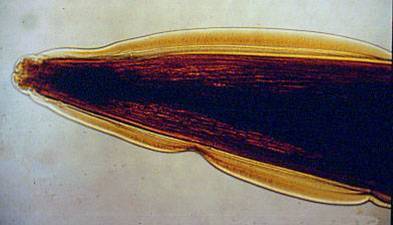
Alae folds of Toxocara canis - restricted on one side
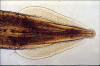
Alae of Toxocara cati - more pronounced than in canis
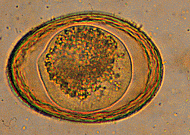
Egg of Toxascaris leonina - egg is oval with the inside morula not completely filling the egg
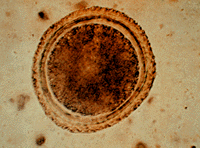
Toxocara egg - round, brown with thick pitted shell

-
SA/EQ Ectoparasites89
-
Ticks Part 2 - Transfer To 111
-
Endoparasites - Nematodes, T. gondii, Fasciola spp.99
-
Ectoparasites - Cattle59
-
Ectoparasites - Sheep46
-
Equine Endoparasites27
-
SA Protozoa19
-
SA Cestodes27
-
Leishmania and babesia16
-
SA Ascarids19
-
SA Hookworms and Filarial Nematodes29
-
SA Metastrongyles28
-
FA Trichostrongylidae66
-
FA Protozoa26
-
PO Ecto/Endoparasites37
-
OV endoparasites36



