Schedule P provides & helps
- provides detail about loss & LAE reserves
- only can be used by outside parties to assess reserve adequacy
- helps: support and provide disclosure for SAO, show how reserves have developed over time, source of payment patterns for tax discounting, show split between case and IBNR, provide historical claim count data, provide data to calc RBC loss sensitive discount
Part1
summary of all LoBs combined and separate schedules by line
- typically 10 AYs plus prior years but certain lines only 2 AYs
- EP are shown by CY so they do not change in subsequent years
- losses shown by OP (AY), CMP (RY), tail policies (PY), fidelity & surety (discovery year)
- LAE is divided into DCC & A&O
- S&S: paid losses are always net of S&S received and unpaid can be recorded net or gross
- case & IBNR: net of tabular discount and both gross and net of non tabular whereas in BS reserves are net of all discount
DCC & A&O
- DCC: defense, litigation and medical cost containment; in AS needs to be assigned to AY in accordance with associated loss
- A&O: all expenses associated with adjusting and recording the claim other than those included in DCC; in AS needs to be assigned in any justifiable way
net claim counts & claim count uses
- net claim counts = direct + assumed unless all business ceded
- claim count data can be used to analyze/identify
Changes in loss
Changes in claim settlement or reserving philosophy
when analyzing trends, important to account for changes in
MOB
Policy limits
Reinsurance attachment points & limits
Way company counts claims
Part2-4
loss triangles of each line
Net incurred loss & DCC
Net paid loss & DCC
Net bulk & IBNR reserves for loss & DCC
- data net of S&S and reinsurance and contains 10 years
- case reserves = part2-part3-part4
- data is gross of discounting so will not reconcile with part1 if company discounts but can be reconciled by adjusting for tabular discount which is disclosed in notes to financial statements
actuarial projections
these parts can be used to develop losses, LDFs can be derived
-issues: various allocations, internal pooling or reinsurance arrangements may have impact on data and may not be obvious, only 10 years of data but long tailed may develop later than 10, includes participation in pools or associations, commutations will distort, data combines loss & DCC, cannot really understand any observed trends
hindsight tests from part2
how company’s ultimate projection has changed over past year and past 2 years
Part5
10 years of claim counts on direct + assumed basis grouped by AY for certain LOBs
Cumulative # CWOP
Outstanding
Cumulative # reported
- counts can be used to identify trends, identify changes in the way the claims are settled and reserved
- One common inconsistency between companies is that some companies record counts on a per claim basis, whereas others per claimant basis
claim closure rates
-claim closure rates = closed claims/total reported claims = (rptd-outstanding)/reported
Identify changes in claim settlement rate
Closing early adv = min chance claim will develop adversely and allow insured to receive treatment, repair, or recover from loss
Important to monitor because changes will distort loss proj methods
Can reduce due to: reduction in staff, growth in book without increase in staff, surge in claims from CAT
claim freq
-claim freq=claim counts/EP; exposure is preferable because EP can be distorted from rate changes
average claim severities
Avg closed = net paid/closed with pay counts
Avg CO = net CO/open counts
Avg rptd = net reported/reported counts
Can review to identify trends
Changes during first few years of development important since biggest impact on indicated reserves
reasonableness tests
-reasonableness tests: checks on unpaid claim estimates
Avg claim freq = ult claim count by AY/corresponding EP
Avg ult sev = ult loss by AY/ult claim counts
Avg unpaid sev = unpaid loss / unpaid claims
Part6 & differences from Part1
cumulative prem earned for last 10 years valued as of 12/31
-prem may change at future valuations due to factors: prem audits, retrospective rated policies, lags in reporting
Audits – recalculate premium based on changes between expected and actual exposure counts
- Retrospective rating adjustments – bill for additional premium or return premium based on experience of book.
- differences between Part1 bc part1 is fixed whereas part6 will reflect adj to exposure year prem
Part7
provides prem and loss info on loss sensitive contracts on policy year basis; optional since only completed by companies that are using loss sensitive adjustment to RBC
Intercompany pooling
diff to intercompany reinsurance; gross and net losses are combined and then distributed to each company based on pooling %
- intercompany reinsurance is accounted for as 3rd party reins
- sched P is only exhibit that does not treat pooling arrangement as reinsurance
Frequency trend drivers
speedup claim setup in claim system, increase in nuisance claims, shortened statute of limitation, deteriorating BOB, change in type of claims, new business strategy, change in reins structure, change in policy limit, rate deteriorating, change in claim count def
Severity trend drivers
improved claims process identifies simpler lower severity claims and closes them earlier, increase in S&S, increase in reins coverage, more CWOP, claims closed faster which drives down ALAE, change in claim count def
Newly rptd claims during CY
Newly rptd claims during CY= cumulative rptd @ t– cumulative rptd@ t-1
Total claims closed during CY
Total claims closed during CY = open @t-1 + newly rptd claims during CY - open @t
calculating new yr part 3
remove C1 and subtract C2 from other columns
combine prior and R1
use part1 to get net loss & DCC paid for each AY during CY
C4=C3+net loss paid
result is paid @ new eval
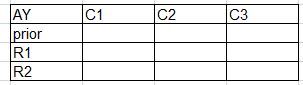
calculating new yr part 2
remove C1 and part2 - part3 = unpaid @ prior eval
combine prior and R1
add new prior part3 to above; remaining rows remain the same from previous AS
C4=part3+net bulk&IBNR+net C/O from part1
final result is incd @ new eval
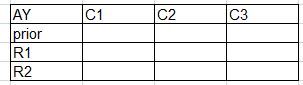
trend analysis examples of Schedule P
All Claim Closure = (Reported – Outstanding) / Reported, Monitor the speed that claims were settled
Claims Outstanding = Outstanding / Reported, Identify any changes in claim settlement practices
Claim Closure Rate = Claims Closed with Payment / Reported, This reveals the changes in the rate at which the claims are settled
Claims Closed with Pay = Claims Closed with Payment / (Reported – Outstanding), To see if there is a change in claims closed with pay compared to total closed claims, which could highlight a change in the claims settlement process
Claim Frequency = Reported / Earned Premium, To identify change in the rate claims are reported relative to EP, which is a proxy for exposure.
Claim Severity = Incurred Loss / Reported, Average severity trend analysis shows how the average severity of reported claims has changed over time.
Incurred Loss Ratio = Incurred Loss / EP, To show the change in loss ratios over time
calc paid loss for CY using 2 SchedP part1
and where this number will reconcile
subtract older Sched P from newer
you do not subtract prior yr row & next yr bc prior yr row in newer Sched P is incremental
Underwriting & Investment Exhibit: Section on Paid Loss

-
Odomirok 1-524
-
Odomirok 6-751
-
Feldblum Statutory Surplus19
-
Odomirok 8-933
-
Odomirok 1117
-
Odomirok 127
-
Odomirok 1320
-
IRIS26
-
RBC39
-
RBC236
-
Measurement Tools20
-
Accounting Systems10
-
Assets21
-
Income & Surplus23
-
Schedules & Exhibits15
-
Schedule F24
-
Schedule P30
-
Notes to Financial Statements34
-
IEE26
-
SSAPs14
-
SAP v GAAP20
-
IFRS and Solvency II11



