- A 52-year-old man presents with a 6 month history of progressive weakness. He first noticed difficulty with fine motor coordination of the right hand, but this later progressed to involve the right arm and later all extremities. On examination, he has dysarthria and reduced gag reflex. There is generalized motor weakness and atrophy. Deep tendon reflexes are hyperactive in both upper and lower extremities. Sustained ankle clonus is present. Fasciculations are seen in the tongue, across the chest, and in all limbs proximally. Sensory examination is normal. There is no family history of neurologic disorders. 1. What is the most likely diagnosis in this patient? a. Progressive muscular atrophy b. Amyotrophic lateral sclerosis c. Primary lateral sclerosis d. Adult-onset spinal muscular atrophy e. Kennedy’s disease (X-linked spinobulbar muscular atrophy) 2. Which of the following statements is correct regarding the disorder depicted in question 1? a. Dysphagia and dysarthria are rare as presenting features and do not typically occur as the disease progresses b. Acute respiratory failure is a common initial presentation c. Urinary incontinence and impotence occur early d. Cognitive dysfunction is present in many patients with this disorder e. Pseudobulbar affect (pathologic laughter and crying) is not a feature of this disorder, and its presence should prompt evaluation for other causes
- b, 2. d This patient’s history and examination, including evidence of upper and lower motor neuron dysfunction, are suggestive of amyotrophic lateral sclerosis (ALS). ALS is a neurodegenerative disorder that affects motor neurons in the anterior horn of the spinal cord, but also the motor cortex and brain stem. Sporadic ALS affects men more than women. It can present at any age, but with a peak incidence in the sixth to seventh decades of life. The hallmark of ALS is evidence of both upper motor neuron (UMN) disease (such as hyperreflexia, clonus, and presence of a Babinski sign) and lower motor neuron (LMN) disease (atrophy, fasciculations in the limbs, trunk, tongue, and occasionally face) in the absence of sensory symptoms or sensory abnormalities on examination. Clinical presentation is variable, but most often muscle weakness begins focally, usually in the extremities (two-thirds of cases) and spreads to involve contiguous regions, though there is significant variability in the pattern of motor weakness. The split-hand phenomenon is a feature of ALS, characterized by weakness and atrophy of the lateral hand (thenar and first dorsal interosseous muscles) with relative sparing of the medial hand (hypothenar) muscles. About one-third of patients present with bulbar symptoms, such as dysarthria or dysphagia (bulbar-onset ALS). Other symptoms of bulbar involvement include sialorrhea. Pseudobulbar palsy (pathologic laughter and crying without a corresponding change in mood) and excessive yawning also occur in ALS and do not necessarily suggest an alternative diagnosis. Muscle cramps commonly occur. Only a minority of patients with ALS (approximately 1%) present with acute respiratory failure, though the majority progress to respiratory failure. Cognitive impairment of some degree is present in up to 50% of patients with ALS; it is mostly subclinical, but can be detected on neuropsychologic testing. In a small proportion of cases, the cognitive dysfunction is more evident, manifesting as a dementia that is typically of the frontotemporal type, namely frontotemporal dementia (FTD). This tends to occur most frequently in patients who present with bulbar-onset ALS. On the other hand, a subset of patients presenting with FTD have clinical and electrodiagnostic features of motor neuron disease. The pathology of patients with so-called ALS-FTD includes atrophy in the frontal and temporal lobes and ubiquitin-positive, TDP-43-positive, tau-negative inclusions. Autosomal dominant forms have been linked to TDP-43 gene mutations on chromosome 9. Curiously (for unclear reasons), the region of motor neurons in the sacral spinal cord that are responsible for sphincter control, Onufrowicz nucleus (also known as Onuf’s nucleus) is generally spared in ALS, and sphincter dysfunction is typically not a prominent problem. Sensory involvement and dysautonomia are also uncommon in ALS, but can occur. ALS is relentlessly progressive and ultimately fatal within 2 to 5 years of symptom onset, although in approximately 20%, survival is longer than 5 to 10 years after symptom onset. Primary lateral sclerosis (discussed in question 6), progressive muscular atrophy (discussed in question 10), Kennedy’s disease (X-linked spinobulbar muscular atrophy, discussed in question 33), and spinal muscular atrophy (discussed in question 35) are all motor neuron disorders. In these disorders, either UMNs or LMNs alone are affected, not in combination, in contradistinction to ALS. In early ALS, however, combined UMN and LMN dysfunction may be subtle or absent until later stages when its presence is necessary for diagnosis (by definition; see question 31). In Kennedy’s disease, there is often a family history of motor neuron disease in males and gynecomastia is present on examination. Bradley WG, Daroff RB, Fenichel GM, et al. Neurology in Clinical Practice, 5th ed. Philadelphia, PA: Elsevier; 2008.
- A 16-year-old boy presents with progressive bilateral lower extremity numbness and weakness, with difficulty walking for the past 2 months. He reports worsening over the past 5 days, and this morning when he woke up he was unable to move his legs and felt numb from his upper chest down. His examination shows mild weakness and areflexia in both upper extremities, and significant weakness with spasticity and hyperreflexia in the lower extremities. He has a sensory level at T2. His MRI is show in Figure 11.1. Which of the following is the most likely diagnosis?
a. Acute transverse myelitis
b. Spinal cord infarct
c. Cord compression from a metastatic tumor
d. Epidural hematoma
e. Meningioma with spinal cord compression
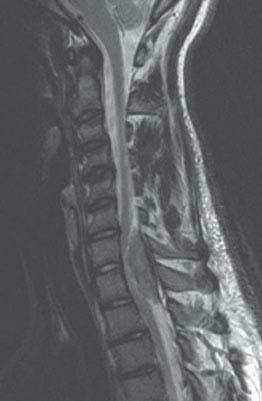
- e
Figure 11.1 shows an intradural extramedullary tumor compressing the spinal cord. The tumor is located at the C7 to T1 vertebral level and is dural based. Meningiomas are one of the most common intradural extramedullary tumors. They are nonglial neoplasms that are usually benign and can cause neurologic problems due to compression. Because they grow slowly, neurologic manifestations progress very gradually and may compensate for the degree of compression. Patients may have very large tumors causing significant compression without prominent manifestations on clinical examination.
This patient does not have an acute transverse myelitis nor a spinal cord infarct because the presentation in both of these conditions is usually acute to subacute, with MRI findings showing a parenchymal cord lesion and not an extramedullary mass. Spinal cord infarct may be sudden in onset and usually affects the anterior cord (anterior spinal artery), causing primarily bilateral weakness and pain and temperature loss rather than vibration and position loss (dorsal columns are relatively spared). Acute transverse myelitis progresses over hours or a few days rather than months. A metastatic tumor usually has a more subacute presentation with prominent back pain. Because metastatic tumors develop more rapidly, the patient would have more symptoms and neurologic deficits than this patient has for the degree of compression seen on this MRI. An epidural hematoma also presents rapidly with an acute compressive myelopathy syndrome manifesting as spinal shock, usually with no evidence of spasticity or hyperreflexia on presentation.
Bradley WG, Daroff RB, Fenichel GM, et al. Neurology in Clinical Practice, 5th ed. Philadelphia, PA: Elsevier; 2008.
Jacob A, Weinshenker BG. An approach to the diagnosis of acute transverse myelitis. Semin Neurol. 2008; 28:105–120.
Ropper AH, Samuels MA. Adams and Victor’s Principles of Neurology, 9th ed. New York: McGraw-Hill; 2009.
- Which of the following statements is incorrect regarding the management of amyotrophic lateral sclerosis (ALS)?
a. Periodic assessment of lung function is indicated in patients with ALS
b. There is evidence to suggest that management of patients with ALS in multidisciplinary clinics is beneficial
c. Riluzole is an inhibitor of glutamate release that modestly slows disease progression
d. Frequent evaluation of swallowing function is important as patients with ALS are at increased risk of aspiration
e. Parotid and submandibular botulinum toxin injections are ineffective in patients with ALS with refractory sialorrhea
- e
Parotid and submandibular botulinum toxin injections are effective in some patients with amyotrophic lateral sclerosis (ALS) with refractory sialorrhea, and should be offered when appropriate.
Guidelines have been issued by the American Academy of Neurology for the management of patients with ALS. The majority of patients experience hypoventilation, and orthopnea becomes significant in advanced stages. Nocturnal oximetry, supine forced vital capacity, and supine maximal inspiratory pressure should be periodically assessed in patients with ALS. Noninvasive ventilation should be offered as indicated, and it likely improves quality of life. Management of patients with ALS in multidisciplinary clinics, including experts in neurology, speech therapy, physical and occupational therapy, respiratory therapy, social work, and case management, is likely of benefit.
Pharmacologic treatment of ALS may include riluzole, an inhibitor of glutamate release, which slows disease progression, prolonging survival by approximately 3 months. Patients may experience side effects of dizziness, fatigue, and gastrointestinal upset, which are usually mild and transient; if intolerable, dosage can be reduced or taken with food prior to deciding to discontinue it. Importantly, blood count and liver enzymes should be checked routinely 1 month after beginning riluzole, monthly for 3 months, then every 3 months for the rest of the first year, and yearly afterward. Other medications being investigated as disease-modifying therapies include ceftriaxone, creatine monohydrate, and tamoxifen, but definitive data showing benefit are not available as of 2010. Management is therefore largely symptomatic.
Frequent evaluation of swallowing function is important as patients with ALS are at increased risk of aspiration. Placement of a percutaneous gastrostomy tube stabilizes body weight and maintains hydration in patients with ALS; although survival is probably not prolonged significantly, quality of life is improved. Treatment of pseudobulbar affect is off-label with tricyclic antidepressants or selective serotonin reuptake inhibitors, although an effective dextromethorphan-quinidine combination was FDA approved in October 2010.
Miller RG, Jackson CE, Kasarskis EJ, et al. Quality Standards Subcommittee of the American Academy of Neurology. Practice parameter update: The care of the patient with amyotrophic lateral sclerosis: drug, nutritional, and respiratory therapies (an evidence-based review): Report of the Quality Standards Subcommittee of the American Academy of Neurology. Neurology. 2009; 73:1218–1226.
Milller RG, Jackson CE, Kasarskis EJ, et al. Quality Standards Subcommittee of the American Academy of Neurology. Practice parameter update: The care of the patient with amyotrophic lateral sclerosis: Multidisciplinary care, symptom management, and cognitive/behavioral impairment (an evidence-based review): Report of the Quality Standards Subcommittee of the American Academy of Neurology. Neurology. 2009; 73:1227–1233.
- A patient with a chronic progressive myelopathy presents for evaluation. You suspect vitamin B12 deficiency. Regarding this condition, which of the following is incorrect?
a. Vitamin B12 levels may be within normal limits despite clinical manifestations of deficiency
b. Elevated gastrin levels, anti-intrinsic factor antibodies, and anti-parietal cell antibodies may be associated with vitamin B12 deficiency
c. It can cause white matter vacuolization
d. Serum vitamin B12 level is the only laboratory test that needs to be followed when treating these patients
e. The most common cause of vitamin B12 deficiency is malabsorption
- d
Serum methylmalonic acid (MMA) and homocysteine levels should be obtained when following patients with vitamin B12 deficiency receiving treatment.
Vitamin B12 or cobalamin deficiency is a major cause of neurologic disease. Manifestations include subacute combined degeneration of the spinal cord, peripheral neuropathy, optic neuropathy, and even cognitive impairment.
Vitamin B12 as methylcobalamin is a cofactor for the enzyme methionine synthase in the conversion of homocysteine into methionine, which is then adenylated to S-adenosylmethionine. S-adenosylmethionine is required for methylation reactions, and decreased levels may lead to reduced myelin basic protein methylation and white matter vacuolization. Methionine also facilitates the formation of formyltetrahydrofolate, which is involved in purine and pyrimidine synthesis, and therefore low methionine levels secondary to vitamin B12 deficiency impair DNA synthesis. In another pathway, vitamin B12 as adenosylcobalamin is a cofactor in the conversion of methylmalonyl CoA to succinyl-CoA. Vitamin B12 deficiency will lead to the accumulation of methylmalonate and propionate, providing abnormal substrates for fatty acid synthesis, and therefore interfering with myelin synthesis.
In some cases of vitamin B12 deficiency, vitamin B12 levels may be within normal limits; however, MMA and homocysteine will be elevated, helping in the diagnosis.
Malabsorption is the most common cause of vitamin B12 deficiency, and achlorhydria in the setting of pernicious anemia is an important cause. Pernicious anemia is an autoimmune condition in which anti-intrinsic factor and anti-parietal antibodies may be present. Given that these patients have achlorhydria, gastrin levels may be elevated as well. Parenteral vitamin B12 supplementation is the treatment of choice in cases of malabsorption, and usually the hematologic abnormalities improve rapidly; however, the neurologic manifestations may not resolve completely. Vitamin B12 levels rise with treatment, regardless of the clinical effect; therefore, MMA and homocysteine levels should be followed.
Ropper AH, Samuels MA. Adams and Victor’s Principles of Neurology, 9th ed. New York: McGraw-Hill; 2009.
- A 52-year-old woman from Ohio who has not traveled outside of the state her entire life presents with gait difficulties of 2 years’ duration. There is no family history of a similar problem. On examination, she has significant lower extremity spasticity, with a scissoring gait. There is bilateral ankle clonus, Babinski signs are present bilaterally, and deep tendon reflexes are pathologically brisk throughout, especially at the knees and ankles. There are no fasciculations. Sensory examination is normal. MRI of the brain and spine are normal. What is the most likely diagnosis in this patient?
a. Tropical spastic paraparesis
b. Amyotrophic lateral sclerosis
c. Hereditary spastic paraparesis
d. Primary lateral sclerosis
e. Cervical spondylosis
- d
Primary lateral sclerosis (PLS) is characterized by presence of upper motor neuron signs at least 3 years from symptom onset, without evidence of lower motor neuron dysfunction. PLS is considered along the spectrum of amyotrophic lateral sclerosis (ALS), although it is controversial as to whether or not it is a separate entity. It typically presents in the sixth decade of life with a progressive spastic tetraparesis and later cranial nerve involvement. Rarely, bulbar onset occurs. Spasticity, rather than muscle weakness or atrophy, is the most prominent feature. It typically progresses slowly over years. Autonomic involvement does not typically occur. Autopsy on patients with PLS has shown significant cell loss in layer 5 of the motor and premotor cortex, predominantly the large pyramidal Betz cells with corticospinal tract degeneration. The majority of patients with ALS who present with predominantly upper motor neuron signs and symptoms eventually develop lower motor neuron involvement within 3 to 4 years.
The differential diagnosis of PLS is broad and a thorough work-up to exclude any possibilities is indicated. It includes cervical myelopathy, although sensory abnormalities and other features of myelopathy such as bowel and bladder symptoms should be present, and a normal MRI of the spine excludes this. Similarly, multiple sclerosis is high on the differential diagnosis of PLS; the presence of sensory symptoms, changes on MRI of the brain and spine, and CSF findings (when CSF is available for analysis) distinguish between the two. Tropical spastic paraparesis due to HTLV-1 typically occurs in endemic regions (equatorial and south Africa, the Caribbean, parts of Asia, and Central and South America) and rarely in the United States. Patients with hereditary spastic paraparesis often, though not always, have a family history of similar symptoms and signs and have white matter abnormalities on MRI of the brain and spine. Another differential diagnosis is stiff person syndrome, which is associated with anti-glutamic acid decarboxylase antibodies, which should be assessed for in a patient with this presentation. Other disorders that can present with spastic quadriparesis that should be considered include hexosaminidase A deficiency, adrenomyeloneuropathy, a paraneoplastic process, and autoimmune processes (such as Sjgren’s syndrome).
Treatment is symptomatic, and usually includes baclofen (a GABAB agonist) or tizanidine (an α2 agonist) to reduce spasticity.
Bradley WG, Daroff RB, Fenichel GM, et al. Neurology in Clinical Practice, 5th ed. Philadelphia, PA: Elsevier; 200
- A 52-year-old man who is an intravenous drug user, HIV seropositive with a CD4 count of 120 and noncompliant with antiretrovirals, develops progressive neurologic symptoms over several months, including ataxia, spastic paraparesis, and sensory loss below his waist. After you examine him you suspect that he has a myelopathy. Which of the following is correct regarding HIV-related myelopathy?
a. Copper deficiency is the most important factor for the development of this type of myelopathy
b. Vitamin B12 deficiency is the most important cause of this type of myelopathy
c. Pathologic analysis of the spinal cord shows lateral and posterior column demyelination with microvacuolar changes
d. Pathologic analysis of the spinal cord shows axonal degeneration as the hallmark finding
e. HTLV-1 is the most common etiology associated with this type of myelopathy
- c
This patient has HIV, is immunocompromised as evidenced by the low CD4 count, and has a progressive myelopathy. This population of patients should undergo an evaluation for various infectious agents as the potential cause of myelopathy, including syphilis, viruses such as herpes zoster and HTLV-1, mycobacteria, and fungal agents. However, the most common cause of spinal cord involvement in patients with HIV is primary HIV-related myelopathy. This is a vacuolar myelopathy, in which there is lateral and posterior column demyelination with microvacuolar changes and axonal preservation. Given that other potential conditions can cause myelopathic symptoms in patients with HIV, HIV-related vacuolar myelopathy should be a diagnosis of exclusion.
HIV-related vacuolar myelopathy presents in patients with AIDS, and affected patients have gradually progressive gait difficulty, spasticity, leg weakness, and impaired proprioception. There is no back pain and the upper extremities are typically spared. MRI may reveal spinal cord atrophy, but is most often normal. There is no effective treatment, and the initial goal is prevention with anti-retroviral therapy.
HTLV-1 is a cause of spinal cord disease in patients with HIV; however, it is not the cause of HIV-related vacuolar myelopathy. HTLV-1 causes tropical spastic paraparesis or HTLV-1-associated myelopathy. This is a chronic progressive myelopathy endemic in equatorial and south Africa, as well as in parts of Asia, Central and South America, and the Caribbean. This virus can be transmitted via contaminated blood, sexual activity, breast-feeding, and rarely in utero. Only 1% to 2% of infected individuals will develop neurologic disease. These patients will manifest with a slowly progressive spastic paraparesis, lower extremity paresthesias, painful sensory neuropathy, and bladder dysfunction. MRI reveals increased signal on T2-weighted images with atrophy of the thoracic cord, but these findings are not specific for this condition. The diagnosis is made with positive serology in blood and CSF to HTLV-1, as well as PCR. No antiviral agent is available for the treatment of HTLV-1.
Boisse L, Gill J, Power C. HIV infection of the central nervous system: Clinical features and neuropathogenesis. Neurol Clin. 2008; 26:799–819.
Bradley WG, Daroff RB, Fenichel GM, et al. Neurology in Clinical Practice, 5th ed. Philadelphia, PA: Elsevier; 2008.
Ropper AH, Samuels MA. Adams and Victor’s Principles of Neurology, 9th ed. New York: McGraw-Hill; 2009.
- A 30-year-old man presents for evaluation of gradually progressive lower extremity spasticity, which has worsened slowly over the past 5 years. On examination he has spasticity of the lower extremities, with no evidence of lower motor neuron findings and no other neurologic abnormalities. He says that his father had a similar problem, and his younger brother is starting to have difficulty walking. Work-up has been negative, including an MRI of the brain and cervicothoracic spine that was unremarkable, normal vitamin B12 and copper levels, normal CSF studies for infectious and inflammatory conditions, negative HIV and HTLV-1 serologies, and nonreactive VDRL. Which of the following is the most likely diagnosis?
a. Hirayama disease
b. Hereditary spastic paraparesis
c. Amyotrophic lateral sclerosis
d. Progressive muscular atrophy
e. Multiple sclerosis
- b
On the basis of the family history and clinical findings of this patient, he most likely has hereditary spastic paraparesis (HSP), which is a group of disorders characterized by progressively worsening spasticity of the lower extremities, with variable weakness and difficulty walking. It is inherited most commonly in an autosomal dominant fashion, but it can occur in an autosomal recessive fashion, although X-linked and sporadic cases have also been reported. This condition can present at any age from childhood to late adulthood; however, more frequently the onset is between the second and fourth decades of life. Clinically, it has been divided into pure and complicated forms. The pure form presents only with lower extremity spasticity, whereas sensory and other neurologic functions are intact. The complicated form has other neurologic features, including optic neuropathy, deafness, amyotrophy, peripheral neuropathy, ataxia, dementia, mental retardation, and extrapyramidal dysfunction. Several genetic mutations have been identified involving various HSP loci and genes. The most common mutation is on chromosome 2p22 involved with the SPAST gene encoding for the protein spastin, which is inherited in an autosomal dominant fashion. Other proteins involved include atlastin, paraplegin, spartin, and maspardin, among others. Treatment is symptomatic, with pharmacologic treatment of spasticity and supportive care for disability.
This patient does not have Hirayama disease, amyotrophic lateral sclerosis (ALS), progressive muscular atrophy (PMA), or multiple sclerosis. Hirayama disease involves the upper extremities with predominant lower motor neuron findings (discussed in question 37). ALS manifests with a combination of upper and lower motor neuron findings. PMA (discussed in question 10) manifests with lower motor neuron findings, which are not seen in this patient. There are no features to support the diagnosis of multiple sclerosis on this patient.
Bradley WG, Daroff RB, Fenichel GM, et al. Neurology in Clinical Practice, 5th ed. Philadelphia, PA: Elsevier; 2008.
Ropper AH, Samuels MA. Adams and Victor’s Principles of Neurology, 9th ed. New York: McGraw-Hill; 2009.
- A 78-year-old man who has a history of diabetes and hypertension presents in septic shock with a blood pressure of 60/40 mm Hg. He is admitted to the ICU, where antibiotics and pressors are started. Over the next few days he improves; however, it is noticed that he cannot move his legs, and has a sensory level approximately at T6. His MRI of the spine shows a midthoracic spinal cord T2 hyperintensity. The most common mechanism for this patient’s condition is:
a. Infarct in the territory of the artery of Adamkiewicz
b. Watershed infarct
c. Epidural abscess
d. Aortic dissection
e. Epidural hematoma
- b
This patient has a watershed infarct of the spinal cord, which may occur after prolonged hypotension. The area of the spinal cord most susceptible to watershed infarcts is at the upper midthoracic levels (between T4 and T8), given that blood supply is scarce between the blood supply coming from the vertebral circulation and the aortic circulation, though watershed infarcts at lower levels have been described. Patients with vascular risk factors for atherosclerotic disease are at higher risk for developing this type of spinal cord infarct.
The artery of Adamkiewicz is a large radicular artery that arises between T8 and L3 and supplies the lower thoracic and upper lumbar regions. This patient most likely has an infarct in the watershed region rather than in the area supplied by the artery of Adamkiewicz. The patient does not have a history to suggest an aortic dissection.
In both epidural abscess and epidural hematomas, the MRI will show an epidural collection that was not present in this patient.
Blumenfeld H. Neuronatomy through Clinical Cases, 1st ed. Sunderland, MA: Sinauer Associates; 2002.
Ropper AH, Samuels MA. Adams and Victor’s Principles of Neurology, 9th ed. New York: McGraw-Hill; 2009.
- A 45-year-old woman presents with bilateral upper extremity weakness of 3 years’ duration. She began experiencing weakness of finger flexors and extensors in the right hand 2 years earlier, with similar weakness later occurring in the left hand. Over the prior year, the weakness had progressed and she could no longer abduct her arms beyond 30 degrees or fully flex or extend her forearms. Physical examination revealed significant atrophy of proximal upper extremity muscles, occasional fasciculations in the deltoids and biceps bilaterally, diminished tone in the arms, and Medical Research Council 2/5 strength in most muscle groups of the upper extremities. Left hip flexors were 4/5; otherwise motor power in the lower extremities was 5/5. Legs had normal tone, no ankle clonus, and absent Babinski sign bilaterally. Deep tendon reflexes could not be elicited in the upper extremities and were 1+ in the lower extremities. EMG showed evidence of widespread motor neuron dysfunction. What is the most likely diagnosis in this patient?
a. Progressive muscular atrophy
b. Amyotrophic lateral sclerosis
c. Postpolio syndrome
d. Adult-onset spinal muscular atrophy
e. Inclusion body myositis
- a
Progressive muscular atrophy (PMA) is considered along the spectrum of amyotrophic lateral sclerosis (ALS), although this is controversial; it is a motor neuron disease that affects only the lower motor neurons, distinguishing it from ALS, which affects both upper and lower motor neurons. PMA often presents with focal asymmetric distal weakness that later involves more proximal regions and other extremities, with lower motor neuron features on examination, such as atrophy, hyporeflexia, and fasciculations. PMA begins at an earlier age as compared to ALS, and survival is often longer than ALS, with a median survival of 5 years, though more rapidly progressive and more chronic forms of the disease occur. Bulbar and respiratory involvement occur later in the disease as compared to ALS. Laboratory evaluation may reveal moderately elevated creatine kinase, but never more than 10 times normal, and EMG shows evidence of motor neuron disease.
Patients with ALS can present with predominantly lower motor neuron features early in their disease, with upper motor neuron findings not occurring until later. Therefore, a diagnosis of PMA is usually reserved for patients who have electrodiagnostic evidence of motor neuron disease and isolated lower motor neuron findings at least 3 years from symptom onset. The poliovirus infects anterior horn cells, leading to a lower motor neuron pattern of weakness similar to PMA. In those who survive, a postpolio syndrome may emerge years after recovery, marked by progressive fatigue, and weakness in muscles previously affected minimally or seemingly not at all. The history provided in this case is not consistent with postpolio syndrome. Unlike PMA, which progresses, on average, over 3 to 5 years, adult-onset spinal muscular atrophy is even more indolent and often affects predominantly proximal muscles. Inclusion body myositis is on the differential diagnosis of PMA and has a very indolent onset; relatively selective weakness of deep finger flexors and knee extensors in the setting of normal or only slightly elevated (less than two times normal) serum creatine kinase should prompt work-up for this disorder, including EMG and muscle biopsy.
Bradley WG, Daroff RB, Fenichel GM, et al. Neurology in Clinical Practice, 5th ed. Philadelphia, PA: Elsevier; 2008.
- Regarding the vascular supply of the spinal cord, which of the following is incorrect?
a. There is one anterior spinal artery that supplies the anterior two-thirds of the spinal cord
b. There is one posterior spinal artery that supplies the posterior one-third of the spinal cord
c. Segmental arteries arising from the aorta and internal iliac arteries feed the circulation at the thoracic and lumbar levels
d. There is an epidural venous plexus system that connects pelvic venous plexuses and the intracranial venous system
e. The anterior spinal artery originates from the vertebral arteries
- b
There are two paired posterior spinal arteries.
The blood supply to the spinal cord is provided by an arterial network that runs longitudinally along the cord, and its core is conformed by one anterior and two posterior spinal arteries. The anterior spinal artery suppli es the anterior two-thirds of the spinal cord and originates from the vertebral arteries just before they join to form the basilar artery. The two paired posterior spinal arteries supply the posterior third of the spinal cord and originate from the vertebral arteries as well. These three arteries receive contributions from multiple segmental and radicular arteries, which arise from intercostal and iliac arteries that originate from the aorta. The largest radicular artery is the artery of Adamkiewicz, which supplies the lower thoracic and upper lumbar regions of the spinal cord.
The cervical and upper thoracic regions receive multiple collaterals from the vertebral arteries and other cervical vessels. Similarly, the conus medullaris and cauda equina are also richly vascularized from the contribution of multiple radicular arteries. There is a watershed region in between these two well-perfused regions located between T4 and T8. Between the anterior and posterior spinal circulations there is a circumferential network as well.
There are anterior and posterior venous systems that drain into radicular veins and eventually into the epidural venous plexus system. This epidural venous plexus is a valveless system and extends from the pelvic region to the intracranial venous system. This could explain metastatic lesions in the CNS originating from the pelvic region.
Blumenfeld H. Neuronatomy through Clinical Cases, 1st ed. Sunderland, MA: Sinauer Associates; 2002.
Ropper AH, Samuels MA. Adams and Victor’s Principles of Neurology, 9th ed. New York: McGraw-Hill; 2009.
- A 69-year-old man who has hypertension, hyperlipidemia, diabetes, coronary disease, and peripheral vascular disease undergoes an endovascular intervention for a thoracoabdominal aneurysm. After the procedure he has new neurologic findings attributed to an anterior spinal artery infarct of the spinal cord. On examination you expect to find:
a. Paraplegia with bilateral loss of sensation to pain and temperature below the lesion, and preserved sensation to vibration and proprioception
b. Paraplegia with bilateral loss of sensation to vibration and proprioception below the lesion, and preserved sensation to pain and temperature
c. Loss of sensation to vibration and proprioception bilaterally, and preserved sensation to pain and temperature, with no weakness
d. Loss of sensation to pain and temperature bilaterally, and preserved sensation to vibration and proprioception, with no weakness
e. Weakness on one side with loss of sensation to vibration and proprioception ipsilaterally, and loss of sensation to pain and temperature on the contralateral side
- a
The spinal cord has ascending and descending pathways distributed in the white matter funiculi. The corticospinal tract originates from the primary motor cortex. Approximately 85% of the fibers decussate at the level of the pyramids and descend in the lateral funiculi as the lateral corticospinal tract. Fifteen percent of the fibers descend uncrossed as the anterior corticospinal tract.
The dorsal columns of the spinal cord are formed by the fasciculi of gracilis and cuneatus, both carrying information related to vibration and proprioception. These fasciculi ascend ipsilaterally to the nucleus gracilis and cuneatus in the dorsal medulla. Fibers from these nuclei form the medial lemniscus, which decussates in the brain stem and ascends to the thalamus.
Sensation of pain, temperature, and crude touch is carried by the lateral spinothalamic tract. Peripheral sensory fibers enter the cord through the dorsal rami and cross over two to three segments above the level of entry to the contralateral side, where they enter the lateral spinothalamic tract. They ascend to synapse in the thalamus.
The anterior spinal artery provides blood supply to the anterior two-thirds of the spinal cord, perfusing the areas containing the corticospinal and spinothalamic tracts, but sparing the dorsal columns supplied by the posterior spinal arteries. Therefore, an anterior spinal artery infarct would manifest with paraplegia below the level of the infarct, as well as loss of sensation to pain and temperature, but spare the sensation to vibration and proprioception.
Option C can be produced by an infarct in the posterior spinal arteries territory, which is uncommon. Option E is consistent with Brown-Séquard (hemisection) syndrome, with ipsilateral loss of motor function and sensation to vibration and proprioception below the level of the lesion, and contralateral loss of sensation to pain and temperature. This happens because the lesion affects the spinothalamic tract after its decussation, and the corticospinal tracts and dorsal columns before the decussation. Options B and D are not likely in the setting of this patient.
Blumenfeld H. Neuronatomy through Clinical Cases, 1st ed. Sunderland, MA: Sinauer Associates; 2002.
Ropper AH, Samuels MA. Adams and Victor’s Principles of Neurology, 9th ed. New York: McGraw-Hill; 2009.
- A 70-year-old man complains of back pain, lower extremity weakness, and sensory deficit to all modalities below his mid-abdominal region for the past 3 days. Since onset, his neurologic manifestations have progressed rapidly such that he is paraplegic on the day of evaluation. His MRI is shown in Figure 11.2. The most important risk factor for this patient’s condition is:
FIGURE 11.2 (A) Sagittal STIR MRI; (B) sagittal T2-weighted MRI
a. An episode of hypotension
b. Recent aortic manipulation
c. Atherosclerosis
d. The presence of a dural arteriovenous fistula
e. Use of warfarin for atrial fibrillation
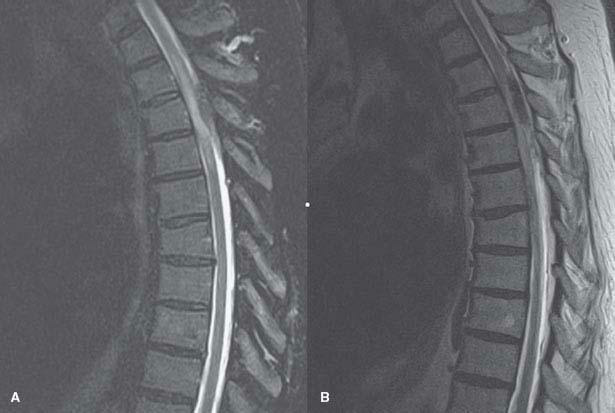
- e
Figure 11.2 shows an epidural collection consistent with an epidural hematoma. The most common initial symptom is back pain, followed by development of a myelopathic syndrome as the hematoma compresses the cord. It is more common in males and more frequent in the thoracolumbar region. Major risk factors for spinal epidural hematoma include anticoagulation either from medications or from coagulopathies and thrombocytopenia. Other factors that may increase the risk of this condition are trauma, neoplasms, pregnancy, and vascular malformations.
Dural arteriovenous fistula is the most common vascular malformation of the spinal cord, and presents with an insidious and slowly progressive myelopathic syndrome, sometimes with acute exacerbations. These manifestations are caused by increased venous congestion and mass effect in the spinal cord, leading to venous infarcts. Acute hemorrhages may occur; however, dural arteriovenous fistulas rarely produce epidural hematomas. MRI of the spine may show cord signal abnormalities and flow voids, but the definitive diagnostic procedure is conventional angiography.
Atherosclerosis, aortic dissection, and aortic manipulation (especially above the renal arteries) are associated with ischemic infarcts of the spinal cord. Prolonged hypotension may be associated with watershed infarcts of the spinal cord. Hypotension, atherosclerosis, and aortic manipulation are not typically associated with spinal epidural hematomas.
Kreppel D, Antoniadis G, Seeling W. Spinal hematoma: A literature survey with meta-analysis of 613 patients. Neurosurg Rev. 2003; 26:1–49.
Ropper AH, Samuels MA. Adams and Victor’s Principles of Neurology, 9th ed. New York: McGraw-Hill; 2009.
- Which of the following statements is incorrect regarding the pathophysiology of amyotrophic lateral sclerosis (ALS)?
a. Glutamate-induced excitotoxicity has been postulated as a cause
b. Mutations in the superoxide dismutase gene account for approximately 20% of familial ALS
c. No environmental exposures have been definitively identified to be associated with ALS
d. A rare form of ALS with parkinsonism and dementia had been identified in a geographically restricted area in the Western Pacific island of Guam
e. The majority of ALS cases are familial and most often X-linked
- e
The majority of amyotrophic lateral sclerosis (ALS) cases are sporadic. Familial ALS is usually autosomal dominant in inheritance, although autosomal recessive forms occur and X-linked inheritance is rare.
The cause of ALS is unknown; there are various hypotheses and several environmental exposures postulated and investigated as causative but without definite evidence of associations. The majority of ALS cases are sporadic; approximately 10% are familial. Several gene mutations or deletions have now been identified, resulting in differing patterns of inheritance (most frequently autosomal dominant, but also autosomal recessive and rarely X-linked), age of onset, and phenotypic variability. Mutations in the copper/zinc superoxide dismutase (SOD1) gene on chromosome 21 account for approximately 20% of cases of familial ALS and less than 5% of sporadic ALS cases. The abnormal SOD1 protein usually maintains its dismutase function, but appears to damage motor neurons through other mechanisms, including a toxic gain of function of the mutant protein. More than 160 mutations have been identified, most often inherited in an autosomal dominant fashion. A rare form of ALS associated with parkinsonism and frontotemporal dementia was identified in a geographically restricted area in the Western Pacific island of Guam. Several theories abound regarding this rare syndrome, including exposure to cyanobacterial toxins and the presence of specific genetic mutations in the indigenous population.
Bradley WG, Daroff RB, Fenichel GM, et al. Neurology in Clinical Practice, 5th ed. Philadelphia, PA: Elsevier; 2008.
15. A 69-year-old man presents with 6 months of gradually progressive lower extremity weakness. His MRI is shown in Figure 11.3. Regarding this patient’s condition, which of the following is correct?
FIGURE 11.3 Sagittal T2-weighted MRI
a. On examination there will be evidence of atrophy and fasciculations in the lower extremities
b. On examination there will be evidence of spinal shock
c. Steroids are indicated
d. Radiation therapy should be started immediately
e. On examination there will be spasticity in the lower extremities with hyperreflexia and upgoing toes
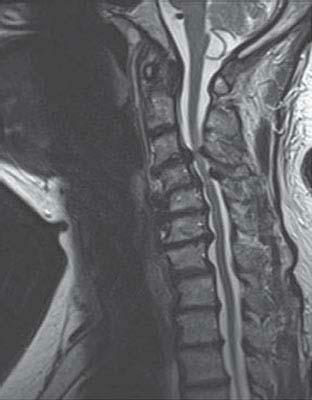
- e
The patient’s history and MRI shown in Figure 11.3 are consistent with a cervical spondylotic myelopathy with spinal cord compression, which has occurred slowly over months. This condition is the most common cause of spinal cord compression in the elderly. Spondylosis is a degeneration of the spinal column, in which there is formation of osteophytes that eventually lead to compression of the spinal cord and nerve roots. Along with this, there are also disc herniations and ligamentum flavum hypertrophy, leading to narrowing of the spinal canal. Because the degenerative process progresses slowly, the neurologic manifestations develop insidiously, unlike acute cord compressions in which the patient has manifestations of spinal shock, which include weakness below the level of the lesion with flaccidity and hyporeflexia, sensory loss, and sphincteric dysfunction.
Patients with cervical spondylotic myelopathy gradually develop neck stiffness and pain, weakness at and below the compression level, and unsteady gait. The examination shows findings of upper motor neuron signs below the level of compression, with spastic paraparesis, hyperreflexia, and upgoing toes. In the upper extremities there may be evidence of lower motor neuron signs, such as areflexia and atrophy, mainly at the same level of the compression. Patients have sensory deficits and may experience L’hermitte’s phenomenon, an electric sensation radiating down the back that occurs following neck flexion. The diagnostic test of choice is MRI of the spine. Goals of treatment include prevention of further neurologic deficits and therapies to help improve existing ones. Surgical decompression is the treatment of choice. Nonoperative options may provide pain relief; however, once myelopathic findings are evident surgical intervention may be required.
Radiation therapy plays no role in the treatment of cervical spondylotic myelopathy, and is reserved for the treatment of radiosensitive neoplasms. Steroid therapy is not indicated and is mainly used in patients with traumatic spinal injury and in neoplastic cord compression.
Ropper AH, Samuels MA. Adams and Victor’s Principles of Neurology, 9th ed. New York: McGraw-Hill; 2009.
- A 59-year-old man from Cape Town presents with progressive lower extremity weakness associated with numbness and paresthesias in both legs, as well as bladder and bowel incontinence. He has a history of diabetes, hypertension, chronic obstructive pulmonary disease with long-standing intermittent use of steroids, and prostate cancer with metastasis to the lower thoracic spine, treated with radiation 12 months prior. His MRI shows T2 hyperintensity in the thoracic spinal cord, with no evidence of compression or extradural mass. What is the most likely diagnosis?
a. Lathyrism
b. Transient radiation myelopathy
c. Epidural lipomatosis
d. Delayed radiation myelopathy
e. Konzo
- d
This patient has had radiation to the spine with development of radiation-induced myelopathy. There are two types of radiation-induced myelopathy, a transient and a delayed form. The transient form happens early, approximately 3 to 6 months after the radiation treatment, and presents with dysesthesias in the extremities that eventually resolve without sequelae. The delayed form occurs 6 months or greater following radiation therapy, as in this case. The presentation is insidious with paresthesias and dysesthesias of the feet, L’hermitte’s phenomenon, and progressive weakness of the legs. Eventually, bowel and bladder can be affected. The MRI shows increased T2 signal in the affected regions, sometimes with heterogeneous gadolinium enhancement. Steroids have been tried; however, the key is prevention by minimizing the dose of radiation used.
Lathyrism is a neurotoxic disorder presenting as a myelopathy with subacute spastic paraparesis. It is endemic in certain parts of Ethiopia, India, and Bangladesh, and occurs from consumption of Lathyrus sativus, a legume (grass pea or chick pea) that contains the toxin β-N-oxalylamino-l-alanine. It is more prevalent in poor populations.
Konzo is a type of myelopathy that presents with a spastic paraparesis of abrupt onset, sometimes associated with involvement of the visual pathways. It is most commonly seen in certain parts of Africa and results from consumption of poorly processed Cassava, which contains cyanide. It is more prevalent in droughts and in poor populations.
Epidural lipomatosis is a condition in which there is hypertrophy of extramedullary adipose tissue in the epidural space, and is usually associated with chronic use of steroids. Patients present with back pain and myelopathic findings. The treatment involves stopping steroids, and sometimes even surgical decompression. MRI of the spine demonstrates the fatty tissue within the spinal canal producing spinal stenosis, which was not described in this patient.
Bradley WG, Daroff RB, Fenichel GM, et al. Neurology in Clinical Practice, 5th ed. Philadelphia, PA: Elsevier; 2008.
Ropper AH, Samuels MA. Adams and Victor’s Principles of Neurology, 9th ed. New York: McGraw-Hill; 2009.
- A 45-year-old woman is evaluated for progressive spastic paraparesis. She also has anemia and leukopenia. Her vitamin B12 level is 300 pg/mL (220 to 700 pg/mL), folate level is 1.9 mg/mL (2 to 18 mg/mL), and copper is 90 μg/dL (85 to 155 μg/dL). Which of the following is correct in the treatment of this patient?
a. Start copper supplementation and observe for improvement before providing vitamin B12 or folate
b. Start folate supplementation
c. Check methylmalonic acid and homocysteine, and start vitamin B12 and folate supplementation
d. Start zinc supplementation
e. No therapies are needed because the test results are within normal limits
- c
This patient likely has a myelopathy and hematologic disturbances from a metabolic cause. Deficiency of vitamin B12 and/or copper can lead to this clinical picture and it is difficult to differentiate the etiology; therefore, blood levels of these vitamins and trace elements should be checked. Methylcobalamine acts as a cofactor for methionine synthase in the reaction where homocysteine is converted into methionine. This enzyme also requires folate as a cosubstrate. This metabolic pathway is important for DNA synthesis, and when there is lack of the cofactors or substrates, there is dysfunction leading to the clinical manifestations including myelopathy and hematologic disturbances.
Folate deficiency can lead to neurologic disturbances like those seen in vitamin B12 deficiency; however, they are less frequent and less severe. When patients have vitamin B12 and folate deficiency, and only folate is supplemented, hematologic abnormalities improve, but not the neurologic manifestations. Therefore, both should be supplemented at the same time. In this case, folate levels are low but vitamin B12 levels are within the normal range. However serum vitamin B12 levels can be normal in some patients with vitamin B12 deficiency, and serum methylmalonic acid (MMA) and total homocysteine levels should be checked because they are more sensitive in detection of these deficiencies.
Patients with copper deficiency can also have these clinical manifestations; however, this deficiency is encountered less frequently than that of vitamin B12 and folate. In this case, the copper level is borderline low and should be rechecked in the future; this level would in all likelihood not explain all the manifestations in this patient.
Zinc induces the synthesis of metallothionein in enterocytes. Copper has high affinity for metallothionein and will bind to it, entering the enterocytes that eventually are sloughed off the mucosa, leading to loss of copper. Therefore, zinc ingestion may be associated with copper deficiency and may decrease copper levels.
In this patient, MMA and homocysteine should be checked, and vitamin B12 along with folate should be started.
Bradley WG, Daroff RB, Fenichel GM, et al. Neurology in Clinical Practice, 5th ed. Philadelphia, PA: Elsevier; 2008.
Ropper AH, Samuels MA. Adams and Victor’s Principles of Neurology, 9th ed. New York: McGraw-Hill; 2009.
- A 33-year-old man from Cleveland with unknown past medical history presents to the hospital in July with fever, mild lethargy, and bilateral lower extremity weakness, which has progressed over the past 5 days. On examination he is mildly confused with flaccid quadriparesis and areflexia. Which of the following is the most likely etiology?
a. An enterovirus
b. A flavivirus
c. HTLV-1
d. HTLV-2
e. A herpesvirus
- b
This patient has West Nile virus (WNV) infection. WNV is a flavivirus transmitted by mosquitoes. It causes an illness characterized by meningitis, encephalitis, and myeloradiculitis. Cases in the United States present during summer months, and the initial symptom is fever, progressing to altered mental status, gastointestinal symptoms, back pain, and flaccid weakness with areflexia, more often proximal and asymmetric and sometimes affecting all limbs. The progression to nadir occurs in 3 to 8 days.
The diagnosis is made with serology, CSF antibodies, and/or PCR. CSF shows neutrophilic pleocytosis, with high protein and normal glucose. MRI shows cauda equina, spinal cord, and/or leptomeningeal enhancement. Pathologic studies have shown perivascular inflammation with anterior horn cell loss in the spinal cord.
Many enteroviruses and herpesviruses are associated with a transverse myelitis, usually as a post-infectious phenomenon; there are no features of transverse myelitis in this case. Poliovirus is an enterovirus that can lead to areflexic flaccid paralysis from damage to anterior horn cells; however, poliovirus does not cause the encephalopathic changes seen in WNV, and furthermore, it has been eradicated from the United States.
This patient does not have a history to suggest HIV, which causes a gradually progressive myelopathy characterized by spastic paraparesis with impaired vibration and proprioception sensation, and sensory gait ataxia. The pathologic finding in HIV myelopathy is microvacuolar changes. Myelopathy from HIV is usually a late disease manifestation, and does not seem to be the case in this patient.
HTLV-1 is a virus transmitted via sexual, parenteral, or maternal routes, which causes a chronic progressive myelopathy known as tropical spastic paraparesis. The myelopathy is usually localized in the thoracic region, and pathologically, there is neuronal cell loss, microvacuolization, and long tract degeneration. The diagnosis is made by detecting antibodies to HTLV-1 in the serum and CSF, as well as PCR. This virus is also associated with adult T-cell lymphoma and leukemia. HTLV-2 is also associated with a progressive myelopathy and can be seen in native Americans, intravenous drug users, and patients with HIV, but this is much less common than HTLV-1.
Jeha LE, Sila CA, Lederman RJ, et al. West Nile virus infection: A new acute paralytic illness. Neurology. 2003; 61:55–59.
Ropper AH, Samuels MA. Adams and Victor’s Principles of Neurology, 9th ed. New York: McGraw-Hill; 2009.
- A previously healthy 36-year-old woman presents with rapidly progressive flaccid paraparesis. She recalls an episode of right-eye visual loss about 2 years ago, which resolved without treatment. Her spine MRI shows a large T2-hyperintense lesion extending from T5 to T11. MRI of the brain shows few scattered nonspecific white matter lesions. Her ESR is elevated and antinuclear antibody (ANA) is positive. CSF analysis shows 49 WBCs/mm3 (normal is up to 5 lymphocytes/mm3), half of which are polymorphonuclear leucocytes, a protein level of 92 mg/dL (normal is up to 45 mg/dL), normal immunoglobulin G (IgG) index, and no oligoclonal bands. Which of the following is incorrect regarding this condition?
a. In neuromyelitis optica, ANA positivity suggests a separate diagnosis of systemic lupus erythematosus
b. Neuromyelitis optica–IgG is an antibody against aquaporin-4
c. Asians and African populations are more frequently affected
d. Pathologic analysis of the spinal cord tissue will show inflammation, demyelination, and necrosis
e. Antibodies against aquaporin-4 are part of the diagnostic criteria
- a
This patient has neuromyelitis optica (NMO) or Devic’s disease, which is an inflammatory demyelinating disease of the CNS affecting the optic nerves and spinal cord. It is nine times more common in women than in men, and unlike multiple sclerosis, it tends to affect more Asian and African populations. Patients present with a combination of optic neuritis and myelitis. The myelitis usually presents acutely as a longitudinally extensive transverse myelitis extending over three or more segments. This commonly causes bilateral signs and symptoms, which can be severe.
MRI of the spinal cord demonstrates T2 hyperintensity and gadolinium enhancement. MRI of the brain may show white matter changes; however, these changes are nonspecific and not necessarily diagnostic for multiple sclerosis. There are sometimes unusual brain changes in areas where aquaporin channels are common, such as in the brain stem and hypothalamus. Occasionally posterior reversible encephalopathy syndrome changes will be present.
CSF is frequently abnormal, showing increased WBCs and increased protein with normal glucose. Oligoclonal bands are rarely present in the CSF, in contrast to multiple sclerosis. Pathologic analysis of the spinal cord tissue will show inflammation and demyelination, with polymorphonuclear infiltrates and eosinophils, associated with necrosis.
The NMO-IgG antibody helps make the diagnosis and is part of the diagnostic criteria. It has a sensitivity of 64% and a specificity of 99%. This antibody is directed against aquaporin-4, which is a protein found in astrocyte foot processes around cerebral microvessels located at the blood-brain barrier.
A majority of patients will have nonspecific seropositivity to other autoantibodies, including the antinuclear antibody. The presence of these antibodies does not establish the presence of other autoimmune disease nor does it establish causality. It is possible that these seropositivities are a result of a general predisposition to autoimmunity.
Matiello M, Jacob A, Wingerchuk DM, et al. Neuromyelitis optica. Curr Opin Neurol. 2007; 20:255–260.
Wingerchuk DM, Lennon VA, Pittock SJ, et al. Revised diagnostic criteria for neuromyelitis optica. Neurology. 2006; 66:1485–1489.
- A 34-year-old man has progressive neurologic manifestations. He was a normal child and adolescent, and he was fine until he was about 23 years of age when he started noticing numbness and tingling in his feet and difficulty running. He has been diagnosed with a spastic paraparesis and has been getting gradually worse over the past few years to the point that now he needs a walker to walk. He also has very mild cognitive impairment, behavioral problems, mild hearing and visual impairment, as well as urinary incontinence. His past medical history is significant for at least five admissions to the ICU secondary to upper respiratory infections, leading to significant hypotension and hypoglycemia, for which he has required steroids. Regarding this condition, which of the following is correct?
a. He has amyotrophic lateral sclerosis
b. He has pure hereditary spastic paraparesis
c. The most likely diagnosis is neuromyelitis optica
d. He has adrenomyeloneuropathy
e. He has primary lateral sclerosis
- d
This patient has adrenomyeloneuropathy, which is one of the phenotypes of adrenoleukodystrophy. This is a peroxisomal disorder transmitted in an X-linked fashion and associated with a mutation in the ABCD1 gene on chromosome Xq28, which encodes a peroxisomal adenosine triphosphate-binding cassette transporter protein. Because of this mutation there is an impaired ability to oxidize very long chain fatty acids (VLCFAs), especially hexacosanoic acid, leading to the accumulation of VLCFAs in tissues and plasma.
In adrenoleukodystrophy there are four main phenotypes; an early onset cerebral white matter disease (adrenoleukodystrophy), adrenomyeloneuropathy, isolated Addison’s disease, or asymptomatic. In adrenomyeloneuropathy, male patients begin having manifestations around age 20, with slowly progressive paraparesis, sensory neuropathy, problems with sphincter control, mild hypogonadism, and mild cognitive impairment. Some patients may develop hearing and visual impairment as well. Most patients also develop adrenal insufficiency. Increased levels of VLCFAs in plasma and cultured fibroblasts help in the diagnosis. Patients require steroids for the adrenal insufficiency; however, this medication does not have an effect on the CNS involvement. Very early bone marrow transplantation may be a therapeutic option.
Neither amyotrophic lateral sclerosis, primary lateral sclerosis, hereditary spastic paraparesis, nor neuromyelitis optica lead to adrenal insufficiency or the cognitive, behavioral, or sensory features that the patient in the case has.
Fenichel GM. Clinical Pediatric Neurology: A Signs and Symptoms Approach, 6th ed. Philadelphia, PA: Saunders Elsevier; 2009.
- A patient presents with a several months’ history of gradually progressive sensory loss to pain and temperature over his shoulders and both arms bilaterally, with preserved sensation to light touch, vibration, and proprioception. On examination he has findings suggestive of multiple old injuries in both upper limbs. He also has weakness and atrophy in both upper extremities, with minimal findings in the lower extremities. Which of the following is correct regarding this condition?
a. Syringomyelia can cause this syndrome
b. MRI will likely show an infarct in the anterior spinal artery territory
c. The syndrome is consistent with Brown-Séquard syndrome
d. The findings suggest subacute combined degeneration of the spinal cord
e. This patient has a watershed infarct of the spinal cord
- a
This patient has a dissociated sensory loss with loss of sensation to pain and temperature and preserved sensation to light touch, vibration, and proprioception in his upper extremities. This clinical syndrome is seen with central spinal cord lesions in which there is compromise of crossing fibers in the midline anterior to the central canal, which carry sensory input related to pain and temperature. Usually the distribution of this sensory loss is described as “cape-like” or “shawl-like”. Because it does not affect the posterior columns, the sensory modalities carried by this pathway are not affected. This dissociated sensory loss is seen in syringomyelia, in which there is a cavitation in the central parts of the spinal cord, usually in the cervical region, sometimes extending upward to the brain stem or downward to the thoracic region. It has been described that patients with syringomyelia, given their lack of sensory input in their upper extremities, may experience repeated trauma and recurrent injuries. Syringomyelia may be associated with other developmental anomalies of the vertebral column or skull, as well as with Chiari malformations.
This patient does not have a spinal cord infarct, because the history is that of a gradually progressive illness, and there is no significant motor disturbance, such as that seen from infarcts affecting the anterior horns and corticospinal tracts.
Brown-Séquard syndrome, or hemisection of the spinal cord, is a characteristic syndrome in which there is loss of pain and temperature sensation contralateral to the side of the lesion due to interruption of the crossed spinothalamic tract. There is also ipsilateral loss of proprioception and vibration sensation below the level of the lesion from interruption of the ipsilateral posterior columns, as well as ipsilateral weakness below the lesion from corticospinal tract involvement.
Blumenfeld H. Neuronatomy through Clinical Cases, 1st ed. Sunderland, MA: Sinauer Associates; 2002.
Ropper AH, Samuels MA. Adams and Victor’s Principles of Neurology, 9th ed. New York: McGraw-Hill; 2009.
- Which of the following is correct regarding neoplastic disease of the spinal cord?
a. Ependymomas are the most common intramedullary spinal cord tumor in children
b. Astrocytomas are the most common intramedullary spinal cord tumor in adults
c. Myxopapillary ependymomas originate from the filum terminale
d. Meningioma is the most common extradural tumor of the spinal cord
e. Intramedullary spinal cord metastases are more common than primary intramedullary neoplasms
- c
Neoplasms of the spinal cord can be divided into primary or metastatic. Also they can be divided anatomically into extradural, intradural extramedullary, and intradural intramedullary.
Primary neoplasms accounting for intramedullary spinal cord metastases include small cell lung cancer, breast cancer, renal cell cancer, lymphoma, and melanoma. However, metastatic intramedullary disease is not very common, and primary intramedullary tumors are more frequent.
Meningioma is a common intradural extramedullary tumor, which has predilection for the thoracic spine, and with its growth can produce spinal cord compression. Nerve sheath tumors such as schwannomas and neurofibromas are also intradural and extramedullary.
The most frequent intradural intramedullary tumors found include ependymoma and astrocytoma. Astrocytomas are most common in children and are usually slow-growing low-grade tumors. Ependymomas are the most common intramedullary tumors in adults, usually arising from the central canal and expanding outward. Myxopapillary ependymoma is a type of ependymoma that arises from the ependymal cells in the filum terminale, and is the most common tumor in this location.
Fenichel GM. Clinical Pediatric Neurology: A Signs and Symptoms Approach, 6th ed. Philadelphia, PA: Saunders Elsevier; 2009.
Ropper AH, Samuels MA. Adams and Victor’s Principles of Neurology, 9th ed. New York: McGraw-Hill; 2009.
- A 12-year-old girl with no past medical history except a febrile illness about 1 week ago, presents with 3 days of headache, altered mental status, inability to move her legs, and urinary incontinence. On examination she is confused, has no meningeal signs, and has a flaccid paraplegia with areflexia and sensory loss below her waist. Her CSF shows 40 WBCs/mm3 (normal up to 5 lymphocytes/mm3) with lymphocytic predominance, a protein level of 70 mg/dL (normal up to 45 mg/dL) with normal glucose, and high immunoglobulin G index. MRI of the brain shows symmetric subcortical white matter lesions, and MRI of the spine shows an expanding intramedullary lesion between T5 and T10 with gadolinium enhancement. The most likely diagnosis isa. Multiple sclerosis
b. Acute disseminated encephalomyelitis
c. Neuromyelitis optica
d. Idiopathic transverse myelitis
e. Bacterial meningitis
- b
This patient has an acute neurologic disorder temporally associated with a recent febrile illness, with findings suggestive of an inflammatory myelopathy and encephalopathy. At the time of presentation, the illness was apparently monophasic, with symmetric involvement of cerebral white matter and simultaneous spinal cord involvement. CSF findings support an inflammatory cause. In this case the most likely explanation for her clinical picture is acute disseminated encephalomyelitis (ADEM).
ADEM is an inflammatory demyelinating disorder of childhood in which there is a monophasic immunologic reaction to a viral illness. Patients have an encephalopathy, with confluent white matter changes on MRI and inflammatory markers in the CSF. Occasionally, the spinal cord is also affected with features of a transverse myelitis, in which the lesion affects more than three segments of the spinal cord. The treatment is intravenous steroids in high doses.
Encephalopathy is not a feature of neuromyelitis optica; the patient may have some white matter lesions, but in contrast to ADEM, they are not symmetric or confluent.
Multiple sclerosis is an inflammatory demyelinating disorder that presents with a relapsing and remitting or a progressive course. When it affects the spinal cord, the lesions are usually in short segments, not like in this case. Acute encephalopathy is not common in multiple sclerosis.
The diagnosis of idiopathic transverse myelitis is made when the patient has a transverse myelitis with no other explanation, and usually without other features. This patient has encephalopathy and white matter brain lesions, making transverse myelitis unlikely.
The clinical, imaging, and CSF findings do not correlate with bacterial meningitis.
Fenichel GM. Clinical Pediatric Neurology: A Signs and Symptoms Approach, 6th ed. Philadelphia, PA: Saunders Elsevier; 2009.
Ropper AH, Samuels MA. Adams and Victor’s Principles of Neurology, 9th ed. New York: McGraw-Hill; 2009.
- A 50-year-old man presents with gradually progressive weakness in his upper extremities over the past 6 months. A cervical MRI is obtained, which is shown in Figure 11.4. On the basis of the location of the lesion, on examination you will find:
a. Patellar and ankle areflexia
b. Sensory level below the level of the nipples
c. Sparing of superficial abdominal reflexes
d. Horner’s syndrome
e. Flaccid weakness of his lower extremities
- d
Horner’s syndrome is seen in patients with spinal cord lesions above T1, where the spinal sympathetic tract synapses before exiting the spinal cord (discussed in Chapters 1 and 10). This patient has a lesion above T1, and will likely have a Horner’s syndrome.
As shown in Figure 11.4, this patient has an intramedullary lesion producing signal abnormality in the cervical cord from C1 to C6. Because the lesion has developed gradually, the patient will likely have myelopathic findings with upper motor neuron manifestations below the lesion. Therefore, the patient will likely have increased tone with spasticity and hyperreflexia below the level of the lesion. Some cases will demonstrate lower motor neuron findings at the same level of the lesion due to involvement of anterior horn cells, in this case probably in the upper extremities. A sensory level is helpful for clinical localization of the level of the lesion. The level of the nipple line correlates with T4. Other levels that are useful landmarks are the base of the neck (C4), umbilicus (T10), groin (L1), and anal region (S5). In this case the lesion is in the cervical region; therefore, the patient’s sensory level is likely above the nipple line. The presence of superficial abdominal reflexes is a normal finding, and their absence indicates a corticospinal tract lesion above the T6 segment.
Blumenfeld H. Neuronatomy through Clinical Cases, 1st ed. Sunderland, MA: Sinauer Associates; 2002.
- All of the following conditions are associated with atlantoaxial dislocation, except:
a. Rheumatoid arthritis
b. Klippel-Feil syndrome
c. Systemic lupus erythematosus
d. Down’s syndrome
e. Morquio syndrome
- c
The ligaments between the atlas and the axis, as well as the odontoid process, are important in maintaining the stability of this articulation. When this articulation fails, or the odontoid is absent or damaged, atlantoaxial dislocation can occur, leading to neck pain and other manifestations of spinal cord compression including quadriplegia and death.
Rheumatoid arthritis is known to produce a destructive inflammatory process of the ligaments that attach the odontoid process to the atlas and the skull, therefore causing atlantoaxial dislocation.
Other causes of this condition include Klippel-Feil syndrome, Down’s syndrome, and Morquio syndrome. Klippel-Feil syndrome is a condition in which there is decreased number and abnormal fusion of cervical vertebrae. Morquio syndrome is a skeletal disease in which the odontoid process may be aplastic or absent, leading to secondary spinal cord disease.
Systemic lupus erythematosus has been associated with syndromes consistent with myelitis or myelopathy, but not atlantoaxial dislocation.
Fenichel GM. Clinical Pediatric Neurology: A Signs and Symptoms Approach, 6th ed. Philadelphia, PA: Saunders Elsevier; 2009.
Ropper AH, Samuels MA. Adams and Victor’s Principles of Neurology, 9th ed. New York: McGraw-Hill; 2009






